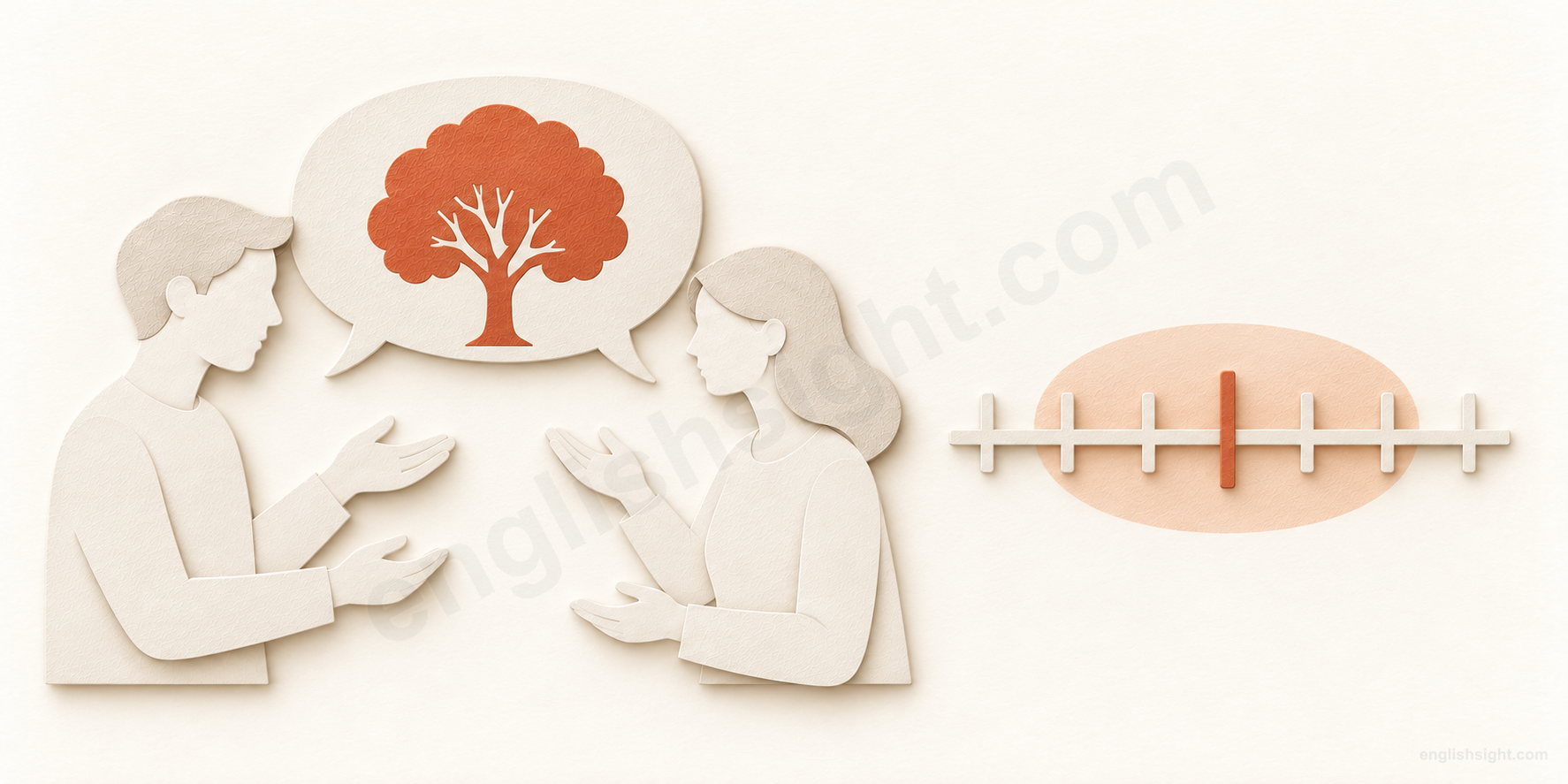
Read the words around about to choose the relationship.
A reference point and a surrounding field
A reference point and a surrounding field
A subject or a reference value.
about
Related to a topic, or close to a value rather than exact.
A message concerns that subject; an estimate allows nearby values.
The speakers talk about the tree; the scale suggests an approximate value, without a fixed margin.
A topic gives thought a reference point; an estimate allows a small area around a value. Spatial uses can describe different places within an area.
This comparison helps memory. It does not derive refusal, suggestions, or idioms mechanically; learn those with their complete wording.
About can connect a thought to its subject, give a rough value, or describe activity around an area. Be about to adds a separate, fixed way to describe an event just ahead.
The sketch connects some uses as a memory aid. It is not a universal definition or a claim that every native speaker sees the same mental picture.
01
Subjects, feelings, and concerns
Ask what the message, feeling, feature, or action relates to. The surrounding words supply the precise relationship.
01
talk / ask / read / know about + noun; about + -ing / wh-clause
talk about the trip
name the subject
Situation
You discuss travel plans.
Interpretation
Taking the train is the topic.
About connects a message to its subject.
A book about birds has birds as its subject; ask about a ticket requests information. After prepositional about, use a noun, an -ing form, or a clause such as what happened. In What are you talking about?, about naturally stays at the end. British informal be on about means be talking about, sometimes with an annoyed tone. Think about moving means consider the move; learn about a city means gain information about it.
In a sentence
We talked about taking the train.
Watch the difference Say discuss the trip, without about; say talk about the trip, not talk the trip.
02
adjective / noun + about + noun / -ing
worried about the exam
identify what a feeling concerns
Situation
The final bus may leave before you arrive.
Interpretation
That possibility causes worry.
The feeling word supplies the emotion.
Happy, excited, worried, sorry, and a question or concern can take about to name their subject. Sorry about the delay expresses regret concerning it; sorry for interrupting apologizes for your action. Preposition choice depends on the whole expression, not a universal rule for emotions.
In a sentence
I’m worried about missing the last bus.
Watch the difference About missing uses -ing, not about miss; interested normally takes in.
03
do something / anything / nothing about + problem
do something about it
take action on a problem
Situation
The gate still does not close.
Interpretation
You call for a repair or another response.
The problem is the target of action.
Do something about the gate asks for action, without specifying the solution. There’s nothing we can do about it says we cannot change or remedy the situation; it does not mean we cannot discuss it.
In a sentence
We need to do something about the broken gate.
Watch the difference About it names the problem; do it names the action itself.
04
there is something + adjective + about + person / thing
something strange about it
attribute a noticeable quality
Situation
A detail in the photo catches your attention.
Interpretation
The photo feels unusual.
The quality belongs to the thing considered.
Something unusual about the photo leaves the exact feature unnamed. The best thing about this room is the light identifies an aspect for evaluation. Neither construction means the photo or room is speaking about that quality.
In a sentence
There’s something unusual about this photo.
Watch the difference Something unusual is the order; not unusual something in this construction.
05
be (all) about + noun / -ing
be all about helping
explain a main purpose or essential concern
Situation
Someone asks why the club exists.
Interpretation
Helping newcomers is its central aim.
All emphasizes the focus; it need not mean every detail.
Be about can describe what an activity involves, beyond a book’s topic. All about highlights its main point or values. What was that about? can ask why an odd exchange happened, rather than request the topic of a text.
In a sentence
This club is all about helping new students.
Watch the difference Be about helping concerns purpose; be about to help concerns an action starting soon.
02
Approximation, degree, and the next moment
Closeness can concern a number, a state, or an event. Read the full construction, especially to and negation.
06
about + number / time / measurement
about twenty minutes
give an approximate value
Situation
You estimate the journey time.
Interpretation
Twenty minutes is a useful rough guide.
The real value may be a little higher or lower.
About modifies an estimate: about six, about half, about my height. At about six combines a time preposition with an approximation. Around often works too; approximately sounds more formal. About does not set an exact margin of error. Round about six is another way to give an approximate time.
In a sentence
The walk takes about twenty minutes.
Watch the difference About twenty is not necessarily less than twenty; almost twenty normally is.
07
(just) about + adjective; just about + all / everyone
just about ready
be almost at a limit or completed state
Situation
Only one small preparation remains.
Interpretation
You are nearly ready.
Here closeness concerns degree, not a rounded number.
Just about ready means nearly ready; just about everyone means almost everyone. I can just about hear you can mean I can hear you, but only with difficulty. By contrast, just about now is approximately now. The following words select the reading.
In a sentence
We’re just about ready to leave.
Watch the difference Do not assume just about always means approximately or always means successfully completed.
08
be + (just) about to + base verb
be about to leave
be on the point of doing something
Situation
You are at the door, ready to leave.
Interpretation
The phone rings immediately before departure.
To introduces an infinitive in this fixed construction.
About to places an event very near the reference moment; was about to looks forward from the past. It does not guarantee the action happened: an interruption may prevent it. For an ordinary plan next month, be going to is usually more suitable.
In a sentence
I was about to leave when the phone rang.
Watch the difference Use about to leave, not about leaving, for this imminent-event meaning.
09
be + not about to + base verb
not be about to agree
firmly refuse or have no intention of doing something
Situation
Someone asks you for a private password.
Interpretation
You reject the request.
The negative construction can express resolve.
In a firm response, not about to means unwilling, not merely not this minute. It can sound emphatic or confrontational. Context can still give a literal timing reading, as in The train isn’t about to leave; it is still being cleaned.
In a sentence
I’m not about to share my password.
Watch the difference Do not soften a clear refusal into a promise to do it later.
03
Around an area and active nearby
Spatial about often alternates with around, especially across British and North American English. Fixed pairs add their own meanings.
10
movement / looking verb + about (+ place)
walk / look about
move or look in various directions
Situation
You explore without one fixed destination.
Interpretation
Your route covers different parts of town.
About does not specify a complete circle.
Look about the room means look in different directions. Walk about describes movement within an area, not necessarily around its boundary. These uses are especially British; around is the usual North American alternative.
In a sentence
We walked about the old town after lunch.
Watch the difference About the town does not necessarily mean all the way round the town.
11
lie / stand / be + about; about + place
lying about / nobody about
be scattered, waiting, or present locally
Situation
Tools have not been put away.
Interpretation
They lie in different places.
Location is loose rather than precisely mapped.
Lying about suggests scattered objects; standing about often suggests waiting or doing little. Is anyone about? asks whether anyone is nearby, and flu about means flu is circulating locally. These location uses are especially British; around is often the alternative.
In a sentence
There were tools lying about the kitchen.
Watch the difference About here means in this area; it does not mean concerning this place.
12
about + person / body part
arms about someone
surround or encircle
Situation
Her brother comes close.
Interpretation
She hugs him.
Something is placed around a person.
About his shoulders or arms about him describes surrounding contact. Around is the more neutral everyday choice; this use of about can sound literary. It is related to space, not the topic meaning of a story about him.
In a sentence
She put her arms about her little brother.
Watch the difference A scarf about her neck means around her neck, not a scarf concerning her neck.
13
be + out and about; be + up and about
out and about / up and about
be active or moving around again
Situation
Your father has been resting in bed.
Interpretation
He can get up and move again.
The paired words form established expressions.
Up and about often marks recovery from illness or rest. Out and about means away from home doing things or visiting places; it can also signal recovery enough to go out. Neither expression requires aimless wandering.
In a sentence
Dad is up and about again after the operation.
Watch the difference Out and about does not simply mean outside at one fixed point.
04
Suggestions and familiar replies
Short expressions can suggest, redirect, urge, agree, or close a conversation. Their function depends on context and tone.
14
how / what about + noun / -ing; how about + clause
How about meeting here?
propose an option
Situation
You need a place and time to meet.
Interpretation
You offer a concrete plan.
The whole question acts as a suggestion.
How about coffee? offers an option; how or what about meeting asks the listener to consider an activity. Informal How about we meet here? uses a full clause, especially in North American English. It does not ask how the meeting physically happens.
In a sentence
How about meeting here at six?
Watch the difference Say How about meeting?, not How about to meet?
15
what / how about + person / thing
What about you / the cost?
turn attention to another person or issue
Situation
A taxi has been proposed.
Interpretation
You raise a practical concern.
Context decides whether this is a suggestion or a question.
I’m having soup. What about you? asks for the other person’s choice. What about the cost? can raise an overlooked difficulty. How about Maya? can ask for news of her. Do not give every short about-question a suggestion reading.
In a sentence
We can take a taxi, but what about the cost?
Watch the difference What about you? normally carries forward an understood topic; it need not ask about your life generally.
16
it is about time + subject + past form; about time to + verb
It’s about time…
say action is due or overdue
Situation
The shelf has been loose for weeks.
Interpretation
You urge a repair now.
This idiom evaluates delay, not approximate clock time.
The past form in It’s about time we fixed it points to a needed action now, not an earlier repair. It’s about time to go is also possible. About time! reacts to something finally happening and may sound impatient.
In a sentence
It’s about time we fixed that loose shelf.
Watch the difference About six is an approximate time; about time we left says we should leave now.
17
that is about it / all
That’s about it.
say there is little or nothing else to add
Situation
You finish giving instructions.
Interpretation
The main instructions are complete.
It refers back to what has been covered.
That’s about it closes a list or explanation with room for minor details. That’s about all works similarly. It does not mean that the previous explanation was on the subject of a mysterious thing called it.
In a sentence
Add your name at the bottom, and that’s about it.
Watch the difference Use context to distinguish closing an explanation from a literal description of a topic.
18
tell me about it
Tell me about it!
show you know the same frustrating experience
Situation
Someone complains about the bus.
Interpretation
You strongly agree from experience.
An apparent request can function as agreement.
As an informal response to a familiar problem, Tell me about it! often means I know exactly what you mean. In a genuine information-seeking context, tell me about it can still request details. Tone and context decide.
In a sentence
“The bus is late again.” “Tell me about it!”
Watch the difference Do not automatically launch a long explanation when this idiom expresses shared frustration.
19
beat about / around the bush
beat about the bush
avoid saying the main point directly
Situation
Someone keeps giving background details.
Interpretation
You ask for a direct answer.
Learn the full idiom rather than add up its words.
The expression describes indirect talk, often to avoid an awkward subject. Beat about the bush is British; beat around the bush is the North American form and is also used elsewhere. It has nothing to do with an actual garden in this context.
In a sentence
Please don’t beat about the bush—tell me the result.
Watch the difference This idiom is stronger than simply giving useful background information.
20
Talk about + noun phrase / adjective!
Talk about bad luck!
emphasize an extreme example
Situation
You arrive just after the last bus has left.
Interpretation
You react strongly to your bad luck.
The whole exclamation adds emphasis, not a request for discussion.
Talk about bad luck! presents the situation as a striking example of bad luck. This informal frame can also introduce an adjective: Talk about expensive! strongly emphasizes how expensive something is. The tone may show surprise, criticism, or admiration, depending on what follows. Learn this conversational use as a complete expression; the topic sketch alone does not explain its force.
In a sentence
Talk about bad luck! We missed the last bus by ten seconds.
Watch the difference Compare ordinary Talk about your trip, an instruction to discuss it, with the emphatic exclamation Talk about bad luck!
05
Established combinations with verbs
These phrases concern tasks, causes, and behavior. A spatial memory aid cannot predict their meanings or object positions.
21
go / set about + noun / -ing
go / set about a task
tackle or begin a task
Situation
You need a home but have no method.
Interpretation
You ask how to approach the search.
The verb selects approach, beginning, or continuing work.
Go about finding a flat asks how to tackle it. Set about finding one emphasizes starting purposeful work. Go about your business means carry on with your usual activities; while you’re about it means while you are doing that task. These do not describe walking around a building.
We set about cleaning the kitchen means we began that task. In this task sense, set about doing is not used in the passive.
In a sentence
How should I go about finding a flat?
Watch the difference Use go about finding, not go about to find; set about doing is different from set out to do.
22
see about + noun / -ing
see about a repair
deal with or arrange something
Situation
The window needs repair.
Interpretation
You undertake to investigate and make arrangements.
See about is an established action phrase.
See about getting it repaired means take steps to arrange it, not merely look at it. We’ll see about that can instead challenge someone’s claim or refusal: the speaker intends to intervene. Neither reading follows from a picture of eyesight.
In a sentence
I’ll see about getting the window repaired.
Watch the difference See about something does not guarantee that it has already been done.
23
bring about + result; result + come about
bring about / come about
cause a result or describe its occurrence
Situation
A new timetable is introduced.
Interpretation
A useful change follows.
Bring about names a cause; come about names what happens.
The timetable brought about a change assigns a cause. How did the change come about? asks how it happened. Bring about is separable: bring it about, not bring about it. Come about has no direct object in this meaning.
In a sentence
The new timetable brought about a useful change.
Watch the difference A change came about is possible; it came about a change is not.
24
mess about; mess someone about
mess about
waste time or treat someone inconsiderately
Situation
Work is waiting while someone plays.
Interpretation
You ask them to become serious.
The object changes the meaning of this informal phrase.
British mess about can mean fool around instead of working, or spend relaxed time playing. We spent the afternoon messing about by the lake describes relaxed recreation. Mess someone about means inconvenience them through unreliable or unfair behavior. He keeps changing the plan and messing me about describes repeated changes that inconvenience the speaker. Around is also used. Learn the whole phrase, not a topic meaning of about.
In a sentence
Stop messing about and finish your homework.
Watch the difference Mess me about has a person as object; it is not the same pattern as mess about without an object.
Grammar and limits of the picture
Three grammatical jobs
About is pronounced /əˈbaʊt/. It is a preposition in about the trip and an adverb in about twenty or walk about. Oxford lists be about to under adjective; Collins also labels some present/available uses adjective. These labels reflect analysis, not different spelling or inflection.
Keep the full construction
Prepositional about takes a noun, pronoun, -ing form, or suitable clause; to in be about to takes a base verb. About itself is not a verb and has no tense or passive. A verb phrase containing it may have its own rules, as in change was brought about.
Regional and scope notes
Around is often preferred in North American spatial uses, but it cannot replace about in every topic or idiomatic expression. This lesson covers a selection of common modern uses, not every verb combination. Nautical turns, archaic measurements of circumference, and uncommon or specialized idioms are not expanded.
Choose from the whole expression
Use the situation, grammar, and tone as well as about.
1. The walk could take nineteen or twenty-one minutes. Which estimate fits?
2. Your friend is at the door and will leave in a moment. Which sentence expresses this?
3. Suggest that you meet at six. Which question is natural?
4. A new rule caused a change. Which sentence gives that meaning?
Sources and teaching notes
Usage was checked against the linked dictionary pages. Explanations, examples, and the sketch are original; the visual links are teaching comparisons.
The sketch is a memory aid, not a mental picture shared by every speaker.