Separate acid as a chemical noun from its adjective uses and fixed expressions.
Chemical effects and a sharp impression
Chemical effects and a sharp impression
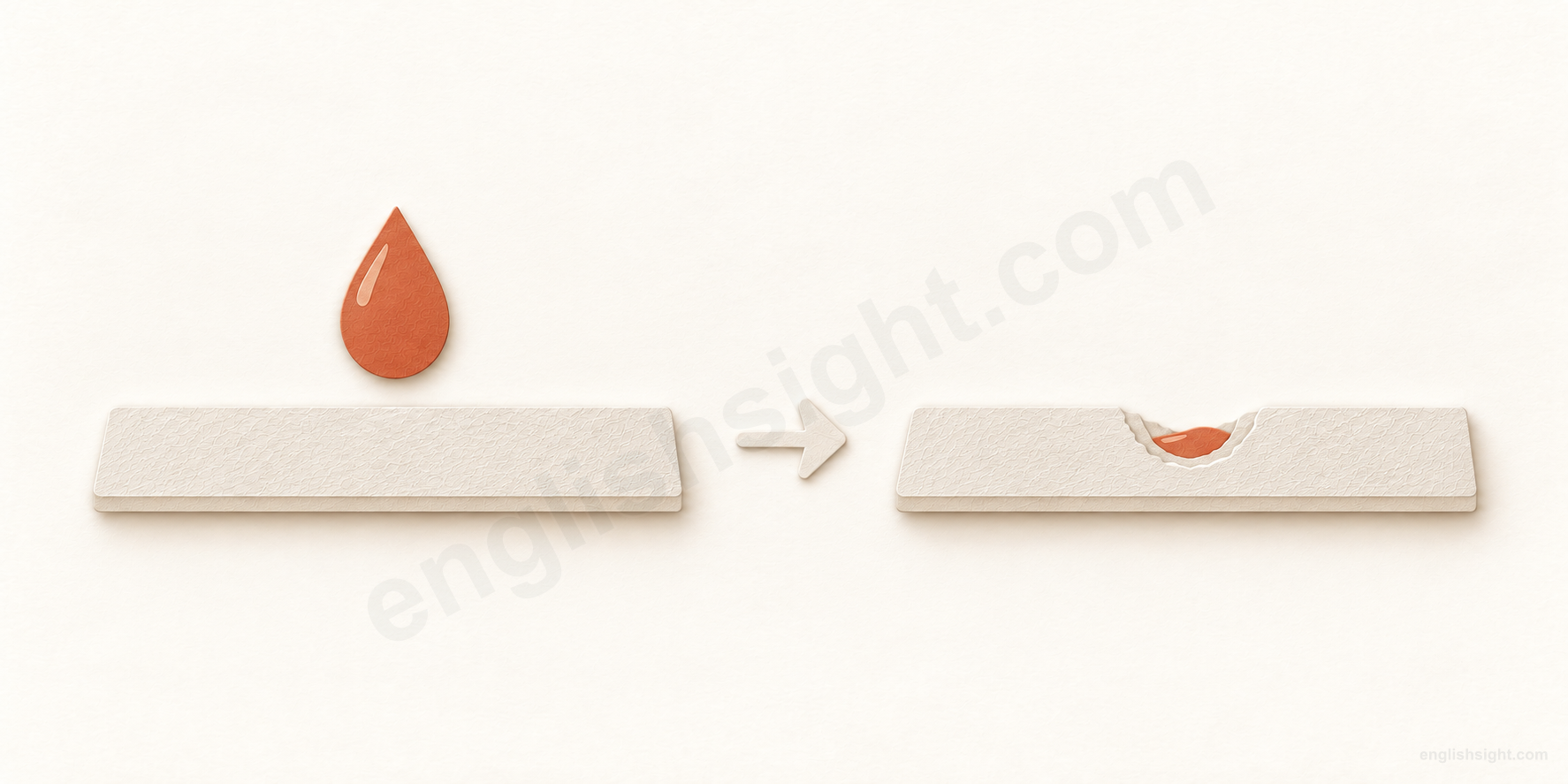
An acid drop is above an intact material strip.
acid
A small hollow remains, with a trace of liquid inside.
The acid reacts with this material at the contact point.
Some acids can eat into certain materials where they make contact.
Acid names a chemical class. Some acids can eat into materials they contact; the adjective also describes sour taste and, figuratively, a biting or piercing effect.
The sketch shows one possible reaction, not a defining property shared by every acid. The acid-test and LSD expressions cannot be predicted from this visual model.
Acid /ˈæsɪd/ can name a chemical or describe a quality. A useful memory link is sharpness: a sour taste, a cutting remark, or a piercingly bright color. This link is not a complete definition of a chemical acid.
The diagram illustrates one possible chemical effect. The lesson then separates literal uses, figurative descriptions, and expressions that need to be learned as a whole.
01
Chemical substances in everyday contexts
Name a substance or chemical family, describe a material, and recognize environmental and health expressions.
01
contain / produce / neutralize + acid; an acid; plural acids
acid / an acid / acids
a chemical substance or a kind of chemical
Situation
A laboratory report identifies a substance.
What you communicate
You name the material or compare different kinds.
Uncountable acid names material; an acid names one kind, and acids names several kinds.
Acid is a noun as well as an adjective. The bottle contains acid treats it as material. This is an acid classifies a substance; several acids compares kinds. A bottle of acid counts the container, not the material.
In elementary aqueous chemistry, an acid solution has a pH below 7 and reacts with a base to form a salt. More advanced definitions are broader. Acid does not simply mean any dangerous liquid.
Verbs describe what happens: a process can produce acid, a base can neutralize an acid, and some acids can damage materials. The reaction belongs to the particular substance and conditions; the noun alone does not promise that everything will dissolve.
In a sentence
The two bottles contain different acids.
Watch the difference Some acid means an amount; an acid usually means a kind. Do not make every mention countable.
02
citric acid; an amino acid / amino acids; fatty acids
citric acid; amino acids; fatty acids
names of specific acids or chemical families
Situation
You read an ingredient list or a science text.
What you communicate
The word before acid identifies the substance or family.
The modifier is part of the chemical name, not a new figurative sense of acid.
Citric acid is found in lemons and other fruits. The complete name is normally uncountable: The label lists citric acid. It is not a request to count separate pieces of acid.
Amino acids include the building blocks of proteins. A book may introduce one amino acid and then several amino acids. Fatty acids occur in fats and oils; nutrition texts may discuss omega-3 fatty acids. These plural forms count chemical kinds or members of a family.
These names do not mean that a food must taste sour or be corrosive. Learn the whole name and its context; do not infer a health benefit or danger from acid alone.
In a sentence
The chapter explains how amino acids form proteins.
Watch the difference Keep the ending on the head noun: amino acids, not aminos acid.
03
acid + material noun; material + be + acid / acidic
acid soil / an acid solution / an acid bath
having the chemical properties of an acid
Situation
A gardener checks the soil, or a scientist tests a solution.
What you communicate
You describe its chemical condition.
Here acid is an adjective: it describes the soil or solution rather than naming a separate object.
Acid soil and an acid solution use acid before a noun. You can also say The soil is acid. Acidic is another adjective used for this chemical property: acidic soil.
The contrast in this context is alkaline. It is not a contrast between dangerous and safe, nor between sour and sweet. A description of soil is not an invitation to taste it.
Acid can also describe something that contains or uses an acid: an acid bath is a liquid preparation used in a process, not an ordinary bath for washing a person. The wider noun phrase identifies its purpose.
In a sentence
The garden has acid soil.
Watch the difference An acid solution is a solution with acidic properties; an acid by itself names a substance or kind.
04
acid rain; damage caused by acid rain
acid rain
rain with increased acidity associated with environmental pollution
Situation
A report discusses air pollution and rainfall.
What you communicate
You identify an environmental problem.
The established compound describes the rain’s chemistry, not its appearance.
Acid rain is rain whose acidity has increased because of environmental factors such as air pollutants. Rain remains the head noun; acid describes its relevant property.
The whole expression is normally uncountable: reports about acid rain. The phrase does not mean that drops are visibly colored or that all rain has the same acidity.
In a sentence
The students read a report about acid rain.
Watch the difference Say acid rain in general, not an acid rain when naming the environmental phenomenon.
05
stomach acid; have / experience + acid reflux
stomach acid / acid reflux
acid in the stomach, or acidic contents flowing back into the food pipe
Stomach acid refers to acid in the stomach. In acid reflux, acidic stomach contents flow back into the esophagus, the tube carrying food to the stomach. Reflux supplies the direction of flow.
The expressions are usually uncountable: stomach acid and acid reflux. A person can say I have acid reflux. This language lesson explains the term, not how to diagnose or treat a symptom.
In a sentence
The leaflet explains the difference between stomach acid and acid reflux.
Watch the difference Acid reflux is not simply another name for all stomach acid.
02
A sharp taste, voice, or color
The adjective can describe sensory sharpness or a figurative biting effect. The context tells you which kind.
06
an acid taste / flavor; taste + acid
an acid taste / taste acid
a sour, sharp taste
Situation
You describe the flavor of a fruit drink.
What you communicate
The listener understands its sour edge.
The adjective describes a taste; it does not by itself name a laboratory chemical.
An acid taste or acid flavor has a sour sharpness. After taste, acid is an adjective: The juice tastes acid. Sour is often a straightforward everyday choice for this flavor.
This is a useful sensory link to the idea of biting sharpness. But acid is not interchangeable with every negative taste word: bitter chocolate is not automatically sour, and spicy describes a different sensation. A sour taste also does not automatically mean food has spoiled.
In a sentence
The berries give the sauce a slightly acid taste.
Watch the difference For flavor use tastes acid or tastes sour; tastes an acid is not the same adjective pattern.
07
acid + remark / tone / wit; reply / say + acidly
an acid remark / acid wit / an acid personality
cutting criticism or biting humor
Situation
A speaker replies with an unkind, pointed comment.
What you communicate
The listener hears criticism with a sharp edge.
The sharpness is figurative: words can feel biting without involving a chemical.
An acid remark, acid tone, or acid reply sounds sharply critical or unkind. Acid wit and acid humor emphasize pointed, often sarcastic observation. The adjective gives the words a quality; it does not mean the speaker literally uses acid. The same adjective can describe a person’s manner or temperament: His acid personality made casual conversation uncomfortable. Here it describes a tendency to be sharp or ill-natured, rather than one particular remark.
A sharp-taste association can help you remember this branch. It is a teaching comparison, not a rule for decoding every phrase. Acid criticism is stronger and more colored than neutral criticism. The related adverb acidly describes how someone speaks: she replied acidly.
Acid can also be a figurative noun in descriptions such as Her review was full of acid: the writing is full of biting criticism. This is a marked descriptive use, not a countable chemical in that sentence.
In a sentence
He answered my friendly question with an acid remark.
Watch the difference Use acid for the remark and acidly for the manner: an acid reply; she replied acidly.
08
acid green / yellow; an acid-green + noun
acid green / acid yellow
a piercingly bright color
Situation
You describe an unusually vivid item of clothing.
What you communicate
The listener imagines an intense, striking color.
Here sharpness belongs to the visual effect, not to chemical content.
Acid green and acid yellow describe intensely bright, sometimes jarring shades. This is a descriptive color use, especially useful to recognize in writing about clothing or design.
The color phrase does not claim that the fabric contains acid. Learn the established color combinations rather than adding acid to any color or any object meaning attractive.
In a sentence
She chose an acid-green jacket for the performance.
Watch the difference Acid-green describes appearance; acid-resistant describes resistance to a chemical. They are different constructions.
03
Expressions learned as a whole
A decisive test and the slang drug meaning require their own conventional meanings.
09
the acid test of / for + noun; the acid test is whether…; pass the acid test
the acid test
a decisive way to judge truth, quality, or success
Situation
A plan sounds good, but you need a revealing practical check.
What you communicate
The result shows whether it really works.
The whole expression means a decisive test; acid alone does not mean decisive.
The acid test of a plan is a situation or result that reveals its real worth. The acid test for a product can be how it performs in actual use. A whether-clause can state the criterion.
You can also say that something passes the acid test. The figurative expression does not require chemicals. It draws on a historical test for gold, but learners can use the modern expression without reenacting that process.
In a sentence
The acid test of this app is whether beginners can use it without help.
Watch the difference Not every difficult test is an acid test: the phrase emphasizes what the test reveals about real quality or success.
10
acid (uncountable slang); be on acid; drop acid
acid / on acid / drop acid / an acid trip
informal language referring to LSD and its use
Situation
A novel or conversation mentions acid in a drug context.
What you communicate
You recognize the slang reference rather than a chemistry lesson.
This is an established uncountable noun sense that needs contextual recognition.
Acid can be slang for the drug LSD. On acid describes someone under its influence; drop acid is a slang expression meaning take LSD. Drop here does not mean accidentally let a chemical fall. An acid trip is an experience caused by taking LSD; trip supplies the idea of the drug experience.
The context matters: acid in a laboratory report normally has the chemical meaning. A description such as a familiar style on acid may be figurative, suggesting a bizarre or exaggerated version rather than making a literal claim about drug use.
In a sentence
In the novel, the character claims he was on acid that night.
Watch the difference This is marked slang. The meaning cannot be reliably predicted from the sour-taste model.
Use context before the memory link
Acid is not a general word for danger
The sketch depicts a possible reaction with one material. Acids vary, and sour food, chemical strength, concentration, and corrosive effects are not interchangeable descriptions. Do not taste an unknown substance to identify it.
Noun, adjective, and related words
The ordinary noun plural is acids. The adjective does not take a plural ending: acid soils. Acidic describes an acid property; acidity names that property, and acidly describes a biting manner of speaking. This lesson is not a productive verb lesson and has no phrasal-verb family to conjugate.
A connection is not a universal mental picture
Sharpness is a teaching link for selected sensory and figurative uses. It does not prove a single origin for every modern meaning or describe what every English speaker imagines. Specialized rock and metalworking senses, music genres, regional idioms, and detailed chemical classifications are outside this introductory course.
Choose the meaning in context
Check whether acid names a substance, describes a quality, or belongs to a fixed expression.
1. You are comparing two kinds of chemical. Which phrase fits?
2. Someone gives an acid reply to a friendly greeting. What does acid describe?
3. The acid test of a design is whether people can use it easily. What is being described?
4. A review describes an acid-yellow coat. What does the reviewer mean?
Sources and teaching notes
The sources below support the usage inventory. Explanations and examples are original; the diagram is a limited teaching illustration of a possible chemical effect.
The diagram shows one possible effect, not a mental picture shared by all English speakers.