Use across for crossings, opposite positions, extent, and established expressions.
See the sides and what connects them
See the sides and what connects them
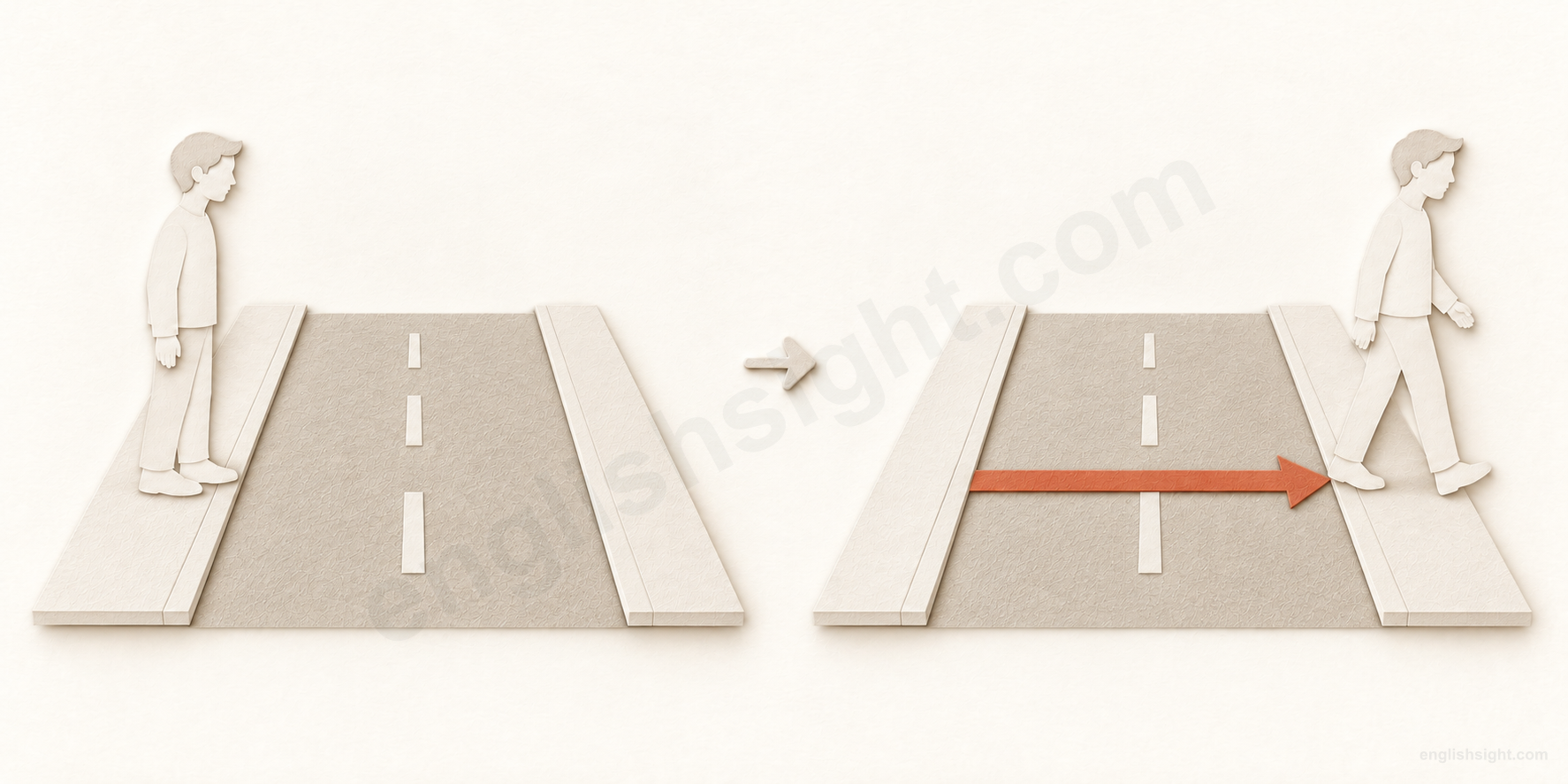
A man stands on one side of the road.
across
The same man is on the opposite side.
He walks across its width, rather than along its length.
The route crosses the road from side to side. An opposite position or a span can also be described with across without movement.
The two lines mark opposite sides of a space. The arrow crosses it; the lower line marks its width. A position across the space needs no actual movement.
This model connects spatial uses and can help with abstract ranges. It does not mechanically explain chance discovery, impressions, or every idiom.
Across often relates one side of a space to another. A person can move across it, an object can stretch across it, or a place can already be on the opposite side.
The sketch is a teaching model, not a claim about every native speaker’s mental picture. Distribution and familiar verb combinations require their own context.
01
Crossing a space
A moving subject crosses a road, an area, or a boundary. The verb supplies the action; across supplies the relation to the sides.
01
verb of movement + across + space / boundary
walk across the road
move from one side toward the other
Starting situation / reference
You are on one side of the road.
Result / relation
You reach the bakery on the other side.
The road is crossed, not followed lengthwise.
Walk, swim, drive, and fly name the movement. Across names the space crossed. Run across the road is literal running; cut across the park means take a shorter route through it.
Across presents a route between sides; it does not always assert completion: We were walking across the road describes an activity in progress. Through emphasizes being inside a space; over can emphasize passing above an obstacle.
In a sentence
We walked across the road to the bakery.
Watch the difference Across is a preposition, not a verb: We crossed the road or We walked across it, not We acrossed it.
02
go / get + across; across + to + destination
go across / across to
reach the other side without repeating the space
Starting situation / reference
The bridge has already been mentioned.
Result / relation
We can reach its far end.
The context supplies what is crossed.
Across can stand without a following object: Come across! means come to this side. Get across can describe managing to cross, and be safely across describes the resulting position.
In She walked across to the window, to introduces the destination, while across describes the intervening space. Back across reverses a crossing; straight across describes its direction.
In a sentence
The bridge is narrow, but we can get across.
Watch the difference Do not add to before the space crossed: across the river; across to the island names the destination.
03
travel / walk + across country; across the country
across country
cross rural land, or travel from one region to another
Starting situation / reference
The main road follows a longer route.
Result / relation
Our walk goes through the countryside.
Country can mean countryside or a nation.
Across country can mean traveling through rural land away from main roads and towns. The example uses this reading; it does not claim a journey across an entire nation.
It can also mean a long journey between parts of a country: They moved across country for work. Across the country may describe such a journey or nationwide distribution, depending on the verb.
In a sentence
We walked across country, away from the main road.
Watch the difference Do not assume across country always means a nationwide journey; the route and context decide.
02
Opposite sides, surfaces, and width
Across can describe a position or an extent without any movement. Read the verb and the following noun before imagining a journey.
04
be + across + space; be + across from + landmark
across the street / across from
be on the opposite side
Starting situation / reference
Our hotel is on this side of the street.
Result / relation
The pharmacy is on the other side.
A location needs no crossing event.
The pharmacy is across the street gives its position. Across from our hotel names the opposite landmark directly, especially in American English; across the street from our hotel names both the gap and the landmark.
Across the table from me works in the same way. The informal across the way means nearby on the other side of a road or space. Opposite the hotel is another way to locate something.
In a sentence
The pharmacy is across the street from our hotel.
Watch the difference Across the hotel does not mean opposite the hotel. Use across from the hotel or opposite the hotel.
05
look / glance + across + at + person; look across + space
look across at
direct your gaze over a space toward someone
Starting situation / reference
Mia and her brother sit on different sides.
Result / relation
Her gaze reaches toward him.
The eyes turn; the person need not move.
Across locates the line of sight across a gap. At identifies its target. Look across the lake describes the space in view; look across at someone directs attention toward that person.
The table is the intervening space in the example, while her brother is the target. A look across a room does not mean the observer walks through it.
In a sentence
Mia looked across the table at her brother.
Watch the difference Do not confuse look across at someone with look after someone, which means care for them.
06
noun / be / stretch + across + space
a bridge across the river
extend between sides or lie crosswise
Starting situation / reference
There is an opening between two sides.
Result / relation
A rope spans that opening.
Extent replaces movement.
A bridge across the river connects its sides. A rope across an entrance may block the way instead. Across describes the relation; it does not itself mean connect or block.
Cut straight across describes a crosswise cut, rather than a cut along the length. Across the grain means crossing the direction of the wood fibers, not following them.
With his arms across describes a crossed arm position, not a journey. Merriam-Webster classifies this use as adjectival; with his arms crossed is another way to express the posture.
In a sentence
A rope stretches across the entrance.
Watch the difference A bridge across the river spans the river; a bridge along the river follows its course.
07
spread / write / lie + across + surface
spread across / lie across
cover or move over part of a surface
Starting situation / reference
Her expression is neutral.
Result / relation
A smile becomes visible on her face.
A surface can be covered without being crossed completely.
Write across a page places writing over its surface. A coat lying across a chair rests over part of it; it need not cover the whole chair. Across does not always require touching two exact edges.
A smile spreading across a face describes an expression becoming visible; a shadow can pass across it. Hit someone across the face instead locates a blow on that part of the body. The verb supplies the event.
In a sentence
A smile spread across her face when she saw the photo.
Watch the difference Across her face does not mean through the inside of her face. Smiles and blows are different events supplied by their verbs.
08
be / measure + distance + across
three metres across
measure the width from side to side
Starting situation / reference
You want to know the table’s width.
Result / relation
Its side-to-side measure is one metre.
Across follows the measurement.
One metre across gives the width; for a round table it normally gives the diameter. How far across is the river? asks about its width, not its length or depth.
Compare a one-metre-wide table, where wide is part of a description before the noun. Across in this measurement pattern follows the amount; it is not the verb cross.
In a sentence
The round table is one metre across.
Watch the difference One metre across describes width. One square metre describes area; the two are not interchangeable.
09
number + across; across / down
five across
identify a horizontal answer in a crossword
Starting situation / reference
Two clues may share a starting number.
Result / relation
Across selects the horizontal answer.
Crosswise direction becomes a puzzle label.
In an English crossword, five across means the answer to clue 5 that runs horizontally. Five down identifies the vertical answer. The number identifies a clue, not the number of letters.
This is a specialized application of the side-to-side direction, rather than a new theory about crossing. English crossword answers normally run left to right for across and top to bottom for down.
In a sentence
I have solved five across, but not five down.
Watch the difference Five across does not mean a five-letter word. Check the separate answer length.
03
Places, groups, and shared scope
An area can become a range of places or people. Across connects that range; it does not automatically mean every individual is affected equally.
10
across + place / organization
across the country
extend through many parts of a place or organization
Starting situation / reference
People live in different regions.
Result / relation
The service reaches places nationwide.
A range replaces a single crossing route.
Across the country can mean throughout the country rather than moving from coast to coast. Across the company similarly includes different parts of an organization; from across Europe identifies varied places of origin.
All across and right across can emphasize the extent. Distribution does not by itself promise identical coverage at every address. Across is not usually a substitute for for in a duration such as for three hours.
In a sentence
The service is available across the country.
Watch the difference A train traveling across the country moves; a service available across the country is distributed. Read the verb.
11
across + groups / boundaries; cut across + divisions
across cultures / cut across groups
involve different categories rather than stay inside one
Starting situation / reference
People are divided into age groups.
Result / relation
The concern affects several groups.
The boundary can be social or conceptual.
Work across borders and communicate across cultures connect different sides of a boundary. Compare across several age groups, where the range consists of categories, not geographical places.
An issue that cuts across age groups affects people beyond one group. Cut across can also mean act contrary to usual divisions or procedures. This abstract use differs from taking a shortcut across a field.
In a sentence
The concern cuts across age groups.
Watch the difference Across cultures does not claim that all cultures are the same. It names the range involved.
12
verb + across the board; across-the-board + noun
across the board
apply generally to all categories in the relevant set
Starting situation / reference
The shop sells several kinds of goods.
Result / relation
The reductions extend to every category.
The whole relevant range is included.
Across the board is an idiom for general application to all members or categories under discussion. It may concern prices, pay, rules, or performance; no physical board is needed.
Before a noun, the adjective is commonly hyphenated: an across-the-board reduction. The idiom concerns scope; a context must tell you whether every reduction has exactly the same amount or rate.
In a sentence
The shop reduced prices across the board.
Watch the difference Keep the in this idiom. Across a board can simply describe movement over a physical board.
04
Finding, impressions, and communication
These established combinations need their own grammar and context. The idea of connecting two sides can help memory but cannot predict all their meanings.
13
come / run across + person / thing
come across / run across something
find or meet by chance
Starting situation / reference
You are sorting a drawer, not searching for a postcard.
Result / relation
You unexpectedly find one.
Chance discovery belongs to the whole combination.
Come across a person or thing means meet or find them unexpectedly. Run across has a similar chance-encounter meaning; it does not require running. Compare literal run across a road.
Keep the encountered object after across: I came across it, not I came it across. This is different from the separable communication pattern get it across.
In a sentence
I came across an old postcard while sorting a drawer.
Watch the difference Come across the bridge can describe movement. Come across a postcard describes finding; the object helps select the reading.
14
come across as + adjective / noun; come across + adverb
come across as friendly
give other people a particular impression
Starting situation / reference
The interviewers listen to Jo.
Result / relation
They form an impression of Jo’s manner.
The audience receives an impression.
Come across as calm describes how someone seems to others, not a change into a calm person. As introduces the quality or identity; come across well describes a favorable overall impression.
A person can come across as rude without intending to be rude. To me can name the observer. This pattern has no encountered object, unlike come across an old friend.
In a sentence
In the interview, Jo came across as calm and thoughtful.
Watch the difference Use come across as friendly, not come across friendly as. The impression may differ from the person’s intention.
15
message / feeling + come across (+ to + audience)
the meaning comes across
be conveyed or understood by an audience
Starting situation / reference
Her enthusiasm is expressed in her voice.
Result / relation
Listeners can perceive it in the recording.
The message or quality is the subject.
When a meaning, feeling, or quality comes across, an audience can understand or perceive it. The subject is what is communicated; no object needs to be moved or found.
Compare She comes across as enthusiastic, which describes the impression of her, with Her enthusiasm comes across, which makes the communicated quality the subject. Clearly describes how successfully it is conveyed.
In a sentence
Her enthusiasm comes across clearly in the recording.
Watch the difference Come across does not always mean find by chance. A message as subject usually selects the communication reading.
16
get / put + message + across (+ to + audience); message + get across
get / put a point across
make an idea understandable to other people
Starting situation / reference
The team has not understood your point.
Result / relation
The sketch helps them understand.
Someone causes successful communication.
Get a point across and put a point across mean communicate it so that others understand. You can also say get across a point; with a pronoun, use get it across or put it across.
The point got across makes the message the subject and describes successful reception. To the team names the audience. This mental connection is a memory analogy; across alone does not mean explain.
In a sentence
I used a sketch to get my point across to the team.
Watch the difference Say get it across to them, not get across it to them. Get across the river is a physical crossing instead.
17
be + across + issue / details
be across the details
be informed about and familiar with a matter
Starting situation / reference
You need to prepare for the meeting.
Result / relation
You understand the relevant details.
This established expression concerns knowledge.
Collins also records be across a problem in the sense of being informed about or dealing with it. In workplace conversation, are you across the details? asks whether you know the relevant information.
Know the details or be familiar with the issue is a clear alternative for a broad audience. Learn this expression as a unit; the side-to-side sketch cannot predict this meaning reliably.
In a sentence
Before the meeting, make sure you are across the details.
Watch the difference You are across the issue concerns knowledge; you are across the road concerns location. The following noun matters.
Read the verb, object, and whole expression
Across, cross, through, and along
Across is usually a preposition or adverb; cross is a verb. Across highlights sides, through highlights an interior, and along follows a line. These viewpoints can overlap; they are not absolute rules about every landscape.
No automatic completion or equality
A progressive crossing need not be finished. A static position needs no motion. Distribution across an area need not be uniform. The verb, tense, and context supply these distinctions.
Grammar and boundaries
Across has no tense or productive passive/causative forms of its own. Verb combinations have their own grammar. Merriam-Webster also labels a crossed-position use adjectival; this lesson treats that under crosswise position rather than adding a new common sense.
Choose the expression that fits
Check whether the situation concerns movement, position, width, finding, or communication.
1. You are giving the location of a café opposite a station. Which sentence fits?
2. You want to describe crossing a road on foot. Which sentence is grammatical?
3. You successfully explained an idea. Replace the idea with it.
4. You unexpectedly found a photo while cleaning. Which expression fits?
5. A circular tray is 40 centimetres across. What is being measured?
Sources and teaching notes
Usage was checked in the publisher pages below. Explanations, examples, and the sketch are original teaching material; visual connections are learning interpretations.
One principle sketch connects selected uses. Individual speakers need not share this mental image.
Explanations follow your language setting. Target expressions, patterns, and examples remain in English; example translations follow the translation switch.