Use adjustment for a revised setting, a corrected figure, or adapting to new conditions.
A change toward a better fit
Change something so it fits the need
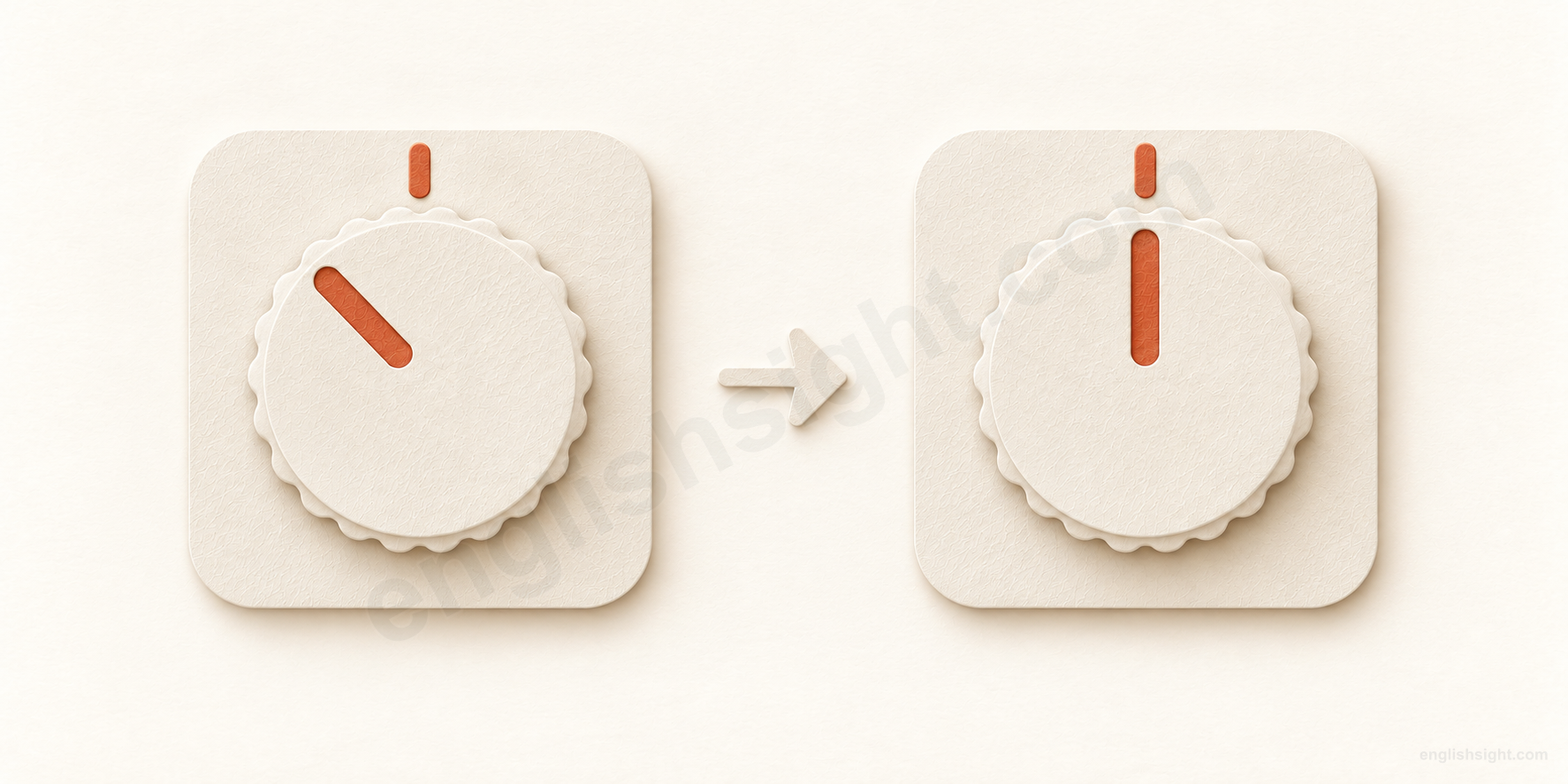
The knob’s index points away from the fixed reference.
adjustment
The index lines up with the same reference.
Turning the knob changes the setting.
A setting is changed to fit a fixed reference.
An adjustment changes a setting, arrangement, figure, or response to fit a need or changed conditions more closely.
This is a teaching connection, not a promise that every adjustment is small or successful. The surrounding expression identifies what is changed and why.
Adjustment is a noun, pronounced /əˈdʒʌstmənt/. Its plural is adjustments. It can name a particular change, the process of changing, or a mechanism that makes changing possible.
A useful connection is changing something in relation to a need or condition. Read the surrounding words to find out what changes: a timetable, a calculation, or someone’s habits. Personal adjustment can be substantial and gradual.
01
Change details and settings
Separate the action of adjusting, the amount of work needed, and a device’s adjustment feature.
01
make + an adjustment / adjustments + to + thing
make an adjustment to something
change a detail to make something work or fit better
Starting situation
A meeting plan leaves no time for lunch.
Change or result
You move one session to make room for a break.
To names the thing being changed.
An adjustment often changes part of an existing arrangement rather than replacing the whole thing. Make an adjustment describes carrying out that change; make a few adjustments describes several changes. Plans, recipes, designs, and machine settings can all be adjusted.
Say a minor, slight, or small adjustment for a limited change, and final adjustments for finishing changes before something is ready. Fine adjustments are small, precise changes, such as carefully setting a lens. The aim is usually correction or suitability, but the noun does not guarantee success. A change is broader: replacing the entire plan is a change, but calling it a small adjustment would understate it.
In a sentence
We made a small adjustment to the timetable so everyone could have lunch.
Watch the difference The usual collocation is make an adjustment, rather than do an adjustment.
02
need / require + adjustment; need / require + an adjustment
need adjustment / need an adjustment
require a process of changing or one particular change
Starting situation
A bicycle brake does not work as it should.
Change or result
You identify a need to alter its setting.
Countability changes how the work is presented.
The brake needs adjustment treats adjusting as work or a process without counting individual changes. The brake needs an adjustment presents one change as a separate item. Both are possible; the article is not simply optional everywhere. Some adjustment of the brake may be necessary is another process description.
Use a few adjustments for separate changes and a little adjustment for an amount of adjusting. Need and require describe necessity, not completed work. Adjustment is a noun: compare The brake needs adjustment with We need to adjust the brake, where adjust is the verb.
In a sentence
The brake may need a little adjustment before the bicycle is ready.
Watch the difference Do not say a few adjustment or an adjust; use adjustments after a few and adjustment after an.
03
height / seat adjustment; adjustment mechanism; the adjustment on + device
height adjustment / the adjustment on a device
the ability or mechanism used to change a setting
Starting situation
A chair seat is too high for its user.
Change or result
Its adjustment mechanism allows the seat to be lowered.
Adjustment can name the means of changing, as well as the change itself.
Height adjustment in a product description usually names a feature that lets you change the height. An adjustment mechanism is the device that makes the change possible. In instructions, the adjustment on a machine can also mean a control such as a knob or lever, though control or knob is often clearer in everyday speech.
Compare I made an adjustment to the chair: that describes an action already taken. This chair has height adjustment describes what the chair allows, even when nobody is changing it. The setting is the selected height; the adjustment changes it.
In a sentence
This chair has height adjustment, so you can lower the seat.
Watch the difference Having an adjustment feature does not mean the device has already been set correctly.
02
Revise amounts and comparisons
Name the quantity that changes, the direction of revision, or the factor a calculation allows for.
04
an adjustment in + prices / rates; an upward / downward adjustment to + amount
an adjustment in prices / a price adjustment
a revision of a level or amount
Starting situation
A listed price no longer matches the intended price.
Change or result
The seller revises the amount.
In names the quantity or area where a change occurs.
An adjustment in prices reports a change in price levels; an adjustment to the price presents the price as the thing revised. These can describe the same event from different angles. A price adjustment may be an increase, a reduction, or a correction; context tells you which.
Upward and downward make the direction explicit. If a charge is reduced because an item has a defect, the reduction can be called a price adjustment. The expression alone does not promise a refund, identify the reason, or establish a store policy.
In a sentence
The invoice shows a downward adjustment to the price because the cover was damaged.
Watch the difference Adjustment by itself does not mean increase or discount. State the direction when it matters.
05
before / after adjustment for + factor; without adjustment for + factor
after adjustment for inflation
after revising figures to take a relevant factor into account
Starting situation
Figures from two years are affected by different price levels.
Change or result
A calculation allows for inflation before comparison.
For names the factor allowed for, rather than the figure being changed.
Adjustment for inflation is a calculation that allows for changes in the general price level. It helps separate a change in money amounts from a change in purchasing power. The expression describes how the figures are treated; it does not say someone has changed actual prices or wages.
Compare an adjustment to the sales figures, which identifies the data revised, with an adjustment for inflation, which identifies a factor taken into account. Before adjustment and after adjustment distinguish the original and revised figures. Without adjustment for inflation means that this factor has not been allowed for.
In a sentence
After adjustment for inflation, sales were slightly lower than last year.
Watch the difference For does not mean inflation itself was corrected or removed from the economy.
03
Adapt habits and outlook
People may change gradually in response to new conditions. This need not be a minor change.
06
someone’s adjustment to + situation / -ing; be a major adjustment for + person
adjustment to a new situation
changes in habits or thinking as someone adapts
Starting situation
A new job requires a different daily routine.
Change or result
You gradually develop habits that fit the new routine.
To can name the conditions a person adapts to.
Her adjustment to the new job describes her process of adapting. Here the job is the situation she responds to, not necessarily the thing she changes. This differs from adjustments to the work schedule, where the schedule itself is altered.
Adjustment to living alone uses to as a preposition, so living is an -ing form. A major adjustment can describe a substantial or difficult personal change: Working nights was a major adjustment for me. The change need not feel small, even though small alterations are central in the equipment sense.
In a sentence
My adjustment to working nights took longer than I expected.
Watch the difference Use adjustment to working nights, not adjustment to work nights, when to introduces what you adapt to.
07
a period of adjustment; an adjustment period; go through a period of adjustment
a period of adjustment
time during which someone gets used to changed conditions
Starting situation
A family has just moved to a new town.
Change or result
They spend time becoming familiar with daily life there.
Period counts the stretch of time; adjustment names the adapting process.
A period of adjustment and an adjustment period both describe time allowed or needed for adapting. Go through a period of adjustment emphasizes experiencing that phase. Emotional, cultural, and personal adjustment indicate which aspect of life is involved.
An adjustment period is not a fixed number of days. Adjustment difficulties or adjustment problems describe trouble adapting, without automatically naming a medical condition. The dial picture illustrates a change toward a better fit, but people do not usually adapt in one quick turn.
In a sentence
We went through a period of adjustment after moving to the new town.
Watch the difference A difficult period of adjustment is an ordinary description, not by itself a diagnosis.
08
need / make + an attitude adjustment
an attitude adjustment
a change in how someone thinks about or responds to something
Starting situation
You treat every suggestion as criticism.
Change or result
You start listening for useful ideas.
The change concerns outlook and behavior.
An attitude adjustment applies the idea of changing a setting to a person’s outlook. It can describe a deliberate change in your own response. The phrase is a familiar combination of attitude and adjustment, not a phrasal verb.
You need an attitude adjustment can sound critical or confrontational, especially when spoken by someone in authority. Naming the behavior directly can be more constructive: Please let other people finish speaking. The phrase does not specify what the new attitude should be; context supplies that.
In a sentence
I needed an attitude adjustment: the feedback was meant to help, not to attack me.
Watch the difference Do not assume this is a neutral way to advise another person; it can sound like a rebuke.
Read the noun and its surrounding words
Adjustment, change, and adaptation
Change covers any difference. Adjustment usually presents a revision in relation to a need, a setting, or conditions. Adaptation overlaps with personal adjustment, but also has uses such as a film adaptation that adjustment does not share.
To, in, of, and for
To may identify what is altered or the situation a person adapts to. In identifies the area or quantity where a revision occurs. Of can identify what undergoes adjustment, as in adjustment of the lens. For can identify a factor allowed for in a calculation. These are noun phrases, not phrasal verbs.
Scope and specialized meanings
This lesson covers general modern noun uses and selected familiar combinations. Insurance settlements, technical accounting procedures, medical uses such as spinal adjustment or adjustment disorder, and legal rules about reasonable adjustments require their own context. The lesson does not teach those specialist systems.
Choose what is being adjusted
Read the whole construction, including its article and preposition.
1. You mean some work on a setting, without counting separate changes. Which phrase fits?
2. In “her adjustment to living alone,” what does living alone identify?
3. A report gives results “after adjustment for inflation.” What has been done?
4. A notice says only “There will be a price adjustment.” Can you be certain prices will fall?
Sources and teaching notes
Dictionary entries support the usage distinctions below. The explanations and examples are original; the dial diagram is a teaching model. Collocation pages provide examples of combinations, not independent definitions or frequency rankings.
The diagram illustrates a useful connection; English speakers need not share one mental picture.