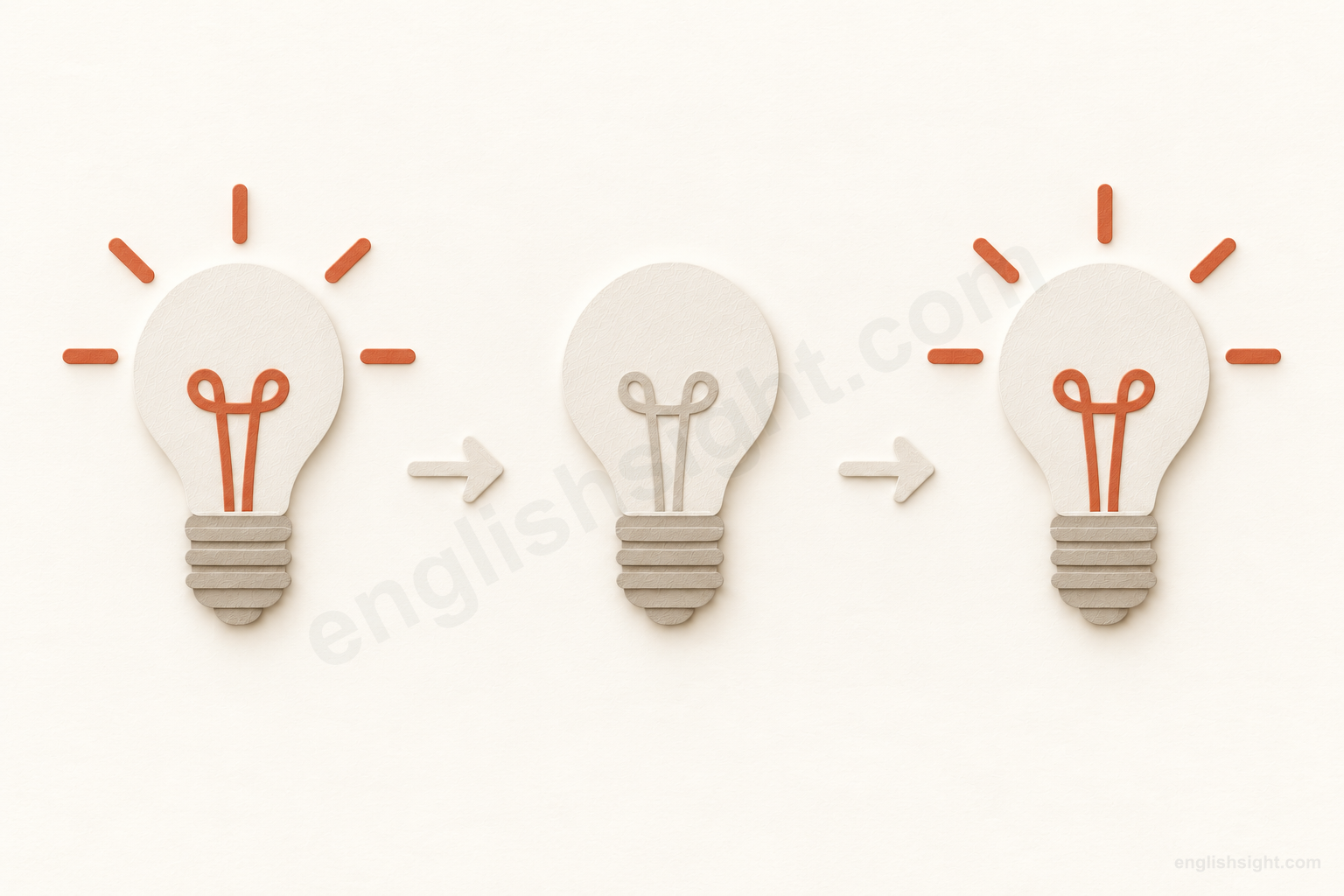
Find what returns, then read the whole expression.
What occurs once more?
Earlier, interrupted, present again
The lamp was on.
again
The lamp is on again.
It goes off; time moves forward.
The same lamp is on, goes off, and is on again: its earlier state returns.
Again presents an event or state as occurring once more, in relation to an earlier occurrence or condition.
The lamp illustrates a returning state. An action can also happen again without an opposite state between occurrences. The arrows show time moving forward; the picture is a teaching aid, not a shared mental image attributed to all speakers.
Again connects the present or a later occasion with something that has happened or held before. You can repeat an action, meet someone another time, or return to an earlier condition.
This connection is a useful learning model. Conversation formulas, logical connectors, and amount comparisons need their own explanations; the picture cannot predict every phrase.
01
Another occurrence or a return
Identify what is repeated: an event, an attempt, or a former condition. Extra words can specify emphasis, a fresh start, or frequency.
01
verb + (object) + again
try / see / say it again
have another occurrence of an action or event
Earlier situation
There has already been one attempt.
Later situation or response
You make a further attempt.
Again relates a later occurrence to an earlier one.
Again is an adverb: the verb supplies the action, and again says that an occurrence is a repeat. You can try again after failure, or watch a favorite film again after enjoying it. Failure is not part of again.
In Please read the message again, place again after the object. Do not put it between read and the message. Sentence-initial Again, the alarm rang is possible when narrating another occurrence; neutral everyday requests usually put again at the end.
Again does not mean exactly twice in total: a later attempt can be the third, fourth, or tenth. It also does not itself mean continuously; She called again describes a further call, whereas She was still talking describes continuation.
In a sentence
I checked the address again before leaving.
Watch the difference Use again for recurrence and still for continuation; read again the message is not the neutral object order.
02
be / feel + state + again; be home / back / together again
well / home / together again
be back in a former condition or place
Earlier situation
The lamp was on, then off.
Later situation or response
It is on at a later time.
The earlier condition holds once more.
In The lamp is on again, the repeated element is a state. The diagram shows one lamp at three times, not three different lamps. In feel well again, a healthy condition has returned after illness; again does not mean that recovery has happened twice.
Home again concerns a former location; together again concerns a former relationship or arrangement. Back can explicitly mark return: We drove there and back again. Again may reinforce a return already expressed by back.
Context controls the scope. Open the window again can request another opening action, or the restoration of an open state. It need not imply that this particular person opened it before; what was open before may simply need to be open now.
In a sentence
After the repair, the lamp was working again.
Watch the difference Again can repeat a state, not just an action; it does not mean time literally moves backward.
03
start again; do + object + (all) over again
start again / all over again
begin anew or repeat a whole task
Earlier situation
Your recording contains a mistake near the beginning.
Later situation or response
You record from the start.
All over emphasizes repeating the whole process.
Start again makes a fresh start explicit. Do it again alone says to repeat the action but does not specify how much of a larger task must be redone. Do it all over again emphasizes doing the whole thing anew.
Start over is especially familiar in American English; start again is widely understood. Start over again combines the fresh-start meaning with recurrence. All over again can also describe a whole experience returning: The music made me feel young all over again.
In a sentence
The file was lost, so we had to write the report all over again.
Watch the difference Do not confuse all over again, a whole repeat, with over and over again, many repeats.
04
verb + again and again; over and over (again); time and (time) again
again and again / over and over again
repeat many times
Earlier situation
One reminder has not been enough.
Later situation or response
The reminder is given repeatedly.
These expressions emphasize a series of occurrences.
Again and again, over and over (again), and time and (time) again all emphasize repeated occurrences. Their attitude comes from context: repetition may be useful practice, a welcome success, or an annoyance.
Time and again fits sentence-initial position naturally: Time and again, the tests gave the same result. No expression here specifies an exact number or a fixed interval. Repeatedly is a compact alternative.
In a sentence
We listened to the short recording over and over again.
Watch the difference Over and over again means many times, not simply restarting once.
05
once again / once more + clause; verb + yet again
once again / yet again
highlight another occurrence
Earlier situation
A familiar event has happened before.
Later situation or response
You draw attention to its recurrence.
The added word changes emphasis and often tone.
Once again can simply emphasize recurrence: Thank you once again is a renewed thanks. It does not guarantee that this is only the second thanks. Once more is another familiar equivalent.
Yet again highlights an event recurring after previous occurrences and often conveys impatience or surprise: The lift has broken yet again. It can also accompany praise, so annoyance is not a fixed part of its meaning.
In a sentence
Once again, the volunteers stayed late to help.
Watch the difference Yet again often sounds more pointed than again; avoid adding an irritated tone unintentionally.
06
(every) now and again + clause; verb + (every) now and again
(every) now and again
happen occasionally
Earlier situation
An activity is not a regular routine.
Later situation or response
It happens from time to time.
The whole phrase describes occasional frequency.
Now and again and every now and again describe something happening sometimes, without a regular schedule. Now and then and every now and then are alternatives.
The phrase can frame the sentence or follow the activity. It is not an instruction to do something now and then immediately repeat it; its occasional meaning belongs to the whole expression.
In a sentence
Every now and again, we take a different route home.
Watch the difference Again and again emphasizes many repetitions; now and again emphasizes occasional occurrences.
07
never + verb + again; not + verb + again; Not again!
never again / not again
exclude or react to a further occurrence
Earlier situation
A past experience was unpleasant.
Later situation or response
You reject a repeat or react when it returns.
Negation concerns recurrence, not continuous duration.
Never again rules out any further occurrence: I will never lend him my bike again. Not again! can be an exclamation of dismay when a familiar problem returns.
I will not call again means no further call is planned. I no longer call him concerns the end of a habit; the two may fit the same situation but organize it differently. In standard international English, do not use again by itself to mean any longer.
In a sentence
I will never leave my keys in the door again.
Watch the difference Never again looks toward no further occurrence; again is not a general substitute for anymore.
02
Repeating information and reacting
Some expressions ask for words again; others express agreement, reconsideration, or irritation. Learn the whole expression and its tone.
08
wh-question + again?
What was your name again?
ask for information you think was given before
Earlier situation
You were introduced but cannot recall the name.
Later situation or response
You request a reminder.
Again treats the question as a return to earlier information.
A question ending in again often asks for a reminder: What time does the shop close again? The speaker believes this information was mentioned or known before. It need not be an exact repetition of the same words.
What was your name again? commonly refers to a person’s current name; was can refer back to the introduction rather than a name change. Sorry can soften the request. What is your name again? is also possible.
In a sentence
Sorry, which floor is the meeting on again?
Watch the difference For a first introduction, omit again unless you have reason to expect the information was already given.
09
Come again?; Could you say that again, please?
Come again?
ask someone to repeat what they said
Earlier situation
You did not catch a statement.
Later situation or response
You invite the speaker to say it once more.
The phrase requests repeated speech, not another visit.
Come again? is an informal spoken request to repeat an utterance. Depending on intonation, it can also signal surprise or disbelief at what you think you heard.
Could you say that again, please? is a clearer, more broadly polite alternative. Come again tomorrow, with an actual visit and a time, has the ordinary meaning of returning; punctuation and context distinguish the request.
In a sentence
“The delivery fee is eighty pounds.” “Come again?”
Watch the difference Come again? can sound abrupt in formal service situations; choose a fuller polite question when needed.
10
statement → You can say that again!
You can say that again!
strongly agree with a statement
Earlier situation
A friend describes a difficult journey.
Later situation or response
You emphatically agree.
This fixed reply approves the statement rather than requesting repetition.
You can say that again! is an informal expression of strong agreement. The speaker is not normally asking for the sentence to be spoken again.
Compare Can you say that again? This question genuinely asks for repetition. Word order and the complete expression matter; the agreement meaning is not a separate meaning of can in every context.
In a sentence
“That was a long queue.” “You can say that again!”
Watch the difference You can say that again! agrees; Can you say that again? asks for another hearing.
11
think again (about + noun / -ing); If you think…, think again!
think again
reconsider a judgment or plan
Earlier situation
You have settled on an expensive option.
Later situation or response
You reconsider whether it is wise.
Another round of thinking may change the decision.
Think again often means reconsider rather than merely repeat the same thought. Think again about the booking asks someone to reassess it; it does not guarantee that they will reach a different conclusion.
The warning If you think this will be easy, think again! challenges someone’s assumption directly. It can sound confrontational, so consider a softer suggestion such as Perhaps we should think again about this.
In a sentence
Before paying the deposit, we should think again about the venue.
Watch the difference Reconsideration allows a change of mind; again alone does not mean cancel.
12
Here we go again!
Here we go again!
recognize a familiar situation starting again
Earlier situation
A printer has jammed several times.
Later situation or response
Another jam begins.
The speaker recognizes the return of a familiar pattern.
Here we go again! is an informal reaction when something starts happening again, especially an unwelcome event. It may express weary recognition of another argument, delay, or technical problem.
The people need not be traveling: go is part of the conventional expression. A playful tone can lighten the complaint, but the phrase often suggests that the speaker has had enough.
In a sentence
The screen froze. “Here we go again,” Maya sighed.
Watch the difference This is a reaction to a returning situation, not necessarily a suggestion to start an enjoyable activity.
13
There you go again, + -ing phrase
There you go again!
criticize someone’s familiar behavior
Earlier situation
Someone repeatedly interrupts.
Later situation or response
They interrupt once more.
You points the criticism at the other person.
There you go again! addresses someone who is repeating a characteristic behavior that the speaker dislikes. A following -ing phrase can name it: There you go again, interrupting me.
Here we go again reacts to the whole situation. There you go again points at what you are doing. This personal criticism can make a disagreement sharper.
In a sentence
There you go again, blaming the weather for everything.
Watch the difference Do not use this as a neutral encouragement; it normally criticizes the listener.
14
be + at it again
be at it again
be doing a familiar activity again, often a troublesome one
Earlier situation
You recognize signs of a repeated activity.
Later situation or response
You identify who has resumed it.
It refers to the activity supplied by the context.
Be at it again commonly suggests that someone has resumed behavior the speaker disapproves of. The activity may already be known, or a following phrase can clarify it.
Unlike do it again, which can be a direct instruction, They are at it again comments on an activity already underway. The pronoun it does not necessarily name a physical object.
In a sentence
The neighbors are at it again, arguing about the parking space.
Watch the difference Without enough context, it leaves the activity unclear; do not treat at it as a literal location.
15
will not / would not + verb + again in a hurry
not do it again in a hurry
be unwilling to repeat an unpleasant experience soon
Earlier situation
A restaurant visit went badly.
Later situation or response
You are reluctant to return.
In a hurry contributes reluctance about another occurrence.
In I won’t eat there again in a hurry, the speaker means the bad experience has made them unwilling to repeat it soon. The sentence does not merely promise to eat more slowly next time.
This informal pattern is often a pointed negative assessment. It need not be a permanent vow never to return; never again is stronger in its literal time scope.
In a sentence
I won’t book that hotel again in a hurry; the room was filthy.
Watch the difference Read the whole negative expression; hurry is not about how fast the booking is made.
03
Adding a point or changing perspective
Again can connect ideas in a discussion. A supporting point and a counterpoint are different relationships.
16
clause; (but) then again, + clause; there again, + clause
then again / there again
introduce a contrasting consideration
Earlier situation
One option sounds attractive.
Later situation or response
You add a reason to hesitate.
The next point qualifies the previous point.
Then again, but then again, and there again introduce a consideration on the other side. But again is another possible contrasting introduction in context. These expressions can weaken a claim without completely rejecting it.
Then here is part of a discourse expression, not a promise that one event will happen afterward. Again invites another look at the issue; the full phrase signals the contrast.
In a sentence
The flat is small. Then again, it is very close to work.
Watch the difference Then again introduces a counterpoint; it does not mean that the flat becomes small a second time.
17
(and) again, + related statement
And again, …
add a related point or draw attention to a parallel
Earlier situation
You have described one weakness of a proposal.
Later situation or response
You add another related consideration.
Again links a new point with an earlier line of thought.
In discussion, sentence-initial again can introduce an additional consideration or show that something similar applies to a new case. This connective use is especially at home in explanations and arguments.
If you say The smaller model is quiet. Again, the larger model makes little noise, you point out a parallel; you do not say that the larger model has become quiet twice. Also is often a simpler way to add a point. In Again, please check the date, context may instead make again a renewed reminder.
In a sentence
The plan needs more staff. And again, we must allow for training costs.
Watch the difference An additional point supports or extends the discussion; then again explicitly introduces a contrast.
04
Another serving or an added amount
The same again requests a repeat order. In comparisons, again can add an amount to an existing baseline.
18
Same again, please; have / would like + the same again
(the) same again
request another serving of the previous order
Earlier situation
You have finished one drink.
Later situation or response
You ask for another of the same kind.
The previous order supplies the missing description.
Same again, please is an informal ordering expression, especially for drinks. The server understands the kind and often the quantity from the earlier order. I’ll have the same again is a fuller version.
You are requesting an additional serving of the same kind, not asking for the used drink or container back. Outside an ordering context, specify what is to be repeated if the reference is unclear.
In a sentence
When the server returned, I said, “The same again, please.”
Watch the difference The expression relies on a known earlier order; it does not tell a new server what you want.
19
half as much / many / tall again as; half again as much / many as; as much again
half as much again / as much again
add a proportion of the original amount
Earlier situation
The original price is forty pounds.
Later situation or response
Adding half of it makes sixty pounds.
Again marks an addition to the baseline amount.
Half as much again as means the original amount plus half of that amount: £40 plus £20 gives £60. For countable items, half as many again works the same way: 10 plus 5 gives 15. This pattern is especially British; American English also uses half again as much or half again as many.
As much again adds a whole equal amount, making twice the baseline. These are comparison patterns, not an instruction to measure something twice. In half as tall again, the result is 150% of the original height.
Compare half as much as, without again: that gives 50% of the baseline. The small extra word reverses which side of the original amount you are on. Fifty percent more is often a clearer way to express half as much again.
In a sentence
The larger suitcase costs half as much again as the £40 model: £60.
Watch the difference Half as much again is 1.5 times the baseline, not half the baseline and not double.
Keep recurrence separate from the rest of the message
Again, still, and back
Again marks recurrence; still marks continuation. Back often marks return to a place or condition, but does not replace again in every sentence: Read it back may mean read it aloud to someone, whereas Read it again asks for another reading.
Scope depends on context
Someone can close a door again because they closed it before, or because it needs to return to a closed state. Again does not always require the same person to repeat an action. It also does not specify an exact number, interval, or emotional attitude.
Word class and pronunciation
Again is an adverb, not a verb with tense forms. Both /əˈɡen/ and /əˈɡeɪn/ are established pronunciations. Passive, causative, and progressive forms belong to a surrounding verb, not to again; try again is an ordinary verb plus adverb, not automatically a phrasal verb.
Scope of this lesson
This selection covers modern general uses and familiar expressions. It does not teach archaic again meaning in reply, regional negative again meaning any longer, or separate compound adjectives such as born-again and on-again, off-again.
Choose what happens again
Use the context and the complete expression, not just the idea of repetition.
1. A lamp worked, stopped working, and now works after a repair. What does working again emphasize?
2. You visit an old friend occasionally, without a regular schedule. Which expression fits?
3. A friend says, “That exam was difficult.” You reply, “You can say that again!” What do you mean?
4. A bag costs £40. A larger one costs half as much again. What is the larger price?
5. “The train is expensive. Then again, it gets us there much faster.” What does then again do?
Sources and teaching notes
Publisher entries informed the coverage. Explanations, examples, and the visual teaching model are original to this lesson. Source-to-unit mappings are recorded in coverage.json.
The diagram is a learning aid, not a claim about every native speaker’s mental picture.