Follow air from breathing and flight to impressions, broadcasting, and familiar expressions.
Something invisible can occupy space
Something invisible can occupy space
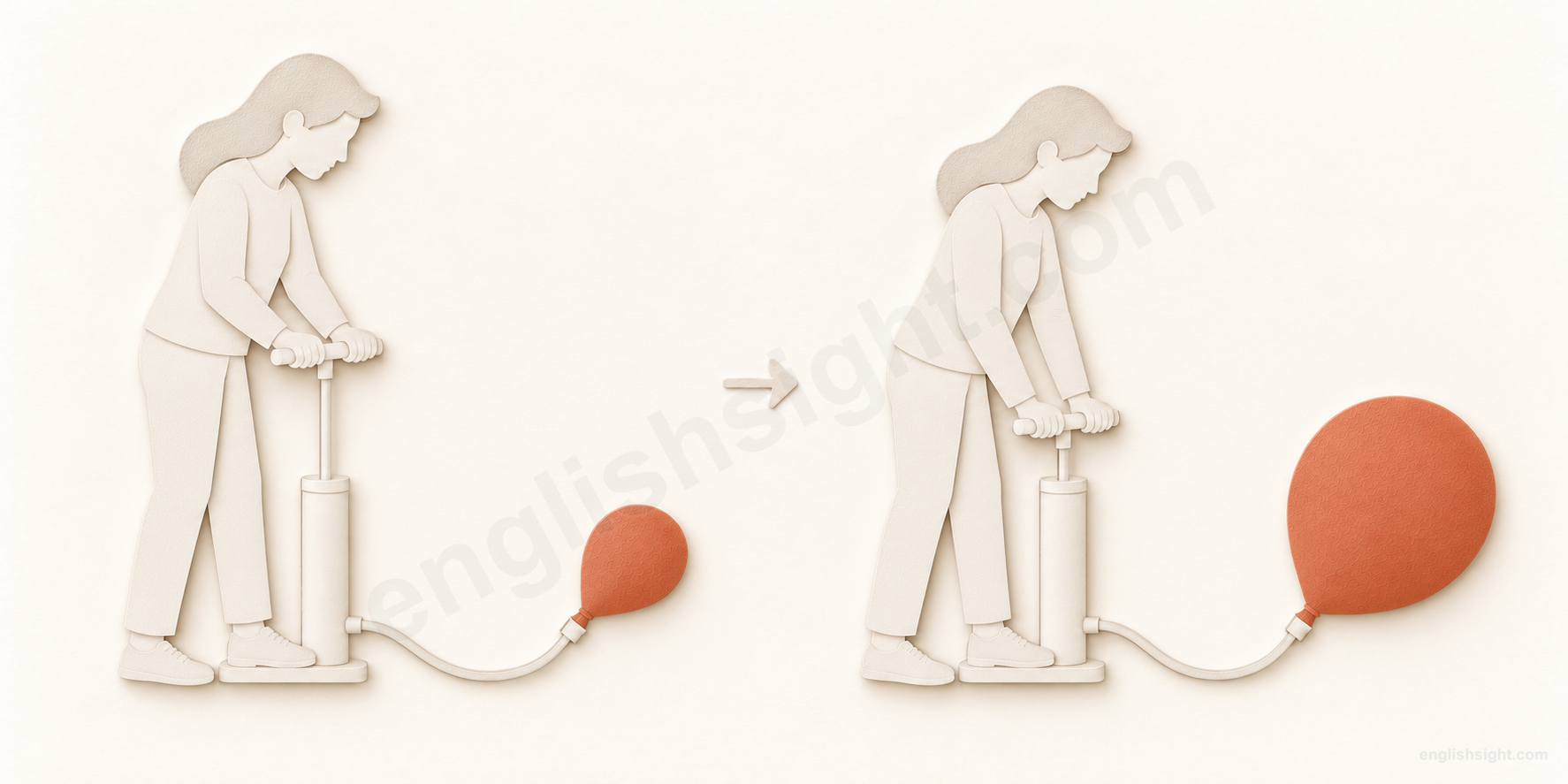
The balloon is small, and the pump handle is raised.
air
The same balloon is larger, with the pump handle lowered.
She pumps air through the hose into the balloon.
Invisible air takes up space: adding air expands the balloon.
Air is the mixture of gases around us: it fills space and can move into, out of, and through things.
The balloon shows a physical property of air, not a derivation of every meaning. The impression and music branches have distinct histories; fixed expressions depend on their full wording.
You cannot usually see air itself, but you can breathe it, move it, and fill things with it. This physical starting point helps with many everyday uses.
Some branches and fixed expressions must be learned separately. An air of confidence, a musical air, and put on airs are not different kinds of gas.
01
The gas around us
Start with breathing, freshness, pressure, and surrounding space. Air is usually uncountable in these uses.
01
breathe (in) air; gasp for air; come up for air
breathe air
take the surrounding gas into the lungs
Situation / starting point
A swimmer is below the surface.
Meaning / outcome
She reaches the surface and can breathe.
Air names the substance; breathe names the action.
Air is present even when it is still and invisible. We breathe air, not an air or several airs. The air in this room identifies a particular surrounding supply.
Use gasp for air when someone struggles to draw air in. A swimmer or whale comes up for air to breathe at the surface. A breath is one intake or release; air is what is taken in.
In a sentence
The swimmer came up for air beside the boat.
Watch the difference Air and oxygen are not exact synonyms: oxygen is one of the gases in air.
02
get / need some fresh air; a breath of (fresh) air
get some fresh air
spend a little time where the air feels fresh
Situation / starting point
You have been inside a crowded room.
Meaning / outcome
You step outside for a short break.
Fresh describes the air; get describes obtaining or experiencing it.
Get some fresh air often means go outside for a while. A breath of fresh air can literally be a brief opportunity to breathe outside; it need not mean exactly one measured breath.
Air can be warm, cold, dry, damp, stale, or polluted. Fresh air is a description in everyday conversation, not a guarantee that outdoor air is free of pollution.
In a sentence
Let’s step outside and get some fresh air before the next session.
Watch the difference Say some fresh air, not a fresh air. The a in a breath of fresh air belongs to breath.
03
put air in + object; pump air into + object; let air out (of + object)
put air in a tyre
fill an object with more air
Situation / starting point
A bicycle tyre feels too soft.
Meaning / outcome
A pump adds air inside it.
Air occupies space inside an object as well as around it.
Put some air in a tyre and pump air into a tyre describe adding the gas inside. Let air out describes releasing it. Air pressure tells us about how strongly the gas pushes against a surface.
An air pump moves air. An air filter removes unwanted material from air; air quality and air pollution concern its condition. In these combinations air modifies another noun without becoming plural.
In a sentence
Could you put some air in the back tyre before we leave?
Watch the difference Tyre is British spelling; tire is American spelling. Use more air, not more airs.
04
be in the air; throw / rise into the air; move through the air
in / into / through the air
in or moving across the space around things
Situation / starting point
A ball leaves someone’s hand.
Meaning / outcome
It travels above the ground.
In locates; into marks entry; through describes a route.
The ball is in the air describes its position. Throw it into the air highlights the movement away from the ground or hand. It flies through the air describes the route.
Sounds and smells can fill or hang in the air too: The smell of bread hung in the air. Here air is the surrounding medium, not just a very high part of the sky.
In a sentence
The children tossed a bright scarf into the air.
Watch the difference The article is usual in these space phrases: in the air. This differs from the transport phrase by air.
05
in the open air; open-air + noun
in the open air
outside rather than inside a building
Situation / starting point
A music event could be held indoors.
Meaning / outcome
The audience sits outside.
Open air is an established way to name an outdoor setting.
In the open air locates an activity outdoors. An open-air concert uses a hyphen when the expression comes before a noun to describe it.
The phrase concerns the setting. A concert in the open air is not necessarily broadcast on the air; those expressions answer different questions.
In a sentence
We watched the play in the open air behind the museum.
Watch the difference Use in the open air, not on the open air, for an outdoor activity.
06
turn on / turn off the air (= air conditioning)
turn on the air
switch on the air conditioning in context
Situation / starting point
The car interior is hot.
Meaning / outcome
Someone starts the cooling system.
In American conversation, the air can stand for air conditioning.
If a driver says Turn on the air, the intended object may be the car’s air conditioning. The setting supplies the missing part of the longer name.
Air conditioning or AC is clearer when the context does not already identify a cooling system. This shortened use does not mean creating the gas around us.
In a sentence
It’s getting hot in the car; can you turn on the air?
Watch the difference Do not use this shortened meaning in every context or treat all mentions of the air as a cooling system.
02
Aircraft and the space above the ground
The preposition distinguishes a means of travel, a viewpoint, and the beginning of flight.
07
travel / go by air; send / transport + object + by air; air travel / freight
travel / send something by air
use an aircraft for transport
Situation / starting point
A parcel needs to reach a distant country.
Meaning / outcome
It is carried on an aircraft.
By air names the method of transport.
Travel by air contrasts with travel by road, rail, or sea. Send a parcel by air concerns how the parcel is carried, even if the sender stays home.
Air travel and air freight use air before a noun. The phrase by air does not need an article; on a plane refers to being aboard a particular kind of vehicle.
In a sentence
We sent the replacement part by air to save time.
Watch the difference Use by air, not by the air, for a transport method.
08
see / photograph + object + from the air; take to the air
from the air / take to the air
view from above or begin flying
Situation / starting point
A helicopter is on the ground.
Meaning / outcome
It rises and its passengers see the town below.
From gives the viewpoint; take to marks the start of flight.
From the air tells us where an observer or camera is looking from. It does not simply say how somebody travels: a photograph can show the town from the air.
Take to the air means begin flying. Aircraft and birds can do this. The established expression uses take to; take the air can instead mean go outside for fresh air.
In a sentence
As the helicopter took to the air, we saw the whole harbour below us.
Watch the difference By air describes transport; from the air describes a viewpoint. They are not interchangeable.
03
An impression, a manner, or a tune
These are established noun branches. The article and plural form matter; a balloon does not explain them all.
09
have an air of + noun; with a(n) + adjective + air
an air of confidence
a noticeable impression or manner
Situation / starting point
You notice a speaker’s calm voice and posture.
Meaning / outcome
The speaker gives an impression of confidence.
An air of names a quality perceived by an observer.
Have an air of confidence does not state how much confidence the person actually feels. It describes the impression they give. A room can have an air of mystery, and someone can reply with a serious air.
Think of an impression surrounding a person or place as a memory aid. This is a separate established meaning, not a claim that confidence is literally a gas.
In a sentence
Despite her nerves, she answered with an air of confidence.
Watch the difference Use an air of confidence here. The article belongs to this impression sense, unlike uncountable fresh air.
10
put on airs; give yourself airs; airs and graces; with your nose in the air
put on airs
behave as though you are superior to others
Situation / starting point
Someone begins treating ordinary acquaintances as beneath them.
Meaning / outcome
Others criticize that display of superiority.
Plural airs expresses disapproval, not several portions of gas.
Put on airs and give yourself airs criticize a superior manner. Airs and graces is a related expression, especially British. These phrases suggest pretension; an air of confidence can be entirely positive.
With your nose in the air similarly describes an unfriendly, superior attitude: He passed us with his nose in the air. It can evoke a raised head, but the criticism concerns behavior.
In a sentence
She became famous but never put on airs with her old friends.
Watch the difference Putting on airs is not the same as turning on the air conditioning. Keep the plural and the full expression.
11
a(n) + adjective + air; play an air; plural airs
play an air
play a melody, in older or musical usage
Situation / starting point
A musician chooses an old melody.
Meaning / outcome
The audience hears that tune.
Musical air is a countable noun and a separate branch.
An air can mean a tune. You are likely to meet this meaning in older writing or titles of musical pieces rather than in ordinary requests for a song.
The violinist played two old airs uses a normal countable plural. It has nothing to do with the disapproving airs in put on airs. Learn the musical meaning for recognition without replacing everyday tune or melody.
In a sentence
The violinist played an old air that her grandfather had taught her.
Watch the difference Do not force the gas model onto the musical meaning or assume that every song is naturally called an air today.
04
Let air in, make views heard, or broadcast
As a verb, air can describe a physical process or public communication. Read the subject and object to identify the action.
12
air + room; air out + room; air + room / it + out; room + airs out
air a room / air it out
let fresh air enter and circulate
Situation / starting point
A room has been closed for a long time.
Meaning / outcome
An open window allows air to circulate.
The room is affected by the action; air is now a verb.
Air the room is especially British; air the room out or air out the room is the usual North American pattern. Out belongs to a separable phrasal verb. With a pronoun say air it out.
You can leave the room to air out, with the room as subject, or give the room an airing. In The room was aired before we arrived, the passive leaves the person doing it unmentioned.
In a sentence
Let’s open the windows and air the room out before the guests arrive.
Watch the difference Say air it out, not air out it. Out does not give air your opinions the same meaning.
13
air + clothes / bedding; leave + clothes / bedding + to air
air the blankets
expose fabric to air or warmth to freshen or dry it
Situation / starting point
Blankets have been stored in a cupboard.
Meaning / outcome
They are spread out in a well-ventilated place.
The fabric is exposed; the action is not washing.
Air clothes, sheets, or blankets means leave them where air or warmth can dry them fully or remove a stale smell. The object is the fabric, whereas in air a room it is the enclosed space.
Leave the blankets to air is intransitive: the blankets are undergoing the process. The blankets have been aired is a passive form. Neither construction says they have been washed.
In a sentence
We aired the blankets on the balcony before putting them away.
Watch the difference Air does not mean wash or iron. State those actions separately if you mean them.
14
air + views / concerns / grievances; give + issue + an airing
air your concerns
make thoughts or complaints known to others
Situation / starting point
Team members have concerns they have not voiced.
Meaning / outcome
They express the concerns at a meeting.
The object is information; the audience is supplied by the situation.
Air an opinion, concern, grievance, or disagreement means express it openly. It need not involve a television broadcast or the entire public: a team meeting can provide the audience.
The concerns were aired uses the passive. Give an issue an airing is a related noun construction meaning let it be presented or discussed. Expressing a concern does not automatically settle it.
In a sentence
The meeting gave everyone a chance to air their concerns about the new schedule.
Watch the difference Air concerns means voice them; clear the air focuses on easing tension or uncertainty.
15
station + airs + programme; programme + airs; programme + is aired
a programme airs / is aired
a radio or television programme is broadcast
Situation / starting point
A documentary has been prepared.
Meaning / outcome
An audience can receive it at its scheduled broadcast time.
A station can air a programme; a programme can air.
The station airs the interview is transitive. The interview airs tonight is intransitive. The interview will be aired tonight is passive. These patterns describe the broadcast from different grammatical viewpoints.
This broadcasting verb is especially associated with American usage in Collins; it is also understood elsewhere. Airing a prerecorded programme does not make it live. Program is the usual American spelling; programme is British for a broadcast show.
In a sentence
The documentary airs on Friday, and the interview will be aired the following week.
Watch the difference Air is a broadcast verb here. It does not describe a director making the programme or an audience watching it.
05
Familiar expressions in conversation
Learn these expressions as units. Their meanings depend on the whole phrase and the situation.
16
be / go / come on (the) air; go off (the) air; take + programme + off the air
on / off the air
being broadcast or no longer being broadcast
Situation / starting point
A presenter waits for a broadcast to begin.
Meaning / outcome
The presenter’s voice is transmitted to listeners.
On and off contrast broadcast status.
We are on the air means the broadcast is going out. Go off the air means stop broadcasting; take a show off the air can mean remove it from the schedule.
On air and off air are also used without the. Off-air remarks are made outside the broadcast. A show can be on the air without being live, because a recording can be broadcast too.
In a sentence
We’re back on the air after a short technical delay.
Watch the difference On the air concerns broadcasting; in the air can concern physical position or a shared feeling.
17
feeling / change / possibility + be + in the air
change / excitement is in the air
a feeling or possibility seems present in a shared situation
Situation / starting point
People sense that something may happen.
Meaning / outcome
A mood or expectation is noticeable among them.
The surrounding atmosphere is a useful metaphor for a shared feeling.
Excitement is in the air describes a mood people can sense. Change is in the air suggests signs or expectations of change rather than a completed decision.
The expression need not mean everyone has spoken about it. Compare Smoke is in the air, which is physical, and Our plans are up in the air, which normally means the plans remain undecided.
In a sentence
With the festival only a day away, excitement was in the air.
Watch the difference Do not infer that a predicted change has definitely happened merely because it is in the air.
18
plan / date / future + be / remain + (still) up in the air
still up in the air
not yet finally arranged or decided
Situation / starting point
Two possible dates are being considered.
Meaning / outcome
No final date has been chosen.
The plan lacks a settled decision, not a physical position.
A date, plan, or someone’s future can be up in the air. Still emphasizes that the uncertainty continues. It does not mean the proposal has been cancelled.
For a helpful memory image, think of something that has not settled into place. This is an interpretation of the phrase, not a rule that up always means undecided.
In a sentence
The wedding date is still up in the air because the venue has not replied.
Watch the difference Up in the air usually describes unresolved arrangements here; walking on air expresses happiness.
19
clear the air; clear the air with + person; talk to clear the air
clear the air
ease tension or clarify doubts; also improve the physical air
Situation / starting point
A misunderstanding has made two colleagues uncomfortable.
Meaning / outcome
They talk frankly and understand each other better.
In social use, the change is in the relationship or shared understanding.
Clear the air often means discuss a problem so that tension, suspicion, or confusion is reduced. An apology or a factual explanation may help; simply saying something does not guarantee success.
The expression also has a physical use: The shower cleared the air after the humid afternoon. That concerns the surrounding air, whereas Our conversation cleared the air concerns a difficult situation.
In a sentence
We spoke privately to clear the air after yesterday’s argument.
Watch the difference Keep the in this idiom. Air a complaint means express it and may happen before the air is cleared.
20
vanish / disappear into thin air
vanish into thin air
disappear without an apparent explanation
Situation / starting point
A small object was here a moment ago.
Meaning / outcome
It cannot be found and no one knows where it went.
Into points toward disappearance in this fixed expression.
Vanish or disappear into thin air exaggerates how completely or mysteriously something has gone missing. The speaker need not believe that the object has literally stopped existing.
Thin air on a mountain is a physical description of less dense air. Into thin air in this idiom is not a report about mountain conditions.
In a sentence
My spare key seems to have vanished into thin air.
Watch the difference Use into for disappearance; out of thin air usually concerns appearance or creation.
21
appear out of thin air; conjure / produce / make + object + out of thin air
appear / create something out of thin air
seem to appear or be produced from no visible source
Situation / starting point
No one can see where a person or resource would come from.
Meaning / outcome
It appears unexpectedly, or someone says it cannot simply be produced.
Out of marks the imagined source: nowhere.
Someone can appear out of thin air when their arrival is surprising. Conjure money out of thin air imagines producing a resource without any available source.
The phrase can also challenge invented information: You cannot make up the figures out of thin air. Context tells us whether the point is surprise, lack of resources, or lack of evidence.
In a sentence
We can’t create extra staff out of thin air; recruitment takes time.
Watch the difference Out of thin air does not mean the resource is made from the gases in the atmosphere.
22
person / idea / approach + be + a breath of fresh air
a breath of fresh air
a welcome, refreshing change
Situation / starting point
A familiar routine has become dull or frustrating.
Meaning / outcome
A new person or approach feels pleasantly different.
Freshness is applied to an experience rather than to breathing.
Calling a person or idea a breath of fresh air is a compliment about a welcome difference. It need not concern their smell, their physical location, or the literal air.
Compare I went outside for a breath of fresh air, where the words can describe an actual outdoor break. The subject and situation distinguish the two uses.
In a sentence
Her practical suggestions were a breath of fresh air after hours of vague discussion.
Watch the difference The idiom is usually positive. It does not simply mean any change, including an unwelcome one.
23
be walking / floating on air
walk / float on air
feel extremely happy
Situation / starting point
Someone has been waiting for good news.
Meaning / outcome
The news arrives and the person feels delighted.
The expression evokes lightness, not literal flight.
Be walking on air and be floating on air describe great happiness. A person receiving long-awaited good news might use them without walking anywhere.
This emotional idiom is different from a plane in the air. The form on belongs to the fixed expression; replacing it with in loses the usual happiness meaning.
In a sentence
After the scholarship offer arrived, Amira was walking on air all weekend.
Watch the difference Do not confuse walking on air with putting on airs, which criticizes a superior manner.
24
be (all) hot air; talk a lot of hot air
all hot air
impressive-sounding talk with little substance
Situation / starting point
Someone makes grand promises.
Meaning / outcome
A listener doubts that the promises have substance or will lead to action.
The speaker dismisses the talk, not its temperature.
All hot air and a lot of hot air are informal and critical. The words can dismiss empty promises or impressive claims that do not seem meaningful or true.
A heater blowing hot air is physical. Calling a speech hot air is a judgment, so use it with care when speaking directly to the person who gave the speech.
In a sentence
Without a budget or a plan, those promises sound like hot air.
Watch the difference The idiom is uncountable: a lot of hot air, not several hot airs.
25
pluck + number / figure / name + out of the air; a finger-in-the-air estimate
pluck a figure out of the air
choose a number without a considered basis
Situation / starting point
Someone asks for an estimate before you have calculated it.
Meaning / outcome
You give a number chosen on the spot.
The missing source is reasoning or evidence.
Pluck a number or name out of the air means select it with little thought or basis. The criticism is about how it was chosen, not whether it could accidentally be correct.
A finger-in-the-air estimate is another informal way to describe a rough guess. These expressions are more pointed than simply saying the figure is approximate.
In a sentence
I haven’t checked the costs, so I don’t want to pluck a figure out of the air.
Watch the difference The usual phrase is out of the air here; out of thin air has a broader appearance-or-creation use.
26
(build) castles in the air
build castles in the air
make attractive plans that lack a realistic basis
Situation / starting point
Someone imagines a grand future without resources or practical steps.
Meaning / outcome
Another person questions how the dream could happen.
The unsupported building is a metaphor for an unrealistic plan.
Castles in the air suggests enjoyable dreams with little prospect of becoming real. Build belongs to the image; no actual construction needs to take place.
It can sound literary or gently critical. Ordinary ambitious plans are not automatically castles in the air: the expression questions their realistic foundation.
In a sentence
Before we build castles in the air about opening three cafés, let’s see whether one can pay its bills.
Watch the difference The usual idiom has plural castles and in the air. It does not mean any successful long-term planning.
27
air / wash + possessive + dirty laundry / linen + in public
air your dirty laundry in public
make embarrassing private matters public
Situation / starting point
A family has a private disagreement.
Meaning / outcome
Someone discusses it where outsiders can hear or read it.
Air has its public-expression sense; dirty laundry is metaphorical.
Air your dirty laundry in public criticizes revealing private problems to outsiders. Dirty linen and wash instead of air occur in related versions of the idiom.
Unlike air the blankets, this is not advice about drying fabric. The speaker is judging a public disclosure; the idiom does not prove that every discussion of a private problem is wrong.
In a sentence
They asked the relatives to stop airing their dirty laundry in public on social media.
Watch the difference The expression is disapproving and concerns private affairs, not ordinary reports of a problem at work.
28
come up for air (after + activity / period)
come up for air
pause an absorbing or demanding activity
Situation / starting point
Someone has worked intensely without a break.
Meaning / outcome
They pause and reconnect with other things.
A breathing break at the water’s surface becomes a metaphor for a pause.
After hours of concentrated work, come up for air means stop for a little while. It does not say that the person was physically underwater or unable to breathe.
Compare the literal swimmer in the first group. In both contexts for air gives the purpose of the imagined pause; in the work context the complete expression carries the figurative meaning.
In a sentence
I’ve been editing all afternoon; I’ll come up for air and join you for tea.
Watch the difference Do not replace this idiom with come up with air. Come up with usually introduces an idea or solution.
Choose the meaning from the whole pattern
Air is not the same as wind or sky
Air is the gas; wind is air moving as a current. A room can contain still air without wind. Sky usually directs attention to the open region above us; air can also be inside a tyre, a room, or a balloon.
Countability changes with meaning
Say some air, clean air, and the air in the room for the gas. Say an air of mystery for an impression, an old air for a tune, and put on airs for pretentious behavior. These article and plural choices are part of the particular use.
Verb forms and objects
The forms are air, airs, aired, and airing. The verb can take an object: air a room, concerns, or a programme. Rooms and clothes can be left to air, and programmes can air. Passive forms such as was aired are possible. Air out is separable; by air and in the air are prepositional phrases, not phrasal verbs.
The model has a boundary
The sketch explains invisible gas occupying space. It is a teaching model, not a picture shared by every native speaker. Air’s impression and musical senses cannot all be predicted from it. This lesson selects useful modern expressions, with a brief recognition note on musical air; it does not cover every compound, technical sense, or historical form.
Read the whole expression
Choose the sentence that fits the situation and notice the article, preposition, or object.
1. A bicycle tyre needs inflating. Which sentence is natural?
2. No one has chosen the date of the meeting. Which expression fits?
3. You want to ventilate a room. Replace the room with it. Which order works?
4. She feels nervous but gives a confident impression. Which sentence fits?
5. Your key is missing and you cannot explain where it went. Which direction fits?
6. A recorded radio programme is being transmitted now. Which claim follows?
7. A new colleague makes a stale routine feel lively and useful. Which compliment fits?
Sources and teaching notes
The sources below were read to check meanings, grammar, and expressions. Explanations and example sentences are original. The visual model is a teaching interpretation, not evidence of a single origin for every use.
The diagram explains a physical relationship; the other meanings need their own patterns.