An amount is a quantity; amount to tells what something comes to.
A quantity under consideration
A quantity under consideration
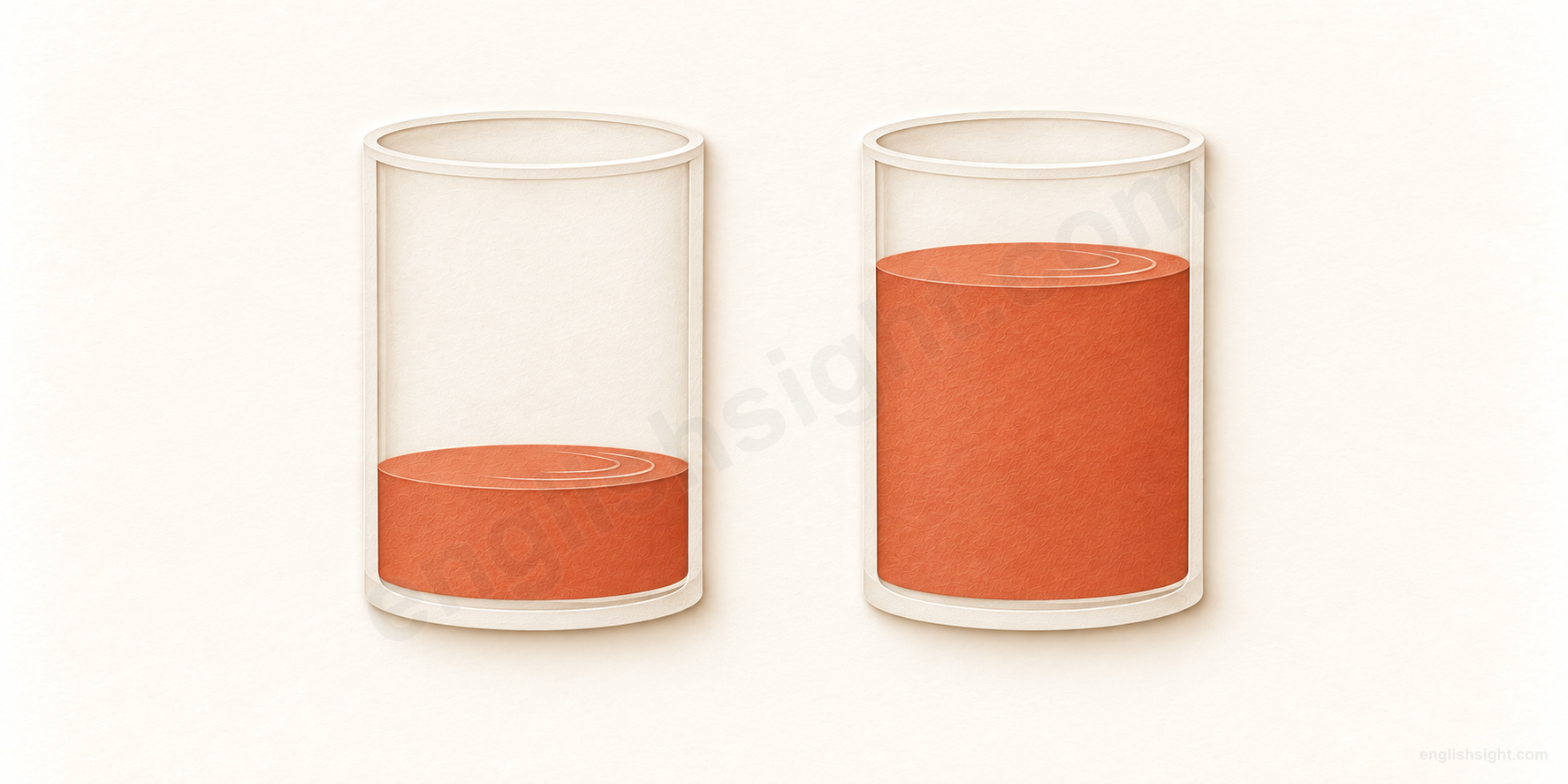
The left container holds a small amount of water.
amount
The right container holds a larger amount of water.
Compare how much each same-sized container holds.
Same-sized containers, different amounts of water.
An amount is how much of something is being considered. With amount to, we state or assess what a whole comes to in quantity, effect, or outcome.
The containers illustrate quantity, not a necessary change over time. Practical equivalence and achievement are established extensions of amount to, not literal levels of water.
You may know what something is and still need to ask how much there is. Amount brings that question into focus, from water and time to the money shown on a bill.
As a verb, amount normally appears with to: charges amount to a total, and an action can amount to a refusal. These uses connect quantity with an overall result, but familiar outcome expressions still need to be learned in context.
01
How much, how suitable, and how equal?
Talk about a quantity, describe its size, and distinguish it from a count of individual things.
01
the amount of + uncountable noun; the amount + clause
the amount of water / time / work
how much of something there is
Situation
You need to know how much water remains.
What we express
You describe the quantity of water.
Amount directs attention to how much, not to what the substance is.
Use amount of with a substance or with something treated as a quantity: water, food, time, work, information, or effort. The of-phrase names what you are measuring. The amount of water can be exact or approximate; amount does not supply a unit or a number.
The amount of time we need means how much time we need. When the subject is the singular phrase the amount of time, use a singular verb: The amount of time available is limited. The plural amounts is possible when discussing several quantities: The amounts recorded are different. Amount can also be followed directly by a clause when the quantity is understood: I was surprised by the amount she ate means I was surprised by how much she ate.
The diagram compares quantities of water. Time and effort do not have literal water levels; that visual comparison is a teaching aid, not a rule that every amount must fill a container.
In a sentence
We reduced the amount of water we use each day.
Watch the difference Say the amount of water, with of. For a direct question, How much water do we need? is simpler than asking for an amount.
02
a small / large / considerable / fair amount of + noun; small / large amounts of + noun
a small / large amount; large amounts of
describe the size of a quantity
Situation
You compare how much work two jobs require.
What we express
You say one requires a substantial quantity.
The adjective supplies the size; amount alone does not mean a lot.
A small amount of means a little; a large or huge amount of means a lot. A considerable amount of work is substantial. A fair amount of work usually suggests quite a lot, though the evaluation depends on the situation; fair here is not about justice.
Plural amounts of can emphasize quantities or repeated supplies: Small amounts of flour were added at a time. It does not turn flour into countable individual objects. In ordinary conversation, a lot of work is often a simpler alternative to a large amount of work.
In a sentence
Restoring the old table took a considerable amount of work.
Watch the difference Use a large amount or large amounts, not a large amounts. Amount can refer to a tiny quantity as well as a huge one.
03
a certain amount of + noun
a certain amount of
some, without giving a precise quantity
Situation
You can help, but cannot offer unlimited time.
What we express
You acknowledge some available time without specifying how much.
Certain can leave the quantity unspecified.
A certain amount of time can mean some time, with no exact figure given. It can suggest a limited allowance in context. With abstract nouns such as patience, freedom, or doubt, it can describe a degree of something rather than a measured physical supply.
Certain does not make the quantity large. Nor does it always mean the speaker is uncertain: We have agreed on a certain amount can refer to a particular amount known to the people involved. The surrounding sentence tells you whether it means some or a specific agreed quantity.
In a sentence
I can give you a certain amount of time, but I cannot stay all afternoon.
Watch the difference Do not interpret a certain amount as a guaranteed large supply or as an exact number stated in the sentence.
04
the right amount (of + noun)
the right amount of
the quantity suitable for a purpose
Situation
A sauce needs salt, but too much would spoil it.
What we express
You add enough for the intended taste.
Right evaluates the quantity against a need.
The right amount of salt is the amount that suits the recipe or your taste. The right amount is not necessarily the maximum. The same pattern works with time, exercise, detail, and help: suitability comes from the adjective right and the situation.
Use too much salt or not enough salt to describe the mismatch directly. Too large an amount of salt is possible, but heavier. If the substance is already clear, you can leave out the of-phrase: Add the right amount.
In a sentence
This spoon helps me add the right amount of salt.
Watch the difference The right amount describes suitability, not moral correctness or the right-hand side.
05
the same amount (of + noun) as…; equal amounts of A and B
the same amount; equal amounts of
compare or divide quantities that match
Situation
Two batches need matching quantities of flour.
What we express
Both receive the same quantity.
Equality concerns the quantity, not the identity of the material.
The same amount of flour means an equal quantity of flour. Equal amounts of flour and sugar compares two quantities of different ingredients. Use a clear measure when precision matters; equal volumes and equal weights need not give the same result.
In Add the same amount as before, as introduces the comparison. In We both paid the same amount, money is understood and the of-phrase is unnecessary. Neither sentence says the people used the very same coins or banknotes.
In a sentence
Use the same amount of flour as you used yesterday.
Watch the difference Same amount means matching quantity; it does not mean the same physical portion or the same substance.
06
amount of + mass noun; number of + plural countable noun
amount of money / number of coins
choose between a measured quantity and a count of items
Situation
You describe both money and the coins carrying it.
What we express
You choose amount for money and number for separate coins.
The noun after of determines the usual learner choice.
Money is normally uncountable, so say an amount of money. Coins is plural and countable, so a number of coins is the usual choice. Similarly, compare the amount of information with the number of messages, and the amount of time with the number of hours.
Amount with plural countable nouns does occur, especially when speakers treat things as a collection. Dictionaries differ in how strongly they object to it. For careful writing and a dependable learner pattern, choose number of people, books, or mistakes. Quantity can work with either measured material or countable items.
In a sentence
The number of coins increased, but the amount of money stayed the same.
Watch the difference Do not assume a greater number of coins always means more money; the value of each coin matters.
02
Bills, payments, and sums
When money is understood, amount can identify a sum without repeating of money.
07
pay / refund + an amount; the full amount; the amount due; to the amount of + sum
the full amount; the amount due
a sum of money, often already identified
Situation
You have paid only part of a bill.
What we express
You check the total sum and what is still owed.
Money can be understood without an of-phrase.
On a payment page, amount commonly means the sum to enter or pay. The full amount is all of the sum under discussion; the amount due is the sum owed at the stated time. After a part-payment, these can be different figures.
An amount can stand alone when money is clear: Please enter an amount. Amounts can refer to different sums: The two payments were for different amounts. In formal financial writing, to the amount of $75 specifies a sum of $75; everyday speech usually gives the figure directly.
In a sentence
The bill was $90, but after my $30 payment the amount due was $60.
Watch the difference Do not confuse the amount due with the amount already paid. Read the payment label and the date.
03
Plenty, free choice, and no effect
Any amount of and no amount of do different jobs. Their meanings depend on the complete expression.
08
there is any amount of + noun; any amount (you choose)
any amount of
a very large supply, or whatever quantity is chosen
Situation
A shop has plenty of spare fabric.
What we express
You emphasize that a large supply is available.
The established plenty meaning depends on context.
There is any amount of fabric left can mean there is plenty. This is an established emphatic use; it is not a claim that an infinite quantity exists. You can replace it with plenty of when you want a very direct expression.
In You may donate any amount, any instead allows free choice: a small or a large sum is acceptable. That does not say every donation will be large. Read the whole sentence to distinguish abundance from unrestricted choice.
In a sentence
There is any amount of spare fabric in the cupboard; take what you need.
Watch the difference Any amount does not always mean a lot. In a donation instruction, it can include a very small sum.
09
no amount of + noun / -ing activity + will / would / can / could + verb
no amount of
however much there is, it will not achieve the result
Situation
A road is closed, and complaining cannot reopen it.
What we express
You stress that even more complaining will not help.
The expression denies effectiveness, not the existence of a quantity.
No amount of complaining will reopen the road means that even a great deal of complaining will fail. The speaker may have heard many complaints already. No amount of does not simply report zero complaining.
The noun phrase is the subject, followed by a statement of what cannot be achieved. Use an uncountable noun or an -ing activity such as planning, arguing, or apologizing. Choose a different sentence for a plain absence: There were no complaints reports that nobody complained.
In a sentence
No amount of complaining will reopen the road before the repairs are finished.
Watch the difference The clause already expresses the negative idea: No amount of practice will help means practice cannot solve this problem, not that nobody practiced.
04
What does it amount to?
Use amount to for a total, an equivalent practical meaning, or an assessment of the eventual result.
10
subject + amount / amounts / amounted to + total
amount to $45
come to a stated total
Situation
A purchase has several separate charges.
What we express
You state their combined value.
The verb reports the total; to introduces that total.
The charges amount to $45 means their combined value is $45. Amount to can total money, time, or another measurable quantity. It often suits reports and calculations; add up to or come to can express the same calculation more conversationally.
The subject controls the verb: The bill amounts to $45; The charges amount to $45. Use to before the figure. This is not the noun pattern an amount of money, and it does not mean someone is actively increasing the bill.
In a sentence
The materials cost $38 and delivery cost $7, so the charges amounted to $45.
Watch the difference Say amount to $45, not amount $45 or amount of $45 when amount is the verb.
11
amount to + noun phrase / -ing clause; amount to the same thing
amount to a refusal / the same thing
have effectively the same meaning or result
Situation
Someone offers an answer that avoids a direct no.
What we express
You judge that its practical meaning is refusal.
This is an evaluation of effect, not a numerical calculation.
Amount to a refusal says a response functions as a refusal, even if the person uses different words. Amount to the same thing says two descriptions or choices have the same important result: Walking takes an hour; so does the bus journey, including the wait. For our deadline, they amount to the same thing.
To is a preposition here, so it can be followed by an -ing clause: Changing the date without asking would amount to breaking our agreement. The whole pattern expresses equivalence in practice. It does not mean amount has acquired the independent meaning break, refuse, or agree.
In a sentence
Her offer to help only after the deadline amounted to a refusal.
Watch the difference Say amount to breaking an agreement, not amount to break an agreement. The judgment concerns practical effect, not necessarily identical wording.
12
not amount to much; amount to little / nothing / little more than + noun
not amount to much; amount to nothing
be small or have little or no important result
Situation
A long meeting produces only a minor change.
What we express
You assess its limited practical value.
Much can refer to quantity or significance.
The changes do not amount to much can mean they are not substantial or important. If you are discussing a donation, not amount to much may instead mean the sum is small. Context selects quantity or significance.
Our work amounted to nothing says the effort produced no worthwhile result in the speaker’s judgment. It need not mean nobody worked or literally nothing happened. Nothing is stronger than not much. Amounted to little more than a discussion similarly judges the result as barely beyond a discussion.
In a sentence
We talked all afternoon, but the changes we agreed on did not amount to much.
Watch the difference Do not automatically interpret nothing as a zero money balance; it can judge the outcome of an effort.
13
person / project + amount to something; never / not amount to anything
amount to something / anything
develop into something successful or significant
Situation
Someone talks about a person’s future achievement.
What we express
The expression judges whether they become successful.
This established extension concerns achievement, not a person’s price.
When used about a person’s future, amount to something means achieve something worthwhile or become successful. In negative predictions, anything is usual: He said I would never amount to anything. The remark is harsh and dismissive; it is useful to recognize without treating it as a neutral description.
The expression does not measure a person’s human worth, and success is the speaker’s assessment. About a project, amount to something can similarly suggest that it develops into something significant. This outcome meaning is conventional; the water diagram cannot predict it on its own.
In a sentence
When I left school, I wanted to amount to something, though I had no clear career plan.
Watch the difference You will never amount to anything is a personal put-down. Use a specific, respectful description when discussing someone’s plans.
Keep the quantity and the grammar clear
Amount, number, and size
Use amount of water but number of bottles as a reliable learner distinction. Amount does not tell you whether the quantity is large, whether it is enough, or whether it has increased; adjectives and context supply that information.
Noun of, verb to
Compare the amount of the payment with The payment amounts to $45. The noun takes of to name what is quantified; the verb pattern uses to for a total or equivalent outcome. The complement stays after to, including a pronoun: It amounts to that, not It amounts that to.
Forms and scope
Noun: amount, plural amounts. Verb: amount, amounts, amounted, amounting; the stress is on the second syllable, /əˈmaʊnt/. Amount to is intransitive with a prepositional complement; there is no ordinary direct object to turn into a passive. Ordinary descriptions of totals usually use simple forms. Amounting to $45 can modify a noun, as in charges amounting to $45. This lesson does not expand historical upward movement, specialized accounting definitions, or unrelated words such as mount.
Choose the quantity or the effect
Use the whole sentence to decide what amount is doing.
1. You are counting separate messages, not measuring the information in them. Which is the dependable choice for careful writing?
2. A repair costs $70 and delivery costs $10. Which sentence states the total?
3. No amount of apologizing will restore the deleted files. What does this say?
4. A reply says help is available only after the deadline. It amounts to a refusal. What is being judged?
5. A charity says, You may donate any amount, even one dollar. What does any amount allow?
Sources and teaching notes
Dictionary entries support the usage distinctions below. The explanations, situations, examples, and visual model were written for this lesson. The quantity diagram is a teaching interpretation.
The diagram is a teaching aid; it does not describe a mental picture shared by every speaker.