Connect an amused feeling with the activities and attractions that can provide it.
Entertainment and the person enjoying it
From something entertaining to someone’s enjoyment
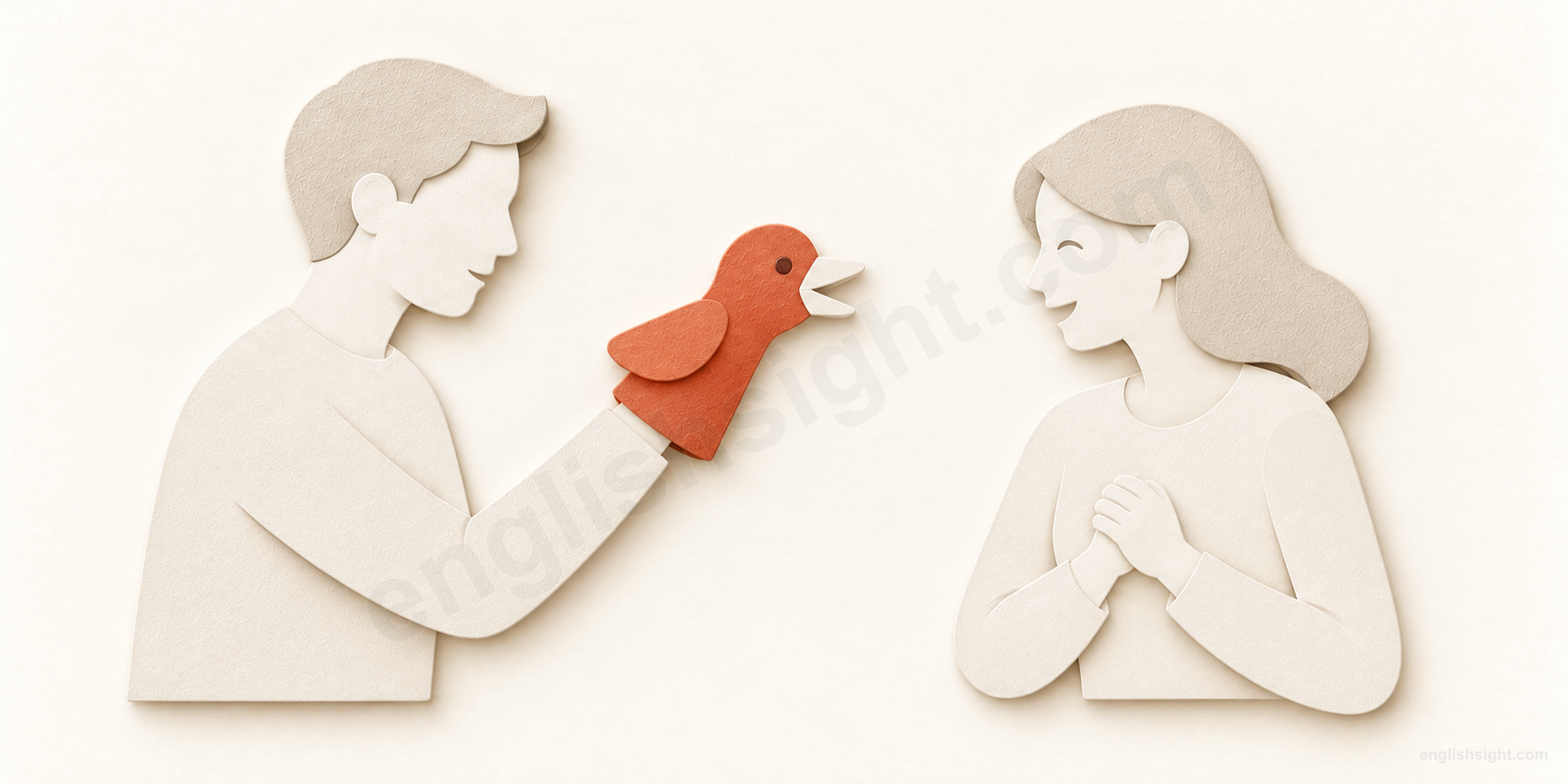
A bird hand puppet provides something entertaining.
amusement
The viewer smiles with amusement.
A puppeteer performs with the bird puppet for a viewer.
The puppet entertains; the viewer's smile shows amusement. Enjoyment need not involve comedy.
Someone finds pleasure in something funny or entertaining; amusement can name that experience or something that provides it.
The puppet example shows a source of enjoyment and a person’s response. Other amusement may be quiet or active and need not involve comedy. The sketch is a teaching model, not a universal mental image.
Amusement can be the small pleasure of finding something funny, or the enjoyment of being entertained. With a plural ending, amusements can be the activities, games, or rides themselves.
Keep track of the person enjoying something and the thing providing that enjoyment. This connection helps organize the uses, but the whole expression decides whether we mean a feeling, a purpose, an activity, or a place.
01
Finding something funny
Describe the feeling, its cause, and how it appears in someone’s reaction.
01
amusement + at + noun / -ing form
amusement at something
the feeling of finding something funny
Situation / source
A dog tries to carry a branch through a narrow gate.
Feeling / use
You find its repeated attempts funny.
The person has the feeling; at introduces what prompts it.
Amusement names the feeling, rather than the funny event itself. Amusement at his reply points to the reply as its cause. The response may be a quiet smile rather than loud laughter.
Treat this feeling as uncountable: some amusement, a little amusement, or great amusement. In We watched the dog with amusement, amusement describes how we felt; it does not count separate reactions or imply that everyone felt exactly the same way.
In a sentence
There was amusement at the dog’s attempts to squeeze through the gate.
Watch the difference For the feeling, say a feeling of amusement, not an amusement. The countable noun has a different use.
02
watch / listen + with amusement; smile / laugh + in amusement
with amusement / in amusement
react while feeling amused
Situation / source
A friend tells an exaggerated story.
Feeling / use
You smile while listening.
These prepositional phrases describe the person’s reaction.
Listen or watch with amusement describes the attitude accompanying the action. Smile or laugh in amusement connects the visible response to the feeling. Neither phrase names a place.
Compare She watched with amusement and She watched for amusement: with describes how she reacted; for gives her purpose. She could start watching for another reason and then become amused.
In a sentence
Nora listened with amusement as her brother described his disastrous haircut.
Watch the difference Do not replace with by for automatically: reaction and purpose are different.
03
(much) to + possessive + amusement, + clause
much to someone’s amusement
with the result that someone finds it funny
Situation / source
A small child imitates the teacher’s serious manner.
Feeling / use
The teacher finds the imitation funny.
To links the event to the reaction it produces in a named person.
To my amusement, the chair squeaked whenever I moved presents my reaction to what happened. Much strengthens that reaction; the phrase can come before or after the main clause.
This result construction also occurs with other emotion nouns, such as to my surprise. It does not mean that the event was arranged for my entertainment. An accidental event can produce amusement too.
In a sentence
Much to the teacher’s amusement, the child copied her serious voice.
Watch the difference Use the teacher’s amusement or her amusement; not to the teacher amusement.
04
hide / show + (possessive) amusement; a hint / note of amusement
hide / show amusement
conceal or reveal the feeling
Situation / source
An inappropriate comment makes you want to smile.
Feeling / use
You try to keep a neutral face.
Having a feeling and letting others notice it are separate.
Hiding, concealing, or suppressing your amusement means keeping the reaction from showing. Showing amusement makes it visible. A hint of amusement or a note of amusement describes a small sign in a face or voice.
Mild amusement is a weak reaction. Wry amusement adds a sense of irony, often about something awkward or disappointing. These descriptions do not require enthusiastic approval of what happened.
In a sentence
I tried to hide my amusement when the speaker’s phone played a silly tune.
Watch the difference Amusement is a feeling, not necessarily approval: a person can find a mistake funny and still want it corrected.
02
Enjoying time and providing entertainment
Amusement also concerns being pleasantly occupied. The activity need not be a joke.
05
provide / cause amusement; a source of amusement + to / for + person; get amusement from + something
provide amusement / a source of amusement
give people something enjoyable or funny
Situation / source
Friends have a long wait before their train.
Feeling / use
A guessing game keeps them entertained.
The game supplies the enjoyment; the people experience it.
Provide amusement names what the activity gives people. Cause amusement often describes something that makes people find a situation funny. A source of amusement identifies where that enjoyment comes from.
The source may be a planned game or an unintended mistake. In The game provided amusement for the children, for identifies the people entertained; it does not turn amusement into a countable object.
From the person’s side, get amusement from something describes receiving that enjoyment: The children get a lot of amusement from the guessing game. The preposition from points back to its source.
In a sentence
The guessing game provided plenty of amusement during the long wait.
Watch the difference Say plenty of amusement, not many amusement. A source is countable; the feeling or enjoyment after of is not.
06
do something + for amusement / for someone’s (own) amusement / for the amusement of + person
for amusement / for someone’s amusement
for the purpose of enjoyment or entertainment
Situation / source
You choose a light activity in your free time.
Feeling / use
You enjoy doing it without needing a practical result.
For marks purpose; a possessive can identify whose enjoyment matters.
Do something for amusement means do it to enjoy yourself. For my own amusement stresses my personal enjoyment. For the amusement of the children identifies a different audience.
I draw imaginary animals for my own amusement does not require the drawings to make me laugh. This is the broader entertainment sense. In relaxed conversation, for fun is often a simpler alternative.
Whose enjoyment matters in context: imitating a friend for everyone else’s amusement may upset the friend. The noun itself does not guarantee that an activity is kind or harmless.
In a sentence
I invent little card games for my own amusement.
Watch the difference Use for amusement to explain why you do something; use with amusement to describe an amused reaction.
07
an amusement; several / various amusements
amusements
activities that people do for enjoyment
Situation / source
Visitors have free time at a holiday camp.
Feeling / use
They choose among games and other leisure activities.
The noun now names things that entertain, rather than the enjoyment itself.
In this countable sense, an amusement is a pastime or entertainment, and amusements is usual when discussing a range of them. Several amusements means several activities, not several units of a feeling.
A favorite amusement is possible, but a favorite pastime or hobby will often fit ordinary personal conversation more easily. Do not use amusement for every kind of happiness: being pleased with a good exam result is not necessarily being entertained.
In a sentence
The camp offers several indoor amusements for rainy afternoons.
Watch the difference Many amusements counts activities. Much amusement refers to a lot of enjoyment or an amused feeling.
03
Games, rides, and places to play
The noun can name entertainments themselves and can modify the name of a place or machine.
08
plural amusements; amusement + ride / machine
seaside amusements / amusement rides
games, rides, and similar attractions
Situation / source
A family walks along the seafront.
Feeling / use
They see rides and games offered to visitors.
Amusements can refer to physical attractions available for entertainment.
On a seafront or at a fair, the plural amusements can mean rides and games. This is a specific application of the countable entertainment sense, especially familiar in British descriptions of seaside attractions.
In amusement ride or amusement machine, amusement comes before another noun to specify its entertainment purpose. The final noun carries the plural: amusement rides, not amusements rides.
In a sentence
We walked past the seaside amusements without going on any rides.
Watch the difference A sign saying Amusements points to attractions; it does not mean that everyone there feels amused.
09
an amusement park; at / go to + an amusement park
amusement park
a place with rides and other activities for entertainment
Situation / source
You are planning a family day out.
Feeling / use
You choose a park with rides and games.
Park is the head noun; amusement describes the kind of park.
An amusement park offers rides, games, and other attractions. The compound is a place name category: it does not simply mean any park where someone happens to enjoy themselves.
Use at for a visit or activity there: We spent the afternoon at an amusement park. To count the places, say two amusement parks. Keep amusement singular inside the compound.
In a sentence
We spent Saturday at an amusement park outside the city.
Watch the difference A quiet public garden is not automatically an amusement park just because you enjoy it.
10
an amusement arcade; play games in / at + an amusement arcade
amusement arcade
an indoor place with game machines
Situation / source
Rain interrupts a walk beside the sea.
Feeling / use
You go indoors to play games on machines.
The compound names a particular entertainment venue.
Amusement arcade is British English for a place with game machines, traditionally operated with coins. Arcade is also used in British and North American English for this kind of venue.
An arcade need not contain the large rides associated with an amusement park. The shorter word arcade also has other meanings, so a game or holiday context helps identify this one.
In a sentence
We played a racing game in the amusement arcade while it rained.
Watch the difference Use amusement arcade for the venue and amusement machine for an individual machine.
Choose the right form and relationship
Amusement, amused, and amusing
Amusement is a noun: Her amusement was obvious. Amused describes the person’s response: She was amused by the puppet. Amusing describes what gives that pleasure: The puppet was amusing. Say I am amused, not I am amusement. These related forms help you identify the experiencer and the source.
Count the entertainments, not the feeling
Some amusement and much amusement refer to a feeling or enjoyment. Several amusements counts activities or attractions. A source of amusement counts the source. This noun has no verb tense, passive voice, or particle-verb family; related amuse is a separate verb.
Amusement is narrower than happiness
A person may be happy about a promotion without finding anything funny or seeking entertainment. Amusement fits being amused or entertained. Fun is a useful informal choice for enjoyable activities; entertainment can name what is offered to an audience. These words overlap without replacing each other in every sentence.
Enjoyment can be socially awkward
To someone’s amusement identifies their reaction, not everybody’s. If people enjoy a joke at another person’s expense, the target may be hurt or annoyed. Nothing in the noun says the feeling is shared.
Feeling, purpose, or attraction?
Use the whole sentence to decide what the noun and its surrounding words do.
1. You want to say that an unexpected noise made people find the situation funny. Which sentence uses the feeling as an uncountable noun?
2. You make up puzzles because you enjoy doing it. Which phrase explains your purpose?
3. The audience found an accidental mistake funny. Which sentence presents that result without saying the mistake was planned?
4. A holiday brochure lists amusements for rainy days. What does the plural most naturally refer to?
5. A puppet makes you smile. Which sentence describes your response with an adjective?
Sources and teaching notes
The sources below support the meanings, patterns, and word-family contrasts. Explanations, examples, and the principle sketch are original teaching material.
The image illustrates a teaching connection; people do not all imagine the word in the same way.