From a measured opening to a way of looking, presenting, or seeking.
One direction relative to another
One direction relative to another
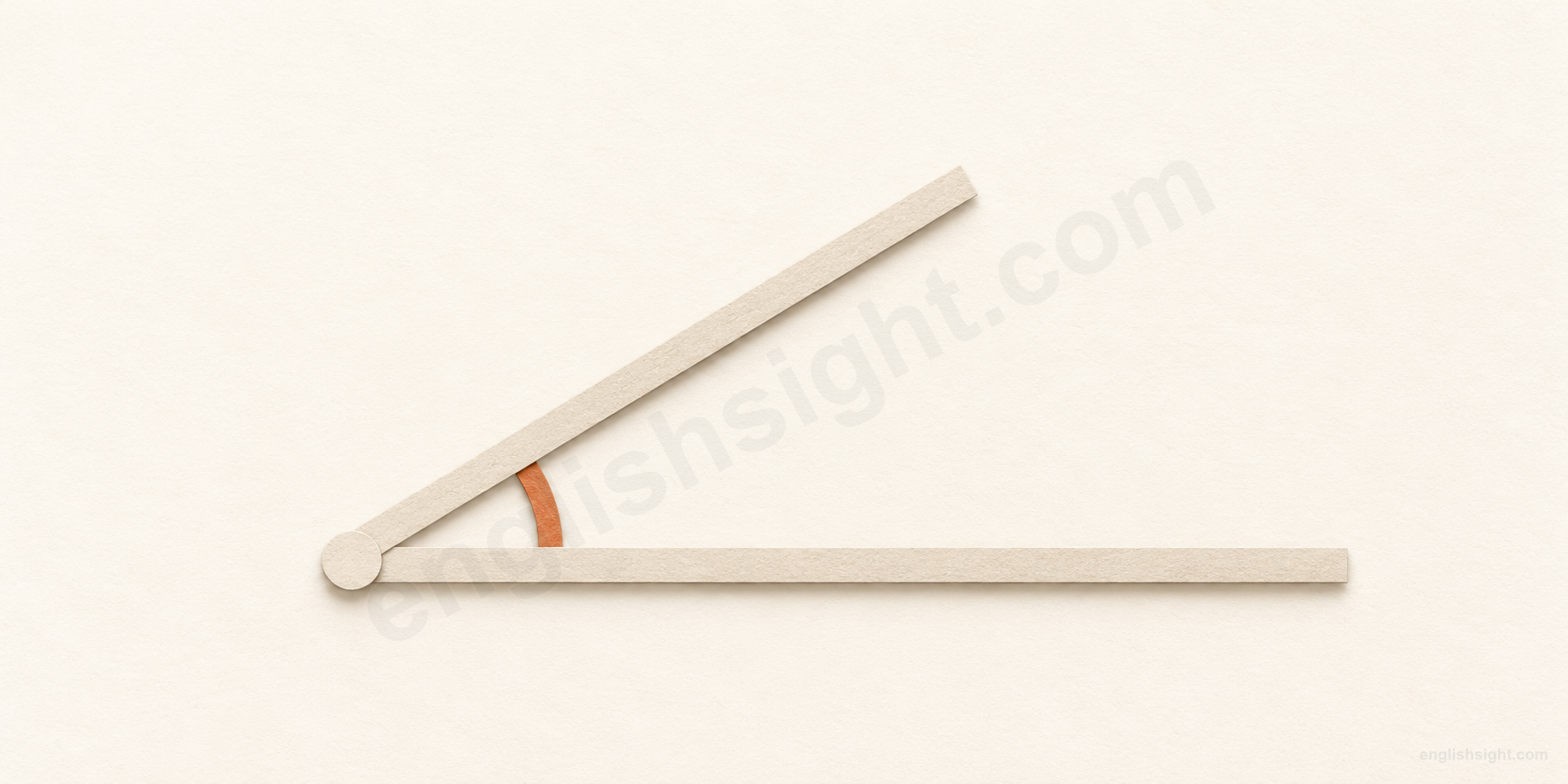
A horizontal reference direction.
angle
A second direction slopes upward from the same point.
The orange arc marks the opening between the two directions.
An angle compares directions, not arm lengths; the drawing shows a spatial relationship, not movement.
An angle describes the opening or directional relationship between two lines or surfaces; a different angle can also give a different view.
The two arms and their shared point show a relationship, not travel. Viewpoints extend this spatial idea as a teaching comparison; the indirect-seeking expression and the fishing branch must also be learned in context.
An angle relates one direction to another. You can measure the opening between two lines, notice how an object tilts, or change the direction from which you look at it.
English also uses angle for a way of considering or presenting something. Other expressions, such as What’s his angle? and angle for a compliment, need their own context. The fishing verb is a separate branch.
The diagram gives a useful teaching connection for the spatial meanings. It is not a claim that every English speaker imagines the same picture, or that every use can be predicted from it.
01
Openings, corners, and sloping positions
Begin with a relationship between directions. A number measures it, a corner gives it a shape, and a phrase can describe how something leans.
01
the angle between A and B; an angle of + number + degrees; a number-degree angle
an angle of 45 degrees
the amount of opening between directions
Starting situation
Two straight lines meet at one point.
Relationship or result
You measure how far their directions differ.
An angle measures an opening, not the length of either line.
Use angle between to identify the two lines or surfaces being compared. Two lines can form or make an angle: The two strips form an angle of 45 degrees. Draw an angle, measure an angle, and calculate an angle describe different classroom tasks; they do not create different meanings of angle.
An angle of 45 degrees and a 45-degree angle give the same measurement. In the second form, 45-degree is a modifier before the noun: degree stays singular and the written modifier normally has a hyphen.
Compare a line five centimetres long with an angle of 45 degrees. Making both arms of a drawn angle longer does not make the angle larger if their directions stay the same.
In a sentence
Measure the angle between the two lines before you cut the paper.
Watch the difference Use degrees for this measurement, not centimetres. Say a 45-degree angle, not a 45-degrees angle.
02
an acute angle; a right angle; an obtuse angle
an acute / right / obtuse angle
name common sizes of angle
Starting situation
You compare an opening with a square corner.
Relationship or result
You classify it by its size.
The adjective names a mathematical class, not a mood or an opinion.
An acute angle is greater than 0 degrees and less than 90 degrees. A right angle is exactly 90 degrees. An obtuse angle is greater than 90 degrees and less than 180 degrees.
A triangle may have a right angle. In this phrase, right does not mean correct or on your right-hand side. Likewise, acute and obtuse here describe angle size, not pain or intelligence.
A sharp angle in everyday description suggests a pointed shape, but acute angle is the precise mathematical term when the numerical range matters.
In a sentence
The drawing shows an obtuse angle of 120 degrees.
Watch the difference Exactly 90 degrees is right, not acute or obtuse; exactly 180 degrees is not obtuse.
03
sharp angles; the angles of + object
sharp angles
the pointed or recessed corners of a shape
Starting situation
Two edges of a structure come together.
Relationship or result
Their meeting creates a visible corner.
Here angle names part of the shape rather than a numerical measurement.
In a description of a building or a design, angles can be the corners made by meeting edges or surfaces. The physical meeting is closely related to the opening in the diagram.
Everyday corner is often the easier word for a room or a street location: Meet me on the corner. Do not replace every corner with angle; angle is useful when you want to draw attention to shape.
In a sentence
The new museum has sharp angles and almost no curves.
Watch the difference A street meeting place is normally a corner, not an angle.
04
at an angle; at a slight / awkward angle; at an angle to + reference
at an angle
in a sloping or tilted position
Starting situation
A picture is expected to hang level.
Relationship or result
One end is higher than the other.
At introduces orientation; the reference may be understood or named with to.
At an angle often means visibly slanted rather than level or upright. A slight angle describes a small tilt; an awkward angle suggests an inconvenient or unnatural position. A plane descending at a steep angle has a sharply sloping course relative to the horizontal.
At an angle to the wall explicitly compares the object’s direction with the wall. If you give a number, say at an angle of 30 degrees to the wall or at a 30-degree angle to the wall.
At all angles can describe things pointing in many untidy directions: After the storm, the branches stuck out at all angles. This physical phrase differs from considering a problem from all angles.
In a sentence
The frame hangs at a slight angle, so the left side is higher.
Watch the difference Use at for a sloping position. From an angle normally identifies a viewing position.
05
be / place something + at right angles to + reference; at a right angle to
at right angles to
in a perpendicular relationship to something
Starting situation
You compare the direction of a shelf with a wall.
Relationship or result
They meet at 90 degrees.
The whole phrase specifies an exact relationship between two directions.
At right angles to is a conventional plural phrase even when you describe a single object. At a right angle to is also possible.
To names the reference object, not a destination: the shelf does not move to the wall. Compare parallel to the wall, which describes a different relationship.
In a sentence
Place the short shelf at right angles to the wall.
Watch the difference Keep the full form at right angles to or at a right angle to; do not write at right angle to.
02
Seeing, thinking, and choosing a focus
A different viewing position can reveal something new. English also uses angle for an approach, a story’s focus, or, informally, a person’s private purpose.
06
see / photograph something + from + adjective + angle; camera angle; viewing angle
from a different angle
from another physical viewing position
Starting situation
You cannot see the handle clearly from the front.
Relationship or result
Moving to one side reveals it.
The object can stay still while the observer’s position changes.
From names where the view comes from. A camera angle is the direction from which a camera shows its subject; changing the camera angle can change which features are visible. Angle of vision similarly refers to the direction from which you see something.
The angle of the screen concerns its orientation, while a viewing angle concerns how it is seen. The two can affect each other, but they do not name the same relationship.
In a sentence
Try photographing the chair from a higher angle to show the seat.
Watch the difference From a different angle does not necessarily mean that the object has been turned.
07
look at / consider something + from another / all angles; an angle on + topic
look at a problem from another angle
consider a situation in a different way
Starting situation
The team has discussed only the price.
Relationship or result
You also consider the time the work will take.
The viewpoint changes figuratively; nobody needs to move.
A different angle on a problem is a different approach to it or a different aspect to examine. The spatial link is useful as a teaching comparison: a new view can bring a neglected feature into focus.
Consider it from all angles means examine its relevant sides carefully. It is a conventional way to ask for breadth, not a promise that every imaginable possibility has been checked.
Use from to introduce a viewpoint in look at it from another angle. Use on when attaching angle to its topic: a fresh angle on the problem.
In a sentence
Let’s look at the problem from another angle: how much time would each option save?
Watch the difference This angle need not be measured in degrees, and a different angle is not automatically a better answer.
08
an angle on a story; the human / financial angle; find a new angle
the human angle
the selected aspect that gives a story its focus
Starting situation
A factory closes and many facts could be reported.
Relationship or result
A writer focuses on the families affected.
The angle selects what the account emphasizes, not where the camera stands.
A news angle or an angle on a story is the approach that organizes an account. The human angle focuses on people and their experiences; a financial angle would focus on money.
The writer chooses a focus within the event. This need not mean inventing facts or deliberately misleading readers. Compare camera angle, which can be purely physical.
In a sentence
Our article explores the human angle of the factory closure through workers’ stories.
Watch the difference A story’s angle is its focus or approach; it is not the same as the story being false.
09
What’s + possessive + angle?; play (all) the angles
What’s his angle?
what private advantage or purpose is driving him?
Starting situation
Someone unexpectedly offers a generous favour.
Relationship or result
You suspect that he wants something in return.
This informal question often signals suspicion about a person’s purpose.
In What’s his angle?, angle is an informal word for a motive, often one the person has not openly stated. It asks what advantage he hopes to gain, not which direction he is facing.
The American expression play the angles or play all the angles means use the available ways of reaching a goal. It can suggest strategic self-interest: He plays all the angles to get his proposal accepted.
Compare looking at a proposal from all angles, which describes careful consideration. Playing the angles describes acting to obtain an outcome. Learn the whole idiom; geometry alone does not supply it.
In a sentence
He never offers free help. What’s his angle this time?
Watch the difference This can sound distrustful. What does he hope to achieve? is a more neutral question.
03
Adjusting, directing, and seeking
The verb can set a physical direction or shape a presentation. Learn angle for and the fishing use separately rather than guessing them from geometry.
10
angle + object + towards / toward / away from / up / down; be angled + direction
angle the lamp towards the page
adjust an object so it points or slopes in a chosen direction
Starting situation
The lamp points away from your work.
Relationship or result
You turn its head so it lights the page.
The subject adjusts an object; the following phrase states its direction.
In angle the lamp, the lamp is the object being positioned. Towards the page supplies the intended direction. Angle does not itself say whether the turn is up, down, left, or right.
Angle the screen away from the window aims it differently to reduce reflections. A passive is natural too: The screen was angled away from the window. Angled can also describe the resulting position, as in an angled mirror.
Angle often draws attention to a sloping or deliberately chosen orientation; turn is a broader verb and does not always highlight that relationship.
In a sentence
Angle the lamp towards the page so you can read the small print.
Watch the difference For physical positioning say angle it towards me, not angle for me; angle for has another established use.
11
path / road + angle(s) + left / right / downhill / towards + place
the path angles to the left
a route goes or turns in a slanting direction
Starting situation
You follow a route past a gate.
Relationship or result
Its course then turns diagonally left.
Here the path is the subject and there is no object being adjusted.
The path angles left describes the shape or direction of the route. The path need not physically move; the sentence guides your attention along it.
A phrase such as angles downhill adds the slope. Contrast We angled the sign towards the path: that transitive sentence describes someone positioning an object.
In a sentence
Beyond the gate, the path angles to the left towards the pond.
Watch the difference The path angles left is intransitive; do not add an unnecessary object after angles.
12
angle + report / programme + towards / toward + audience; be angled towards + audience
angle a report towards an audience
shape a presentation for a particular viewpoint or audience
Starting situation
A science report could serve several kinds of reader.
Relationship or result
The writer chooses explanations for beginners.
The object is information being presented, not a physical thing being tilted.
Angle an article towards a particular audience means choose its emphasis and presentation with those readers in mind. In the passive, a programme can be angled towards younger viewers.
This is especially useful when discussing media or editorial choices. It may be neutral audience adaptation; context can also suggest a slanted presentation. The verb alone does not prove that facts are false.
Towards and toward are both standard. Compare angle for a younger audience: without the report as object, that can suggest trying to attract an audience rather than describing how the report is presented.
In a sentence
The editor angled the science report towards readers with no technical background.
Watch the difference In this pattern the report is the object and the audience follows towards; it is not the hinting pattern angle for.
13
angle for + desired thing; be angling for + reaction / opportunity
angle for a compliment
try to get something indirectly
Starting situation
Someone describes their effort and waits for a reaction.
Relationship or result
You think they hope to receive praise.
For introduces the desired response or advantage, not a physical direction.
Angle for commonly describes indirect attempts to obtain praise, sympathy, an invitation, or an advantage. It is often used in the progressive because the attempt is in progress.
The expression can carry mild criticism or suspicion: the speaker thinks the person is hinting rather than asking openly. An attempt need not succeed.
Keep the desired thing after for, including a pronoun: She was angling for it. This is not the separable pattern angle it for. In a sentence about actual fish, angling for trout can instead have the literal fishing meaning.
In a sentence
“I spent hours on this cake,” he said, clearly angling for a compliment.
Watch the difference It describes an indirect attempt, not proof that praise was given. Do not interpret for as the direction of a tilt.
14
go angling; angle for + kind of fish
go angling
fish using a hook and line
Starting situation
You plan a fishing trip beside a river.
Relationship or result
You spend time fishing with a line and hook.
This is a separate fishing branch, not a lesson about degrees.
Go angling names the activity of fishing with a line and hook. The word can name the pastime even when no fish is caught.
Fishing is the broader everyday word. Angling is useful for the particular pastime; the noun angler means someone who does it. In go angling, the -ing form names the activity after go.
Dictionary histories distinguish this fishing verb’s origin from the noun meaning a geometric angle. Do not invent a rule that people fish because the rod makes an angle.
In a sentence
We went angling by the river, but we did not catch anything.
Watch the difference Go angling describes the activity, not successful catching. Angling for a compliment is figurative and has no actual fish.
Read the relationship and the whole expression
Angle and angel
Angle /ˈæŋɡl/ has the g sound heard in get. Angel /ˈeɪndʒl/ has a different first vowel and the consonant sound heard in jump. A geometric angle and an angel are different words; check the letter order.
At, from, to, and for
At an angle gives a position. From an angle gives a viewpoint. At an angle to the wall names a reference. Angle for a response names what someone hopes to obtain. These prepositions do different jobs.
Nouns and verb forms
The ordinary noun is countable: an angle, two angles. Verb forms are angle, angles, angled, angling; drop the final e before -ing. Physical and editorial objects allow a passive, such as The mirror was angled down. The route and fishing uses are intransitive.
What the lesson covers
These are common modern uses and selected related expressions, not a frequency ranking or a complete geometry course. Specialist angle tools, advanced geometry, astrology, the archaic fishing-hook noun, and the historical people called the Angles are outside the lesson.
Choose the angle that fits
Use the scene and the complete pattern to decide.
1. You extend both arms of a drawn angle without changing their directions. What happens to its size?
2. A shelf must form exactly 90 degrees with a wall. Which instruction fits?
3. Nobody moves, but the team stops discussing cost and starts discussing time saved. Which sentence fits?
4. A colleague keeps mentioning their excellent work, hoping you will praise them. What are they doing?
5. Someone offers unexpected help and you suspect they want a favour in return. What does What’s their angle? ask?
6. We went angling, but caught nothing. Is this contradictory?
Sources and teaching notes
Dictionary uses were checked against Oxford and Collins. Explanations and examples are original; the connection between spatial direction and viewpoint is a teaching model, not a rule that generates every expression.
The diagram is a teaching aid, not a shared mental picture attributed to all speakers.