Name living creatures, then use context to read the wider connections.
A category with context-dependent boundaries
A creature category whose range depends on context
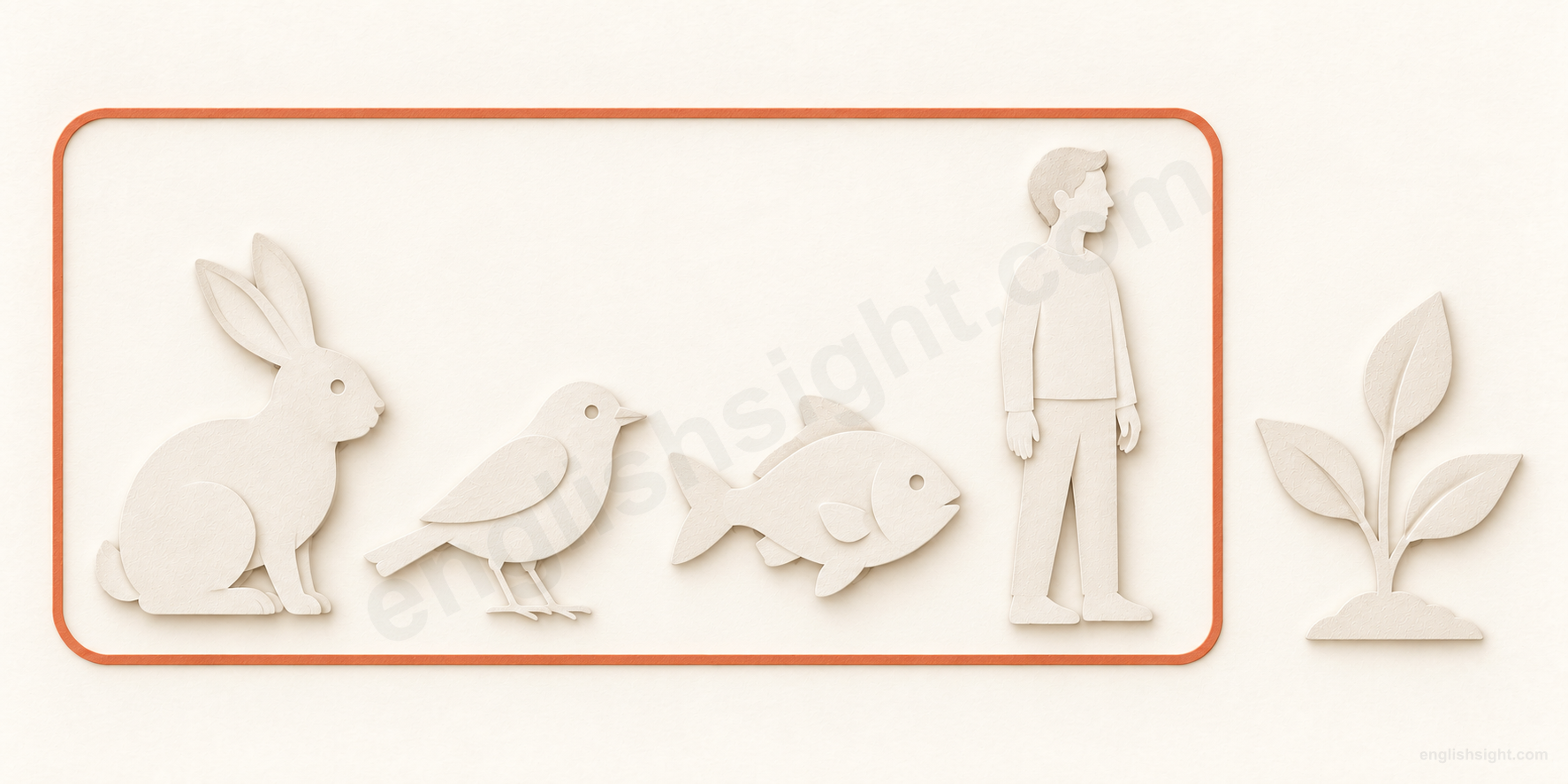
A rabbit, a bird, a fish, and a person have different body forms.
animal
The plant remains outside that group.
In biology, they belong to one animal group.
In biology, all four are animals; the plant is not.
Animal names a living creature; context determines which creatures the speaker includes.
The sketch uses the broad biological category: people, birds, and fish are animals too. Everyday speech may contrast humans and animals or animals and birds. A category does not become a physical movement, and it cannot predict fixed expressions.
Animal can name a rabbit near a fence, the broad biological group that includes people, or a person’s type in an informal expression. Begin with the creature category, then read the whole combination.
The diagram shows the broad biological use. It is a teaching model for classification, not a claim that every English speaker imagines the same picture. Everyday contrasts and established expressions need their own explanations.
01
Which living creatures?
Start with the countable noun. Its range depends on whether you are speaking generally, contrasting groups, or discussing biology.
01
an animal; two animals; animals + plural verb
an animal / animals
a living creature, with a range supplied by context
Situation / context
You see a creature near the fence.
What you mean
You identify it as an animal without naming its species.
Animal names a category, not just one species.
A rabbit is an animal. Use an for one unspecified animal and animals for more than one. Animals need food makes a general statement; the animals need food refers to an identifiable group.
In everyday talk, animal often excludes people. A speaker may also separate animals from birds, fish, or insects, especially when discussing mammals. In animals and birds, the contrast narrows animals; it does not establish a biological rule.
Creature is another general word for a living being. Pet adds a relationship with people: a pet is kept for companionship, so animal and pet are not interchangeable.
In a sentence
An animal moved behind the fence, but I could not see what it was.
Watch the difference Say an animal, not a animal; the plural is animals, not animal.
02
the animal kingdom; a kind of animal; humans are animals
the animal kingdom / humans are animals
the broad biological group that includes humans
Situation / context
A lesson compares different living things.
What you mean
Birds, fish, insects, and humans are included in the animal group.
Biological animal includes people and many creatures without four legs.
In biology, humans, birds, fish, and insects are animals. Animal does not mean only a furry creature with four legs. Plants belong to a different group.
The animal kingdom names the group as a whole. In Humans are animals, animals is plural because it classifies humans. There is no contradiction between that scientific statement and the everyday contrast humans and animals: the context changes the range.
In a sentence
Our biology lesson compares insects with other animals.
Watch the difference Do not use an everyday contrast as evidence that birds or people are biologically outside the animal group.
03
wild / domestic / farm + animal(s); a pack animal
wild / domestic / farm animals
describe an animal’s relationship to human life
Situation / context
You need to say more than the creature’s name.
What you mean
A modifier identifies how or where it lives, or its role.
The modifier supplies the kind; animal stays the category.
Wild animals are not domesticated, although a wild species can be kept in captivity. Domestic animals are kinds bred over generations to live with or be used by people, such as dogs and cattle. Farm animals are kept on farms. These labels can overlap: a cow can be both a domestic animal and a farm animal.
A pet is an animal kept as a companion. A farm animal is not automatically a pet. A pack animal carries loads; in that expression pack refers to a load, not necessarily to a group of animals.
Other useful descriptions include a dangerous animal, an injured animal, an endangered animal, and a marine animal. Each adjective adds information; it does not create a new meaning of animal.
In a sentence
The children learned how to care for the farm animals.
Watch the difference Domestic does not mean that every individual animal is safe to approach; it describes the kind’s relationship with people.
04
a social animal; social animals
a social animal
an animal that naturally lives in a group
Situation / context
A species lives with others of its kind.
What you mean
You describe group living as a characteristic.
Social supplies the group-living meaning.
In a nature discussion, social animals live naturally in groups. Animal is literal here; social describes how the creatures live.
Humans are social animals can describe our tendency to live with others. It need not mean that every person enjoys noisy parties. A party animal, by contrast, is an informal description of someone’s enthusiasm for parties.
In a sentence
The guide explained that wolves are social animals.
Watch the difference A social animal is not necessarily a tame animal or an animal that likes human attention.
02
Things connected with animals
Before another noun, animal can identify a source, a recipient, a subject of study, or a concern. Read the second noun to find the relationship.
05
animal + product(s) / fat / protein
animal products / animal fat
things or substances that come from animals
Situation / context
You compare the sources of ingredients or materials.
What you mean
You distinguish an animal source from a plant source.
Animal identifies origin; products or fat names what comes from it.
Animal products come from animals; milk and eggs are examples. Animal fat contrasts with plant or vegetable fat. The connection is source, not resemblance.
Write animal products even when the products come from many animals. Here animal modifies products; products carries the plural ending. Animals’ products has a possessive structure and is not the usual general category label.
In a sentence
This recipe uses plant oil instead of animal fat.
Watch the difference Animal products does not mean products intended for animals; animal feed has that different relationship.
06
animal + feed / behavior / shelter / lover
animal feed / animal behavior
food for animals or behavior shown by animals
Situation / context
You read a label or a study title.
What you mean
The following noun tells you how animals are involved.
Animal + noun does not always mean made from animals.
Animal feed is food intended for animals. A bag of grain can be animal feed even though grain comes from plants. Compare animal products, which identifies an animal source.
Animal behavior, also spelled animal behaviour in British English, means how animals act. An animal shelter provides a place of care for animals, and an animal lover is a person who loves animals. Read the complete combination instead of assigning the same relationship to every animal + noun.
In these category labels, animal normally stays singular: animal shelters and animal lovers. To discuss the actions of particular creatures, the animals’ behavior is a possessive alternative.
In a sentence
We keep the animal feed in a dry shed.
Watch the difference Do not assume animal feed contains meat. The expression tells you who eats it, not its ingredients.
07
animal welfare; animal rights; cruelty to animals
animal welfare / animal rights
animals’ well-being and claims about their treatment
Situation / context
People discuss how animals are kept and treated.
What you mean
They identify a concern about care or rights.
Welfare focuses on well-being; rights focuses on what animals should be entitled to.
Animal welfare concerns animals’ health and well-being. Animal rights concerns their entitlement to good treatment and protection from exploitation. The expressions are related, but they put the emphasis in different places.
Cruelty to animals names harmful treatment. Use to after cruelty in that expression: The group campaigns against cruelty to animals. An animal rights campaigner is a person who campaigns for animal rights; the plural rights remains inside the longer phrase.
In a sentence
The charity works to improve animal welfare on farms.
Watch the difference Use animal rights, not animals right, for the general cause. These vocabulary labels do not specify a country’s laws.
08
test + something + on animals; be tested on animals; animal testing
test something on animals
use animals as subjects in a test
Situation / context
A description explains how a product was tested.
What you mean
Animals are identified as the test subjects.
On marks the test subjects; it does not mean on top of them.
Test a product on animals and carry out experiments on animals identify animals as subjects of testing or research. Animal testing is the activity label; laboratory animals are animals kept or used in a laboratory.
The product was tested on animals is passive: the product is the grammatical subject, but animals are still the test subjects. In a hypothetical label, This soap was not tested on animals denies that testing method; it does not itself describe the soap’s ingredients.
In a sentence
The label says this shampoo was not tested on animals.
Watch the difference Do not confuse not tested on animals with contains no animal products; testing and ingredients are different claims.
09
put + animal + out of its misery; put somebody out of their misery
put an animal out of its misery
end an incurably ill or injured animal’s life to stop suffering
Situation / context
A story describes an animal suffering from an untreatable condition.
What you mean
The expression refers to ending its life.
The whole expression carries a serious meaning in an animal-care context.
Put an animal out of its misery is an established expression for killing it to end suffering from an illness or injury that cannot be treated. It does not merely mean comforting or feeding it.
A different conversational use is Put me out of my misery—tell me the result. There, someone asks for information to end anxious waiting; it is not a literal request to die. The situation and the object determine the interpretation.
In a sentence
The novel says the injured horse was put out of its misery.
Watch the difference This is a fixed expression with put. Its meaning is not a special verb sense of animal.
03
An animal’s shape or pattern
Some combinations name objects that resemble animals. They do not necessarily contain anything taken from a real animal.
10
a stuffed animal; stuffed animals; a soft toy
a stuffed animal
a soft toy shaped like an animal
Situation / context
A child packs a favorite toy.
What you mean
You identify an animal-shaped object rather than a living creature.
The full combination can name a representation of an animal.
A stuffed animal commonly means a soft animal-shaped toy, especially in North American English. British English usually calls that a soft toy. The toy need not contain any material from a real animal.
In a museum context, a stuffed animal can instead be a dead animal preserved for display. The bed, the child, or the display case helps you choose the meaning. Compare a live animal, which is alive, with a toy animal, which represents one.
In a sentence
Maya put her stuffed animal beside her pillow.
Watch the difference Stuffed does not always mean a toy: a museum’s stuffed animal may be a preserved specimen.
11
animal print; an animal-print + clothing noun
animal print
a design resembling an animal’s skin or fur pattern
Situation / context
You describe spots or stripes on fabric.
What you mean
You identify a pattern rather than the fabric’s source.
Print names a visual design; animal tells you what it resembles.
In clothing and decoration, animal print can resemble markings such as leopard spots or zebra stripes. The expression describes appearance.
An animal-print scarf can be made from cotton or another fabric. Saying animal print does not establish that real fur or skin was used. Use the material description to find out what an item is made of.
In a sentence
She chose an animal-print scarf with dark spots.
Watch the difference Animal print and animal skin identify different things: a design and a material.
04
Bodies, behavior, and interests
Human uses can emphasize instinct, criticize behavior, or describe an enthusiasm. The surrounding words and tone make these meanings different.
12
animal + instinct(s) / desire(s) / panic; the animal in + someone
animal instincts / animal desires / the animal in someone
basic bodily drives rather than reflective thought
Situation / context
A description emphasizes an immediate bodily reaction.
What you mean
The writer presents instinct or physical desire as dominant.
Animal can emphasize the physical side of human experience.
In animal instincts, animal desires, or animal panic, the adjective emphasizes basic physical drives or reactions. In a story, animal panic suggests a raw urge to escape rather than a carefully considered plan.
This is different from the neutral noun in Humans are animals. The adjective selects a bodily or instinctive aspect. It can sound vivid or judgmental, so physical needs is often a more neutral phrase for an ordinary practical discussion.
The noun can also name this side of a person: the animal in someone means their instinctive or nonrational nature. For example, The story explores the animal in its main character refers to that character’s bodily drives, not to a separate creature inside them. This use is more typical of reflective or literary description than everyday conversation. It need not be the direct insult You are an animal.
In a sentence
The sudden crash filled him with animal panic.
Watch the difference The adjective comes before a noun: animal instincts. The animal in someone is a noun construction for an aspect of human nature; calling someone an animal directly may be an insult.
13
have + animal magnetism; somebody’s animal magnetism
animal magnetism
a strong physical or sexual attraction
Situation / context
A review describes a performer’s appeal.
What you mean
It emphasizes physical presence and attraction.
This established metaphor concerns human attraction, not literal magnets.
Animal magnetism describes a person’s strong physical or sexual attractiveness. It can appear in reviews or be used playfully. It is not simply another name for kindness or popularity.
Magnetism supplies the attraction metaphor; animal emphasizes the physical aspect. Learn the combination as a unit rather than predicting it from the diagram. The old historical use connected with hypnotism is outside this lesson.
In a sentence
The reviewer praised the actor’s animal magnetism.
Watch the difference This expression can sound personal or sexual; charisma is a broader description of someone’s appeal.
14
be an animal; behave like animals; treat somebody like an animal
an animal / treat someone like an animal
criticize brutal behavior or degrading treatment
Situation / context
You describe either someone’s conduct or how others treat them.
What you mean
The grammar identifies who receives the criticism.
Calling someone an animal differs from saying they were treated like one.
Calling a person an animal can strongly condemn cruel, disgusting, or uncontrolled behavior. It is an insulting comparison, not a neutral biological classification.
The prisoners were treated like animals criticizes the treatment: people were denied care or dignity. It does not say the prisoners behaved badly. Compare They behaved like animals, where the criticism falls on their behavior.
Party animal is a different established expression and need not be an insult. The noun alone does not supply the friendly or playful meaning of that longer phrase.
In a sentence
The report says the workers were treated like animals.
Watch the difference Do not assume were treated like animals blames the people receiving that treatment.
15
be a party animal; a political animal
a party animal / a political animal
a person strongly associated with an interest or activity
Situation / context
Someone regularly seeks out a particular activity.
What you mean
You characterize their interests or natural inclination.
A modifier turns animal into an informal description of a person’s type.
A party animal enjoys parties and an active social life, often including late nights. It can be playful: I’m not a party animal, but I enjoy a small birthday dinner. It does not imply cruelty.
A political animal is strongly interested or involved in politics, or naturally suited to that world. It does not identify a particular political opinion. The modifier names the field; animal informally presents the person as a recognizable type.
Keep the countable pattern: a party animal, two party animals. Do not assume any hobby can be freely placed before animal and sound equally natural; learn established combinations.
In a sentence
Jon is a party animal, but his sister prefers quiet evenings.
Watch the difference Someone who goes to one party is not automatically a party animal; the phrase describes a tendency.
05
A kind of person or thing
In informal comparisons and fixed expressions, animal can mean a kind of entity rather than a living creature.
16
be a different animal (from…); be another animal altogether
a different animal
a substantially different kind of person or thing
Situation / context
You compare two activities that seem related.
What you mean
You stress that they work differently.
Animal informally means a kind of entity, not a literal creature.
Running a café is a different animal from cooking at home means the two activities have substantially different demands. It does not say that one activity has become alive.
The comparison can concern a person, organization, project, or situation. Different supplies the contrast. You may also hear an entirely different animal or another animal altogether. These are informal ways to emphasize a difference in kind.
In a sentence
Teaching online is a different animal from teaching in a classroom.
Watch the difference Different animal does not necessarily mean better or worse; the context supplies any evaluation.
17
there is no such animal; no such animal exists
there is no such animal
no person or thing of that kind exists
Situation / context
Someone describes an unrealistic ideal.
What you mean
You deny that anything matches the description.
The fixed expression uses animal to mean an entity of the proposed kind.
There is no such animal can informally reject the existence of the person or thing just described. The reference might be a perfectly effortless job, not a literal species.
For a person, She wants a colleague who is always available and never needs help; there is no such animal rejects that ideal. For a thing, animal has the informal entity meaning also found in a different animal. No such supplies the nonexistence; animal does not itself mean impossible.
In a sentence
A job with no work and unlimited pay? There is no such animal.
Watch the difference Use no such animal without an article after such; not no such an animal.
Read the category, construction, and tone
A noun and a modifier
The countable noun has the plural animals. Before another noun, animal usually remains singular: animal products, animal shelters. Dictionaries may label these relational uses as an adjective or treat animal as a noun modifier; both analyses point to the same practical pattern.
Context sets the boundary
Humans are animals uses biological classification. Humans and animals makes an everyday contrast. Animals and birds can narrow animal further. Do not turn a context-specific contrast into a universal definition.
Biology is not an insult
A biology teacher can classify people as animals without criticizing them. Calling a particular person an animal in an argument can be deeply insulting. The construction and situation matter.
No verb family to invent
This lesson covers the modern noun and adjective or noun-modifier uses. Ordinary passive and tense patterns belong to verbs such as test, treat, and put. Animal has no everyday phrasal-verb family to learn here.
Choose the relationship
Read the full expression and decide how animal is being used.
1. A biology teacher says that a bird, a fish, and a person all belong to one broad group. Which sentence fits?
2. A farm buys grain for its cows. Which label describes the grain’s purpose?
3. A report says the workers were treated like animals. What is being criticized?
4. A child takes a stuffed animal to bed. What is the likely reference?
5. Someone says that managing a café is a different animal from cooking at home. What do they mean?
6. An employer who grants every request and never expects any work? There is no such animal. What does the reply express?
Sources and teaching notes
The sources below support the uses and distinctions. Explanations and examples are original; the category diagram is a teaching aid. Some linked collocation pages provide usage examples rather than separate definitions.
The diagram illustrates biological grouping; it does not represent a picture shared by all speakers.