Name an ant, describe its community, and recognize a restless-person idiom.
An individual in a shared life
An individual in a shared life
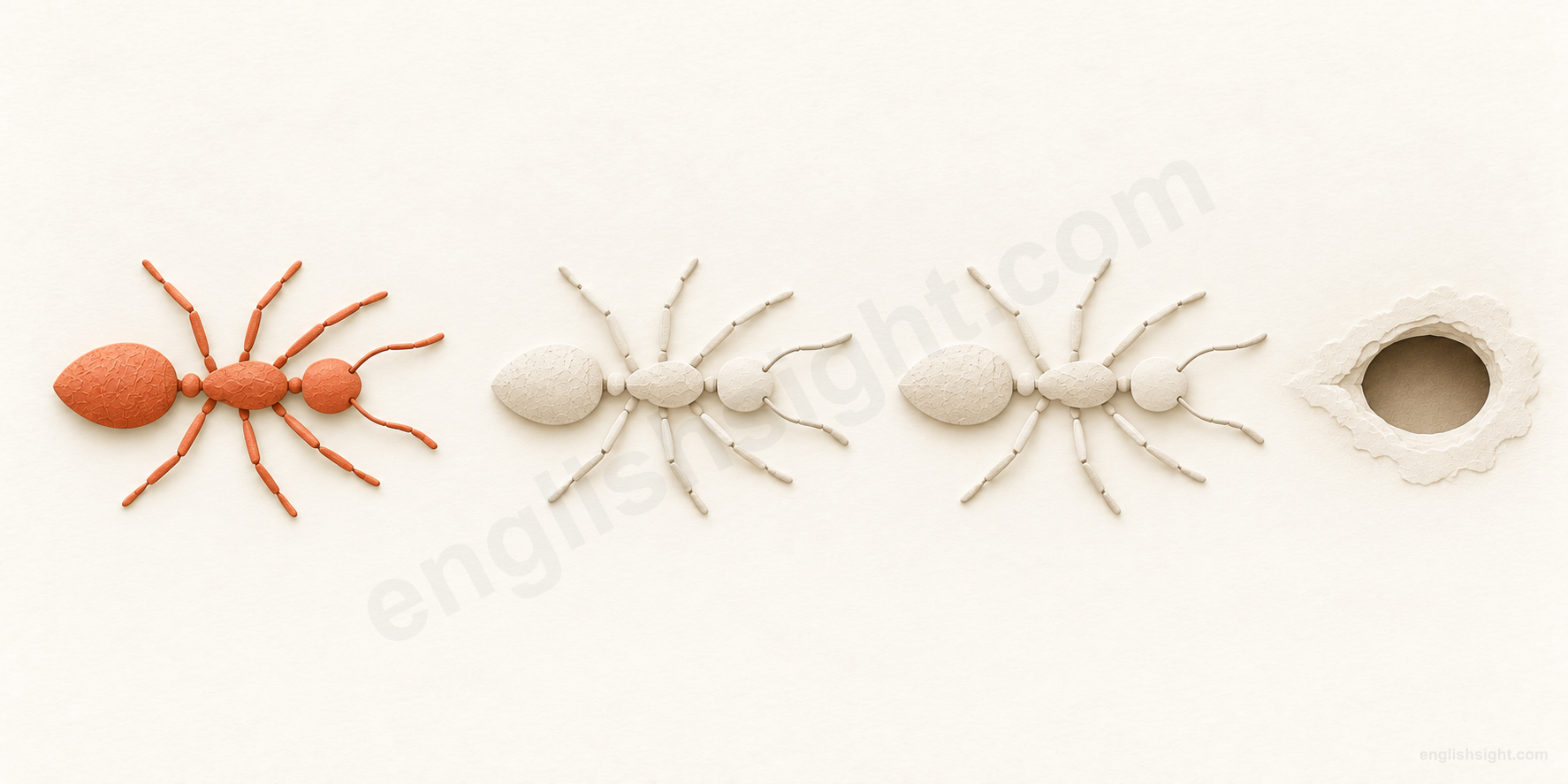
One ant is highlighted in terracotta.
ant
One nest entrance represents their shared home.
Two other ants share the same setting.
An ant is one insect; a colony is its community, and a nest is its home. These are three individuals together, not one ant turning into many.
An ant is a small insect that lives as part of an organized community called a colony.
This picture joins the individual insect to colony life. It is a teaching scene, not a universal mental image or a rule that predicts every animal name and idiom.
Ant usually names a particular insect. Most combinations in this lesson keep that meaning: another word tells you its role, its home, or the kind of problem it causes.
Keep the individual and the group distinct. Ant is the animal; colony is its community. The idiom have ants in your pants is a separate established expression, rather than a rule for inventing new meanings.
01
An individual and a household visitor
Ant is a countable noun. Start by identifying the insect, then use ordinary sentence patterns to say where ants are or describe a problem.
01
an ant; number + ants; ants + plural verb
an ant / ants
one insect or several insects
Starting situation
You notice a small insect on the picnic cloth.
What you communicate
You identify it and say where it is.
Ant names the insect; the article and plural ending show number.
An ant is a small insect that lives in a colony. Ant is countable: an ant, two ants, many ants. Use an before the vowel sound in ant /ænt/. With an adjective, choose the article for the next sound: a small ant.
There is an ant on your sleeve points out one insect. There are ants on your sleeve points out more than one. Ants live in colonies uses the plural without an article to talk about ants generally.
In An ant is crawling across the cloth, crawling describes its movement. It is not a special meaning of ant. Insect is the broader category; ant names a particular kind of insect.
In a sentence
There is an ant on the picnic cloth.
Watch the difference Use an ant for one unspecified insect, and ants are for several. Ant is a noun here, not a verb meaning crawl.
02
have ants in + place; there are ants + place; an ant infestation
have ants in the kitchen
report ants in a place, possibly as a problem
Starting situation
You find several ants near the kitchen sink.
What you communicate
You tell someone that ants are present there.
Have reports a situation; ant infestation describes a larger unwanted problem.
We have ants in the kitchen means ants are present in our kitchen. Have does not suggest that we deliberately keep them as pets. There are ants in the kitchen states their presence more directly.
An ant infestation describes large numbers of unwanted ants in a place. Finding a single ant does not by itself establish an infestation. In this noun combination, ant identifies the kind of infestation; the final noun carries the article and plural: an ant infestation, two ant infestations.
Get rid of the ants means remove the unwanted ants. The removal meaning comes from get rid of, not from ant or from a new phrasal verb built on ant.
In a sentence
We have ants in the kitchen again.
Watch the difference Say an ant infestation, not an ants infestation. This lesson explains the language, rather than choosing a pest-control treatment.
02
The group, its home, and its members
Colony names the community; nest names its home. Other nouns describe particular roles or kinds. These combinations usually keep the ordinary insect meaning of ant.
03
an ant colony; a colony of ants; ant colonies
an ant colony / a colony of ants
a community of ants living together
Starting situation
You watch several ants associated with the same home.
What you communicate
You talk about their community as one group.
Colony names the group; ant identifies its members.
An ant colony and a colony of ants both refer to an organized community of ants. This develops the shared-life part of the core picture: an individual ant is one member of the group.
In ant colony, ant is a noun used before another noun. It normally stays singular even though a colony contains many ants. In a colony of ants, ants is plural because it names the many members.
The colony and its nest are related but distinct: the colony is the community, while the nest is the place it inhabits. A line of ants describes their visible arrangement, not necessarily the whole colony.
In a sentence
A colony of ants lives beneath the old stone.
Watch the difference Keep ant singular before colony and plural after of: an ant colony, a colony of ants.
04
an ant nest; an ants’ nest; an anthill; an ant farm
an ant nest / an ants’ nest
the place where ants live
Starting situation
Ants disappear into a small opening in the soil.
What you communicate
You describe their home rather than the insects themselves.
Nest names the home; an anthill is a mound associated with nesting.
An ant nest and an ants’ nest can both name the home. In the first, ant modifies nest as a noun. In the second, ants’ is a plural possessive: the nest of the ants. The apostrophe follows the plural s.
An anthill is a mound made as ants dig their nest. It is not a word for a single ant or for the colony itself. Ant nest is the more general phrase when you mean their home without focusing on a mound.
An ant farm is a container or habitat used to keep and watch ants, including their nest-building activity. It is an artificial setting, not an agricultural field. The habitat manual listed in the sources illustrates that object; its old care instructions are not advice for this lesson.
In a sentence
The ants’ nest is under the paving stones.
Watch the difference A colony is the group; a nest is its home. The spelling ants’ marks a plural possessive, while ant nest needs no apostrophe.
05
a worker ant / a queen ant; worker ants / queen ants; a flying ant
a worker ant / a queen ant
an ant described by its role in the colony
Starting situation
You read about different members of a colony.
What you communicate
You distinguish workers from queens.
The first noun specifies a role; the head noun ant still identifies the animal.
A worker ant and a queen ant are both ants. Worker and queen identify different roles within colony life. These are not separate metaphorical meanings of ant.
Workers are female ants that perform colony tasks. Queens are reproductive females. Do not read queen as a claim that the ant gives spoken orders like a human ruler.
Pluralize the head noun: worker ants and queen ants. A flying ant describes an ant with wings; it does not automatically name a separate species. Some ants have wings, so wingless is not part of a definition that covers every ant.
In a sentence
Worker ants are moving around the entrance.
Watch the difference Use worker ants, not workers ant. Role labels and the description flying do not all classify ants in the same way.
06
a fire ant; fire ants; adjective + ant; white ant = termite
a fire ant / a red ant
identify a named kind or describe its appearance
Starting situation
Someone gives you a name or a color description for an ant.
What you communicate
You distinguish a fixed animal name from an ordinary description.
A named kind is not always predictable from its separate words.
A fire ant is a kind of ant known for a painful sting. Fire belongs to the established name: it does not mean that the insect is burning. The plural is fire ants.
A red ant can simply be an ant described as red. That description alone does not identify it as a fire ant. Similarly, small in a small ant describes its size rather than creating a new sense of ant.
White ant is an established name for a termite, which is a different insect. Learn that name as an exception: an animal name containing ant does not always refer to a true ant. Termite is the clearer word when that is the animal you mean.
In a sentence
The book has a photograph of a fire ant.
Watch the difference Do not identify a fire ant from the word red alone, or assume that white ant means any pale-colored ant.
03
Restless people: an established idiom
The familiar expression about ants in someone’s pants describes a person’s restlessness. Learn its meaning and tone as a whole.
07
subject + have / has + ants in + matching possessive + pants
have ants in your pants
be restless or impatient and unable to keep still
Starting situation
A child keeps moving while waiting for an outing.
What you communicate
Someone playfully describes the child’s restlessness.
The whole idiom describes a person, without asserting that insects are present.
Have ants in your pants is an informal expression for being restless, excited, or impatient to act. Imagine how hard it would be to sit still with insects in your clothing: that is a memory aid for the expression, not proof of its historical origin.
Change the possessive to match the person: I have ants in my pants; she has ants in her pants; they have ants in their pants. Dictionaries use one’s as a placeholder, not as the word you must say.
The expression can sound playful or teasing. In a serious or formal account, restless or unable to sit still is usually more suitable. Context can also make ants in clothing literal; in the ordinary idiom, you are describing behavior.
In a sentence
Maya has ants in her pants while she waits for the bus to the beach.
Watch the difference Keep ants plural and match her with her pants. Do not interpret the idiom as a claim that Maya actually has insects in her clothes.
Keep the animal, the grammar, and the idiom distinct
Ant and aunt are different words
Ant is pronounced /ænt/. Aunt names a parent’s sister or an uncle’s wife; in some accents it sounds the same as ant, while in others its vowel differs. Use spelling and context to distinguish the words.
One noun, several combinations
Ants is the ordinary plural. In ant colony, ant nest, and ant infestation, ant modifies another noun and normally stays singular. These are noun combinations, not phrasal verbs or several unrelated senses of ant.
Names have limits
A queen is not a human ruler; a fire ant is not on fire; a white ant is a termite. Ordinary adjectives, role labels, and established animal names contribute different kinds of information.
Scope of this lesson
This course covers the modern insect noun, practical noun combinations, and the restlessness idiom. The prefix ant-, the suffix -ant in words such as assistant, abbreviations such as ant. for antonym, specialist species lists, and regional expressions are outside its scope. Verb tense, passive, and causative patterns are not relevant to this noun.
Choose the wording that fits
Decide whether you mean an individual, a group, a home, or a person’s behavior.
1. You can see exactly one unspecified insect on a cloth. Which sentence has the right article and agreement?
2. You mean the community of ants, rather than the place they live. Which noun fits?
3. You are describing a large unwanted ant problem in a building. Which noun combination fits?
4. There are no insects in Leo’s clothes, but he keeps fidgeting because he wants to leave. What can a friend playfully say?
Sources and teaching notes
Publisher definitions and usage were checked for the English lesson. Explanations, examples, and the compatibility sketch are original teaching material. The habitat manual supports the ant-farm object only; it is not current care guidance.
The sketch illustrates an individual and colony life; it is not a picture shared by every native speaker.