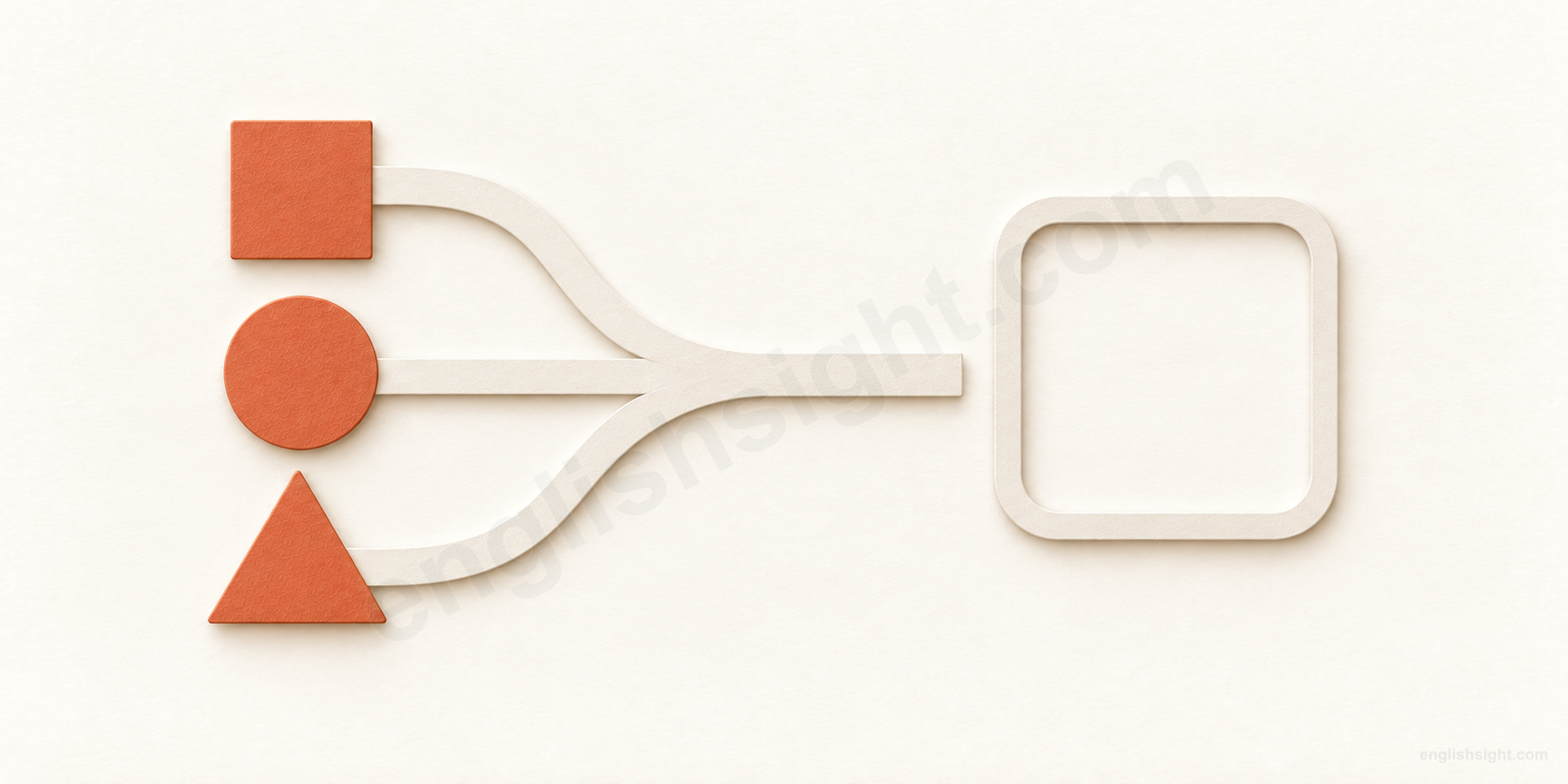
Leave the choice open. Read what the sentence does.
Ask whether there is some, exclude even one, or allow whichever choice fits.
Possible alternatives, with none singled out
Possible alternatives, with none singled out
Possible alternatives: a square, a circle, and a triangle.
any
The frame remains empty; no choice is recorded.
Equal connections single out no candidate.
Any leaves the member or amount unspecified. The sentence determines whether possibilities are asked about, excluded, or allowed.
Keep the possible member or amount unspecified. Then read the question, negative, condition, permission, or comparison around it.
The diagram leaves the final slot empty: it does not assert existence or show that a choice has already been made. It is a memory aid, not a rule that predicts every idiom.
Any does several related jobs. Do you have any coins? leaves their existence open. I don’t have any coins rules them out. Choose any coin leaves the identity open. The surrounding grammar tells you which job is being done.
It can come before a noun as a determiner, stand for an understood noun as a pronoun, or modify a degree in expressions such as any better. Some dictionaries use the traditional label adjective for the noun-modifying use.
The sketch below is a teaching model for open alternatives, not a claim that all native speakers see the same picture. Established expressions and degree patterns still need their own explanations.
01
Is there even one, or any amount?
Questions, negatives, conditions, and expressions of possibility leave existence open or rule it out. The surrounding words do much of the work.
01
question + any + plural countable / uncountable noun
Are there any…? / Is there any…?
ask whether some exist, without giving a quantity
Situation / possibilities
You do not know what is available.
What the sentence establishes
The answer may be yes or no.
Any does not assert that the things exist.
Before a noun, any works as a determiner. Are there any towels? asks about one or more towels; Is there any soap? asks about an unspecified amount. Neither question asks for an exact count.
For ordinary countable items, use a plural noun here; for material or information, use an uncountable noun. Compare a towel, any towels, and any information.
In a sentence
Are there any clean towels in the cupboard?
Watch the difference A positive reply normally uses some: Yes, there are some. Do not automatically carry any into the reply.
02
not / never + verb + any + noun
not / never … any
exclude even one member or the smallest relevant amount
Situation / possibilities
An amount or some members would be possible.
What the sentence establishes
The negative statement excludes all of them in this situation.
Not supplies the negative meaning; any keeps the range open.
I don’t have any tickets means I have no tickets. I never add any salt says that adding salt does not happen, even in a small amount. Any itself is not a negative word: Do you have any? is an open question.
Use either not … any or no before the noun: We haven’t got any rice; We have no rice. For a subject, No students came states that the number who came was zero.
In a sentence
We haven’t received any replies yet.
Watch the difference For an ordinary negative, say no replies or not any replies, not no any replies.
03
if + clause with any; ask / check whether (or if) + clause with any
if / whether … any
leave open whether something exists or happens
Situation / possibilities
A problem may or may not occur.
What the sentence establishes
A condition tells you what to do if it does.
If does not claim that a problem already exists.
If you need any help, call me covers whatever amount of help may be needed. Any fits because the condition leaves that need open.
An indirect question can begin with whether or if: Ask whether they have any rooms; Check if they have any vacancies. Here if means whether, rather than introducing a condition for an instruction.
In a sentence
If you notice any errors, please mark them.
Watch the difference Any is possible without a negative or a question mark. Read the condition or indirect question.
04
hardly / scarcely any + noun; without any + noun; prevent any + noun + from -ing
hardly any / without any / prevent any
talk about almost none, none accompanying something, or something being stopped
Situation / possibilities
The sentence limits or excludes a possible amount.
What the sentence establishes
The limiting word determines how much remains.
A negative meaning does not require the word not.
There is hardly any fuel left means that very little remains, rather than exactly zero. Hardly contributes the near-zero meaning. Without any fuel describes the absence of fuel.
Words such as prevent, ban, and forbid can also occur with any: The cover prevents any dust from entering. The prevention or prohibition comes from the verb; any includes even a small amount within its scope.
In a sentence
There is hardly any fuel left in the tank.
Watch the difference Hardly any is already near-negative: I have hardly any time. Adding don’t changes the structure and may change the meaning.
05
any way / reason + to-infinitive; any chance of + noun / -ing; any idea + question clause
any chance / any idea / any reason / any way
ask whether a possibility, explanation, or solution exists at all
Situation / possibilities
You are unsure whether even one useful possibility exists.
What the sentence establishes
You ask about that possibility rather than count items.
Common abstract singular phrases do not follow a simple “any always needs a plural” rule.
Is there any way to save this file? asks whether a solution exists. Do you have any idea where it is? asks whether the listener knows at all; it does not ask for a list of creative ideas.
Is there any chance of a refund? asks about a possibility. Is there any reason to wait? asks whether waiting has a justification. These are common applications of the existence meaning, with abstract nouns.
In a sentence
Do you have any idea where the spare key is?
Watch the difference Do not turn every singular noun into a plural mechanically: any idea where… and any ideas for… ask different kinds of question.
06
offer / request with some; open availability question with any
some or any in a question?
choose wording for an offer, a request, or an open enquiry
Situation / possibilities
You may be offering tea or checking whether tea exists.
What the sentence establishes
The question’s purpose guides the choice.
A question mark alone does not select any.
Would you like some tea? offers tea. Could I have some water? requests it. Some is common because the speaker treats the thing as available or expects a positive response.
Do we have any tea? checks availability. Some in a question can signal that you expect some to exist; any leaves that existence more open. This is a useful tendency, not a ban on any in every offer or request.
In a sentence
Could I have some water, please?
Watch the difference Do we have any water? and Could I have some water? serve different immediate purposes.
02
Which one? The identity can stay open.
Any can allow a free choice, apply a rule to an arbitrary member, or refer back to a known set. This use works in positive sentences too.
07
any + singular countable noun; any + noun + will do
choose any seat
allow whichever member you choose
Situation / possibilities
Several seats are available.
What the sentence establishes
No particular seat is required.
Any removes a restriction on identity, within the relevant set.
You can choose any seat gives permission to choose whichever seat you want. With a singular countable noun, the choice is normally one member at a time; it does not tell you to occupy every seat.
The relevant set comes from the situation. Any seat on this train does not mean a seat anywhere in the world. Any chair will do says that no special chair is required.
In a sentence
You can choose any seat by the window.
Watch the difference Any works in positive statements when it means whichever. I bought some chairs reports a purchase; I bought any chairs is not the normal way to do that.
08
any + singular noun + can / may / will / should + verb
any member can…
apply a statement to whichever member is considered
Situation / possibilities
You consider an arbitrary member of the group.
What the sentence establishes
The rule applies to that member too.
A free-choice statement can have a general force without ordering everyone to act.
Any member can borrow a helmet means the permission is available to every eligible member. It does not mean every member actually borrows one.
Any competent mechanic should notice the leak makes a general claim about a kind of person. The noun phrase defines the relevant kind; any ranges across its members.
In a sentence
Any member can borrow a helmet from reception.
Watch the difference Keep the singular agreement: Any member is eligible. Every member states the whole-group generalization more directly.
09
any + number + plural noun; any + noun + relative clause; any + that-clause
any two / any … you like / any that…
leave identity open while specifying a number or condition
Situation / possibilities
Some choices satisfy a condition.
What the sentence establishes
All qualifying choices remain eligible.
The number or following clause supplies the restriction.
Choose any two postcards leaves the identities open but fixes the number at two. Any does not always mean exactly one.
Use any information you can find includes whatever information is available. In Keep any that still work, any stands for the previously mentioned objects and that still work selects the useful ones. These positive sentences need no negative meaning.
In a sentence
Choose any two postcards from this box.
Watch the difference You may choose any two permits a choice of two from the group; You must take all of them requires the entire group. A following clause can narrow the eligible set.
10
any of + the / these / possessive + noun; any of + us / you / them
any of the… / any of us
refer to members of an identified group or part of a known amount
Situation / possibilities
The group or material is already identified.
What the sentence establishes
You ask about, exclude, or allow members or amounts within it.
Of connects any with a definite noun phrase or a pronoun.
Are any of these bags yours? asks about a known set. I haven’t read any of her books excludes every book in that set. You can use any of them allows a free choice. The same phrase changes interpretation with its sentence.
An amount can be uncountable: Is any of the soup left? Compare Are any of the chairs free? Agreement reflects whether an amount or plural members are in view. Any one of the chairs is… explicitly singles out one.
In a sentence
Are any of these bags yours?
Watch the difference Say any of my friends, not any my friends; say any friends for an unidentified group. Any of them need not mean exactly one.
11
any without a repeated noun; not … any; any + descriptive clause
Have you got any? / There aren’t any.
leave out a noun that the listener can recover
Situation / possibilities
Both speakers know they are discussing envelopes.
What the sentence establishes
Any can stand without repeating envelopes.
The missing noun still controls what any refers to.
Have you got any? can mean any envelopes, any paint, or another understood thing. Any used this way is commonly called a pronoun. It does not automatically mean people.
A natural exchange is: Do you have any envelopes? — Yes, I have some. / No, I haven’t got any. A standalone quantity answer can use none: How many are left? — None.
In a sentence
I looked for envelopes, but there weren’t any in the drawer.
Watch the difference No any is not the normal standalone answer. Use None or No, there aren’t any.
12
any one of + plural group + singular verb; anyone + singular verb
any one of… / anyone
distinguish a single member from the pronoun for a person
Situation / possibilities
A code must be sent to one of three devices.
What the sentence establishes
You may choose one device, whichever it is.
Two words emphasize one member; one word refers to a person.
Any one of these devices can receive the code singles out one device from a set; the selected member could be any of them. With any one as subject, use a singular verb.
Anyone, written as one word, means any person: Can anyone help? It cannot replace any one when choosing one object. The wider compound family includes anybody, anything, and anywhere, but each compound also has its own uses.
In a sentence
Any one of these devices can receive the code.
Watch the difference Write any one of these devices, not anyone of these devices. In a reference to people, any one of us also emphasizes one member.
13
comparative + than any other + singular noun; as + adjective + as any + clause
any other… / as good as any
compare one item with the other possible members
Situation / possibilities
You compare one room with the remaining rooms.
What the sentence establishes
The comparison ranges across the relevant alternatives.
Other excludes the subject from a group that would otherwise include it.
This room is quieter than any other room in the house compares it with each remaining room. Since this room belongs to the house’s rooms, other avoids comparing the room with itself.
This room is as good as any we’ve seen says that none of the rooms we have seen is better than this one. It does not say that all the rooms are equally good. Any keeps the comparison open to whichever alternative is considered.
In a sentence
This room is quieter than any other room in the house.
Watch the difference Use other when the subject is a member of the group being compared. Any other questions? is a different use: it asks for additional questions.
03
Amounts, degrees, and what continues
Read the words after any: a comparative asks about a difference, more may refer to extra quantity, and any more at the end can refer to time.
14
any + noun + at all; any at all when the noun is understood
any … at all
emphasize that even a minimal amount or possibility counts
Situation / possibilities
A very small amount might still matter.
What the sentence establishes
You include even that minimum in the question or denial.
At all strengthens the already open range.
Is there any water at all? includes even a little water. There isn’t any water at all emphatically excludes it. The emphasis belongs to the full phrase rather than changing any into a word meaning a lot.
I’d welcome any advice at all expresses willingness to accept even a small contribution. Positive uses are possible when the meaning is unrestricted acceptance.
In a sentence
Is there any water at all in the bottle?
Watch the difference Any at all does not mean a large quantity. The speaker may be asking about the smallest useful amount.
15
negative / limiting context + for any length of time; negative + verb + any distance
for any length of time / any distance
refer to a substantial stretch of time or distance in a limiting context
Situation / possibilities
A person can sit briefly but cannot stay seated comfortably for long.
What the sentence establishes
The sentence excludes a sustained period, not necessarily every second.
In these amount phrases, any can concern an appreciable extent.
I can’t sit comfortably for any length of time usually means I can sit only briefly before becoming uncomfortable. The relevant threshold is a worthwhile or substantial period, not necessarily the smallest possible instant.
Similarly, We couldn’t walk any distance before stopping can mean we could not walk very far. This scalar reading is recorded in dictionaries, but context matters: I didn’t walk any distance at all emphatically denies walking even a little. Do not force one minimum-amount interpretation onto every phrase.
In a sentence
I can’t sit comfortably for any length of time.
Watch the difference This does not necessarily mean I cannot sit at all. The full extent phrase and context determine the scale.
16
question / negative / condition + any + comparative adjective or adverb
any better / any faster / any further
ask about or deny a difference of even a small degree
Situation / possibilities
There is a current level or an earlier state to compare with.
What the sentence establishes
You ask whether it has improved at all.
Any modifies the comparative, rather than a following object.
Does it feel any better? asks whether there is any improvement. I can’t work any faster denies being able to increase the speed. Here any functions as an adverb of degree.
If it gets any colder, we’ll go inside uses the same small-difference idea in a condition. Any further can concern distance or progress in discussion: We won’t take the matter any further. Nobody will be any the wiser is a fixed comparative pattern meaning nobody will find out or understand more.
In a sentence
Does your ankle feel any better today?
Watch the difference For a plain positive degree, say much better or a little better. It is any better is not the normal equivalent.
17
be any good (at / for…); be any use (to…); do any good
any good / any use / do any good
ask about quality, usefulness, or a helpful effect
Situation / possibilities
You are unsure whether a thing is useful or effective.
What the sentence establishes
You check for a worthwhile quality or benefit.
Learn these familiar combinations rather than adding any before every adjective.
Is this charger any good? asks whether it works well or is of worthwhile quality. Is this charger any use to you? asks whether you can use it. It isn’t any good at charging my phone rejects its usefulness for that task.
Will restarting do any good? asks whether restarting will help. Good after do names a benefit; it is not a direct description of the action’s moral character.
In a sentence
Will restarting the router do any good?
Watch the difference Any good and any better are established patterns. Do not generalize them to a phrase such as any excellent.
18
any more + plural / uncountable noun; any more with an understood noun
any more + noun
ask about or exclude an additional amount or number
Situation / possibilities
You have already used some paint.
What the sentence establishes
You check whether an extra amount remains.
More concerns additional quantity when it goes with the noun.
Do we need any more paint? asks whether an extra amount is needed. We don’t need any more chairs says the current number is enough.
When the noun is understood, any more can stand alone: Would you like some more soup? — No, I can’t eat any more. The context supplies soup and quantity.
In a sentence
Do we need any more paint for the door?
Watch the difference Keep two words before a noun: any more paint. Anymore is not the spelling for an additional amount of paint.
19
negative clause + any more / anymore / any longer; question + any more / anymore
not … any more / anymore / any longer
say a previous situation has stopped continuing
Situation / possibilities
She used to work at this location.
What the sentence establishes
That is no longer true.
The time meaning depends on the whole negative expression.
She doesn’t work here any more means she worked here before and has stopped. In American English, anymore is a usual spelling for this time adverb; any more is also used, especially in British English.
I can’t wait any longer means the waiting cannot continue. Compare We don’t need any more staff: that concerns extra staff, not necessarily a former habit that has ended.
Questions can ask whether an earlier situation still continues: Do you work there anymore? means Do you still work there? The question does not assume that the work has stopped.
In a sentence
She doesn’t work at this café any more.
Watch the difference Use one negative construction: She no longer works here or She doesn’t work here any longer.
20
noun phrase + if any; few / little, if any, + noun
if any / few, if any
allow for the possibility that the number or effect is zero
Situation / possibilities
There may be effects, but there may be none.
What the sentence establishes
You avoid presupposing an effect exists.
If any is a shortened condition about existence.
List the side effects, if any means list them if there are some. It does not assert that side effects will occur.
Few, if any, shops are open means very few are open and possibly none. Little, if any, progress has been made applies the same reservation to an uncountable amount. Few and little supply the small quantity; if any admits zero.
In a sentence
The update caused few, if any, problems.
Watch the difference If any allows zero. If anything can instead introduce a correction: The room is, if anything, warmer. They are different expressions.
21
any number of + plural noun; any amount of + uncountable noun
any number of… / any amount of…
describe many possibilities or an unrestricted quantity
Situation / possibilities
There are many possible explanations.
What the sentence establishes
You do not narrow the explanation down to one.
The full number or amount expression matters.
Any number of things could cause that noise means there are many possible causes. This established expression often means several or many, rather than giving an exact number.
You may print any number of copies can instead give permission without a numerical limit. You may use any amount of the spare paper similarly leaves the amount unrestricted. The noun after number is normally plural; amount introduces uncountable material.
In a sentence
Any number of things could cause that noise.
Watch the difference Any number of can mean many in a statement, or whatever number you choose in a permission. Read the whole sentence.
04
Choosing a time, expecting soon, and expressing preference
A freely chosen time and an imminent event are different meanings. Familiar time expressions also have conversational uses that need to be learned as a whole.
22
verb + any time / anytime; at any time; have any time + to-infinitive
any time / at any time / anytime
leave the choice of time open
Situation / possibilities
No particular meeting time is required.
What the sentence establishes
The listener can choose within the available period.
The time remains unspecified; the context can still set limits.
Call any time after six allows a choice within the period after six. At any time of day similarly avoids specifying a particular hour.
Anytime is an adverbial spelling: You can call anytime. After a preposition, keep the noun phrase as two words: at any time. Also use two words for an amount of time: Do you have any time to help?
In a sentence
You can call me any time after six.
Watch the difference The amount in I don’t have any time is not the adverb anytime. Free choice also does not cancel after six.
23
event + any minute / moment / day (now); not … any time soon
any minute / moment / day now
expect something soon without knowing the exact moment
Situation / possibilities
The bus is due very soon.
What the sentence establishes
Its precise arrival moment is still unknown.
Unspecified timing combines with an expectation of imminence.
The bus should arrive any minute now predicts a very near arrival. Any day now usually allows a wider timescale of days. Now helps signal this near-future interpretation.
Compare Come any day next week, which offers a free choice of day. In She won’t be back any time soon, the negative sentence denies a return in the near future.
In a sentence
The bus should arrive any minute now.
Watch the difference Any day now is an expectation, not permission to choose a day. The timescale comes from minute, moment, or day and the context.
24
give me + preferred person / thing + any day / time
Give me … any day.
state a clear preference
Situation / possibilities
Someone mentions a crowded night out.
What the sentence establishes
You say which alternative you would prefer.
This conversational expression is about preference rather than a calendar date.
Give me a quiet evening any day means I would readily choose a quiet evening over the alternative under discussion. It is informal, and give me need not be a literal request to hand something over.
The idea of whichever day can help you remember the strength of the preference, but the preference meaning belongs to the established expression. Any time can also occur in this pattern.
In a sentence
Give me a quiet evening at home any day.
Watch the difference Do not interpret this automatically as a request to schedule an evening on an unspecified date.
05
Established expressions in conversation
Any helps leave alternatives open, but the full phrase supplies the meaning: specialness, a firm refusal, a correction, a tentative question, or a result that holds whatever happens.
25
any old + noun; not just any + noun; not any old + noun
any old… / not just any…
say quality does not matter, or emphasize that something is special
Situation / possibilities
A task might need an ordinary container or a particular one.
What the sentence establishes
The expression tells you whether ordinary choices will do.
Old can add casual indifference; it need not describe age.
Any old box will do means an ordinary box of no special type is sufficient. In this informal expression, old does not require the box to have existed for a long time.
This isn’t just any box; it belonged to my grandfather presents the box as special. Not any old box can express a similar contrast. Learn the negation with the full expression: rejecting an ordinary interchangeable item differs from saying no box exists.
In a sentence
Any old box will do for carrying the cables.
Watch the difference Not just any signals specialness or a requirement for something special. It does not mean there are no examples of the thing.
26
in any case / in any event + clause
in any case / in any event
state what holds regardless, or add a decisive point
Situation / possibilities
The timing is uncertain.
What the sentence establishes
One practical conclusion remains the same.
The whole phrase moves the conversation beyond uncertain alternatives.
It may rain or stay dry; in any case, we need the tent says the conclusion holds either way. In any event can likewise mean whatever happens: In any event, I’ll call tonight.
In any case can also add a more decisive reason: I don’t want to go; in any case, I can’t afford it. Here the second point supports the decision regardless of the first. It does not refer to a physical case.
In a sentence
It may rain or stay dry; in any case, we need the tent.
Watch the difference Treat these as sentence-linking expressions. The meaning cannot be recovered by translating case or event in isolation.
27
at any rate + clause; statement + at any rate; or at any rate + refinement
at any rate
return to the main point or make a statement more precise
Situation / possibilities
You have been discussing uncertain details.
What the sentence establishes
You state the point you can safely keep.
Rate is part of an established linking phrase, not a price or speed here.
At any rate, the keys are safe puts the important practical fact back in focus after other details. This use can be close to in any case.
He was kind to me, at any rate limits the claim to what the speaker can vouch for. Or at any rate can refine a claim: It was a wolf, or at any rate a very large dog. The second description is the safer one.
In a sentence
The journey was chaotic. At any rate, the keys are safe.
Watch the difference This phrase can narrow or refocus a statement; it does not always introduce the same logical relation as therefore.
28
question + by any chance; auxiliary + subject + by any chance + rest of question
by any chance
ask tentatively whether something might be true
Situation / possibilities
You think the listener might know the answer.
What the sentence establishes
You ask without assuming they do.
The phrase makes room for the possibility; tone and context still matter.
Do you know the new address, by any chance? presents the possibility that the listener knows it as something to check. This often makes a question sound tentative.
The phrase can appear inside the question too: Are you by any chance waiting for Maya? The full expression is not a question about whether events are random.
In a sentence
Do you know the new address, by any chance?
Watch the difference By any chance can soften an enquiry, but it does not automatically make every question polite.
29
any luck (with + noun / -ing)?; with any luck, + clause
Any luck? / With any luck, …
ask about success or hope for a favorable outcome
Situation / possibilities
A friend has been trying to find a spare ticket.
What the sentence establishes
You ask whether the attempt has succeeded.
Two familiar luck expressions have different conversational jobs.
Any luck? is an informal short question about success: Any luck finding a spare ticket? It can refer to effort and results, not only random fortune.
With any luck, we’ll get seats together expresses hope that circumstances will work out well. It does not guarantee the result. The first expression asks for a report; the second looks ahead hopefully.
In a sentence
Any luck finding a spare ticket?
Watch the difference With any luck is a hopeful condition, not a statement that success is certain.
30
negative clause + by any means; by any means available / necessary
not … by any means
strongly deny a description
Situation / possibilities
Someone might assume the task is easy.
What the sentence establishes
You firmly reject that description.
The fixed negative expression means not at all.
The task isn’t easy by any means strongly denies that it is easy. It can suggest that the task is difficult, though the literal claim is the rejection of easy.
Compare We’ll contact her by any means available, where means refers to methods and any leaves the method unrestricted. That positive phrase is about possible ways of acting, not a strong denial.
In any way, shape or form is another emphatic expression, often used after a negative: We don’t accept bullying in any way, shape or form. It rejects bullying of every type; the full informal phrase supplies the emphasis.
In a sentence
The repair isn’t simple by any means.
Watch the difference By no means is an alternative: The repair is by no means simple. Do not add another negative when you intend the ordinary strong denial.
31
do / want something at any cost / price; not / wouldn’t + verb + at any price
at any cost / at any price / not at any price
accept every cost to achieve something, or refuse every offer
Situation / possibilities
A desired result may involve sacrifices.
What the sentence establishes
The speaker says how far they are prepared to go.
Positive and negative versions point in opposite directions.
They wanted the contract at any cost means they were determined to get it despite expense, effort, or sacrifice. At any price can similarly go beyond money to include difficulties.
I wouldn’t sell this photo at any price rejects every possible price, even a very high offer. Any keeps the range open; the negative rejects that entire range.
In a sentence
They wanted the contract at any cost.
Watch the difference At any cost is strong language about determination. Not at any price is a strong refusal, not an offer to pay more.
32
not + verb + on any account; on no account + auxiliary + subject + verb
not … on any account
forbid something under every possible circumstance
Situation / possibilities
Someone may think there is a good reason to share a code.
What the sentence establishes
The instruction rules out every such reason.
Account means reason in this established expression.
Do not share the code on any account is a firm instruction never to share it, whatever reason someone gives. The meaning is not about an online or bank account.
On no account gives the same strong prohibition. At the start of a clause, it normally triggers inversion: On no account should you share the code.
In a sentence
Do not share the code on any account.
Watch the difference Keep the established preposition on. On any account is not interchangeable with in any case.
33
subject + be not + having any (of it)
not be having any of it
refuse to accept a suggestion, excuse, or behavior
Situation / possibilities
Someone offers an excuse.
What the sentence establishes
The listener refuses to accept it.
This informal expression is about acceptance, not physical possession.
She wasn’t having any of it means she would not agree to, accept, or tolerate what was being proposed. It points back to the excuse, suggestion, or behavior already in the conversation.
Compare She didn’t have any of the cake, which is literal and concerns eating or possessing a portion. The be having construction with it is an established refusal expression.
In a sentence
I offered an excuse, but she wasn’t having any of it.
Watch the difference It refers to the proposal or behavior in context. Do not translate have here as ordinary ownership.
Let grammar choose the interpretation
Any is not inherently negative
Not, never, without, and other limiting contexts provide negative force. A question leaves existence open, while a positive free-choice sentence can allow every relevant alternative.
Countability and agreement
Ordinary quantity questions use any tickets or any rice. Free choice can use any ticket. Abstract expressions such as any idea where… also occur. Match the verb to the intended noun or amount: Are any seats free? Is any rice left? Any one of these seats is fine.
Keep negation in the right place
I didn’t invite any guests ordinarily means I invited none. Some guests didn’t come means a subset failed to come. Do not use Any guests didn’t come as a routine substitute for No guests came.
One model has limits
Open alternatives connect the major uses, but any good, any more, at any rate, and not having any of it have established constructions. A drawing cannot supply their meaning or predict a new combination.
Scope and variation
This lesson targets modern everyday standard usage. Any has no verb forms, passives, causatives, or particle-verb family. End-position any meaning at all, as in That won’t help any, is informal North American usage; for a broadly usable alternative, say That won’t help at all. Regional positive anymore meaning nowadays and dialectal any road are not production targets here.
Choose what the whole sentence means
Consider existence, unrestricted choice, quantity, time, and fixed expressions. Choose the expression that fits the situation.
1. You are checking whether towels are available, with no assumed answer. Which question fits?
2. You have water and are offering it to a visitor. Which is the ordinary offering pattern?
3. Every window seat is available, but the visitor should choose one. Which instruction fits?
4. A little fuel remains, but the amount is very small. Which sentence states that most accurately?
5. You ask about books belonging to a friend. Which noun phrase fits standard English?
6. You mean whichever single one of three devices you choose. Which wording fits?
7. You want to know whether a sore ankle has improved at all. Which question fits?
8. She used to work at this café, but she has stopped. Which sentence expresses that change?
9. A report says, “There were few, if any, complaints.” What does it allow?
10. A bus is due very soon, but its exact arrival time is unknown. Which sentence fits?
11. A buyer offers more and more money, but you will never sell the photo. Which sentence fits?
12. You say, “This isn’t just any pen; it was my grandmother’s.” What are you emphasizing?
13. A friend says, “I can’t sit comfortably for any length of time.” Which interpretation does this usually allow?
Sources and teaching notes
Usage was checked in the publisher sources below. The explanations, examples, and principle sketch were created for this lesson. The visual connection is a teaching interpretation, not a dictionary definition or a claim about every speaker’s mental image.
One diagram connects the major uses. Fixed expressions still need their own grammar and context.