Recognize the fruit, use it naturally in food talk, and understand familiar expressions built around it.
A whole fruit with an inside
A whole fruit with an inside
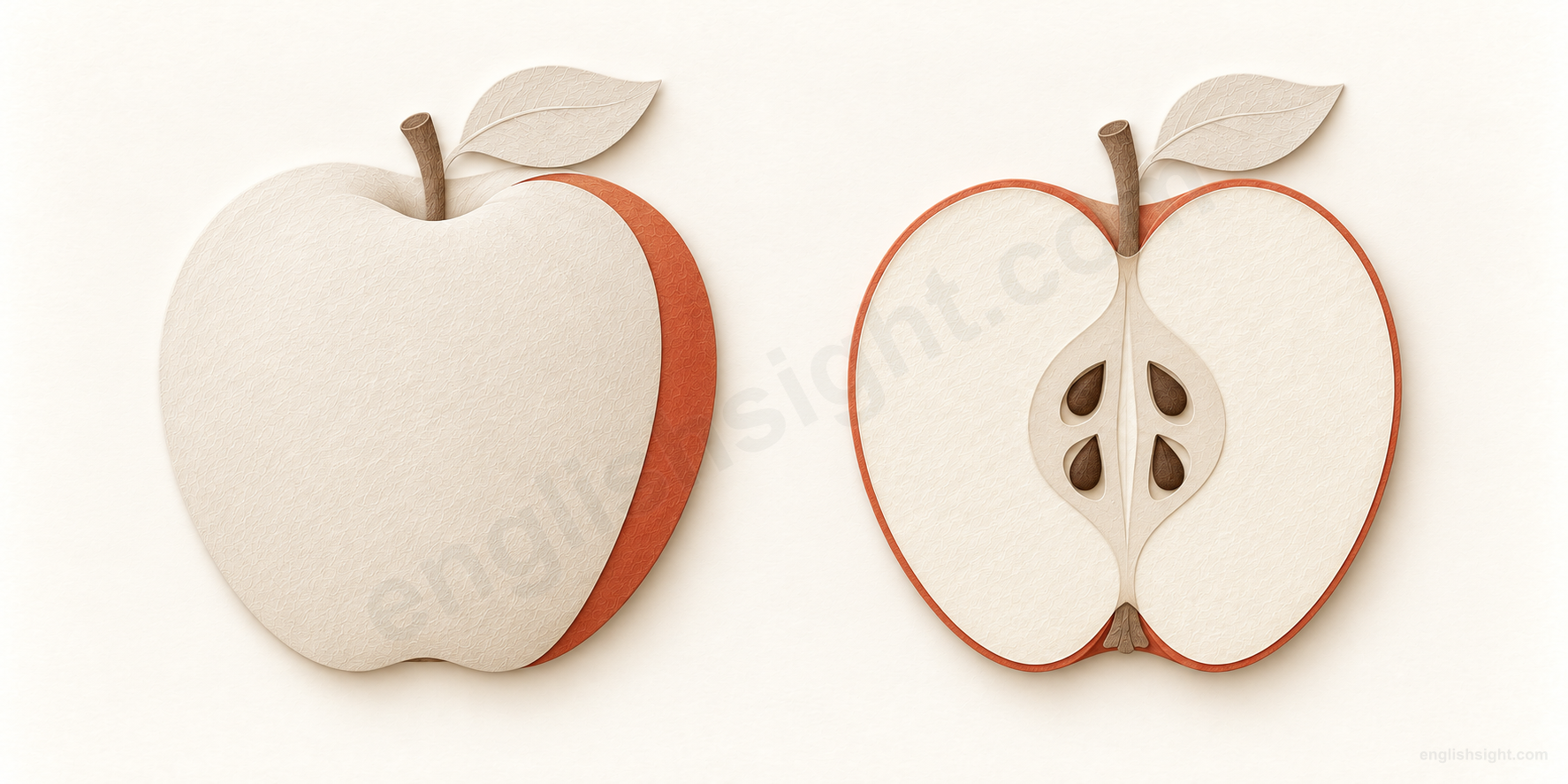
A whole apple
apple
Skin around flesh and a seed-containing core
Compare the outside with a lengthwise cut view.
An apple, whole and in section: skin outside, flesh and a seed-containing core inside.
An apple is a rounded edible fruit with skin surrounding firm flesh and a seed-containing core.
The two views identify the same kind of object, whole and in section. They are not a before-and-after event. The fruit model supports literal uses; fixed expressions need their own explanations.
Apple most often names the fruit you can hold, bite, cut, or cook. It also appears before other nouns to identify a product or the tree that bears it.
Expressions such as the apple of someone’s eye have established meanings of their own. The fruit gives us a useful starting point, not a formula that predicts every phrase.
01
The fruit, its parts, and what we make with it
Start with the concrete object. Counting, ingredient use, and noun combinations change how we refer to it without creating unrelated meanings.
01
an apple; the apple; two apples; apples + plural verb
an apple / apples
name and count the fruit
Situation / starting point
You want one fruit for your lunch.
What the expression conveys
You ask for an apple.
One whole fruit is an apple; several are apples.
Apple names a rounded edible fruit with firm flesh and a seed-containing center. Its skin may be red, green, or yellow; a green apple is not necessarily unripe.
Use an apple for one unspecified fruit and the apple for a particular one. Apples are a convenient snack talks about the category in general. The plural is apples; pronounce apple /ˈæpəl/, with stress on the first syllable.
In a sentence
Could you put an apple in my lunch bag?
Watch the difference Say an apple, but a green apple: the article follows the next sound, and green begins with a consonant sound.
02
some / a little apple; a piece / slice of apple
some apple / a piece of apple
treat the fruit as food material
Situation / starting point
The fruit has been cut into pieces.
What the expression conveys
You add an amount rather than count whole fruits.
Count whole apples; use some apple for an amount of the ingredient.
In food contexts apple can be uncountable: some grated apple, a little apple, or a piece of apple. This keeps the same fruit meaning while presenting it as material.
There are two apples in the bowl counts fruits. There is some apple in the salad identifies an ingredient. A slice of apple counts a slice, so the plural is slices of apple.
In a sentence
I added some grated apple to the mixture.
Watch the difference Some apples normally suggests several fruits; some apple can refer to an amount of cut or prepared fruit.
03
an apple tree; apple trees; apple blossom; an apple orchard
an apple tree
identify the tree that produces apples
Situation / starting point
You are describing what grows in a garden.
What the expression conveys
You name the fruit-bearing tree.
In apple tree, tree identifies the object and apple specifies its kind.
An apple tree is a tree that bears apples. Use apple trees for several trees; apple stays singular before tree. Apple blossom refers to its flowers, and an apple orchard is an area planted with these trees.
Some dictionaries also give apple itself a tree sense. Apple tree is the clear everyday choice when you need to distinguish the tree from its fruit.
In a sentence
There are two apple trees behind the house.
Watch the difference An apple is usually understood as the fruit in ordinary food conversation. Add tree when that is what you mean.
04
apple + food/drink noun; a glass of apple juice; a slice of apple pie
apple juice / apple pie
specify a food’s ingredient or flavor
Situation / starting point
You are choosing a drink or dessert.
What the expression conveys
You name the product and what it is made with.
The second noun supplies the food or drink category.
Apple juice is juice made from apples; apple pie is a pie with apple filling. Apple sauce is a sauce made with cooked apples. These are ordinary noun combinations, not phrasal verbs.
Apple usually stays singular in front of the other noun: two apple pies, not two apples pies. For a serving, say a glass of apple juice or a slice of apple pie. A candy apple in American English, or a toffee apple in British English, is an apple on a stick with a hard sweet coating.
In a sentence
We shared a slice of apple pie after lunch.
Watch the difference Apple describes the ingredient or kind here; it is not a new verb meaning make a pie.
05
cooking / eating apples; peel / core / slice an apple
cooking apples / peel and core an apple
choose fruit for a purpose and prepare it
Situation / starting point
You need fruit for a baked dessert.
What the expression conveys
You choose suitable apples and remove skin and the center.
The purpose and preparation come from cooking, peel, and core, not from a new sense of apple.
Cooking apples are suitable for cooking; eating apples are grown or chosen to eat raw. The labels concern use, not whether an apple has already been cooked. Sweet, sour, crisp, and juicy describe different qualities; crisp describes a firm bite, while juicy describes the amount of juice.
To peel an apple is to remove its skin; to core it is to remove the central part containing the seeds. Slice it means cut it into thin pieces. A crab apple is a small, sour kind of apple, a useful additional name when reading about gardens.
In a sentence
Peel and core the cooking apples, then slice them.
Watch the difference Cooking apples can still be raw; cooked apples have already undergone cooking.
02
Fixed expressions and sayings
Fruit images can help you remember these phrases, but their established meanings belong to the whole expression. Read the situation and the grammar.
06
person/thing + be + the apple of + possessive + eye
the apple of someone’s eye
a person or thing someone especially loves
Situation / starting point
You describe a grandparent’s affection.
What the expression conveys
You identify the person especially dear to them.
The possessor of eye is the person who feels the affection.
The apple of her eye is someone she especially loves. In the example, the granddaughter is loved and the grandmother is the person who loves her. This established expression is affectionate; it is not about anyone’s physical eye.
Change the possessive to match the person: the apple of my eye, his eye, or their eye. The expression often describes a child but is not restricted to children; a cherished thing can also be described this way.
In a sentence
Her granddaughter is the apple of her eye.
Watch the difference Keep the fixed wording the apple of her eye; do not replace eye with eyes in this expression.
07
a bad / rotten apple; a few bad apples; One bad apple can spoil the whole barrel.
a bad / rotten apple
a harmful member of a group
Situation / starting point
One member behaves dishonestly and influences others.
What the expression conveys
You describe that member as a bad apple.
A spoiled fruit is a metaphor for a person who harms a group.
A bad apple or a rotten apple can be a dishonest or troublesome person whose behavior harms other members of a group. This is a strong negative judgment, not a description of someone who simply made a harmless mistake.
The image connects spoiled fruit with a damaging influence. Context separates the literal fruit from the person: remove the rotten apple from the bowl is literal; a rotten apple in the team is figurative. The plural is bad apples. The saying One bad apple can spoil the whole barrel warns that one harmful member can affect the whole group.
In a sentence
One bad apple encouraged the others to cheat.
Watch the difference Calling someone a bad apple is critical and can sound insulting; it does not mean they dislike fruit.
08
compare apples and oranges; compare apples to oranges; things + be + apples and oranges
compare apples and oranges
compare things that differ in relevant ways
Situation / starting point
One price covers a month, and the other covers a year.
What the expression conveys
You challenge the basis of the comparison.
The fruit contrast stands for unlike categories or conditions.
Comparing apples and oranges means making a comparison between things that are too different for the intended conclusion. Apples to oranges is another familiar form. The phrase often challenges an argument about prices, performance, or statistics. These expressions are especially associated with North American English. Apples and oranges can also stand without compare: The two courses are apples and oranges means they differ greatly in relevant ways.
The point is not that different things can never be compared. It is that their relevant differences make this comparison misleading. Explain the difference rather than use the idiom as a substitute for reasoning.
In a sentence
Comparing a monthly fee with an annual fee is comparing apples and oranges.
Watch the difference In the idiom, keep the fruit nouns plural. The topic need not involve real fruit.
09
compare apples to apples; an apples-to-apples comparison
compare apples to apples
compare things on a matching basis
Situation / starting point
Two offers originally include different services.
What the expression conveys
You adjust them to include the same things.
Matching categories make the comparison useful.
Compare apples to apples asks for a comparison between things of the same basic type or on a matching basis. This is particularly useful when discussing costs or performance. It contrasts with comparing apples and oranges. This expression is associated with American English.
Before a noun, the expression can be hyphenated: an apples-to-apples comparison. It does not mean the two options must be identical; it means the relevant comparison conditions should match.
In a sentence
Include delivery in both prices so we can compare apples to apples.
Watch the difference Apples to apples is an established comparison expression, not a rule about which real fruits you may compare.
10
person/event + upset + the apple cart
upset the apple cart
disrupt arrangements or cause plans to fail
Situation / starting point
A group has agreed on arrangements.
What the expression conveys
An unexpected change creates problems for the plan.
The whole expression describes disruption; there need not be a real cart.
Upset the apple cart means cause problems for someone’s arrangements or make their plans fail. The overturned-cart image is a memory aid; the established phrase can concern a meeting, a project, or an agreement.
The subject may be a person or an event: a late cancellation can upset the apple cart. Here upset means disrupt, rather than simply make someone feel sad. The fruit sketch does not predict this idiom.
In a sentence
A last-minute cancellation could upset the apple cart.
Watch the difference Learn the whole expression with upset and the apple cart; apple alone does not mean plan.
11
the apple doesn’t fall / never falls far from the tree
The apple doesn’t fall far from the tree.
a child resembles a parent in behavior or character
Situation / starting point
A daughter shows her father’s habit of making jokes.
What the expression conveys
Someone comments on the family resemblance.
The tree stands for the parent and the apple for the child.
This saying comments on a similarity between a child and a parent, especially behavior or character. It can express warm recognition or criticism, depending on the trait and tone. The saying is especially associated with North American English.
The apple never falls far from the tree is a variant. It is a conventional comparison, not a claim that every child must share every parental trait.
In a sentence
She tells jokes just like her dad—the apple doesn’t fall far from the tree.
Watch the difference This is a whole saying about family resemblance, not a new general meaning of apple as any child.
12
be + as American as apple pie
as American as apple pie
strongly associated with American culture
Situation / starting point
You describe a familiar part of American life.
What the expression conveys
You emphasize its cultural association.
Apple pie is a cultural reference in this fixed comparison.
As American as apple pie describes something seen as typical of American culture or life. The comparison can apply to a custom or activity, not just to food.
The phrase expresses a cultural association; it does not establish where an item was invented or say that everyone in America enjoys it. Keep American capitalized.
In a sentence
To the writer, the neighborhood baseball game is as American as apple pie.
Watch the difference Do not interpret the phrase as a factual claim that apple pie exists only in America.
13
An apple a day keeps the doctor away.
An apple a day keeps the doctor away.
a traditional saying about a healthy daily habit
Situation / starting point
Someone reaches for a piece of fruit.
What the expression conveys
They quote a familiar proverb.
A day means each day in this saying.
This proverb presents eating an apple each day as a way of staying healthy. People quote it as a familiar saying, sometimes playfully. It is language to recognize, rather than a literal promise about avoiding doctors.
An apple a day means one apple per day. Keeps the doctor away supplies the proverb’s claim; apple itself still names the fruit. Learn the full wording as a saying.
In a sentence
“An apple a day keeps the doctor away,” he joked as he packed his lunch.
Watch the difference Recognizing a proverb does not make its claim a medical guarantee.
03
Names that include apple
Two recognizable expressions name a body feature and a city. Learn each complete name instead of substituting a fruit definition.
14
an Adam’s apple; someone’s Adam’s apple
an Adam’s apple
the visible projection at the front of the throat
Situation / starting point
You notice the front of a person’s throat.
What the expression conveys
You name the projection that moves when they swallow.
The whole compound names a body feature, not fruit.
An Adam’s apple is the projection at the front of the throat, particularly noticeable in many men. It moves when a person swallows. The term is a fixed anatomical name, not a piece of fruit in the throat.
Write Adam with a capital A and the possessive apostrophe. You can say his Adam’s apple or an Adam’s apple; the name Adam is part of the term, not the name of the person being described.
In a sentence
His Adam’s apple moved as he swallowed.
Watch the difference Keep the full compound; apple by itself does not normally name this body feature.
15
the Big Apple; in / to the Big Apple
the Big Apple
an informal nickname for New York City
Situation / starting point
You read about someone’s travel plans.
What the expression conveys
You recognize a city nickname.
Capital letters and the article mark the established name.
The Big Apple is an informal nickname for New York City. In a travel story, a weekend in the Big Apple means a weekend in that city, not a visit to a large fruit.
Keep the usual article the and capitalize Big Apple. The nickname is a fixed name; it does not provide a pattern for calling any large city an apple.
In a sentence
They spent a weekend in the Big Apple.
Watch the difference A big apple with lowercase letters ordinarily means a large fruit. The city nickname is the Big Apple.
Keep the fruit and the full expression distinct
A noun, including before another noun
The ordinary word is a noun. In apple juice and apple tree it modifies another noun. This lesson has no productive verb, passive, causative, or phrasal-verb family to add.
Count a fruit; measure an ingredient
Use an apple or two apples for whole fruits; some apple or a slice of apple presents food material. Apple normally stays singular in combinations such as apple pies.
A teaching picture has limits
The drawing identifies the fruit. It does not explain all the history of the idioms, and it is not a claim about a picture every native speaker sees.
Where this lesson stops
Apple as a company name, specialist botanical names, wood as a material, older slang, and less useful regional expressions are outside the main lesson. A name containing apple does not necessarily identify the everyday fruit.
Choose the meaning that fits
Use the context to decide whether apple names fruit, an ingredient, or part of an established expression.
1. You ask for one whole fruit. Which request is standard?
2. You are adding a small amount of grated fruit. Which wording presents it as an ingredient?
3. One price is for a month and another is for a year. Which phrase challenges the comparison?
4. A grandfather calls his grandson the apple of his eye. What does he mean?
5. A recipe asks for cooking apples. Must they already be cooked?
Sources and teaching notes
The sources below support the fruit meaning, grammar, compounds, and named expressions. Explanations and examples are original. The diagram is a teaching aid rather than evidence for an idiom’s origin.
The diagram helps identify the fruit; it is not a picture shared by every native speaker.