From stone structures to curved backs and branches—and two separate uses beyond shape.
A raised curve spans a space
A raised curve with space beneath
Two upright sides frame an open space.
arch
The opening remains clear beneath the curve.
The curved top rises between them.
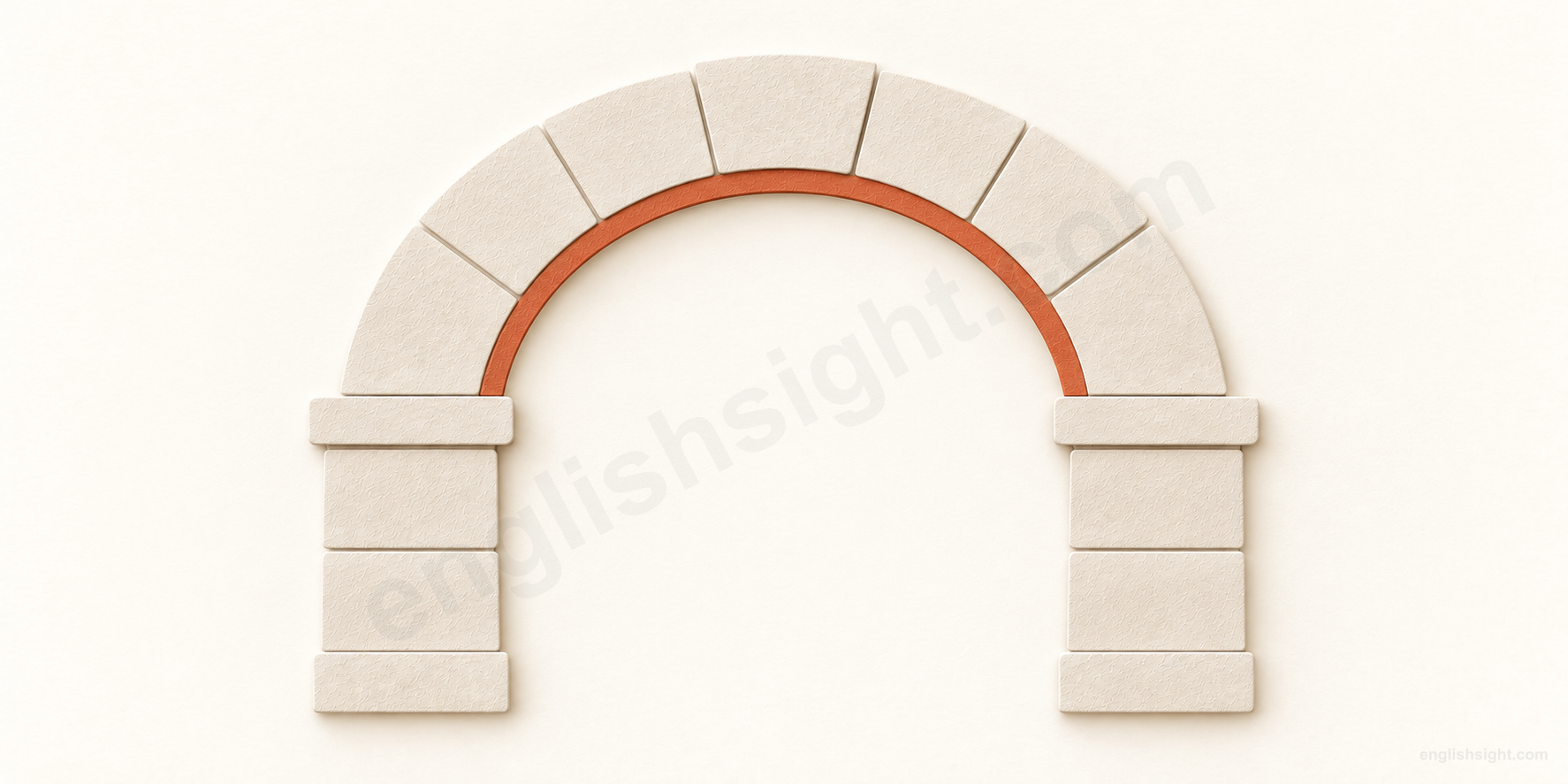
This static stone arch shows a raised curve spanning an open space.
For the central shape family, an arch rises between two sides or points, leaving space beneath the curve.
The sketch shows a structural example. Other shape uses need not support a building or be rigid. The knowing adjective and the combining form arch- are outside this model.
Picture a curve rising between two sides with space beneath it. This is a useful starting point for the shape meanings of arch, including structures, body parts, and the verb for taking that shape.
The adjective in an arch smile and arch- in arch-rival belong to another branch. This lesson separates them rather than claiming one picture predicts every use.
01
Structures and recognizable shapes
Start with the countable noun: a structure, an entrance, a curved outline, and familiar body or vehicle features.
01
a / an + material or shape + arch; plural arches
a stone arch
a curved structure spanning an opening
Situation / starting point
Two sides frame a space in a wall or bridge.
Meaning / result
The arch spans the space above it.
Arch names the curved structure, not the whole bridge.
Imagine a gap with a raised curve joining its sides. That is the central shape in this lesson. A structural arch can carry material above an opening; it is one part of a larger building or bridge.
Say a stone arch, a brick arch, or a bridge with several arches. Round and pointed arches are both possible: an arch need not be a perfect semicircle. A building can contain many arches without being called an arch itself.
In a sentence
The old bridge has five stone arches.
Watch the difference Use an arch, not a arch. The plural is arches, pronounced with an extra syllable.
02
go / walk through + an arch; stand / wait under + an arch
walk through an arch
use an arch-shaped entrance or passage
Situation / starting point
A curved entrance stands between you and a courtyard.
Meaning / result
You pass through its opening.
Through describes passage; under describes a position below.
An arch can name the complete entrance as well as its curved upper structure. Archway makes the passage or entrance especially clear. Some freestanding arches are monuments rather than entrances to buildings.
Walk through the arch focuses on crossing the opening. Wait under the arch puts you below its curved top and does not say you cross anything. Those meanings come from through and under; neither expression is an idiom or a phrasal verb.
In a sentence
Walk through the arch into the courtyard.
Watch the difference An ordinary rectangular doorway is not automatically an arch.
03
form an arch; the arch of + noun
form an arch
make a raised curved outline
Situation / starting point
You look at branches reaching above a seat.
Meaning / result
Their combined outline makes an arch.
The resemblance is in the shape; masonry and load-bearing are unnecessary.
Form an arch and the arch of something extend the shape word beyond buildings. Branches, a raised back, and eyebrows can have an arch without being built structures.
In The arch of her eyebrows was striking, arch is a noun naming their outline. In Her eyebrows arched, it is a verb describing their shape or movement. Bend and curve are broader words: not every bent line has an arch-like rise.
In a sentence
The branches form an arch above the garden seat.
Watch the difference Do not infer strength, an entrance, or movement merely from the shape noun.
04
the arch of + possessive + foot; high / low arches; arch support
the arch of your foot
the raised curved region underneath the middle of a foot
Situation / starting point
You describe where a shoe feels tight.
Meaning / result
You identify the curved middle region of your foot.
This is a body-part use of the shape word.
In everyday footwear talk, your arch or the arch of your foot identifies the raised curve underneath the middle of the foot. You can describe high arches or low arches; these are shape descriptions.
My arches ache uses the plural because you are talking about both feet. Arch support names support for that region, often provided by a shoe or an insert. The expression describes the purpose of the support; arch is not a verb here.
In a sentence
These shoes feel tight around the arch of my left foot.
Watch the difference Arch does not mean the toes or the whole sole. This lesson names the area; it does not recommend treatment.
05
wheel arch; plural wheel arches; around / above the wheel arch
a wheel arch
the curved space over a vehicle’s wheel
Situation / starting point
You inspect the bodywork around a car wheel.
Meaning / result
You identify the arch-shaped opening over it.
The compound names a vehicle feature by its shape.
A wheel arch is the curved space in the vehicle body above a wheel. In descriptions of damage or repairs, the name can locate the surrounding bodywork: rust around the wheel arch.
Learn wheel arch as a complete noun compound. The first noun specifies which kind of arch, and the plural ending goes on the last noun: wheel arches.
In a sentence
There is rust around the rear wheel arch.
Watch the difference The arch is the opening around the wheel, not the round wheel itself.
02
Making, having, or following a curve
The verb can describe a change of shape, an existing arrangement, or a curved route. The subject and following words tell you which.
06
subject + arch + body part; body part + arch
arch your back
bend a body part into a raised curve
Situation / starting point
A cat is standing with its back relatively level.
Meaning / result
It raises its back into a curve.
The subject can cause the curve or be the part that curves.
The cat arched its back has an object: its back is the part whose shape changes. Its back arched has no object: the back itself is the subject. The physical result is similar, but the sentences organize the event differently.
The same verb can describe a neck or another body part taking an arch-like shape. Arching can describe an action in progress: The cat is arching its back. The choice of back does not make arch a general word for every kind of bending.
In a sentence
The cat arched its back when the dog came closer.
Watch the difference Arching a back does not always express the same emotion; the context supplies the reason.
07
arch an eyebrow; arch your eyebrows
arch an eyebrow
raise an eyebrow into a curve as an expression
Situation / starting point
A listener hears a surprising claim.
Meaning / result
One eyebrow rises in response.
The movement is visible; its intended message depends on context.
Arch an eyebrow or arch your eyebrows describes a raised, curved eyebrow expression. In a story, it can suggest surprise, doubt, or disapproval; it does not encode one emotion in every situation.
Collins marks this use as literary. It is useful for understanding written descriptions. Raise an eyebrow is a more straightforward way to describe the gesture. Arch an eyebrow contains a normal verb and object, not a particle verb.
In a sentence
Nora arched an eyebrow when I said I had finished in five minutes.
Watch the difference An arched eyebrow can be a natural shape too; without context it need not show a reaction.
08
subject + arch + over / above / across + noun
arch over something
extend in a curve across or above something
Situation / starting point
Long branches reach toward the middle of a path.
Meaning / result
They curve above it.
The subject can already have this shape; a change is not required.
The branches arch over the path describes their position and shape. It need not mean they are moving now. Over names what lies below the curve; arch contributes the curve itself.
Arch above and arch across can similarly locate the curve. These are ordinary spatial prepositions, not a family of idioms. Compare branches hang over the path: hanging alone does not specify an arch-shaped outline.
In a sentence
The branches arch over the narrow path.
Watch the difference Do not translate every occurrence as an action of bending; this one can describe a lasting arrangement.
09
moving object + arch + toward / through / over + noun
arch through the air
move along a rising and falling curved path
Situation / starting point
A ball leaves a player’s hand.
Meaning / result
Its route rises and then drops toward the basket.
The route curves; the ball need not change its own shape.
Arch can describe the course of a moving object. In The ball arched toward the basket, the verb describes the route, not a bent ball. Toward identifies the direction and does not guarantee the ball scores.
Arc is also used for a curved route: The ball flew in a high arc. Arch ends with the sound in chair; arc ends with the sound in key. Use arc for the mathematical part of a circle. Do not assume every geometric arc is an architectural arch.
In a sentence
The ball arched through the air toward the basket.
Watch the difference Arch and arc overlap in descriptions of flight; the difference is not simply that one moves and the other stays still.
You compare rectangular and curved window designs.
Meaning / result
You choose a window with a curved top.
Arched describes shape; arch before a noun can have a different meaning.
Arched is both the past form of arch and an adjective for an arch-like shape. An arched window names a design; it does not narrate someone bending a finished window.
Her back was arched usually describes its curved position. A true passive can name a cause: The flexible strip was arched by the mechanism. Read the context rather than treating every was arched as an action done by an unnamed person.
Compare an arched eyebrow, a curved eyebrow, with an arch smile, a knowing or mischievous smile. Adding or removing -ed can change the meaning substantially.
In a sentence
The room has two tall arched windows.
Watch the difference For the physical shape, use arched or arch-shaped; an arch smile does not mean an arch-shaped smile.
03
Knowing looks and main rivals
These established adjective and word-building uses belong to a separate branch. Learn their social meaning rather than forcing them into the shape sketch.
11
arch + smile / look / comment / tone
an arch smile
a knowing or mischievous expression
Situation / starting point
A speaker drops a hint that only some listeners understand.
Meaning / result
A knowing smile accompanies the hint.
This adjective describes social tone, not a physical curve.
An arch smile, look, comment, or tone suggests knowing playfulness or mischief. It can also sound self-satisfied or affected, as though the speaker enjoys knowing more than other people.
The dictionaries emphasize different aspects: playfulness in some descriptions, superiority or disapproval in others. The context decides how friendly the effect is. This is a separate vocabulary branch; the curved-structure sketch does not explain it.
In a sentence
With an arch smile, Lena hinted that she already knew the surprise.
Watch the difference Arch is not a neutral synonym for happy, and its tone is not always complimentary.
Arch- intensifies or ranks the following noun; it does not describe a curve.
An arch-rival is the main competitor someone is especially keen to beat. An arch-enemy is the main enemy, so enemy expresses hostility more directly than rival. A rival in sport or business need not be a personal enemy.
Arch- also appears in titles such as archbishop and in words expressing an extreme type. It is a combining form rather than the shape noun followed by another word. Learn established compounds and their spelling; both arch-rival and archrival occur.
Some dictionaries discuss chief or principal under the adjective as well as arch-. That difference in organization does not turn the shape meaning into a theory of rivalry.
In a sentence
Our team plays its arch-rivals on Saturday.
Watch the difference Do not replace every use of main with arch: main road and main reason are ordinary phrases.
Keep shape, grammar, and tone distinct
Arch is not every kind of bend
The shape family highlights a raised curve or a curve over a space. Curve and bend are broader. Arc is the mathematical term for part of a circle and also describes curved paths.
Forms and sentence roles
The noun has singular arch and plural arches. The verb forms are arch, arches, arched, and arching. It can take an object, as in arch your back, or stand without one, as in her back arched. Arch over is a verb with a spatial preposition, not a special idiom.
A shape does not guarantee an emotion
An arched back or eyebrow can have different causes. An arch smile describes a knowing tone, while arch-rival identifies a chief competitor. Neither is explained by literally bending a body part.
Scope of this lesson
This is a selection of useful modern uses, not a frequency ranking. Detailed anatomy, named arch designs, specialist engineering senses, abbreviations, and a full catalogue of words containing arch- are outside its scope.
Choose the meaning that fits
Use the whole sentence: identify the object, shape, movement, or tone.
1. You want someone to cross the opening and enter the courtyard. Which instruction fits?
2. In “The cat arched its back,” what changes shape?
3. A window has a curved top. Which description clearly names that shape?
4. A club is playing its arch-rivals. What does arch- contribute?
5. In “The ball arched toward the basket,” what is curved?
Sources and teaching notes
The linked dictionary entries support the uses and distinctions in this lesson. Explanations, examples, and the shape sketch were written for this course; the organizing model is a teaching aid.
The diagram offers a teaching connection; it is not a claim that every native speaker imagines the same picture.