Use army for a military force, military service, and vivid descriptions of large groups.
Members form a force
Members form a force
Many individual soldiers
army
One organized military force
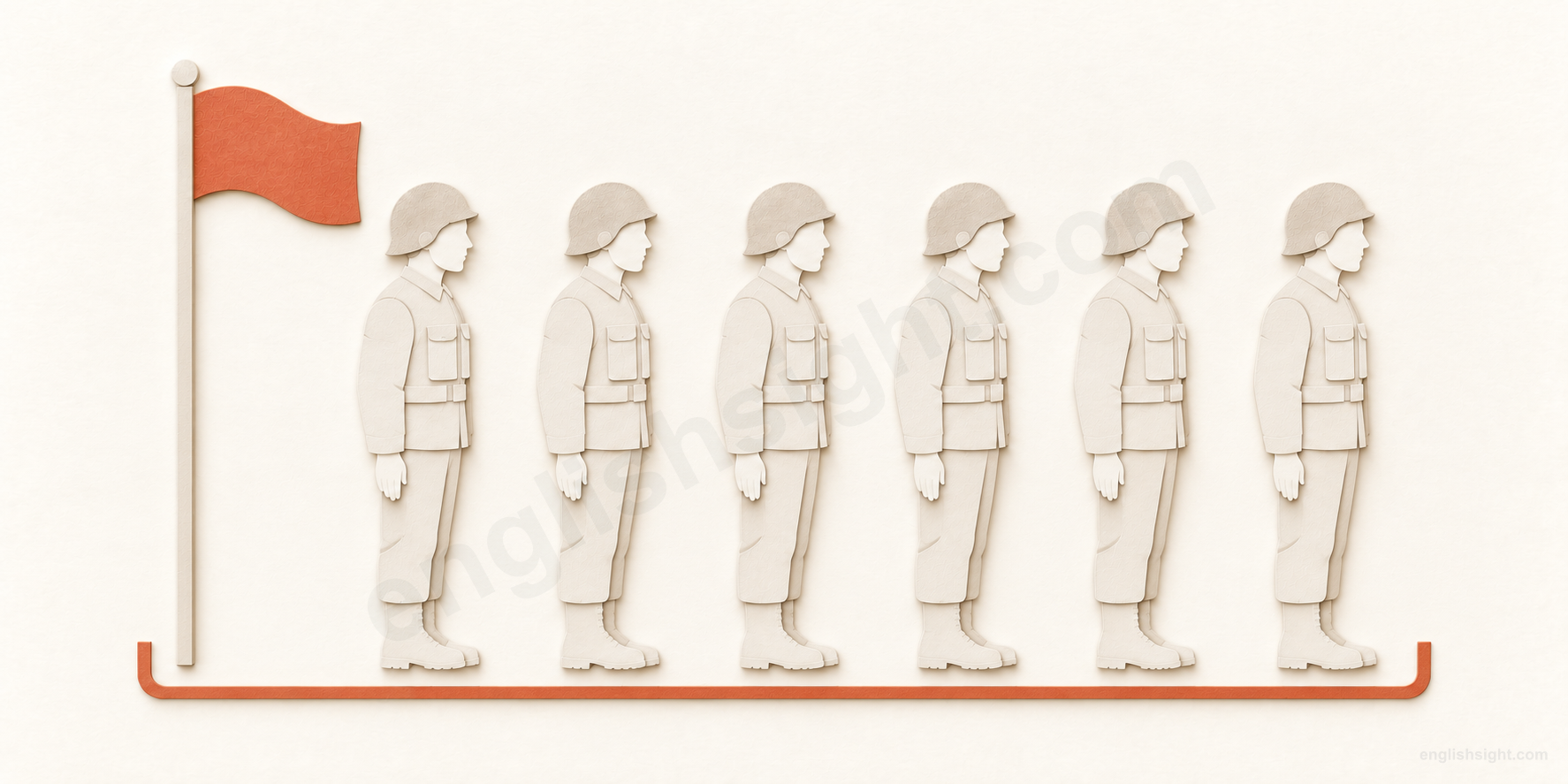
Shared uniforms, formation and a standard show organization.
The six soldiers represent a much larger organized force. Figurative uses borrow the sense of a large body.
An army presents many soldiers as one organized force; figurative uses borrow the sense of a large body, sometimes with a shared purpose.
This is a relationship between members and a group, not a required change from before to after. Size alone does not make a crowd a literal army.
Army usually names a body of soldiers, especially one trained for fighting on land. It treats many members as a single organized force. The same word can name a country’s land service.
In an army of helpers, ants, or cameras, English borrows the impression of a large body. The members may share a purpose, but not every figurative army has military organization. This connection is a teaching model, not a claim about a picture shared by every English speaker.
01
Soldiers and military service
Distinguish an organized fighting force from a country’s land service, then describe membership and things connected with it.
01
an / the / possessive + army; number + armies
an army / two armies
a large organized body of soldiers trained for land warfare
Situation / members
A historical account describes soldiers belonging to separate forces.
Meaning / whole group
You refer to each organized force as an army.
Army counts the whole force, not one soldier.
Army is a countable noun: an army, the army, two armies. A soldier is one person; an army is a body of soldiers with organization and training. It can exist without fighting at that moment.
The force need not be a government’s: a rebel army is also possible. In military writing, an army can additionally name a particular large formation within a wider force; this lesson does not teach its technical command structure.
In a sentence
The two armies agreed to stop fighting at dawn.
Watch the difference Write armies for the plural, not armys. A person is a soldier, not an army.
02
the army; the + country adjective + army
the army
the land-warfare branch of a country’s armed forces
Situation / members
You need to say which military service someone belongs to.
Meaning / whole group
The army identifies the land service.
The army is a particular military institution.
In this use, the army names a country’s land service. The navy and the air force are other services; armed forces is the wider expression covering a country’s military services.
The relevant country can come from context or be named: the Canadian army. Formal names may capitalize Army, as in the British Army; ordinary generic uses such as an army stay lowercase. An army can have helicopters, so the distinction concerns the service rather than where every vehicle operates.
In a sentence
The army and the navy took part in the rescue exercise.
Watch the difference Do not automatically use army for every military service together; use armed forces when that broader meaning matters.
03
join / leave the army; go into the army
join / leave the army
begin or end membership of the military service
Situation / members
Someone is choosing a career or ending military service.
Meaning / whole group
Join marks entry; leave marks departure from membership.
These verbs describe changes in membership, not movement into a building.
Join the army means become a member. Go into the army is another way to describe entering military service. Leave the army means stop serving; it does not necessarily mean walk away from a camp.
Join takes the group directly as its object: join the army. In go into the army, into belongs to the verb phrase describing entry. Neither combination gives army a verb meaning.
In a sentence
Maya joined the army after college and left five years later.
Watch the difference Say join the army, not join in the army. Join in normally concerns taking part in an activity.
04
be / serve in the army; serve in + named army
be / serve in the army
belong to or perform military service in the land forces
Situation / members
You are describing a person’s work or background.
Meaning / whole group
The phrase tells the listener about military membership or service.
In marks membership of an institution here.
She is in the army describes her current membership, not her physical position among a crowd of soldiers. She served in the army reports military service and is useful when describing someone’s past.
The tense gives the time: is in the army, was in the army, has served in the army. Serve in the army focuses on the service; join the army focuses on becoming a member.
In a sentence
My grandfather served in the army before he became a teacher.
Watch the difference Use in for membership: in the army. At an army base describes a location instead.
05
army + noun; army + plural noun
an army officer / an army base
a person, place, or thing associated with the army
Situation / members
A noun such as officer, base, or uniform needs a more specific description.
Meaning / whole group
Army identifies its connection with the military service.
The following noun names the actual person, place, or thing.
Army can come before another noun: an army officer, an army base, army training, an army uniform. The whole phrase names an officer, base, training, or uniform; army narrows the type.
The modifier normally remains singular even if the following noun is plural: army officers, army bases. This is an ordinary noun-modifier pattern, not a separate action meaning. An army base is associated with the service; the army’s base uses a possessive to identify the base belonging to a particular army.
In a sentence
She works as a doctor at an army base.
Watch the difference Say army officers, not armies officers. An officer is one member; the army is the organization.
02
Building and maintaining a force
The verb or adjective supplies the action or time scale: army itself names the body of soldiers.
06
raise / lead / command + an / the army
raise / lead / command an army
create or direct an organized military force
Situation / members
A historical account asks who organized the soldiers and who directed them.
Meaning / whole group
Raise describes creating the force; lead or command describes directing it.
The verb contributes the action; army remains the collective body.
Raise an army means bring a force into existence, for example by recruiting and organizing soldiers. It does not mean physically lift the soldiers. Lead an army and command an army describe directing the force; command emphasizes authority.
These are useful in history and news. The same army can be raised, trained, led, deployed, or defeated: those different actions come from the verbs. In The army was defeated, the passive belongs to defeat, not to army.
In a sentence
The ruler raised an army, but an experienced general commanded it.
Watch the difference Raise an army and join the army describe different roles: organizing a force versus becoming one of its members.
07
a standing army; maintain / keep a standing army
a standing army
a permanent military force maintained in peace as well as war
Situation / members
A country needs a force that is not assembled only for one conflict.
Meaning / whole group
It maintains a standing army on an ongoing basis.
Standing describes continued existence, not posture.
A standing army is maintained permanently, including during peacetime. Learn standing army as a combination: it does not describe soldiers who happen to be on their feet.
Compare raise an army, which focuses on forming a force. Maintain a standing army focuses on keeping one available over time; it says nothing about whether the soldiers are currently in combat.
In a sentence
The country maintained a standing army even during the long peace.
Watch the difference Do not interpret standing as the opposite of sitting in this expression.
03
Large groups beyond the military
An army of can make a group sound numerous or powerful. Some groups cooperate; others merely seem overwhelming in number.
08
an army of + plural noun for people
an army of volunteers
a large group of people working on a shared activity
Situation / members
Many people cooperate to complete a demanding job.
Meaning / whole group
You emphasize their numbers and combined effort.
The group is compared with a force; its members need not be soldiers.
An army of volunteers presents the helpers as a substantial body of people. An army of assistants or technicians works similarly. Of names the members; army makes their combined numbers or effort prominent.
The military idea supplies a comparison, not literal weapons or enlistment. A team of volunteers can be a neutral description of a working group; an army of volunteers gives a stronger impression of scale.
In a sentence
An army of volunteers cleared the park before the festival.
Watch the difference Do not assume an army of volunteers means unpaid soldiers. The surrounding activity determines whether the phrase is military or figurative.
09
an army of + plural noun for animals or things
an army of ants / cameras
a very large number of creatures or things
Situation / members
There are so many creatures or objects that their numbers stand out.
Meaning / whole group
Army makes the multitude sound impressive or overwhelming.
Large numbers matter; a shared plan is not required.
An army of ants is a vivid way to describe a great many ants. The construction also allows things: an army of cameras can stress how many cameras are gathered in one place.
The extension can retain an impression of massed strength without claiming deliberate military organization. Compare an army ant, which names a kind of ant: it is not the same construction as an army of ants.
In a sentence
An army of ants had gathered around the fallen pear.
Watch the difference Of is essential when naming the members of this group: an army of ants, not an army ants.
10
a small / whole / vast army of + plural noun
a small army of helpers
a surprisingly substantial group, often described with playful exaggeration
Situation / members
A job involves more helpers than the listener might expect.
Meaning / whole group
The phrase draws attention to how many people are involved.
Small modifies the imagined army, not necessarily the ordinary size of the group.
A small army of helpers can still mean quite a lot of helpers. The playful comparison treats them as a force that is small for an army but substantial for the everyday job.
A whole army of helpers strengthens the impression of numbers. A vast army of supporters emphasizes an even greater scale. These modifiers change emphasis; none gives a precise headcount.
In a sentence
We needed a small army of helpers to move all those books.
Watch the difference A small army of helpers need not mean only two or three people. Read the phrase as a comparison, not a numerical measure.
04
A challenge and a proverb
These established expressions depend on the whole phrase. One challenges someone’s power; the other stresses the need for food.
11
“I’ll + threat or difficult action.” — “You and whose army?”
You and whose army?
an informal challenge to someone’s ability to carry out a threat or difficult plan
Situation / members
Someone claims they will force you to do something.
Meaning / whole group
You show that you doubt they have the power to do it.
The imagined army represents the extra strength the person would need.
This reply questions someone’s ability to do what they say. It is a rhetorical challenge, not normally a genuine request for the name of a military force.
The tone can be defiant or mocking. Friends may use it in obvious play, but it can escalate a real disagreement; it is unsuitable as a neutral way to ask for help or clarification. Whose asks about belonging, whereas who’s means who is or who has.
In a sentence
“I’ll make you give up your seat.” “You and whose army?”
Watch the difference Use whose, not who’s. This is a confrontational challenge, not a polite question about the other person’s resources.
12
An army marches on its stomach.
An army marches on its stomach.
people need food in order to work or fight effectively
Situation / members
A demanding task is planned, but practical food needs may be overlooked.
Meaning / whole group
The saying reminds people that performance depends on being fed.
The whole proverb makes the point about practical support.
The saying uses an army’s need for food to make a broader point: people cannot perform well if their basic need for food is ignored. It can be quoted about feeding a group doing demanding work.
Marches on its stomach is figurative. It does not describe crawling on a belly, and it is not a general new meaning of army. Learn the sentence as a proverb; its is the possessive referring back to the singular army.
In a sentence
“Let’s feed the volunteers first—an army marches on its stomach.”
Watch the difference Use its for possession, not it’s. The proverb concerns food and effectiveness, not a literal marching position.
Keep the force, its members, and the grammar distinct
One army, many soldiers
Army is a noun, with plural armies. A soldier is a member, and the word troops often refers collectively to soldiers. An army is a whole organized force; the term armed forces covers military services more broadly. The noun has no tense, passive, causative, or phrasal-verb system of its own.
Agreement follows the variety and viewpoint
The army is ready treats the body as one unit and is a safe choice across varieties. British English also allows The army are ready when the members are in view; American English normally prefers singular agreement. For an army of technicians, the head noun is army, so singular agreement is a straightforward choice. With two armies, use a plural verb.
Related names are separate vocabulary
Named organizations and compounds such as the Salvation Army and Swiss Army knife have their own meanings. This lesson concentrates on ordinary army uses, not a catalogue of military ranks, formations, organizations, or equipment.
Choose the right group and pattern
Use the situation to distinguish membership, organization, and figurative numbers.
1. Maya becomes a member of the land service. Which sentence describes that change?
2. A report means all of a country’s military services, including the navy and air force. Which term fits that scope?
3. A charity has an army of volunteers sorting donations. What does army emphasize?
4. The country keeps its force during peace as well as war. Which description fits?
5. A friend says, “We needed a small army of helpers.” What can you reasonably conclude?
6. Someone replies “You and whose army?” to a threat. What are they usually doing?
7. Someone quotes “An army marches on its stomach” before a long day of work. What is the point?
Sources and teaching notes
The sources below support the meanings and usage patterns. Explanations, examples, and the visual grouping were created for this lesson; the grouping is a teaching interpretation.
The sketch explains members belonging to a force. It is a teaching aid, not a shared mental picture.