Move from making art and looking at it to creative fields, practiced skills, and familiar expressions.
Giving expression a form
Giving expression a form
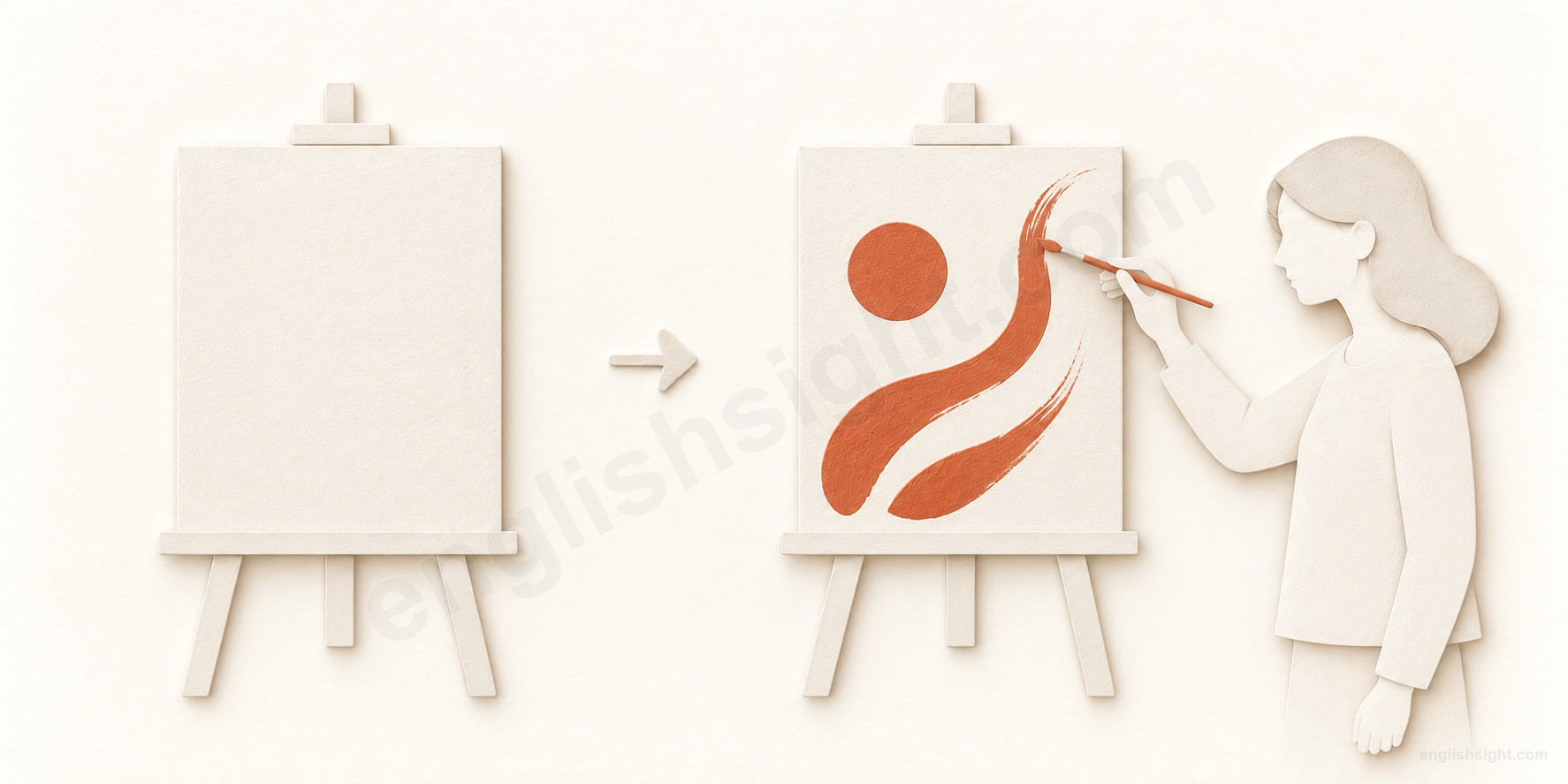
A blank canvas is ready for expression.
art
A circle and flowing strokes form an abstract composition.
The maker chooses and shapes the marks with a brush.
A maker gives expression a form; painting is one example of art.
Art uses skill and imagination to give ideas, feelings, or experiences an expressive form.
The sketch uses painting as one example. Art can use other media and need not be realistic or pretty. The skill sense and fixed expressions need their own context.
Imagine someone choosing a curve, a color, a sound, or a movement to express something. Art can name that creative activity, its results, or the field in which it happens.
English also uses art for a practiced skill, as in the art of listening. Keep that branch alongside the creative sense rather than forcing every use to mean a painting.
01
Making, seeing, and studying art
Start with creative activity, the things people create, and the subject you learn. The surrounding words show which aspect matters.
01
make / create / produce + art
make / create art
use imagination and skill for expression
Situation
Someone chooses shapes, sounds, or materials.
What you express
Those choices become an expressive creation.
Art names the creative activity; paint or clay is only one possible medium.
A person can make art from a memory, a feeling, or an imagined world. The maker chooses how to express something; copying a visible object is only one possibility.
Art is normally uncountable in this use: She makes art, not She makes an art when you simply mean creative work. The sketch shows a blank surface becoming a composition, one example of this broader activity.
Art need not look pretty, realistic, or expensive. Asking Is this art? can invite a judgment about a work rather than ask whether somebody can draw accurately.
In a sentence
Ravi creates art from memories of his childhood.
Watch the difference Use paint or draw for a specific action: draw a portrait, not art a portrait.
02
some art; a piece / work of art; pieces / works of art
a piece / work of art
refer to one creative work, or to works collectively
Situation
A gallery has several paintings and sculptures.
What you express
You discuss the collection or count individual works.
Art can name the results; piece and work let us count them.
We bought some art describes what was bought collectively. We bought two works of art counts two creations. For ordinary individual objects, use a piece of art, a work of art, or a specific noun such as a painting.
In two works of art, works carries the plural ending; art stays unchanged. The museum displays art and The museum displays three paintings differ in how precisely they count and identify the objects.
In a sentence
The gallery bought two works of art by a local sculptor.
Watch the difference Two arts usually suggests two disciplines, not two pictures.
03
study art; be good at art; an art class / teacher
study art / be good at art
learn or show ability in the subject
Situation
Students are learning drawing and other creative methods.
What you express
You name their subject, class, or ability.
The subject is art; a class or teacher is countable.
In school, art is a subject: We have art on Friday. You can study art, take an art class, or be good at art. None of these requires you to be a professional artist.
An art teacher teaches the subject, and an art class is a class in it. Art before another noun often specifies its field; the final noun controls the ordinary plural: two art teachers.
In a sentence
We have art on Friday, and we are learning to make prints.
Watch the difference I study arts may suggest a broader academic program; it is not always equivalent to I study art.
04
digital / contemporary / folk + art; art + gallery / exhibition
digital art / an art gallery
specify a medium, tradition, or connection with art
Situation
You want to describe work or find somewhere to see it.
What you express
A modifier or following noun narrows the topic.
Digital describes how art is made; gallery names a place connected with it.
Digital art uses computers or other digital media. Compare art made on a tablet with a photograph of a paper drawing: merely storing a photo digitally does not describe how the original drawing was made.
Modern art, contemporary art, and folk art are useful labels to recognize. Do not treat all labels as synonyms or assume modern always means made this year.
An art gallery displays works; an art exhibition is a display or event. In We saw digital art at an art exhibition, digital describes the art and art describes the kind of exhibition.
In a sentence
The art gallery has an exhibition of digital art.
Watch the difference Art gallery does not normally mean a gallery that itself is an artwork.
02
Creative fields and learned disciplines
Art, an art, and the arts name different kinds of activity. Some familiar combinations name school subjects or practical disciplines rather than pictures.
05
the arts + plural verb; the visual / performing arts; an arts festival
the arts / visual arts / performing arts
refer to creative fields together or to a group of them
Situation
A town supports music, theatre, and exhibitions.
What you express
You discuss the creative fields as a group.
The plural phrase the arts is broader than paintings alone.
The phrase the arts refers to creative fields as a group. The town supports the arts can include music, literature, dance, theatre, and visual work; it does not simply mean buying paintings.
The visual arts involve work perceived through sight, such as painting and sculpture. The performing arts involve activities presented to an audience, such as acting, dance, and music. The categories serve different purposes and can overlap in particular projects.
Use plural agreement: The arts are important here. In an arts festival, arts helps specify a festival’s focus; the article an belongs to festival.
In a sentence
The arts are part of town life, from theatre to sculpture.
Watch the difference Do not replace the arts with the art unless you mean particular art already identified.
06
be an art / art form; different art forms; turn + activity + into an art form
an art / an art form
identify a particular creative discipline
Situation
You are discussing cinema alongside other creative practices.
What you express
You classify it as a form of artistic expression.
The countable noun names a kind of activity, not one individual object.
Cinema is an art form classifies cinema as a creative medium. The plural art forms might include poetry, dance, and sculpture. An art can also name a discipline, though art form often makes that meaning clearer for a learner.
Turn something into an art form can also praise or humorously exaggerate skill: He has turned making excuses into an art form. The speaker is evaluating his elaborate performance, not announcing a new museum category.
In a sentence
Animation is an art form that combines movement and images.
Watch the difference An art form is a category; a work of art is a particular creation.
07
study fine art; the fine arts; a fine-art course
fine art / fine arts
name art valued primarily for its expressive or aesthetic qualities
Situation
A college offers painting and sculpture courses.
What you express
You describe this area of artistic study.
Fine art is a field name, not simply art that you consider good.
Fine art commonly refers to work such as painting, drawing, and sculpture considered for artistic qualities rather than chiefly for a practical function. Fine arts is also used for these fields together.
In She studies fine art, fine is part of the field name. In That is a fine painting, fine evaluates the painting. The distinction between artistic and practical work is useful here, but real practices can combine both.
In a sentence
Mina studies fine art and works mainly in sculpture.
Watch the difference Fine art does not mean every other creative field lacks value.
08
an arts degree; a Bachelor of Arts; a liberal arts college
an arts degree / liberal arts
refer to broad academic subjects rather than only studio art
Situation
A student chooses history and languages.
What you express
You describe the academic area or kind of education.
Academic arts can include subjects in which no pictures are made.
Arts in an arts degree or Faculty of Arts often refers to subjects such as history, literature, and languages, commonly contrasted with sciences. I study art more readily suggests the creative subject itself.
Liberal arts, especially in North American education, emphasizes general knowledge and thinking rather than training for one technical job. Do not assume that every liberal arts program excludes science, or that the phrase means painting classes.
A Bachelor of Arts is a degree title, often shortened to BA. The exact subjects and degree names depend on the institution; the title alone does not identify an art student.
In a sentence
His arts degree includes courses in history and French.
Watch the difference An arts graduate need not be a painter or an actor.
09
do arts and crafts; an arts and crafts + session / fair
arts and crafts
describe creative activities involving practical making
Situation
A community center offers pottery and jewelry making.
What you express
You name the group of hands-on activities.
The established plural phrase joins creative and practical skills.
Arts and crafts includes activities such as making pottery, jewelry, or decorative objects by hand. An arts and crafts session may focus on one activity; the phrase does not require several unrelated lessons at once.
Keep the familiar plural form arts and crafts. In an arts and crafts fair, fair is the countable head noun: two arts and crafts fairs.
In a sentence
The children made paper birds during an arts and crafts session.
Watch the difference Arts and crafts does not name all university arts subjects.
10
a martial art; practice / learn martial arts
a martial art / martial arts
name a fighting discipline such as judo or karate
Situation
Someone wants to learn a fighting sport.
What you express
You talk about a particular discipline or the group.
Here art belongs to the established name of a trained practice.
A martial art is a fighting discipline, such as judo or karate. Martial arts is the usual plural name for these practices together: She practices martial arts.
Martial supplies the fighting connection; art alone does not mean fighting. Compare learning an art form for performance with learning a martial art: the modifiers and context identify different practices.
In a sentence
He wants to learn a martial art, so he has joined a judo class.
Watch the difference Do not translate art in this combination as a picture or an exhibition.
03
Doing something with practiced judgment
Calling an activity an art emphasizes how well someone handles it. These uses extend beyond galleries and do not require a physical artwork.
11
the art of + noun / -ing; master the art of + -ing; be quite an art
the art of doing something / quite an art
describe an activity requiring skill, judgment, and practice
Situation
A task looks simple but takes experience to handle well.
What you express
You emphasize the ability involved.
The art is the practiced way of doing the activity, not an object produced.
The art of listening means the skill involved in listening well. After of, use a noun or an -ing form: the art of conversation; the art of asking questions. The noun names the activity, not the person who owns an artwork.
Calling something an art often highlights judgment or a personal touch beyond simply following instructions. That is an emphasis, not a claim that rules or scientific knowledge are useless.
Keeping a roomful of children interested is quite an art means it takes considerable skill. Master the art of doing something says you have learned to handle it well.
In a sentence
Nora is learning the art of giving clear feedback.
Watch the difference Use the art of giving, not the art of give or the art to give for this pattern.
12
a lost / dying art; become a lost art
a lost / dying art
describe a skill that few people still practice
Situation
A useful traditional technique is becoming uncommon.
What you express
You comment on its decline, often with regret.
Lost or dying describes the practice becoming rare.
A lost art is a skill that people no longer commonly use or know. The phrase often exaggerates: calling careful letter writing a lost art does not assert that nobody can still write a letter.
A dying art emphasizes that the practice is declining. Compare a lost work of art, which can mean a missing painting or sculpture: adding work changes what is lost.
In a sentence
Repairing these old clocks is becoming a lost art.
Watch the difference A lost art usually refers to a disappearing skill, not a painting whose location is unknown.
13
get / have + task + down to a fine art
get / have something down to a fine art
become very good and efficient at a repeated task
Situation
You repeat a task and work out a reliable method.
What you express
You can now do it smoothly and efficiently.
The complete informal expression evaluates practiced performance.
I’ve got packing down to a fine art says I now pack very well and efficiently. Have something down to a fine art describes the resulting level of skill; get it down to a fine art emphasizes reaching that level.
The thing before down can be a noun or an activity: have the morning routine down to a fine art. Keep the whole expression together. It does not say you have turned packing into a gallery exhibit.
In a sentence
After months of practice, we have the school run down to a fine art.
Watch the difference This informal idiom is different from studying fine art as a subject.
04
Praise, technology, and cultural discussion
Learn these complete expressions in context. Their meanings cannot be predicted just by picturing a painting.
14
be a work of art; describe + object + as a work of art
a work of art
praise something made with exceptional care or beauty
Situation
You admire a cake or another carefully made object.
What you express
You compare its quality to that of an artwork.
The expression can praise an everyday object without literally classifying it as art.
Calling a decorated cake a work of art praises its appearance and the skill involved. This is related to the literal phrase for a painting or sculpture, but it can apply to something made for a practical purpose.
Read the tone and object: This cake is a work of art is usually praise; The gallery restored a work of art normally refers to an actual artwork. The same noun phrase supports both uses.
In a sentence
The baker’s wedding cake was a work of art.
Watch the difference The phrase does not imply that the object must be placed in a museum.
15
a state-of-the-art + noun; be state of the art
state-of-the-art
describe technology using the most advanced methods currently available
Situation
A company installs equipment with very advanced features.
What you express
You describe its level of technical development.
This established adjective concerns current technical achievement.
A state-of-the-art scanner uses highly advanced technology available at that time. The expression is not about drawing, sculpture, or attractive design.
Hyphenate the expression when it comes before a noun: a state-of-the-art studio. After be, an unhyphenated form is also used: The equipment was state of the art when we bought it. A past reference does not guarantee it is still advanced today.
In a sentence
The hospital has installed a state-of-the-art scanner.
Watch the difference New or expensive equipment is not automatically state of the art.
16
art for art’s sake; make art for art’s sake
art for art’s sake
value making art for its own importance
Situation
Someone asks whether every artwork must serve another purpose.
What you express
You express the view that art itself is a sufficient reason.
For its own sake gives the purpose; art alone does not carry the whole claim.
Art for art’s sake names an approach that values art in itself, rather than requiring it to achieve a separate goal. It is a phrase used in cultural discussion, not a rule that all artists accept.
The possessive art’s belongs before sake. In She makes art for art’s sake, the first art names what she makes; the rest explains why. It does not mean she makes art carelessly.
In a sentence
The group defends art for art’s sake, even when a project has no practical use.
Watch the difference Do not interpret sake as the Japanese drink in this expression.
17
an art film; watch / make art films
an art film
identify a film emphasizing artistic aims or distinctive technique
Situation
Friends are choosing between different kinds of cinema.
What you express
You describe a film’s artistic emphasis.
Art helps name a category of film; it does not identify the film’s subject.
An art film typically emphasizes artistic expression, distinctive technique, or unconventional content. It need not tell a story about painters or museums.
You may enjoy an art film or find it difficult; the label does not guarantee that you will admire it. In art films, films takes the plural ending.
In a sentence
The cinema is showing an art film with very little dialogue.
Watch the difference A documentary about painting is not automatically an art film.
Choose the meaning and the count carefully
Art, an art, and the arts
Art is normally uncountable for creative activity, the school subject, and artworks considered together. An art can be a discipline or a skilled activity. The plural phrase the arts refers to creative fields as a group. Count objects with works or pieces, not ordinary two arts.
Art, artist, and artistic
An artist is a person; artistic describes a person’s ability or something’s creative qualities. Art often comes before another noun to name a field or association: an art teacher. Dictionaries sometimes label certain attributive uses as adjectives; the example and context matter more than the label.
Modern noun and established expressions
Pronunciation is /ɑːt/ in standard British English and /ɑːrt/ in standard American English. This lesson centers on the noun, its modifiers, and familiar expressions. Thou art is an old form meaning you are, not a modern verb meaning create art. There is no ordinary phrasal-verb, passive, or causative family to build from this noun.
A model with limits
The creator and composition illustrate expressive making. Academic arts, martial arts, and state-of-the-art have conventional meanings that a painting alone cannot predict. Art and craft can overlap; the words do not establish a universal ranking of creative work.
Choose what art is doing
Check whether the sentence refers to objects, fields, skills, or a whole fixed expression.
1. You bought two paintings. Which sentence counts the objects naturally?
2. A town funds theatre, music, and exhibitions. Which sentence includes these creative fields together?
3. A student has an arts degree in history. Must the student have studied painting?
4. You are developing skill at listening. Which pattern fits?
5. You now pack quickly and efficiently after doing it many times. What fits?
6. An advertisement calls a scanner state-of-the-art. What is it claiming?
Sources and teaching notes
The sources below support the uses and distinctions taught here. Explanations, examples, and the visual model are original teaching material; the model is not evidence that all uses have one meaning.
The sketch is a teaching aid, not a mental image shared by every English speaker.