Use as to name a role, compare a degree, connect events, and build familiar expressions.
A situation and a reference
A situation and a reference
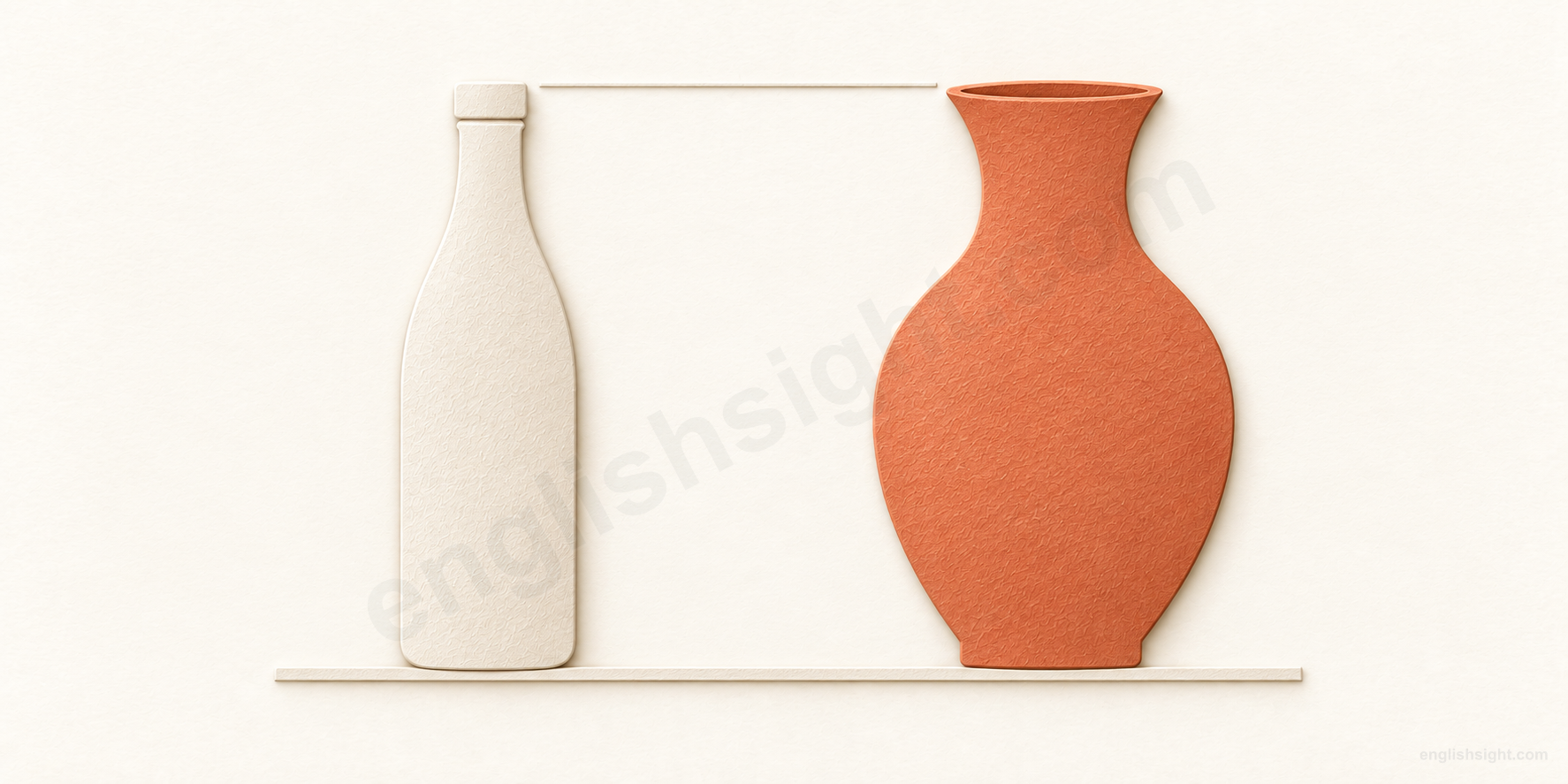
The ivory bottle is the object whose height we describe.
as
The bottle reaches the same height as the vase.
Compare its height with the terracotta vase on the same baseline.
The bottle is as tall as the vase: different shapes, matching height.
One side is what you are describing; the other supplies a role, standard, manner, or background. Read the construction to identify the connection.
Matching height is only one clear illustration. As does not always mean equal, and the diagram cannot predict the meanings of fixed expressions.
As is a small grammatical word with several jobs. It can name what someone is acting as, compare how much or how well, or connect one situation with another. A useful question is: what reference or background does the expression supply?
The sketch focuses on matching a degree. Extending the idea to roles or background is a teaching aid, not a historical derivation of every sense. Time, reason, concession, and idioms still need their own patterns. English speakers do not all picture the word in the same way.
01
Identity, role, and appearance
A noun after as can name a job, function, category, life stage, or assumed identity. The surrounding verb tells you which relationship is intended.
01
work / act / serve as + noun; use + object + as + noun
work as / use as
have a role or perform a function
Situation / starting point
A person does a job, or an object has a use.
Connection / interpretation
You name that role or use.
As introduces the capacity in which someone or something functions.
She works as a guide names her job. We used a box as a seat names the job the box did on that occasion. It need not be what the object was designed for.
Serve as and act as also introduce functions. The meaning of doing work, serving, or acting comes from the verb; as connects it to the role.
Compare She works like a guide: this compares her behavior with a guide’s and does not by itself name her job. The news came as a shock describes how the news was experienced.
In a sentence
We used an empty box as a seat.
Watch the difference Use as for a function; like alone normally gives a resemblance.
02
regard / describe + object + as + noun or adjective; be known as + name
regard / describe / be known as
assign or report a description
Situation / starting point
Someone assesses or names a person or thing.
Connection / interpretation
A category or name is attached to it.
The verb determines whether the description is a judgment, report, or established name.
Regard someone as reliable presents a judgment; describe something as useful reports a description. As can introduce an adjective as well as a noun in these verb patterns.
This place is known as the Old Mill gives a familiar name. In She was described as a leader, the passive changes who is foregrounded; it does not change the role of as.
Learn the verb pattern too: call her a genius and consider her reliable need no as in these ordinary constructions. Do not insert as after every verb that involves a judgment.
In a sentence
The team regards Maya as a dependable leader.
Watch the difference As does not guarantee that a judgment is objectively true.
03
as + life-stage noun phrase, + clause
as a child
during a stage of someone’s life
Situation / starting point
You refer to an earlier period of a person’s life.
Connection / interpretation
You identify the person’s stage at that time.
As a child describes when the subject had that identity.
As a child, I collected shells means I did so when I was a child. It is not a comparison with somebody else’s childhood.
The noun phrase normally refers to the person who is the subject of the main clause. As a child, the sea fascinated me is awkward because the grammatical subject is the sea. When I was a child, the sea fascinated me is clear.
In a sentence
As a child, I collected shells on the beach.
Watch the difference Keep it clear whose life stage the phrase describes.
04
dress (up) as + noun; be disguised as + noun
dress as / disguised as
appear in an assumed identity
Situation / starting point
Someone chooses a costume or hides an object’s nature.
Connection / interpretation
The appearance represents another person or thing.
As names the identity being represented, not necessarily the true one.
Dress as a pirate means wear a pirate costume. A camera disguised as a clock looks like a clock so that people may not notice the camera.
The ideas of dressing and concealment come from dress and disguise. As supplies the identity being presented; it does not itself mean deception.
In a sentence
For the school play, Ben dressed as a pirate.
Watch the difference Dressed as a doctor can describe a costume; it does not establish medical qualifications.
02
Compare a degree, amount, or description
The two parts of as … as set a measure against a reference. Related constructions identify examples, matching things, or a more accurate description.
05
as + adjective / adverb + as + noun, pronoun, or clause; not as / so … as; as + adjective + a/an + singular noun + as + reference
as tall as / as quickly as
compare an equal degree
Situation / starting point
Two people, things, or performances are compared.
Connection / interpretation
One reaches the degree supplied by the reference.
The adjective or adverb names the dimension of comparison.
In as tall as her brother, tall names the property and her brother supplies the reference. In works as carefully as I do, carefully names how the work is done.
With a singular count noun, the adjective can come before a/an: It is as useful a tool as the old one. The order is as + adjective + a/an + singular noun + as + reference. The simpler alternative is This tool is as useful as the old one.
Not as tall as means less tall; not so tall as is another established negative comparison. As tall as does not require as taller as: use the ordinary adjective, not the comparative.
The second part can be shortened when its meaning is clear. As tall as me is normal conversation; as tall as I am makes the clause explicit. Just as tall as emphasizes the match. Similes such as as quiet as a mouse use the same frame, often figuratively.
In a sentence
This shelf is as wide as the desk.
Watch the difference Use as wide as, not as wider as or as wide than.
06
as much + uncountable noun + as; as many + plural noun + as; twice / half as … as
as much as / twice as many as
compare amounts or multiples
Situation / starting point
You compare money, time, objects, or quantities.
Connection / interpretation
You say whether amounts match or differ by a factor.
Much fits uncountable quantities; many fits plural countable things.
As much water as compares water; as many bottles as compares bottles. The noun may be left out when already understood: You have more time; I don’t have as much.
Twice as much means two times the reference amount, and half as many means half the reference number. This bag costs twice as much as that one compares price, not quality.
In as much of a problem as before, of a lets the comparison describe how strongly a singular count noun applies. The basic degree relationship remains the same.
In a sentence
We packed twice as many cups as plates.
Watch the difference As many information is wrong: information is uncountable, so use as much information.
07
as + adjective / adverb + as possible; as + adjective / adverb + as + subject + can
as soon as possible / as fast as you can
reach the practical limit
Situation / starting point
You want speed, care, or another quality at its available maximum.
Connection / interpretation
The action approaches what is possible or what someone can do.
The reference is a limit rather than another object.
As soon as possible asks for the earliest feasible time. As carefully as you can asks for the greatest care the person can manage. Context determines what is actually possible.
ASAP is an abbreviation of as soon as possible, common in messages. It can sound urgent; adding please does not remove every possible pressure.
Do not confuse as soon as possible with as soon as the bus arrives. The latter links an action to an event rather than setting a general earliest time.
In a sentence
Please send the corrected file as soon as possible.
Watch the difference Use possible directly; not as soon as it possible.
08
as many / few as + number; as much / little as + amount
as many as / as little as
highlight a surprisingly high or low amount
Situation / starting point
A number matters because of its size.
Connection / interpretation
The speaker frames it as notably large or small.
The whole phrase adds emphasis; it is not an ordinary comparison between two named things.
As many as forty people frames forty as a notably large number in context. As few as three places frames three as a notably small number.
Use as much as and as little as for money, measured quantities, or uncountable amounts: Tickets cost as little as five dollars. This can advertise a minimum price; it does not say every ticket costs that amount.
The number itself gives the amount; many, few, much, or little supplies the evaluative direction. These expressions need no second comparison noun after the number.
In a sentence
The tiny hall can hold as many as eighty people.
Watch the difference As many as emphasizes a high number in context; it does not always mean an exact upper limit.
09
the same (noun) as + noun / pronoun / clause
the same as
identify a matching thing or feature
Situation / starting point
You compare identities, types, or features.
Connection / interpretation
You say they match in the relevant respect.
Same takes as to introduce the reference.
The same model as mine says the model matches; it does not mean two people own one physical object. The same person as yesterday can instead identify one individual.
The same size as compares a specified feature. Exactly the same as strengthens the match; much the same as allows a broad similarity. Context decides what sameness amounts to.
In a sentence
Your phone is the same model as mine.
Watch the difference Use the same as in this pattern, not the same than.
10
category noun + such as + example(s); such as this; Such as?
such as
give examples or specify a type
Situation / starting point
You name a broad category.
Connection / interpretation
You provide members or an illustrative case.
Such as connects a category to examples; it does not usually give an exhaustive list.
Vegetables such as carrots and peas offers examples of vegetables. For example can introduce a whole new sentence more freely; such as normally belongs inside the phrase or sentence it develops.
Such as this can mean of this kind: A chance such as this is rare. The reply Such as? asks the other person to supply an example.
Do not add a second for example to the same list: fruits such as apples is enough.
In a sentence
Bring waterproof clothes, such as a raincoat and boots.
Watch the difference The examples illustrate the category; as itself does not mean that every member is listed.
11
not so much + X + as + Y
not so much … as …
prefer one description over another
Situation / starting point
A first description seems less accurate.
Connection / interpretation
You replace or qualify it with a better one.
This construction contrasts descriptions rather than simply measuring two quantities.
Not so much a mistake as a misunderstanding says misunderstanding is the better label. It does not need to deny every element of a mistake.
The two sides can also be parallel actions: She doesn’t so much teach as encourage us to discover things. Keep the grammar on both sides easy to compare.
In a sentence
It was not so much a meeting as a chance to catch up.
Watch the difference This use of as introduces the preferred description, not a reason meaning because.
12
without so much as + noun / -ing; not so much as + verb
without so much as
emphasize that even a small action did not happen
Situation / starting point
A minimal courtesy or action would have been expected.
Connection / interpretation
It is missing, along with anything greater.
So much as means even in this negative environment.
Without so much as a word means without even saying one word. Without so much as looking up says that even the small act of looking up did not happen.
The expression often conveys disappointment or criticism. This meaning belongs to the negative phrase; it cannot be predicted by treating much as a physical amount.
In a sentence
He left without so much as a goodbye.
Watch the difference Do not read it as a comparison between the size of two goodbyes.
13
as + plural category noun + go, + evaluation
as hotels go
judge something relative to its type
Situation / starting point
You choose a category as the standard.
Connection / interpretation
You evaluate one example against what is normal for that category.
The category supplies a limited comparison standard.
As hotels go, this one is inexpensive means inexpensive compared with hotels generally. It may still cost more than a hostel or staying with friends.
The same frame works with people or things: as teachers go, as repairs go. Go does not mean physical movement here; the full expression establishes the category used for judgment.
In a sentence
As hotels go, this one is inexpensive.
Watch the difference The judgment is relative to the stated category, not necessarily to every possible alternative.
03
Connect events, explanations, and comments
As can introduce a clause about time, manner, reason, or an unexpected contrast. These are established grammatical uses; equality alone cannot explain them.
14
(just / even) as + clause, + clause
as I was leaving
place events at the same time
Situation / starting point
One event is happening or just begins.
Connection / interpretation
Another event occurs during it or at that moment.
As introduces the event used as the time reference.
As I was leaving, the phone rang places the ring during the departure. Just as I reached the door makes the timing especially exact. Even as can emphasize two events happening at the same time.
As often works well for activities or unfolding events. For a long stable period, while can be clearer: While I lived abroad, I learned to cook. When is a broader choice for identifying an occasion.
An as-clause about the future normally uses a present form when it functions as a time clause: I’ll wave as the train leaves.
In a sentence
Just as I reached the door, the phone rang.
Watch the difference As can also give a reason; use when or while if the timing would otherwise be unclear.
15
as + changing situation, + developing situation
as things change
describe developments together
Situation / starting point
One process develops over time.
Connection / interpretation
Another develops alongside it.
The time relation can track gradual change without proving a cause.
As the room grew warmer, the ice melted describes two developing processes together. Context may suggest a causal connection, but as alone does not establish evidence for it.
The more … the more … explicitly compares changing degrees. As can simply place the developments together without specifying a proportional relationship.
In a sentence
As the afternoon passed, the shadows grew longer.
Watch the difference Do not assume as always means because when two changes occur together.
16
as + reason clause, + main clause; main clause + as + reason clause
as it was late
supply a reason
Situation / starting point
A situation helps explain a decision or result.
Connection / interpretation
You give that situation as background.
This as means because, not during.
As it was late, we took a taxi offers the late hour as the reason. Because makes the reason more explicit and is often the clearer answer to Why?
The same surface form can sometimes suggest time or cause. As she was cooking, I opened a window could refer to timing or a reason. Write while she was cooking or because the kitchen was hot when the distinction matters.
In a sentence
As the café was closed, we made tea at home.
Watch the difference Do not mechanically translate every as as because.
17
verb + as + clause; as agreed / expected / shown; as in + reference
do as I say / as agreed
follow a manner, model, or arrangement
Situation / starting point
Someone gives a method, prediction, or arrangement.
Connection / interpretation
The actual action is related to it.
The as-clause supplies how something is done or the model it follows.
Fold it as I showed you means use the demonstrated method. Just as I predicted points out that events matched a prediction. As in the diagram points to a model or example.
Short forms such as as agreed, as expected, and as shown leave out words understood from context: as we agreed, as was expected, as is shown. Their interpretation depends on the phrase.
Like before a clause is common in informal speech, but as is a straightforward choice for this manner pattern in formal writing. Before a noun, like often expresses resemblance: Draw it like a wheel.
In a sentence
Please fold the paper as I showed you.
Watch the difference An as-clause can specify a method; as a teacher instead names a role.
18
as + comment clause, + statement; statement, + as + auxiliary + subject
as you know / as is often the case
add a comment about a statement
Situation / starting point
You make a statement.
Connection / interpretation
You connect it to shared knowledge, evidence, or a parallel fact.
As can comment on a whole statement rather than supply the time or reason.
As you know, we close early on Fridays treats the schedule as shared knowledge. As you can see points to available evidence. As I mentioned refers back to something said before.
A comment can also come in the middle or at the end. The remark We were delayed, as were several other teams uses formal inversion to add a parallel fact; several other teams were delayed too.
Use shared-knowledge wording thoughtfully: As you know assumes the listener knows it. If that is uncertain, As you may know leaves more room.
In a sentence
As you may know, the library closes early on Fridays.
Watch the difference Here as does not mean because you know.
19
adjective + as + subject + verb; try as + subject + may / might; (as) much as + clause
tired as I was / much as I’d like to
acknowledge a fact before an unexpected contrast
Situation / starting point
A fact might lead you to expect one result.
Connection / interpretation
A different result is nevertheless true.
Word order and the whole construction give as a concessive meaning.
Tired as I was, I stayed to help means that although I was tired, I stayed. This adjective-first pattern is more formal or literary than although I was tired.
Try as I might, I could not move it means that however hard I tried, I failed. This is a set concessive arrangement, not the ordinary command Try as I do.
Much as I’d like to join you, I have to work expresses a strong wish followed by a limitation. As much as I’d like to is also used. With a number, as much as may instead emphasize an amount.
In a sentence
Tired as I was, I stayed to help clear the room.
Watch the difference Do not place as first and expect the same concessive meaning: As I was tired usually supplies a reason.
04
Imagined situations, timing, conditions, and limits
Learn the whole expression. If, soon, long, far, and so change what kind of connection the sentence makes.
20
as if / as though + clause; As if!
as if / as though
compare reality with an apparent or imagined situation
Situation / starting point
Someone’s behavior or some evidence creates an impression.
Connection / interpretation
You describe the situation that it suggests.
The clause is a comparison, not necessarily an assertion that it is true.
He talks as if he owns the place compares his behavior with an owner’s. It may imply that he does not own it, but the grammar alone does not always settle the facts.
It looks as if it is going to rain presents a plausible inference. She treats me as if I were a child presents an unreal comparison; were is a formal option alongside common was. As if she had seen a ghost uses a past perfect for the imagined earlier experience.
As if! is an informal, dismissive reply expressing strong disbelief. As if I would tell him! similarly rejects the suggestion. The sarcastic force belongs to the conversational expression and tone.
In a sentence
He spoke as if he owned the whole building.
Watch the difference As if can describe either a possible explanation or an unreal situation; read the context.
21
main clause + as soon as + present / present perfect for future time
as soon as
put one event immediately after another
Situation / starting point
A trigger event happens.
Connection / interpretation
The next action follows promptly.
Soon contributes immediacy to the event link.
Call me as soon as you arrive asks for the call immediately after arrival. It names a trigger, unlike Call me as soon as possible, which sets a practical earliest time.
For an ordinary future time clause, use the present after as soon as: I’ll call as soon as I arrive. A present perfect is possible when completion matters: as soon as I have checked the figures.
In a sentence
I’ll send the photos as soon as I get home.
Watch the difference For this future time use, say as soon as I get home, not as soon as I will get home.
22
main clause + as / so long as + clause; as long as + time comparison
as long as / so long as
state a condition, a duration, or a reason
Situation / starting point
An action depends on a requirement, lasts for a period, or follows from a known fact.
Connection / interpretation
The clause supplies the requirement, period, or reason.
Context distinguishes a condition, a duration, and an already accepted reason.
You can borrow the bike as long as you return it by six sets a condition: returning it is required. So long as can give the same conditional meaning.
I’ll stay as long as you need me describes a duration: for the whole time you need me. The condition and time meanings can overlap when a situation continues only while another remains true.
As long as or so long as can also mean since when the situation is already accepted as a fact: So long as you’re here, you might as well stay for lunch. Your presence supplies a reason for the suggestion, rather than an uncertain future requirement.
In ordinary future conditions and time clauses, use a present form: as long as it stays dry. Long also has its literal length meaning in This rope is as long as that one, a regular comparison.
In a sentence
You can use my desk as long as you leave it tidy.
Watch the difference Conditional as long as does not require the action to last a long time.
23
as far as + place / clause; as far as … is concerned; go as far as to + verb
as far as
mark a physical limit, a knowledge limit, or a viewpoint
Situation / starting point
A journey, claim, or discussion needs a boundary.
Connection / interpretation
You name the point or perspective it reaches.
Far supplies the idea of extent; fixed endings specify what kind.
We walked as far as the bridge gives a physical endpoint. We have got as far as collecting the data gives a stage of progress. In go as far as to say, the limit can be a strong or surprising claim.
As far as I know means within my available knowledge, so I may not have all the facts. As far as I can tell has a similar limit based on judgment. As far as it goes can acknowledge limited value: It is useful as far as it goes, but it needs more detail.
As far as I’m concerned gives my personal position. As far as cost is concerned introduces that aspect of the discussion. These do not mean that I am worried; concerned is part of the fixed viewpoint expression.
In a sentence
As far as I know, the shop opens at nine.
Watch the difference Distinguish a knowledge limit from an opinion: As far as I know and As far as I’m concerned do different jobs.
24
verb + so as (not) to + base verb
so as to / so as not to
state an intended purpose
Situation / starting point
Someone chooses an action.
Connection / interpretation
You name what that action is intended to achieve or avoid.
Purpose comes from the full so as to construction.
We left early so as to avoid the traffic gives the reason for choosing an early departure. The aim may succeed or fail; the phrase does not guarantee the outcome.
For a negative purpose, use so as not to: She whispered so as not to wake the baby. In everyday language, to avoid or in order not to may also fit.
Compare so quiet as to be inaudible, a more formal degree-and-result construction. In Would you be so kind as to help?, the fixed polite request uses so + adjective + as to, not the ordinary purpose phrase.
In a sentence
We left early so as to avoid the traffic.
Watch the difference Ordinary purpose to has an infinitive: so as to avoid, not so as to avoiding.
05
Add information and organize a message
These expressions add an item, introduce a topic, contrast alternatives, or guide a reader through an explanation.
25
X as well as Y; as well as + -ing; main subject, as well as added phrase, + verb
as well as
add another item or activity
Situation / starting point
One item or activity is already relevant.
Connection / interpretation
You include another one.
The additive expression means in addition to; compare the separate degree use.
The room has a desk as well as a bed includes both. As well as cooking, she teaches adds cooking to her activities. An -ing form works after the additive expression.
Maya, as well as her sisters, is coming treats Maya as the main subject and the sisters as an added phrase. Use Maya and her sisters are coming when you want a simple coordinated plural subject.
He plays as well as I do is different: it compares how well two people play. The same written words can therefore signal addition or equal performance.
In a sentence
The café serves soup as well as sandwiches.
Watch the difference Do not automatically replace every as well as with and without checking the sentence structure.
26
clause / noun phrase + as well
as well
add something too
Situation / starting point
Something has already been mentioned.
Connection / interpretation
You add another item or person.
As well normally comes at the end of the clause or phrase.
Bring a pen as well adds a pen to the things already needed. It is close to too in this use; also often goes earlier in a clause.
As well does not need another as when it means too. Compare Bring a pen as well with A pen works as well as a pencil, which is a complete comparison.
In a sentence
I’ll bring some fruit as well.
Watch the difference In a neutral negative addition, either is usually the clearer choice: I didn’t bring fruit either.
27
as for / as to / as regards + noun; noun + as to + question clause
as for / as to / as regards
introduce or specify a topic
Situation / starting point
A conversation has several matters to cover.
Connection / interpretation
You direct attention to one matter.
These expressions introduce a topic, not a cause or a comparison.
As for lunch, I’ll bring sandwiches moves the conversation to lunch. It can be neutral; a dismissive tone comes from context rather than being compulsory.
As to and as regards are more formal ways of referring to a matter. After a noun, as to can introduce a question: There is doubt as to whether the plan will work.
Use regards with the final s in as regards the price. Separate expressions include with regard to and regarding; do not blend them into as regard to.
In a sentence
As for lunch, I’ll bring sandwiches.
Watch the difference As for introduces a topic; it does not mean because of.
28
X as opposed to + noun / -ing; X as against Y
as opposed to / as against
contrast alternatives or figures
Situation / starting point
Two alternatives or sets of figures could be confused.
Connection / interpretation
You make the difference explicit.
The full expressions introduce a contrast.
A digital copy as opposed to a printed copy clarifies which kind you mean. After to, a noun or an -ing form is natural: walking as opposed to driving.
As against can contrast figures, especially in reports: Sales rose by six percent, as against two percent last year. It is more formal than compared with.
These expressions do not necessarily mean that one person is hostile to another. Opposed supplies contrast inside the established phrase.
In a sentence
I need a digital copy, as opposed to a printed one.
Watch the difference Use opposed to, not opposed than.
29
cause. As a result, + consequence; as a result of + noun / -ing
as a result / as a result of
connect a consequence to what caused it
Situation / starting point
A cause or earlier event is given.
Connection / interpretation
You introduce its consequence.
Result supplies the causal connection; as alone does not.
As a result can link a new sentence to the preceding information: The pipe burst. As a result, the kitchen flooded.
As a result of takes a noun phrase or an -ing form naming the cause: as a result of the storm, as a result of leaving the tap on. As a consequence and as a consequence of have similar functions.
Do not confuse the direction: because of the storm names the cause, while as a result introduces what followed.
In a sentence
The path was icy. As a result, we walked very slowly.
Watch the difference Use of before a following cause noun: as a result of the ice.
30
as a matter of fact, + clause
as a matter of fact
add a fact or correct an assumption
Situation / starting point
Someone has made a claim or assumption.
Connection / interpretation
You supply a factual addition or correction.
The expression marks how the next statement relates to the conversation.
As a matter of fact can introduce extra detail, a correction, or a point that runs against an expectation. It is similar to in fact or actually in these contexts.
It does not make a statement true merely by announcing it. With a corrective tone it can sound pointed, so choose it with the relationship in mind.
In a sentence
“You haven’t met Noor, have you?” “As a matter of fact, we work together.”
Watch the difference Matter belongs to a fixed phrase here; it is not material or a problem to solve.
31
subject + be + as follows: + details; proceed as follows
as follows
introduce the details that come next
Situation / starting point
You announce a list, procedure, or explanation.
Connection / interpretation
The promised details follow.
As follows points forward to the content that is about to appear.
The steps are as follows introduces the list of steps. A colon often separates the introduction from the list.
Follows stays singular inside this fixed expression even after a plural subject: The requirements are as follows. You can also say Proceed as follows before instructions.
In a sentence
The steps are as follows: open the lid, add water, and press start.
Watch the difference Keep follows even with a plural subject; not The steps are as follow.
32
as per + instructions / request / agreement
as per
refer to instructions or an arrangement
Situation / starting point
An instruction, request, or agreement supplies a standard.
Connection / interpretation
You say the action follows it.
Per contributes according to in this formal expression.
As per your instructions means in accordance with your instructions. It is familiar in business writing and sounds formal or administrative.
As requested, following your instructions, or according to the agreement can be plainer alternatives. As per is followed by a noun phrase, not an ordinary full finite clause.
In a sentence
I have attached the revised plan as per your request.
Watch the difference Use as you requested for a full clause, not as per you requested.
33
noun phrase + as a whole; as a whole, + clause
as a whole
consider something as one complete unit
Situation / starting point
A thing or group has many parts.
Connection / interpretation
You assess the complete thing together.
Whole supplies the perspective of a single unit.
The report as a whole is clear evaluates the complete report, even if a few paragraphs need work. It does not claim every detail has the same quality.
Society as a whole refers to society considered collectively. Compare on the whole, which often means generally or taking everything into account; the phrases overlap but have different structures.
In a sentence
The course as a whole was useful, though one lesson was too fast.
Watch the difference As a whole does not necessarily mean every individual part without exception.
06
Dates, present conditions, and familiar responses
Some combinations refer back to a category or situation; others are idioms. Read them as complete expressions rather than translating each word separately.
34
as of + date / time; as from + starting date
as of / as from
set a starting date or a date of reference
Situation / starting point
A change or a status report needs a date.
Connection / interpretation
You state when it applies or when it was true.
The date can be an effective starting point or a snapshot of status.
The new hours apply as of Monday sets Monday as their starting point. As from Monday can also mark a start, especially in British usage.
As of this morning, ten people have replied gives the known position at that time. It does not promise that the number will remain ten. As of now can refer to a change taking effect now or to the current state; the main clause resolves the meaning.
In a sentence
As of this morning, ten people have replied.
Watch the difference Do not assume as of always means starting from; status reports can use it for a reference date.
35
negative / limited statement + as yet; as yet + participial adjective
as yet
refer to the situation up to now or then
Situation / starting point
You check what has happened by a reference time.
Connection / interpretation
Something remains absent, incomplete, or little known.
As yet emphasizes the period up to the reference point.
We have no answer as yet means no answer has arrived up to now. As yet is often found with negatives and expressions such as little or unknown, and sounds somewhat formal.
It also fits a past reference: At that stage, the cause was as yet unknown. Before a participial adjective, as yet can appear inside a noun phrase: an as yet unpublished report.
In a sentence
We have received no explanation as yet.
Watch the difference As yet does not mean immediately; it looks back over the time up to the reference point.
36
as usual / as always / as ever, + clause; as a (general) rule, + clause; as often as not, + clause
as usual / as always / as a rule / as often as not
connect an occasion to a familiar pattern
Situation / starting point
You know what normally happens.
Connection / interpretation
You relate this case or general habit to that pattern.
These expressions relate an occasion or recurring habit to a familiar pattern.
As usual, the train was crowded presents this occasion as matching the normal pattern. As always is stronger and presents the behavior as consistent across occasions. As ever can similarly mean as on previous occasions.
As a rule means generally or usually, allowing exceptions: As a rule, I walk to work. It describes a general tendency rather than necessarily commenting on one particular event.
As often as not means fairly often, in a way that is typical: As often as not, we eat in the garden. It describes a recurring tendency, not an exact measurement of half of all occasions.
As usual is an established short expression. Do not expand it to as usually in the same position.
In a sentence
As usual, I forgot where I had parked.
Watch the difference As a rule is usually a generalization, not a law that everybody must obey.
37
role / category + … as such; noun + as such (in itself); not + label + as such
as such
refer to a role, consider a thing in itself, or qualify a label
Situation / starting point
A role, thing, or label is under discussion.
Connection / interpretation
You say how to consider it or qualify whether the label fits.
Such can refer to a stated role or kind, or to the thing considered in itself.
She is the chair and must be treated as such means treated in that role. Such points back to chair, so the reader needs a clear label to recover.
In “The job as such appeals to me, but the hours do not,” the speaker considers the job itself, apart from its schedule. In this use, as such means in itself, considered separately from other factors; it need not follow an earlier statement assigning someone a role.
It isn’t a holiday as such, but we’ll have free time says holiday is not a strictly accurate description. The exact-label use often appears with a negative.
As such is not a safe automatic substitute for therefore. If you mean a consequence without a recoverable role or category, therefore or as a result is clearer.
In a sentence
This is a draft and should be treated as such.
Watch the difference Identify the role, thing, or exact label under discussion; the phrase does not merely decorate a conclusion.
38
leave + object + as it is / as they are; buy / sell + object + as is
leave it as it is / buy it as is
keep or accept the existing condition
Situation / starting point
Something already has a particular form or condition.
Connection / interpretation
It stays that way or is accepted in that state.
The reference is the thing’s actual present condition.
Leave the layout as it is means do not change it. With a plural noun, use the matching pronoun and verb: Leave the files as they are.
Bought as is, especially in American usage, describes accepting an item in its existing condition, often when it is used or imperfect. As-is can also be hyphenated before a noun.
This lesson explains the expression’s ordinary meaning, not the legal effect of a particular sale agreement.
In a sentence
We bought the old desk as is and repaired it ourselves.
Watch the difference As is does not mean the item is new or in perfect condition.
39
as it is, + actual situation; already-enough statement + as it is
as it is
take account of the actual situation or an existing burden
Situation / starting point
An imagined plan or extra demand is being considered.
Connection / interpretation
You point to the real situation or what is already enough.
This conversational use evaluates the present facts.
We hoped to finish today; as it is, we’ll need another day contrasts the hope with the actual situation.
I have enough work as it is means the current workload is already enough, even without any addition. The phrase can be placed at the end.
Compare Leave it as it is, where the phrase specifies the condition to keep. The words match, but their job in the sentence differs.
In a sentence
I can’t take another shift; I’m tired enough as it is.
Watch the difference Here it does not refer to a particular object that must remain unchanged.
40
description, as it were; as it were inside a clause
as it were
signal a figurative or approximate way of speaking
Situation / starting point
You choose an image or description that is not fully literal.
Connection / interpretation
You mark it as a way of putting the idea.
The phrase gives distance from the wording, not a past-time event.
The archive is our memory, as it were presents memory as an analogy. It signals that the wording is approximate or figurative.
The expression is fairly formal and can sound literary. Were is fixed here; do not change it to was to match an ordinary singular subject.
In a sentence
The archive is the town’s memory, as it were.
Watch the difference As it were does not mean as it was in the past.
41
as good as + finished / lost / certain; as good as + comparison reference
as good as
say something is almost or effectively complete
Situation / starting point
A situation is very close to a result.
Connection / interpretation
You treat it as practically that result.
The idiom can mean virtually rather than equally good.
The repairs are as good as finished means practically finished. It does not mean that the quality of the repairs equals the quality of finishing.
Compare This copy is as good as the original, an ordinary quality comparison. The words after as help distinguish the readings. As good as new says something is in a condition comparable to new, often after repair.
In a sentence
With only one label left to add, the parcel is as good as ready.
Watch the difference In the idiomatic use, good does not necessarily describe something desirable: as good as lost is possible.
42
think / guess / suspect / say + as much
I thought as much
say that new information confirms an expectation
Situation / starting point
Someone tells you a fact.
Connection / interpretation
You say you already suspected that fact.
As much refers back to the content of what was said.
After “The shop is closed,” I thought as much means that was what I expected. It is about the same proposition, not a quantity of thought.
I guessed as much and I suspected as much work similarly. She said as much means she said essentially that thing; it refers back without repeating all the words.
In a sentence
“The last bus has gone.” “I thought as much.”
Watch the difference Do not confuse this with I thought as much about work as about family, which compares amounts of attention.
43
may / might (just) as well + base verb
may / might as well
choose a sensible option or describe an effectively equivalent situation
Situation / starting point
The circumstances leave little advantage in another choice.
Connection / interpretation
You accept an option or compare the actual situation with an imagined one.
The whole modal expression carries the practical judgment.
We might as well walk suggests walking as a reasonable option when, for example, the bus is delayed. It can be resigned rather than enthusiastic.
With this broken connection, we might as well be offline says the actual connection is practically no better than having none. This is an equivalence judgment, not necessarily a proposal to disconnect.
A base verb follows: might as well wait. Compare may well happen, which means quite possibly will happen; removing as changes the construction.
In a sentence
The bus is delayed, so we might as well walk.
Watch the difference May well be late expresses possibility; may as well leave expresses a practical choice.
44
main clause + as and when + clause
as and when
do something when the relevant occasion arises
Situation / starting point
The timing depends on something becoming possible or necessary.
Connection / interpretation
You act on those occasions rather than on a fixed schedule.
The whole phrase leaves timing conditional on circumstances.
We’ll add more chairs as and when we need them means we will add them if and when the need arises. It is familiar in administrative or organizational language.
I’ll send updates as and when I can leaves the timing dependent on available opportunity. Unlike as soon as, it need not promise immediate action after one specific event.
In a sentence
We’ll add more chairs as and when we need them.
Watch the difference The expression does not set a fixed deadline.
45
as luck would have it, + chance event
as luck would have it
introduce what happened by chance
Situation / starting point
A plan meets an unplanned circumstance.
Connection / interpretation
You explain the chance event that affected it.
The fixed expression introduces a coincidence, favorable or unfavorable.
As luck would have it, a neighbor had a spare key introduces a helpful coincidence. The expression can also introduce an inconvenient event: As luck would have it, the lift was broken.
Would have it belongs to the fixed phrase; it does not describe a future intention or mean that luck literally owns something. Whether the chance is good or bad comes from the event and context.
In a sentence
As luck would have it, a neighbor had a spare key.
Watch the difference The phrase can introduce bad luck too; good fortune is not guaranteed by the word luck.
Read the whole construction
Three grammatical labels, several functions
Dictionaries list as as a preposition, adverb, and conjunction. A noun phrase often follows prepositional as; a clause follows conjunctional as; the first as in as tall as marks degree. Labels can differ across grammatical analyses, so focus on the actual pattern. As is not a verb and has no tense, passive, or causative forms of its own.
Pronunciation in connected speech
As often has the unstressed form /əz/ and the strong form /æz/. The final sound is /z/, not /s/. Stress and pronunciation depend on the phrase and emphasis.
Role, resemblance, and manner
She works as a nurse names her role. She works like a nurse compares behavior. Do it as I showed you gives a method. Informal like before a clause is common; choose as when you need the established manner pattern in formal writing.
Time or reason?
As the lights went out, we stopped reading may suggest timing and possibly a reason. Use when, while, or because when you want the relationship to be explicit. A relation in time is not evidence by itself that one event caused another.
Fixed expressions need their own meanings
As if, as long as, as well as, as such, so as to, and might as well are complete constructions. A visual idea of matching cannot produce all their meanings. This lesson covers ordinary modern uses, selected formal patterns, and familiar idioms; it does not claim every technical, historical, regional, or literary expression containing as.
Choose the intended connection
Use the situation and the entire expression. The same small word can perform different jobs.
1. Lena’s actual job is teaching. Which sentence directly states her role?
2. You promise to call immediately after reaching home. Which wording fits?
3. “You can borrow the bike as long as you lock it.” What is required?
4. “She sings as well as teaching.” What does this naturally say?
5. You stayed to help despite being tired. Which sentence makes that contrast?
6. “This is a draft and should be treated as such.” What does such refer to?
7. “The work is as good as finished.” Which meaning fits?
8. You report what you know while allowing that you may lack information. Which expression fits?
Sources and teaching notes
Modern meanings and constructions were checked against Oxford and Collins dictionary material. The explanations, examples, and diagram are original teaching material. The visual connection is a memory aid, not a claim that all uses have one literal meaning.
The diagram illustrates a comparison. It does not represent a picture shared by every English speaker.