Use at to locate, target and relate—then learn the complete expression.
A focus within a wider setting
A focus within a wider setting
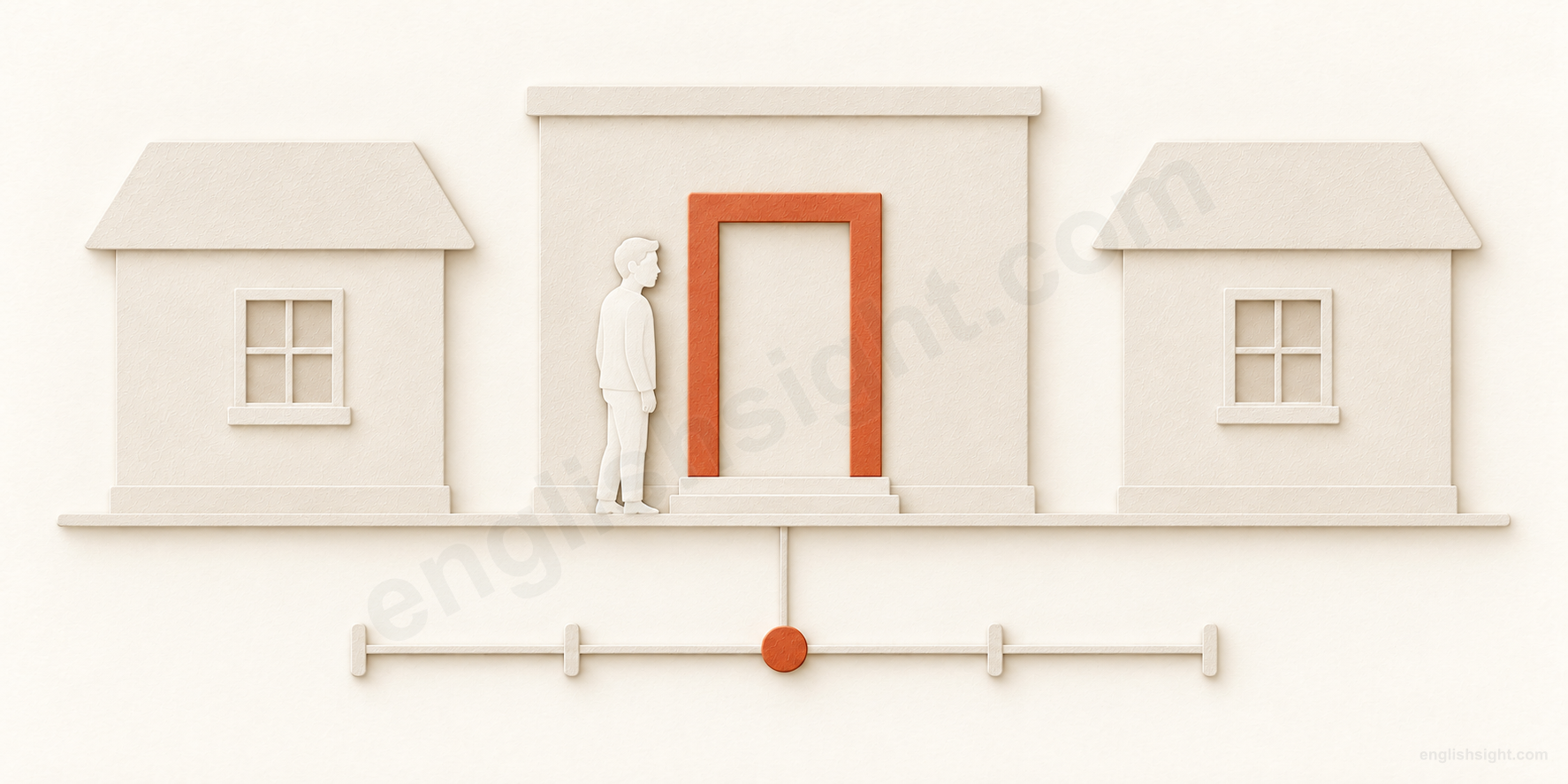
Several building fronts form the wider setting.
at
One place is in focus, aligned with one marked point on the scale.
The person is located at the highlighted entrance.
At identifies a relevant reference point. The scale suggests a time or value.
The figure directs attention toward one marked point. The same point is aligned with a scale below.
The arrow represents direction or attention, not compulsory movement or successful contact. A reference point can stand for a large place.
At is mainly a preposition. It can select a place, time, value or target; the surrounding words determine the relation. A station or a whole event can be treated as a point of reference.
The point sketch is a memory aid, not a claim about every native speaker’s mental image. Fixed expressions need their own meanings and grammar.
01
Places, times and measured points
Locate someone, an event or a value without describing every detail of its surroundings.
01
at + place / address
at the station
locate a person or activity
Situation
Choose a meeting place.
What the phrase identifies
Name the relevant location.
A place is treated as a reference point.
At the door/table means near it or positioned to use it. At 18 King Street gives an address; in London names an area. The place need not be tiny.
In a sentence
Wait for me at the station entrance.
Watch the difference At the station does not specify inside; in the station does. Arrive at a station, but arrive in a city.
02
be at home / work / school; feel at home
at home / work / school
be somewhere or feel comfortable
Situation
You enter an unfamiliar café.
What the phrase identifies
You feel comfortable there.
Some combinations name an activity or familiar state.
At home names your residence; at work can mean working; at school can mean attending school. Feel at home means comfortable, even elsewhere. At university is especially British.
In a sentence
I feel at home in this little café.
Watch the difference No article in at home/work. At the school identifies a particular school site; in bed is usual, not at bed.
03
at + event
at a meeting / party
be present at an occasion
Situation
A concert brings people together.
What the phrase identifies
You meet someone there.
The event supplies the social setting.
At a concert, at a wedding, and at a meeting locate someone by the occasion they attend. In a meeting can emphasize being occupied and unavailable.
In a sentence
I met our new neighbour at a concert.
Watch the difference Say at a party; on a party is not the ordinary event expression.
04
at + time; at Christmas; at the weekend
at six / at night
locate an event in time
Situation
You check the timetable.
What the phrase identifies
You identify the departure time.
A time can function like a marked point.
Use at six, at noon, at dawn and at night. At Christmas means the holiday period; on Christmas Day names the day. At the weekend is British; on the weekend is usual in American English.
In a sentence
The last bus leaves at midnight.
Watch the difference Use on Monday and in October. Normally omit at before next/last/this/every: next Monday.
05
at + age; at the age of + number
at the age of…
say how old someone was
Situation
You describe a childhood achievement.
What the phrase identifies
You give the age when it happened.
Age locates an event on a life timeline.
At seven can mean at seven years old when the context is age; elsewhere it may mean seven o’clock. At an early age leaves the number unspecified.
In a sentence
Mina learned to swim at the age of seven.
Watch the difference Say at the age of seven, not in the age of seven.
06
at + amount / rate / level
at a price / speed / level
state a value on a scale
Situation
Notebooks have a marked price.
What the phrase identifies
Each costs three euros.
Price, speed and level are reference values.
At 30 kilometres an hour gives speed; at 20 degrees gives temperature; at regular intervals gives frequency. Put the cost at €50 means estimate it at that amount. At a discount means below the usual price.
In a sentence
They sell the notebooks at three euros each.
Watch the difference The number is a value, not necessarily a place or time. Bought for €3 focuses on the money paid.
07
at a distance of…; at an angle of…
at a distance / angle
state distance or orientation
Situation
You position a screen.
What the phrase identifies
You specify its angle.
A measurement defines the relation.
At a distance of two metres states separation; at arm’s length means as far away as your arm reaches. At an angle describes a sloping position, not an exact address.
In a sentence
Keep the screen at an angle of forty-five degrees.
Watch the difference Use from to name the other point: at a distance of two metres from the wall.
08
contact someone at + address / number
contact me at… / @
identify an electronic contact point
Situation
Someone needs your contact details.
What the phrase identifies
You supply an address.
The address is the point of contact.
At introduces email addresses and, especially in North America, telephone numbers. The sign @ is read at. Informal online Don’t at me uses at as a verb meaning tag or mention me.
Watch the difference The symbol is pronounced /æt/; unstressed preposition at often has /ət/. Online verb use is informal.
02
Targets, activities and conditions
The verb, adjective or following noun tells us what kind of relation at marks.
09
verb + at + person / thing
look / smile / throw at
direct attention or action toward a target
Situation
A wall is the target.
What the phrase identifies
The throw is directed toward it.
At marks the target; the verb names the action.
Look, stare, point, smile and wave at all direct something toward a focus. Throw at targets something; throw to normally aims to let someone catch it. Shout at often sounds angry; shout to may simply overcome distance.
In a sentence
He threw the ball at the wall.
Watch the difference At does not guarantee contact or success: shooting at a target may miss it.
10
adjective / reaction verb + at + noun / -ing
surprised / angry / laugh at
identify what prompts a reaction
Situation
The room is unexpectedly quiet.
What the phrase identifies
You react with surprise.
At links the feeling to its trigger.
Surprised at the news and angry at being ignored name causes of feelings. Laugh at a joke means find it funny; laugh at a person can mean ridicule them. Angry with a person is also common.
In a sentence
We were surprised at how quiet the room was.
Watch the difference The whole adjective or verb combination determines tone; at alone does not mean hostility.
11
good / bad / skilled at + noun / -ing
good / bad at doing
evaluate ability in an activity
Situation
You consider Leah’s explanations.
What the phrase identifies
You identify a strength.
At introduces the field being assessed.
Good at maths names a subject; good at explaining names an activity. Bad at, hopeless at and skilled at follow the same preposition. Compare good for your health, which describes benefit.
In a sentence
Leah is good at explaining difficult ideas.
Watch the difference After the preposition use explaining, not explain or to explain.
12
work at + noun / -ing; aim at + noun / -ing
work at / aim at / keep at
direct effort toward a goal
Situation
Pronunciation needs practice.
What the phrase identifies
You spend effort improving it.
The target is a task or desired result.
Work at improving emphasizes effort; aim at reducing waste gives a goal. Keep at it encourages persistence. These verb–preposition combinations keep at before a pronoun: work at it.
In a sentence
We are working at improving our pronunciation.
Watch the difference Aim to reduce is also possible, but after aim at use reducing.
13
verb + at + object
pull / nibble at
try or act in small repeated touches
Situation
A thread is loose.
What the phrase identifies
The child keeps tugging it.
An action is directed at something without a promised result.
Pull at suggests tugging, often repeatedly; nibble at means eat small bits. Clutch at a rope can describe an attempt to grasp it. At can limit the action to attempts or partial involvement.
In a sentence
The child pulled at the loose thread.
Watch the difference Do not infer completion: nibbling at a sandwich need not mean finishing it.
14
at + request / invitation; at the sight / sound of…
at someone’s request
act in response to a request or cue
Situation
She asks for fresh air.
What the phrase identifies
You open the window in response.
The following noun supplies the prompting event.
At her request and at his invitation name the reason for an action and sound fairly formal. At the sound of the bell, we stood up links a response to a sensory cue.
In a sentence
We opened the window at her request.
Watch the difference Use a possessive or determiner where needed: at her request, not at she request.
15
be at + state expression
at risk / peace / ease
be in an established condition
Situation
The bridge is unsafe.
What the phrase identifies
Collapse is a possible danger.
The noun phrase names a condition, not a location.
At risk means exposed to danger; at stake means liable to be lost in an outcome. At war/peace name relations; at ease means relaxed; at rest means not moving. At liberty to speak means free to speak; at your disposal means available for your use.
At lunch means having lunch; children at play are playing. At a disadvantage means in a less favourable position, while at an advantage means in a more favourable one: Without a map, we were at a disadvantage. Learn the article as part of each expression.
In a sentence
The old bridge is at risk of collapse.
Watch the difference Learn the complete expression: in danger is natural, but at danger is not the ordinary equivalent.
16
at + possessive + superlative
at her best / at its worst
show a personal extreme of quality
Situation
You compare her performances.
What the phrase identifies
Small halls bring out her finest work.
The comparison concerns this person’s own range.
At her best describes her best condition or performance; at its worst describes the worst state of a thing. At his happiest similarly locates someone at a personal emotional peak.
In a sentence
This singer is at her best in a small hall.
Watch the difference Keep the possessive. At best without her has a different, limiting meaning.
03
Degree, limits and evaluation
Read these complete expressions to understand a quantity, a qualification or emphasis.
17
negative / question / if-clause + at all
not…at all
emphasize any degree or any occurrence
Situation
An announcement is made.
What the phrase identifies
You hear none of it.
The phrase strengthens the absence of even a little.
Not at all means not in the slightest. Did it help at all? asks whether it helped even a little; if you need anything at all allows any need. I’m surprised he came at all stresses that even coming was unexpected.
In a sentence
I couldn’t hear the announcement at all.
Watch the difference Not at all can politely answer thanks. Do not add at all to every positive statement.
18
at least / at most + quantity; or at least…
at least / at most
give a lower or upper limit
Situation
You count the necessary seats.
What the phrase identifies
Four is the minimum.
A boundary leaves possibilities on one side.
At least four means four or more; at most four means four or fewer. At least nobody was hurt finds consolation. He’s home—or at least his car is corrects a claim. You could at least call asks for a minimum effort.
In a sentence
We need at least four chairs.
Watch the difference At least is not always numerical; read the following statement and the speaker’s purpose.
19
at best / at worst + assessment
at best / at worst
assess the most or least favourable outcome
Situation
You consider possible repair outcomes.
What the phrase identifies
Even the best outcome is limited.
The phrase sets an evaluative boundary.
At best often tempers optimism: one month is the favourable estimate, not a promise. At worst introduces the least favourable possibility. Compare at its best, which describes something performing excellently.
In a sentence
At best, the repair will last another month.
Watch the difference At best does not mean excellent; it may introduce a disappointing upper limit.
04
Familiar expressions about time
Small differences in articles and plurals produce different time meanings.
20
at first…; at last…
at first / at last
contrast an initial stage or mark a long-awaited result
Situation
Your first reaction is negative.
What the phrase identifies
Your later opinion changes.
The complete phrases select different stages.
At first means initially, often before a change. At last means finally after waiting: The key turned at last. At first glance/sight means on an initial look. First without at can simply order tasks.
In a sentence
At first I disliked the job, but now I enjoy it.
Watch the difference At last is not the usual way to introduce the final item of a list; use finally or lastly.
21
verb + at once; two things at once
at once
mean immediately or simultaneously
Situation
A ticket needs correction.
What the phrase identifies
You request immediate action.
Context chooses between two established meanings.
Send it at once means send it immediately. Both phones rang at once means they rang simultaneously. Once alone usually means one time; at once does not count repetitions.
In a sentence
Please send the corrected ticket at once.
Watch the difference Keep the two readings separate; two tasks at once concerns simultaneity, not urgency.
22
at times; quantity + at a time; at the same time
at times / at a time
distinguish occasions, batches and simultaneity
Situation
Visitors are waiting outside.
What the phrase identifies
Only two enter in each group.
Articles and plurals change the expression.
At times means sometimes. Two at a time means in pairs; hours at a time means continuous stretches of hours. At the time means then. At the same time means simultaneously, or adds a contrasting point: It’s costly; at the same time, it’s useful.
In a sentence
Let the visitors enter two at a time.
Watch the difference At times and at a time are not interchangeable; the first does not specify group size.
23
at present; at the moment
at present / at the moment
describe the current situation
Situation
You discuss where you are living.
What the phrase identifies
You give your temporary arrangement.
The reference is now, not a future moment.
At present and at the moment both mean now and can frame a situation that may change. At that moment points to a particular moment in a story instead.
In a sentence
I’m staying with my sister at the moment.
Watch the difference Do not confuse at the moment with in a moment, which normally means very soon.
24
at the end of + period / thing
at the end of…
locate something at a final point
Situation
The lesson has a planned ending.
What the phrase identifies
Questions come at that point.
The endpoint belongs to a named period or object.
At the end of the lesson names its final part; at the end of the road names a position. In the end means eventually after events or decisions: In the end, we stayed home. At an end means finished.
In a sentence
We’ll discuss questions at the end of the lesson.
Watch the difference By the end of Friday sets a deadline; at the end of Friday locates an event near Friday’s close.
05
Established expressions in daily life
Use context and the whole phrase; the point model cannot predict these meanings.
25
be / keep something at hand
at hand
be nearby, available or approaching
Situation
The electricity may fail.
What the phrase identifies
A torch is ready to use.
Closeness can concern space or time.
A tool at hand is within reach or available; help may be close at hand. A deadline at hand is approaching. The task at hand is the task currently needing attention.
In a sentence
Keep a torch at hand during the power cut.
Watch the difference At hand need not mean literally in your hand; in your hand describes physical holding.
26
verb + at random / at will / at length
at random / at will / at length
describe how an action is done
Situation
A plan needs consideration.
What the phrase identifies
You discuss it thoroughly.
These fixed expressions specify manner.
At length means for a long time or in detail; its literary finally meaning occurs in At length, they arrived. We picked a card at random means we chose by chance; events that happen at random have no definite plan or pattern. At will means whenever or however you choose.
In a sentence
We discussed the new plan at length.
Watch the difference At length usually describes extensive discussion, not physical length. Learn each phrase as a unit.
27
at cost; at the cost of + noun; at all costs
at cost / at the cost of…
name a price, sacrifice or uncompromising aim
Situation
Winning requires extra work.
What the phrase identifies
Her free time is sacrificed.
Cost may be financial or personal.
At cost means without added profit. At the cost of her health means sacrificing health; at someone’s expense means they pay or suffer. At all costs means whatever is necessary: Avoid another delay at all costs. A joke at your expense makes you look foolish.
In a sentence
She won the contract at the cost of her free time.
Watch the difference At cost and at all costs differ: the first concerns the price; the second expresses determination.
28
be at fault; be at a loss for…; sell at a loss
at fault / at a loss / at sea
express blame, uncertainty or financial loss
Situation
You see unexpected damage.
What the phrase identifies
You cannot find words.
The noun selects the specific difficulty.
At fault means responsible for something wrong. At a loss for words means unable to think what to say; at a loss as to what to do means unsure how to act. Sell at a loss means below cost. At sea can mean on the open sea or figuratively confused.
In a sentence
I was at a loss for words when I saw the damage.
Watch the difference At a loss does not itself assign blame; at fault does. At sea need not describe travel.
29
be at large; noun + at large
at large
be uncaptured or refer to a whole community
Situation
An animal has escaped.
What the phrase identifies
It has not been caught.
These established meanings depend on the subject.
An escaped animal or suspect at large remains free. The public at large means the public generally. The expression does not describe physical size.
In a sentence
The escaped animal is still at large.
Watch the difference The community at large is not a community that has escaped.
30
be at odds with + person / thing; over + issue
at odds with…
be in conflict or inconsistent
Situation
You compare an account with a recording.
What the phrase identifies
They do not agree.
Disagreement can concern people or information.
We are at odds over the budget means we disagree about it. Her account is at odds with the evidence means the two conflict. The phrase does not calculate betting odds.
In a sentence
Her account is at odds with the video evidence.
Watch the difference Use with for the conflicting person or thing, and over for the disputed issue.
31
…, and…at that; be at it again; where someone is at
at that / be at it again
add emphasis or describe a current activity
Situation
An argument starts again.
What the phrase identifies
You recognize a repeated activity.
These conversational units need their own contexts.
A good meal, and cheap at that adds an emphatic extra fact. Be at it again often criticizes repeated behaviour. Informal where someone is at describes their current situation or opinion; where it’s at describes what is popular.
In a sentence
They’ve been at it again, arguing about the music.
Watch the difference For a neutral location question, Where are you? is sufficient; final at is informal and often unnecessary.
Read the whole construction
Preposition and complement
At normally takes a noun phrase, a pronoun in object form, or an -ing form: at me; good at cooking. In What are you looking at?, the complement is questioned. Preposition stranding is ordinary English; at is not a detachable particle here.
Forms and scope
At has no comparative, tense or passive of its own. A verb may be passive, as in He was laughed at. The preposition often sounds /ət/ unstressed and /æt/ when stressed. The noun naming @ and the informal online tagging verb are separate uses.
Learn the chosen preposition
At marks a useful point of reference, in often presents an interior or area, and on often a surface or day. These are guides, not substitution rules: at night, in the morning, on Monday. Learn collocations and regional differences together.
Choose the intended meaning
Use the situation and the complete phrase.
1. You want your friend to catch a ball. Which sentence fits?
2. Four chairs are required, and extra chairs are welcome. Which expression fits?
3. Visitors must enter in groups of two. Which instruction fits?
4. You need to specify that you are inside the station building. Which is more precise?
Sources and teaching notes
Dictionary entries verify the uses; explanations, examples and the diagram are original teaching material. The point connection is a teaching interpretation.
The sketch is a learning aid, not a universal native-speaker image.