Connect attacks on people, ideas, problems, and goals—and learn the separate language of sudden episodes.
An action has a target
An action has a target
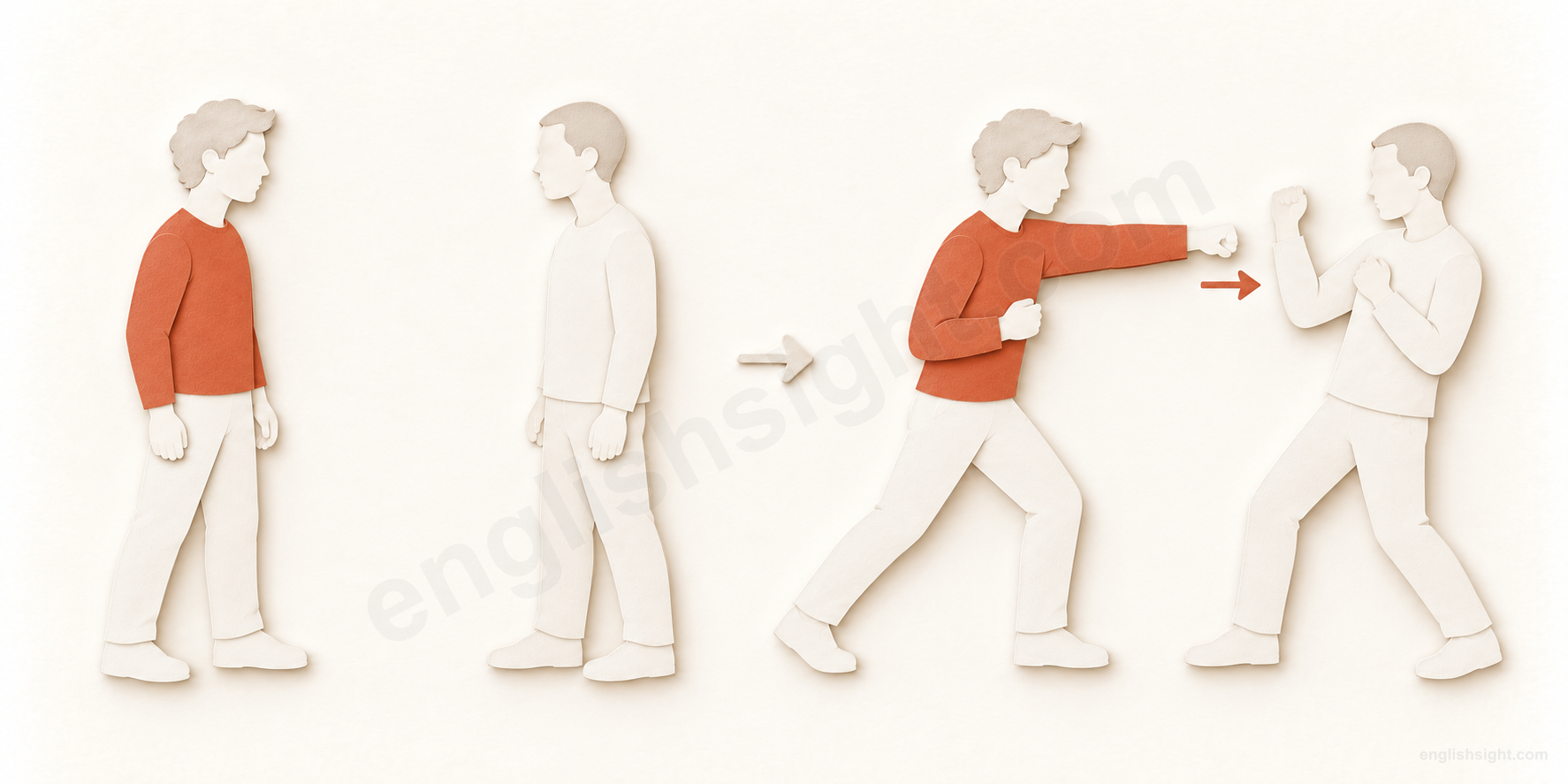
Two men stand apart, facing each other with their arms down.
attack
The other man leans back and raises a forearm to guard himself; the fist has not made contact.
The man in terracotta steps forward and directs a fist toward the other man.
Force is directed at a target; the attack need not succeed.
Direct force or determined effort at a target, often to harm it, overcome it, or gain an advantage.
The physical scene illustrates an attempt against resistance. Critical words, harmful substances, work, and sport adapt this relationship in different ways. Illness and feeling expressions need their own episode interpretation.
Attack can be a verb or a noun. Someone may attack a person, a speaker may attack an argument, and a team may attack a goal. What matters is directed force or determined effort; the word alone does not say the attempt succeeds.
A useful teaching connection is pressure brought against a target. It helps connect several uses, but an attack of illness or emotion is an established episode meaning, and a plan of attack can be entirely peaceful. Read the whole expression.
01
Physical action and its target
Identify who acts, what is targeted, and how a verb differs from the noun naming an event.
01
attack + person / thing; attack; be attacked by + attacker
attack someone
use violence against a person or animal
Situation
A passer-by is near an aggressive dog.
Action or interpretation
The dog tries to bite the passer-by.
The subject acts against the direct object.
The attacker is the subject and the target follows the verb directly: The dog attacked him. The action may cause injury, but attack does not itself say how much harm was done or whether the attempt succeeded.
The target can be left unstated when it is understood: The dog may attack. With introduces a means, as in The man attacked the door with a hammer. By identifies the actor in a passive: He was attacked by a dog.
Physical and military uses share this verb pattern. Troops attacked the bridge describes armed action against a place; it does not simply mean they arrived there.
In a sentence
The dog attacked a passer-by, who escaped without injury.
Watch the difference Say The dog attacked him, not The dog attacked on him. The object pronoun follows the verb: attacked him, not attacked he.
02
an attack on / against + target; an attack by + attacker; launch / carry out / repel an attack
an attack on a target
an event in which force is used against someone or something
Situation
A report needs to name an event and its participants.
Action or interpretation
The noun identifies the attack, its target, and its source.
On or against points to the target; by points to the attacker.
An attack is a countable event: one attack, two attacks. An attack on the village and an attack against the village identify the target. An attack by an armed group identifies who carried it out. Upon occurs too, especially in formal reporting.
Launch or mount an attack presents starting or organizing it; carry out an attack presents doing it. Repel an attack means drive it back. These verbs contribute their own meanings; they are not different senses of attack.
Words before attack specify the type: a surprise attack is unexpected, and an air attack comes from aircraft. In an attack helicopter, attack describes the aircraft’s combat purpose; it does not mean the helicopter is attacking at this moment.
In a sentence
The report describes an attack on the village by an armed group.
Watch the difference Keep noun and verb patterns apart: an attack on the village, but they attacked the village.
03
be / come under attack (from + source) (for + noun / -ing)
be / come under attack
be attacked, or begin to be attacked
Situation
A target is exposed to hostile action.
Action or interpretation
It is receiving an attack or strong criticism.
The target becomes the subject of the sentence.
The building is under attack describes its situation while an attack is being made. The building came under attack marks the beginning of that situation. Under is part of an established expression; the building is not physically underneath an object called an attack.
The same expression works for criticism: The proposal came under attack from residents for being too costly. From names the attackers or critics; for gives the reason for criticism. The context tells you whether the pressure is physical or verbal.
Compare The group launched an attack: the group initiates it. The group came under attack: the group receives it. Neither construction alone tells you whether the attackers achieved their aim.
In a sentence
The proposal came under attack from residents for being too costly.
Watch the difference Use under attack without an article in this expression. Came under attack means began receiving an attack, not began attacking.
02
Strong criticism and an aggressive response
Words can be directed against a person or an idea. These expressions describe criticism, initiative, and vulnerability.
04
attack + target + for + noun / -ing; attack + target + over + issue; attack + target + as + description
attack someone for doing something
criticize someone or something strongly
Situation
A decision or action causes disagreement.
Action or interpretation
Someone directs strong criticism at it or its author.
The object receives criticism; for introduces the reason.
In debate or reporting, attack often concerns words rather than physical violence. A writer can attack a policy, an argument, or a person. Criticize can be calm and measured; attack presents the criticism as forceful or hostile.
For can introduce a noun or an -ing phrase: attack the company for its prices; attack it for raising prices. Over introduces the disputed issue: attack the council over the closure. In attack the plan as unfair, as introduces the critic’s negative characterization.
The passive is natural when the criticized person or thing is the topic: The council was attacked for closing the pool. Grammar does not tell you whether the criticism was justified.
In a sentence
Parents attacked the council for closing the only public pool.
Watch the difference After for, use a noun or -ing form: for closing it, not for close it. A verbal attack does not necessarily involve threats or violence.
05
a personal / verbal attack on + person / idea; an attack ad
a personal / verbal attack
strong criticism aimed at a person or expressed in words
Situation
A discussion could address an idea or its author.
Action or interpretation
A speaker harshly criticizes one of those targets.
Personal identifies the target; verbal identifies the means.
A personal attack directs hostility at someone as a person, rather than simply testing their argument. A verbal attack uses words. The two descriptions can overlap, but a verbal attack on a policy need not be a personal attack.
An attack on someone’s honesty challenges that quality. An attack on an argument challenges the argument. The noun after on matters: it tells you what the speaker is trying to undermine.
An attack ad is a political advertisement designed to criticize an opponent harshly. Here attack modifies another noun; the phrase does not mean someone attacked an advertisement.
In a sentence
We can question the argument without making a personal attack on its author.
Watch the difference Verbal describes words, while personal describes the target. Do not treat the two adjectives as identical.
06
go / be on the attack
go on the attack
begin attacking or strongly challenging the other side
Situation
A speaker has been answering criticism.
Action or interpretation
The speaker starts challenging the opposing side.
The expression presents a move into an active offensive role.
Go on the attack means begin attacking. In a debate it can mean stop merely defending your position and start challenging the other side. Be on the attack describes being in that active role.
The expression also works in war and sport; context determines the kind of action. The noun attack has the in this fixed expression. Go contributes the change into the situation.
A counterattack is an attack made in response to an earlier attack. Going on the attack need not be a response, so the two expressions are not exact equivalents.
In a sentence
After answering the complaint, Maya went on the attack and questioned the committee’s figures.
Watch the difference On the attack describes the side acting aggressively; under attack describes the side receiving the attack.
07
target + be open to attack; leave + target + open to attack
leave something open to attack
make something easy to criticize or challenge
Situation
An argument needs support.
Action or interpretation
A weakness gives critics a way to challenge it.
Vulnerability is present even if no attack has yet happened.
An argument that is open to attack has weaknesses that others can challenge. Leave it open to attack means fail to protect it from that possibility. Wide open makes the vulnerability sound greater.
In The speaker left herself open to attack, herself refers to the speaker. It does not mean she invited physical violence. In another context a position or location can be physically open to attack; read what is vulnerable.
Unlike is under attack, is open to attack does not assert that an attack is already happening. It describes the opportunity available to an attacker or critic.
In a sentence
Without any evidence, the claim is wide open to attack.
Watch the difference Open to attack means vulnerable to criticism or hostile action; it does not mean willing to attack someone.
03
Harm to living things, materials, and systems
An attacker need not be a person using physical violence. Context identifies the harmful process or the digital target.
08
harmful agent + attacks + target; target + is attacked by + agent
a disease / insect / chemical attacks something
a harmful agent damages or adversely affects a target
Situation
A living thing or material is exposed to something harmful.
Action or interpretation
The harmful agent acts on it.
Attack can describe harmful action without conscious intention.
A disease can attack an organ, insects can attack a plant, and a chemical can attack a material. The subject names the harmful agent; the object names what it affects. Chemicals and diseases do not need to have intentions.
The passive keeps the affected thing as the topic: The leaves were attacked by insects. The noun also occurs in insect attack or protection against attack by pests; here it can describe damaging activity generally.
This differs from an attack of asthma. A disease attacks the lungs describes the agent and its target; an asthma attack names an episode experienced by a person.
In a sentence
The acid attacks the metal surface.
Watch the difference Attack does not always describe an intentional enemy. A harmful process can be the subject of the verb.
09
a cyberattack on + digital target; attack + system / network / website
a cyberattack on a website
a deliberate digital attack aimed at a computer system or network
Situation
A website is operating normally.
Action or interpretation
Someone tries to damage or disrupt its system.
Cyber identifies a digital setting for hostile action.
Cyberattack names a deliberate attempt against a computer system, network, or website. The target can follow on, just as with other attacks. A cyberattack may be blocked; the word alone does not guarantee damage.
The verb can also take a digital target directly: Someone attacked the server. An ordinary crash or accidental fault is not automatically an attack; the attack description presents hostile action.
Cyberattack is a compound word, not a phrasal verb made from attack and a particle.
In a sentence
The company blocked a cyberattack on its website.
Watch the difference The phrase on its website identifies the target. It does not merely mean that a news story about an attack appeared there.
04
Work, enthusiasm, and an approach
Attack can turn directed energy toward a task. The surrounding expression tells you whether the aim is solving, eating, or organizing action.
10
attack + problem / task; attack + problem + from another angle
attack a problem / task
work on something with determination and energy
Situation
A difficult task still needs attention.
Action or interpretation
Someone starts working on it energetically.
The target is a difficulty to overcome, not a person to harm.
Attack a problem presents work as a determined effort against a difficulty. The person working is the subject, and the problem or task is the direct object. The expression can suggest a vigorous start or approach.
Let’s attack the problem from another angle means try a different approach. From another angle adds the viewpoint or method; it is not a particle that creates a new phrasal verb.
Tackle a problem is a useful close alternative. Solve a problem goes further: it states a successful result. We attacked it all morning does not mean we finished it.
In a sentence
Let’s attack the hardest part of the project while we are fresh.
Watch the difference Attack the problem means try to deal with it. Attack the proposed solution may instead mean criticize that solution; context and object matter.
11
attack + meal / food
attack a meal
begin eating food eagerly
Situation
A hungry person sits down to eat.
Action or interpretation
The person starts eating with obvious enthusiasm.
Directed energy becomes eager eating in this established use.
With a meal or food as the object, attack can describe enthusiastic eating: The children attacked the pizza. It is a vivid choice, often playful in storytelling, rather than a neutral replacement for every use of eat.
The food is the direct object; there is no on. The image of forceful action contributes energy, but there is no literal fight and no necessary criticism of the food.
Because the expression presents someone getting eagerly to work on the food, it does not by itself say that every piece was eaten. Finish the meal states completion more clearly.
In a sentence
After the long walk, we attacked the sandwiches.
Watch the difference Use this vivid expression for eager eating, not for simply ordering food or disliking it.
12
launch / mount an attack on + problem
an attack on a problem
determined action intended to reduce or remove a problem
Situation
A community faces a persistent problem.
Action or interpretation
An organized effort tries to reduce it.
The preposition on points to the problem being opposed.
An attack on poverty or unemployment can describe organized efforts to reduce something regarded as harmful. The target is the problem, not the people affected by it. Launch an attack presents starting that effort.
This use is common in forceful policy language and headlines; an effort to reduce poverty is a plainer alternative. An all-out attack describes using the full available effort, not necessarily physical force.
Compare an attack on the policy: in political discussion this often means strong criticism of the policy. The noun alone cannot decide whether the speaker means practical action against a problem or criticism of an idea.
In a sentence
The new programme is part of a wider attack on unemployment.
Watch the difference An attack on unemployment targets the problem; it does not mean attacking unemployed people.
13
a plan of attack; a line of attack
a plan / line of attack
a planned method or chosen approach to dealing with something
Situation
People need to decide how to proceed.
Action or interpretation
They choose a method or route for their effort.
Of attack describes an approach, which can be entirely peaceful.
A plan of attack is a strategy for approaching a task or difficulty. It may concern a project, a repair, or an argument; it need not concern violence. The plan comes before or guides the action.
A line of attack is a particular approach, especially a way of challenging someone or arguing against a position. In The lawyer chose a new line of attack, line suggests a route for questioning or argument.
These are noun phrases. The words plan and line contribute organization or direction. They do not name extra actions that attack performs by itself.
In a sentence
Before we reorganize the office, we need a clear plan of attack.
Watch the difference A plan of attack can be friendly and practical. Do not infer hostility from this phrase alone.
05
Illness and sudden feelings
Here an attack is an episode affecting someone. Learn the named condition or the phrase with of, rather than imagining a separate attacker.
14
have / suffer + an asthma attack; an attack of + condition
have an asthma attack / an attack of asthma
experience an episode in which a condition becomes active or severe
Situation
A person may have an ongoing health condition.
Action or interpretation
A particular episode of that condition occurs.
Attack names an episode experienced by the person.
Have an asthma attack and have an attack of asthma both name an episode. Have asthma describes the condition generally. Suffer an attack emphasizes the unpleasant experience; the person is not using force against someone. She suffers from attacks of anxiety describes recurring episodes; attacks is plural because there is more than one.
The illness can appear before attack or after of in established combinations. These patterns are not freely interchangeable for every illness: learn the whole expression rather than building names mechanically.
The episode meaning connects with something affecting someone strongly, but it is not a literal scene with a separate attacker. An attack can have serious or lasting consequences; calling it an episode does not promise quick recovery.
In a sentence
Nina had an asthma attack during the night.
Watch the difference Use Nina had an asthma attack for the episode. Nina attacked asthma would make Nina the person acting against the condition.
15
have / suffer a heart attack; give someone a heart attack (also figurative)
have a heart attack
experience the serious medical event called a heart attack
Situation
A report describes a particular medical event.
Action or interpretation
Heart attack names that event, rather than a general feeling of fear.
The full expression has a specific medical meaning.
A heart attack is a serious event involving a blockage of blood flow to the heart. Have or suffer a heart attack names the experience. This is an established medical term; it is not a phrase for every sudden heart symptom.
Heart comes before attack without of: a heart attack. Compare an attack on the heart, which describes something acting against the heart and does not automatically name the same medical event.
In informal exaggeration, You nearly gave me a heart attack can mean You frightened me badly. That conversational use need not report a literal medical event. Context distinguishes the exaggeration from the medical term.
In a sentence
His uncle is recovering after a heart attack.
Watch the difference Heart attack and panic attack are different terms. Do not treat them as interchangeable names for being frightened.
16
have / experience a panic attack
have a panic attack
experience a sudden episode of intense fear or anxiety
Situation
An account describes someone’s experience of intense anxiety.
Action or interpretation
Panic attack names the acute episode.
Panic specifies the kind of episode; there is no attacking agent.
A panic attack is an acute episode of intense anxiety or fear, often involving physical sensations. The person has or experiences the attack; they are not attacking another person.
This is a conventional name, not just a way to intensify any ordinary worry. Nervous before a presentation can describe a much milder experience, so the two expressions are not automatic substitutes.
The grammar resembles have an asthma attack, but the condition named is different. Likewise, panic attack and heart attack are not interchangeable terms; shared grammar does not make the meanings identical.
In a sentence
She told her friend that she had experienced a panic attack on the train.
Watch the difference Having a panic attack does not mean attacking in a panicked way. The whole phrase names an episode.
17
an attack of + nerves / the giggles / conscience
an attack of nerves / the giggles / conscience
a sudden spell of a feeling, reaction, or moral unease
Situation
Someone is acting or feeling normally.
Action or interpretation
A sudden strong feeling or reaction takes hold.
Of introduces what the person suddenly experiences.
An attack of nerves is a spell of nervousness. An attack of the giggles is a spell of laughter that is difficult to stop. The second can be lighthearted; attack does not make every episode harmful or violent.
An attack of conscience is a sudden feeling of guilt or moral unease. His conscience was under attack would instead present his moral judgment as a target being challenged; the preposition changes the relationship.
These are familiar combinations, not a rule for putting every emotion after attack of. Keep the in the giggles. Learn the whole expression and use plainer wording when an unusual combination would be unclear.
In a sentence
Halfway through the serious speech, we both had an attack of the giggles.
Watch the difference An attack of nerves names what someone experiences; an attack on someone’s nerves would describe a target, not this established episode phrase.
06
Scoring, players, and threats in games
In sport, attack concerns gaining an advantage within a game. An attempt, a group of players, and a threat to a chess piece are distinct uses.
18
team + attacks; attack + goal; an attack on + goal; attacking + play / style
attack / launch an attack on the goal
try to score or gain an advantage in a game
Situation
A team has an opportunity to move play forward.
Action or interpretation
It tries to score, though it may not succeed.
Attack describes offensive play, not necessarily physical aggression.
A team can attack without an object: They attacked throughout the second half. With a stated target, They attacked the goal names what they were trying to score against. The intransitive and direct-object patterns both occur.
An attack can also be one attacking move: The goalkeeper stopped their next attack. Attacking play and an attacking style describe an approach that emphasizes creating scoring chances.
Attack contrasts with defend in the roles of play. It does not mean a team must score, nor does it by itself mean players are breaking rules or hurting opponents.
In a sentence
Our team attacked throughout the second half but could not score.
Watch the difference Attacking play describes a style or action. The attacking players can be playing fairly; attack does not automatically mean a foul.
19
the team’s attack; play in attack; a strong / weak attack
the team’s attack / play in attack
the attacking players or attacking part of a team
Situation
A team has players with different roles.
Action or interpretation
Its attacking players are discussed as one unit.
The noun can name the people performing the role.
In British sports English, a team’s attack can mean its attacking players considered together. Our attack looks strong may assess the forwards as a unit, rather than describe one move.
Play in attack means play in an attacking role: He usually plays in attack. Compare The goalkeeper stopped an attack, where an attack is a move. The article and context help distinguish a team unit from an event.
American sports English often uses offense for the corresponding team role or unit. The exact roles depend on the sport; attack is not a single fixed position across all games.
In a sentence
Their attack is strong, but their defence needs work.
Watch the difference A strong attack can assess the team’s attacking unit. It need not report one forceful attacking move.
20
chess piece + attacks + opposing piece
attack a chess piece
threaten an opposing piece with capture
Situation
A piece is on the board.
Action or interpretation
An opposing piece is in a position to capture it.
In chess, attack can describe a present threat, before any capture.
A chess piece attacks another piece when it threatens capture according to the game’s rules. Your knight attacks my queen describes that relationship on the board; neither piece needs to be moving while you say it.
The target follows the verb directly: attacks the queen. Capture the queen means actually take it in a move. Attack does not report that the capture has happened.
This game-specific extension keeps the target-and-threat relationship. It is included for recognizing ordinary chess discussion, without teaching specialized chess tactics.
In a sentence
Your knight attacks my queen, so I need to protect it.
Watch the difference Attacking a piece is not the same as capturing it. A threat can exist without being carried out.
Keep the target, grammar, and outcome separate
An attempt does not guarantee success
An attack can be blocked, resisted, or unsuccessful. Defeat, destroy, and solve describe results that attack alone does not promise. In sport it need not mean violence, and in a task it need not mean hostility.
Verb object; noun preposition
Use attack someone or attack it for the verb. Use an attack on someone for the noun. Under attack and on the attack are prepositional expressions containing a noun, not separable phrasal verbs. For criticism, for gives the reason and over introduces the issue.
Forms and pronunciation
Both the noun and verb are pronounced /əˈtæk/, with stress on the second syllable. Verb forms are attack, attacks, attacked, attacking; attacked ends in /t/. Use an attack, but a sudden attack. Ongoing action and passive forms are ordinary: is attacking and was attacked.
Count an event, or describe activity generally
An attack and several attacks count events or episodes. Attack can also name activity generally, as in under attack or protection against attack. The attack can name a team’s attacking players. These uses do not all take the same article.
Scope of this lesson
These are selected modern uses, not a frequency ranking. Music and sound engineering use attack for the beginning of a sound; those specialist meanings are outside this lesson. Attacker and counterattack are related words, not extra forms of the verb.
Choose the meaning in context
Identify the word’s job and read the words around it.
1. Choose the ordinary verb pattern when a dog is the attacker and Tom is the target.
2. Residents began strongly criticizing the proposal. Which sentence makes the proposal the target receiving criticism?
3. Parents criticized the council because it closed the pool. Choose the natural expression.
4. “We attacked the problem all morning.” What can you conclude from this wording alone?
5. Which expression names a particular episode rather than the condition generally?
6. During a serious speech, two friends suddenly could not stop laughing. Which phrase fits?
7. In British sports discussion, “Their attack is weakened by injuries” can refer to what?
8. “Your knight attacks my queen.” Has the queen necessarily been captured?
9. “The acid attacks the metal.” What does attack mean here?
Sources and teaching notes
Usage and constructions were checked against the dictionary pages below. Explanations, examples, and the sketch are original teaching material; the proposed visual connection is a learning aid.
The sketch illustrates a teaching connection, not a shared mental picture for every English speaker.