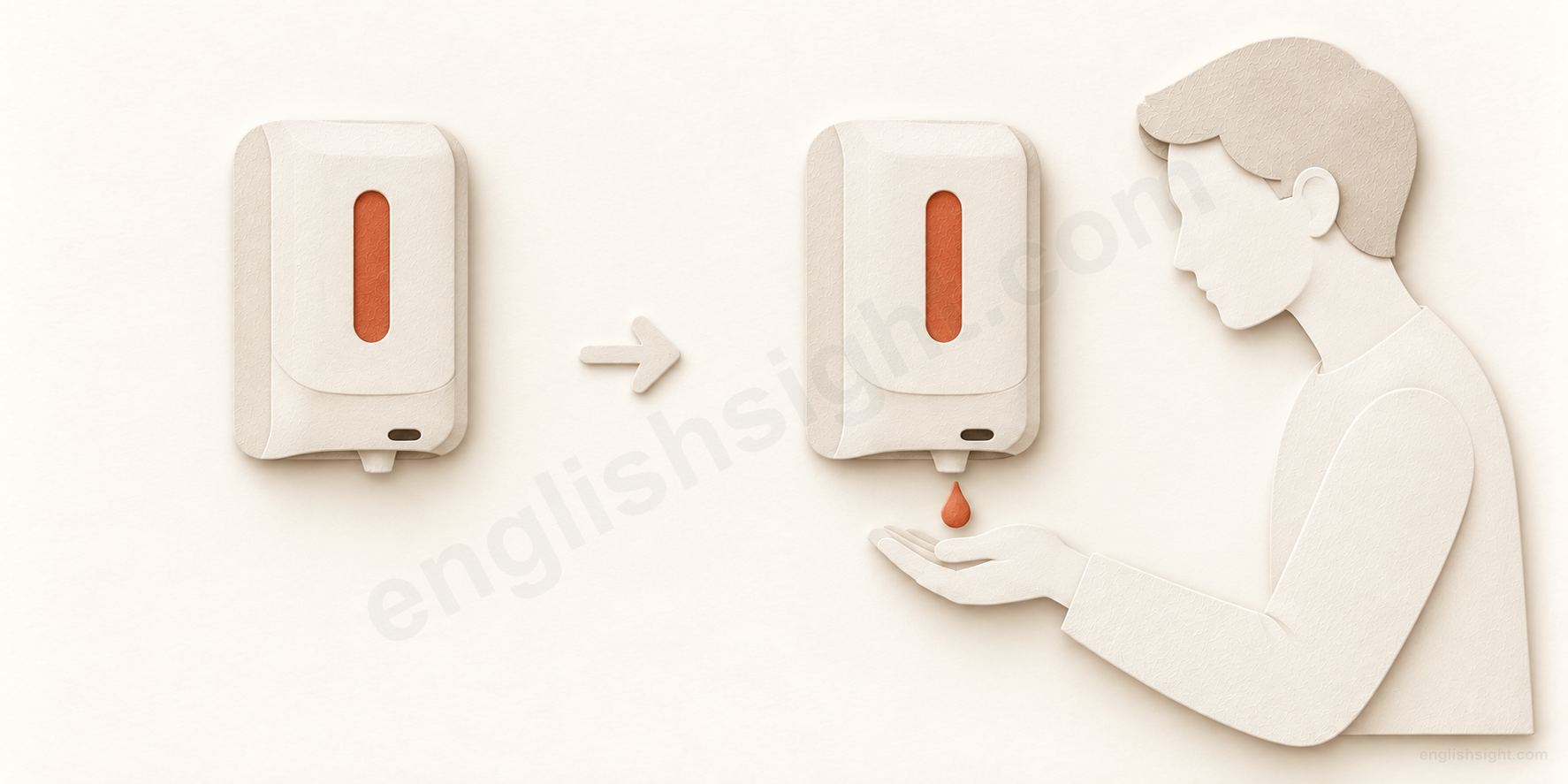
Connect self-operating devices, unthinking actions, and results that follow a rule.
A condition is met; the response follows
A condition is met; the response follows
The dispenser is ready, with no hand beneath it.
automatic
Soap is released without pressing a pump.
A hand enters the sensor's range.
The hand triggers the sensor; the dispenser releases soap without a pump being pressed.
Automatic describes operation or response without a new manual action or conscious decision each time.
A mechanism, a bodily process, a practiced routine, or a rule can supply the control. Automatic does not mean uncaused, instant, perfect, or completely independent of people.
An automatic action or result proceeds through a mechanism, bodily process, learned habit, or established rule without a fresh deliberate decision at each step. Ask what does the controlling and what still has to happen first.
This is a teaching connection across common uses, not a claim that every speaker pictures the same scene. A sensor-controlled dispenser makes one part of the relationship visible; it does not explain every fixed expression.
01
Machines and their controls
Identify the function that a device controls for you. Automatic does not mean that every part of the activity needs no human input.
01
automatic + device noun; device + be + automatic
an automatic dispenser
a device controls a function without repeated manual operation
Situation / condition
The dispenser is ready, but nobody has put a hand below it.
Response / result
A hand reaches the sensor, and soap is released.
The mechanism responds; the user does not press a pump.
Automatic describes how the device works. An automatic soap dispenser releases soap when it detects a hand. A person can still install it, fill it, and supply the triggering action.
The adjective goes before a noun or after be: an automatic dispenser; the dispenser is automatic. Manual control requires a person to operate the relevant control. Neither word tells you whether the device needs electricity.
In a sentence
The automatic dispenser releases soap when I hold out my hand.
Watch the difference Automatic does not promise that a machine works without power, preparation, or a trigger.
02
automatic + process noun; fully automatic + noun
automatic updates
a process runs under an existing setting rather than a new command each time
Situation / condition
You enable a setting that allows the app to update overnight.
Response / result
The app installs an update while you are away.
The process is controlled in advance; it is not necessarily instant.
Automatic can describe a process or function as well as a physical machine: automatic updates, automatic payments, automatic shutdown. The noun identifies what happens under the setting.
Compare an automatic update with a quick update. Quick tells you about speed; automatic tells you about control. Fully automatic emphasizes the extent of automatic operation; it does not mean completely reliable.
In a sentence
I turned off automatic updates before the trip.
Watch the difference Automatic is not a synonym for immediate, free, or error-free. Read which function the setting actually controls.
03
automatic + car / transmission; an automatic; automatics
an automatic car / an automatic
a car whose transmission changes gears for the driver
Situation / condition
You compare rental cars with different transmissions.
Response / result
You choose one that changes gears without manual shifting.
Automatic concerns the transmission, not whether the car drives itself.
Automatic transmission names the gear-changing system. An automatic car has that system. In context, the countable noun an automatic means the car: We rented an automatic. Its plural is automatics.
A manual is the contrasting car type. The noun use is especially associated with British English in Oxford; Merriam-Webster also records both the car and its transmission. The ordinary car meaning does not imply steering, braking, or route choice without a driver.
In a sentence
Could we rent an automatic instead of a manual?
Watch the difference Do not equate an automatic with a self-driving car. The context must make the shortened noun clear.
02
Bodies, habits, and ready-made responses
An action can happen without a fresh conscious choice. It may be a bodily response, a learned skill, or an unthinking social response.
04
an automatic reaction / response / function
an automatic reaction
a bodily response occurs without a deliberate decision
Situation / condition
Something moves suddenly near your face.
Response / result
You blink before deciding what to do.
The response does not require a conscious instruction.
In an automatic reaction or an automatic bodily function, automatic describes a response that occurs without deliberate thought. It does not say that a machine is involved.
This use concerns control, not whether the reaction is useful, polite, or correct. Instinctive can also describe an unthinking response; automatic is useful when emphasizing that no fresh decision was made.
In a sentence
My automatic reaction was to blink.
Watch the difference An automatic reaction need not be a habit that someone has learned. Keep bodily response and practiced routine distinct.
05
action + become / feel + automatic
become automatic
a practiced action needs little conscious attention
Situation / condition
At first, you think carefully about each movement.
Response / result
With practice, you perform it without planning every movement.
An action can become automatic through repetition.
Become automatic describes a change in how much conscious effort an action needs; feel automatic describes how effortless or unthinking it seems. Learned habits can be automatic even though they were difficult at first.
The subject is the action or skill: The movement becomes automatic. The phrase does not mean the person becomes a robot. Practice may reduce conscious effort, but automatic performance is not a guarantee of perfect performance.
In a sentence
After weeks of practice, the finger movements became automatic.
Watch the difference Do not assume automatic always means inborn. A learned routine can also happen without conscious thought.
06
give + an automatic reply / smile
an automatic reply / smile
a familiar response comes out with little thought
Situation / condition
Someone greets you while your attention is elsewhere.
Response / result
You give the usual polite response without considering it.
A human response can sound mechanical without coming from a computer.
An automatic reply or smile may be a habitual human response. It can suggest little attention or feeling, although the context decides how critical the description is.
The same noun phrase can have a technical reading: an automatic reply from an email system is sent under a setting. With a person as subject, the surrounding situation may instead emphasize an unthinking answer. Learn the context, not a fixed translation of the whole phrase.
In a sentence
Still reading the message, he gave an automatic reply to her question.
Watch the difference Automatic does not mean dishonest. It describes the response as unconsidered; the answer may still be true.
03
Rules and expected results
A result can follow from a rule rather than a new decision on each occasion. Identify the condition before assuming the result is guaranteed.
07
automatic + result noun; result + be + automatic + if / after phrase
an automatic result
a result follows under an existing rule
Situation / condition
A competition has a rule that the winner advances.
Response / result
The winner advances without a separate selection decision.
The rule connects the condition with the result.
Automatic qualification, an automatic penalty, and an automatic right refer to results or entitlements that follow under an arrangement. No physical machine is required.
In this use, The result is automatic is also natural. Identify the relevant condition: automatic after one year, for eligible members, or if a team wins. These following phrases specify the condition; they are not phrasal verbs.
In a sentence
Winning the final brings automatic qualification for next year’s tournament.
Watch the difference The example describes a tournament rule, not a rule for every sport or real event. Automatic depends on the stated arrangement.
08
result + be + not automatic; almost automatic
not automatic
a favorable result is not guaranteed merely by one condition
Situation / condition
You have completed the course.
Response / result
An employer still considers other factors before offering work.
Negation rejects an assumed guarantee; it does not make the result impossible.
A job offer is not automatic means completing the course does not by itself ensure an offer. The speaker leaves room for other requirements or a later decision.
Almost automatic weakens the guarantee in a different way: a result follows in nearly every relevant case. Compare possible, likely, almost automatic, and automatic without treating them as exact numerical probabilities.
In a sentence
Finishing the course is useful, but a job offer is not automatic.
Watch the difference Not automatic does not mean forbidden or impossible. It means the result does not follow as a matter of course.
04
Established expressions and word forms
Learn automatic pilot in its literal and figurative uses, recognize a context-specific noun, and choose the adverb when describing an action.
09
(be / set) on automatic pilot; autopilot
automatic pilot
a control system maintains an aircraft’s or ship’s course
Situation / condition
A person sets the system to control the course.
Response / result
The system maintains that course rather than requiring constant manual steering.
Automatic pilot is the name of a control device or system.
Automatic pilot, also called autopilot, is a compound noun. On automatic pilot describes operation using that system. Here pilot does not name a person.
The expression focuses on a control function. It does not assert that every part of a journey takes place without people, and the figurative human-routine meaning belongs to a separate use.
In a sentence
The ship continued on automatic pilot.
Watch the difference Do not read automatic pilot as a human pilot who acts quickly. It names a system in this literal use.
10
be / do something + on automatic pilot; on autopilot; on automatic (American English)
on automatic pilot
perform a familiar routine without thinking carefully about it
Situation / condition
You have carried out the same morning routine many times.
Response / result
You do it again while barely paying attention.
A machine-control expression becomes a metaphor for practiced human behavior.
Be on automatic pilot and do something on automatic pilot describe familiar behavior performed with little conscious attention. The spelling on autopilot is also used.
The idiom does not require actual travel or a control device. A familiar sequence such as getting dressed can feel as though a stored routine is directing it. The comparison is a way of describing behavior, not a claim that the person has no awareness at all.
Collins also records on automatic in American English for operation by, or as though by, an automatic device. In a routine context, I was running on automatic means I was carrying on with little conscious attention. The longer on automatic pilot and on autopilot make the familiar metaphor explicit.
In a sentence
I was so tired that I got dressed on automatic pilot.
Watch the difference Keep on in the established phrase. An automatic pilot is a system; a person on automatic pilot is acting out a routine.
11
automatic + weapon / rifle; an automatic; automatics
an automatic weapon / an automatic
recognize automatic in descriptions of a firearm
Situation / condition
A news report identifies the type of weapon.
Response / result
The reader understands a technical use of automatic, rather than the car meaning.
The surrounding topic determines what the shortened noun names.
An automatic weapon is described as continuing to fire while its trigger is held. The countable noun an automatic can also refer to a firearm.
This is recognition vocabulary for reading or listening. Collins also records automatic as a shortened form of semiautomatic, so an isolated noun in a story may not establish its exact mechanism. An automatic can mean a car elsewhere; the noun alone does not select the sense.
In a sentence
The report described the weapon as an automatic.
Watch the difference Do not infer a precise firearm classification from an isolated use in fiction. Use the surrounding context to identify the noun’s meaning.
12
automatic + noun; be / become + automatic; verb + automatically
automatic / automatically
choose the adjective for a thing or result and the adverb for an action
Situation / condition
You decide whether you are describing a system or saying how something happens.
Response / result
You use automatic with the noun or automatically with the verb.
The word ending changes its grammatical job, not just its spelling.
Compare an automatic backup with The app backs up automatically. The adjective describes the backup; the adverb describes how the app carries out the action.
Automatically also describes human behavior or a rule-based result: I answered automatically; eligible members qualify automatically. Changing the word form does not remove the need to understand the situation.
In a sentence
The app saves my notes automatically.
Watch the difference Say The app saves automatically, not The app saves automatic. Automatic is not a verb meaning to automate something.
Separate control, timing, and certainty
A trigger can still be necessary
An automatic function may need a person to select a mode, start a cycle, or provide a trigger. Identify which operation is automatic rather than assuming the whole activity needs no people.
Adjective, noun, and adverb
Automatic is usually an adjective, before a noun or after be, seem, or become. As a countable noun it has plural automatics; context can identify a car, transmission, or firearm. Automatically is the adverb. This adjective has no tense, passive, causative, or particle-verb family to memorize.
Common coverage and limits
The lesson covers ordinary modern meanings and key established expressions, without a frequency ranking. Specialized automatic writing, technical engineering compounds, and the American-football noun are not expanded.
Identify what happens without a fresh decision
Choose the expression that fits the situation and the grammatical job.
1. A rental car changes gears for you. You still steer it. Which description follows?
2. A course may improve your chances, but an employer must still choose you. Which statement fits?
3. You get dressed while barely paying attention because you know the routine well. Which phrase fits?
4. Describe how an app saves notes without a separate save command.
5. You must put your hand under a sensor, but you do not press a pump. Can the dispenser be automatic?
Sources and teaching notes
Dictionary meanings, noun uses, and the automatic-pilot idiom were checked against the publisher pages below. The explanations, situations, and examples are original; the cross-sense connection is a teaching model.
The sketch illustrates a trigger and a response. It is not a shared mental picture for all English speakers.