Distinguish being awake from waking up, then recognize extensions to awareness and feeling.
Sleep ends; wakefulness remains
The state after sleep ends
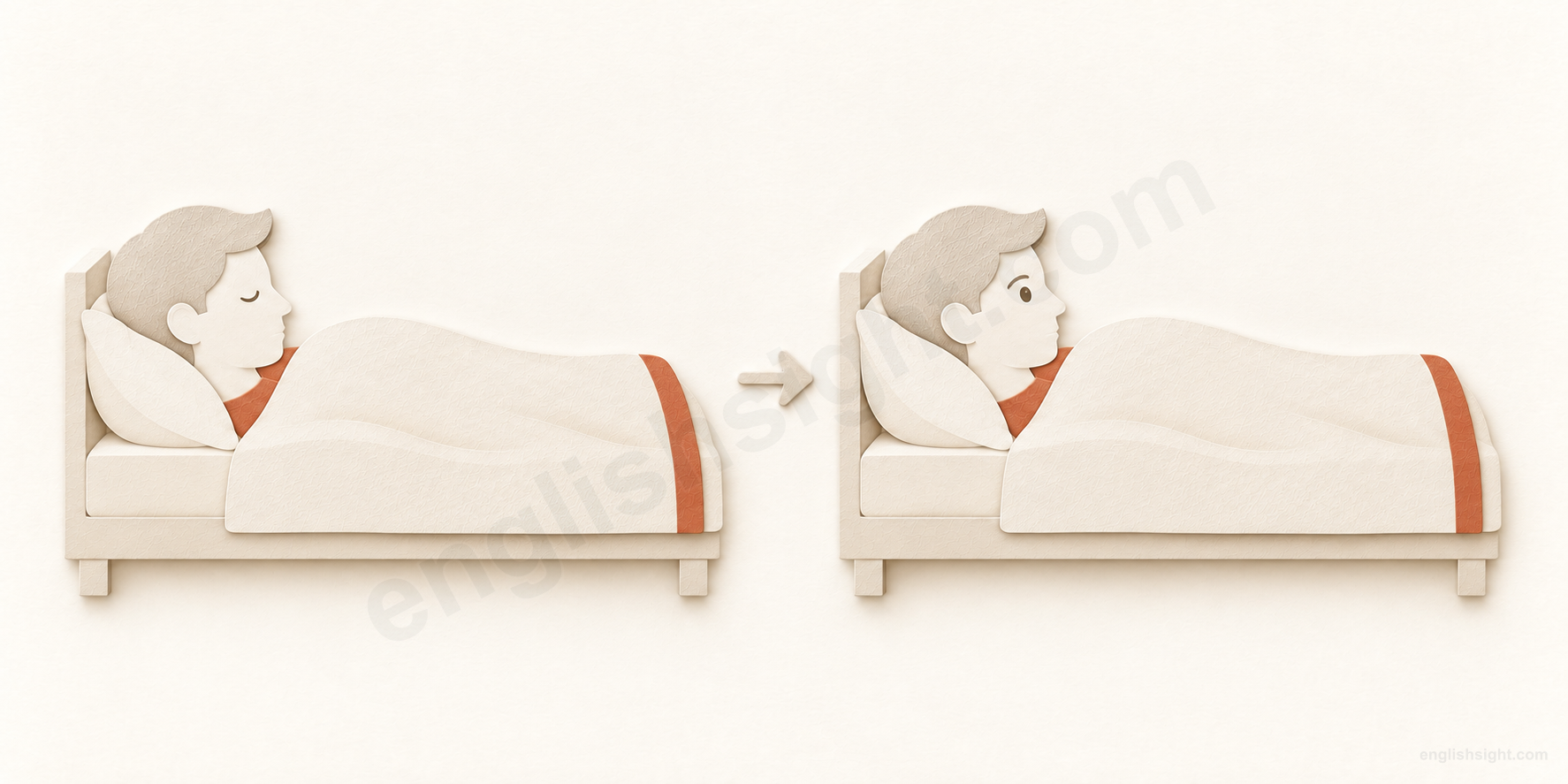
The person is asleep in bed.
awake
The person is awake, still in bed.
Sleep ends; the person awakes.
Awoke marks the change; awake describes the resulting state, even while still in bed.
Awake describes being out of sleep; the verb awake describes entering that state. Figurative uses describe awareness or feelings becoming active.
The two panels contrast sleep and wakefulness in the same bed. The arrow illustrates awoke; awake names the right-hand state. Open eyes are only a visual cue: awake people can close their eyes.
Awake is most useful as an adjective describing someone who is not sleeping. Other words in the sentence tell you whether that state continues, is maintained, or begins.
As a verb, awake marks emerging from sleep. More formal or literary uses extend this change to awareness and feelings. The diagram offers a teaching comparison, not a universal picture in English speakers’ minds.
01
Being awake and staying awake
The adjective describes a state. The verb before it tells you whether that state continues, is maintained, or begins.
01
be + awake
be awake
be out of sleep
Situation / earlier state
You quietly check on a child in bed.
Meaning in context
The child is not sleeping.
Awake describes a state; it does not say when sleep ended.
In Is the baby awake?, awake is an adjective after be. Someone can be awake while still lying in bed, feeling tired, or keeping their eyes closed.
Put ordinary awake after the verb: an awake baby is not the usual wording. Say The baby is awake or a baby who is awake. In the only person awake, it can follow the noun.
Awake can also contrast with unconscious, for example during a procedure. That is still a state, not a promise that the person feels energetic.
In a sentence
I was already awake when you called.
Watch the difference Awake is not the same as up: being awake does not mean being out of bed.
02
stay / remain + awake; be still awake
stay / remain awake
continue without falling asleep
Situation / earlier state
A long journey makes you sleepy.
Meaning in context
You continue to be awake.
Stay and remain supply continuation; awake names the state.
Stay awake often concerns resisting sleep. Remain awake expresses continuation too and sounds more formal. Neither construction by itself says that another person woke you.
Still awake means the state continues at the time mentioned. Stay up focuses on not going to bed; stay awake focuses on not sleeping, even in bed.
In a sentence
I tried to stay awake until my sister got home.
Watch the difference For a continuing state, use I stayed awake, not I stayed wake.
03
keep + someone / yourself + awake
keep someone awake
prevent someone from falling asleep or returning to sleep
Situation / earlier state
A neighbor plays music late at night.
Meaning in context
You cannot sleep because of it.
The object of keep is the person whose waking state continues.
Keep + person + awake makes the person remain out of sleep. Noise, pain, excitement, or worry can do this; deliberate action is not required.
Keep yourself awake has the same pattern with a reflexive object. Contrast wake someone up: that describes ending their sleep, while keep someone awake describes preventing sleep.
In a sentence
The dripping tap kept me awake for hours.
Watch the difference The adjective does not change for past time: kept me awake, not kept me awoke.
04
lie + awake; lie awake + thinking / worrying
lie awake
be lying down without sleeping
Situation / earlier state
You go to bed with a problem on your mind.
Meaning in context
You remain there unable to sleep.
Lie gives the posture; awake gives the accompanying state.
Lie awake often describes sleepless time in bed. Worrying or thinking can explain what occupies the person, but worry is not part of awake itself.
For lying down, the past of lie is lay: Last night I lay awake. Lay something down is a different verb with an object.
In a sentence
I lay awake thinking about the interview.
Watch the difference Do not confuse lie awake with lie about something, which can mean tell an untruth.
05
be / feel + wide awake / fully awake / half awake
wide awake / fully awake / half awake
describe how completely someone has emerged from sleep
Situation / earlier state
Someone speaks just after you wake.
Meaning in context
You may still be drowsy or may be completely alert.
These modifiers describe wakefulness, not the width of the eyes.
Wide awake and fully awake mean completely awake. Half awake and barely awake suggest lingering sleepiness. Wide is an established intensifier here, not a general substitute for very.
Wide awake may describe someone who cannot get back to sleep, but inability to sleep is not required in every context. Before a noun, use the hyphenated compound, as in a wide-awake child; ordinary awake alone usually does not go there. Wide-awake can also mean alert and observant, so the compound can describe attentiveness rather than just the absence of sleep.
In a sentence
I was half awake when the phone rang, but now I’m wide awake.
Watch the difference Use wide awake, not widely awake. Being fully awake does not guarantee careful judgment.
06
come / jerk + awake
come awake / jerk awake
enter the waking state
Situation / earlier state
A sudden sound reaches someone asleep.
Meaning in context
The person becomes awake.
The change comes from come or jerk; awake is the resulting adjective.
Come awake describes emerging into wakefulness. Jerk awake adds a sudden bodily start. These are useful to recognize in descriptions and stories; wake up is simpler in ordinary conversation.
Compare She is awake, a state, with She jerked awake, a sudden change. These are result constructions, not a family of separable phrasal verbs with awake as a particle.
In a sentence
She jerked awake when the tray hit the floor.
Watch the difference Do not assume every verb can naturally take awake as a result; learn the attested combinations.
02
Coming out of sleep
Awake is also a verb, especially in written narratives. Wake up is the usual everyday choice. Read what follows to distinguish a cause, an experience, and a discovery.
07
awake; awake from + sleep / a dream
awake / awake from sleep
stop sleeping
Situation / earlier state
Someone has been asleep.
Meaning in context
Their sleep ends.
The verb marks the change that leads to the adjective’s state.
As a verb, awake can stand without an object. From can name the sleep or dream left behind. Awoke is especially familiar in written accounts; I woke up is the usual conversational alternative.
Useful forms are awake, awakes, awaking, awoke, and awoken. Compare I awoke at dawn, an event, with I was awake at dawn, a state. I have awoken uses the past participle.
In a sentence
I awoke from a strange dream before dawn.
Watch the difference For everyday requests, Wake up! is more usual than Awake!, which can sound literary or dramatic.
08
awake + someone; be awoken + by + cause
awake someone
cause someone to stop sleeping
Situation / earlier state
A child is asleep.
Meaning in context
A noise ends the child’s sleep.
A transitive verb takes the sleeper as its object.
The sound awoke her has a cause as subject and a sleeper as object. This is a formal or literary alternative to The sound woke her up.
The passive is possible: She was awoken by a crash. Was awoken describes an event; was awake describes a state. In wake her up, a pronoun goes before up; awake her has no up particle.
In a sentence
A crash in the kitchen awoke us.
Watch the difference Do not form awake someone up by copying the ordinary wake someone up pattern.
09
awake to + noun phrase; awake to find + situation
awake to a sound / awake to find…
encounter something on waking
Situation / earlier state
You have been sleeping.
Meaning in context
On waking, you hear something or discover a situation.
What follows to can name an experience or introduce a discovery.
In awoke to the sound of rain, to is a preposition followed by a noun phrase: that sound is present as you wake and may have woken you.
In awoke to find the house empty, to find is an infinitive introducing what you discover. It does not mean you deliberately woke for the purpose of finding something. These waking contexts differ from figurative awake to a danger.
In a sentence
We awoke to find that snow had covered the garden.
Watch the difference Do not interpret every awake to as become aware: a rain sound may be a literal waking experience.
03
Awareness and returning feelings
These figurative uses extend beyond sleep. Learn their full constructions and recognize their more formal or literary tone.
10
be + awake + to + risk / possibility / reality
be awake to something
be aware of something and alert to its significance
Situation / earlier state
A team discusses a risk.
Meaning in context
They recognize that risk and take it seriously.
Be awake to describes awareness, rather than a transition out of sleep.
In be awake to the risks, awake is an adjective and to introduces what someone recognizes. This figurative wording is more formal than be aware of the risks.
The sleep connection is a teaching comparison: paying attention contrasts with failing to notice. The sentence need not involve bedtime or an actual sleeping person.
In a sentence
The organizers are awake to the risks of overcrowding.
Watch the difference Awake alone normally concerns sleep; the to phrase makes the figurative target clear.
11
awake + to + something / the fact that + clause
awake to the fact that…
begin to recognize a fact and its implications
Situation / earlier state
People have overlooked a problem.
Meaning in context
They come to understand that it matters.
The verb presents new awareness; to links it to the issue recognized.
Oxford lists awake to something as a phrasal verb. Here it is an established figurative construction: The council awoke to the problem means it began to recognize it, not that the problem made a noise at bedtime.
In awake to the fact that…, the fact is the noun phrase after the preposition to and that introduces its content. Compare were awake to the danger, an awareness state, with awoke to the danger, the onset of awareness.
In a sentence
We finally awoke to the fact that our plan was too expensive.
Watch the difference Keep the preposition before the issue: awoke to the problem, not awoke the problem.
12
awake + a feeling / memory; a feeling + awakes
awake old feelings / memories
cause a feeling to arise or return, or bring back a memory
Situation / earlier state
A feeling or memory has not been active for a long time.
Meaning in context
An experience brings it back.
The figurative change concerns a feeling or memory, not a sleeping person.
Awake can take a feeling or memory as object. A feeling can also awake without an object: it begins to be felt or becomes active again. This language belongs especially to formal or literary description.
The connection with sleep is metaphorical: something inactive becomes active again. In ordinary conversation, brought back memories or stirred up old fears will often sound less literary.
In a sentence
The familiar tune awoke memories of my first school.
Watch the difference This does not make awake a general replacement for start: do not use awake a machine for switch it on.
Keep state, change, and register separate
An adjective after the verb
Be awake, stay awake, keep me awake, and lie awake contain the adjective. Awoke and awoken belong to the verb. Compare I was awake with I was awoken by a noise.
Choose the everyday verb
Wake up is the ordinary conversational choice for ending sleep. Awake as a verb is more formal or literary, especially familiar as awoke in writing. Awaken is a separate related verb, not an inflected form of awake.
Boundaries of this lesson
This lesson includes the principal sleep constructions and recognizable figurative awareness and feeling uses. It does not treat rare inflections, historical meanings, or the specialized noun wide-awake for a hat as everyday vocabulary.
Choose the state or change
Use the whole construction and the situation to choose.
1. You are still in bed, but you have stopped sleeping. Which statement can be true?
2. A dripping tap prevents you from sleeping for an hour. Which sentence describes that continuing effect?
3. Choose the sentence about a completed event that ended someone’s sleep.
4. After ignoring repeated warnings, a company finally recognizes a risk. Which sentence fits?
Sources and teaching notes
The dictionary pages below support the usage inventory. Explanations and examples are original; the visual connection is a teaching model.
The diagram illustrates a useful connection; it does not represent a picture shared by every native speaker.