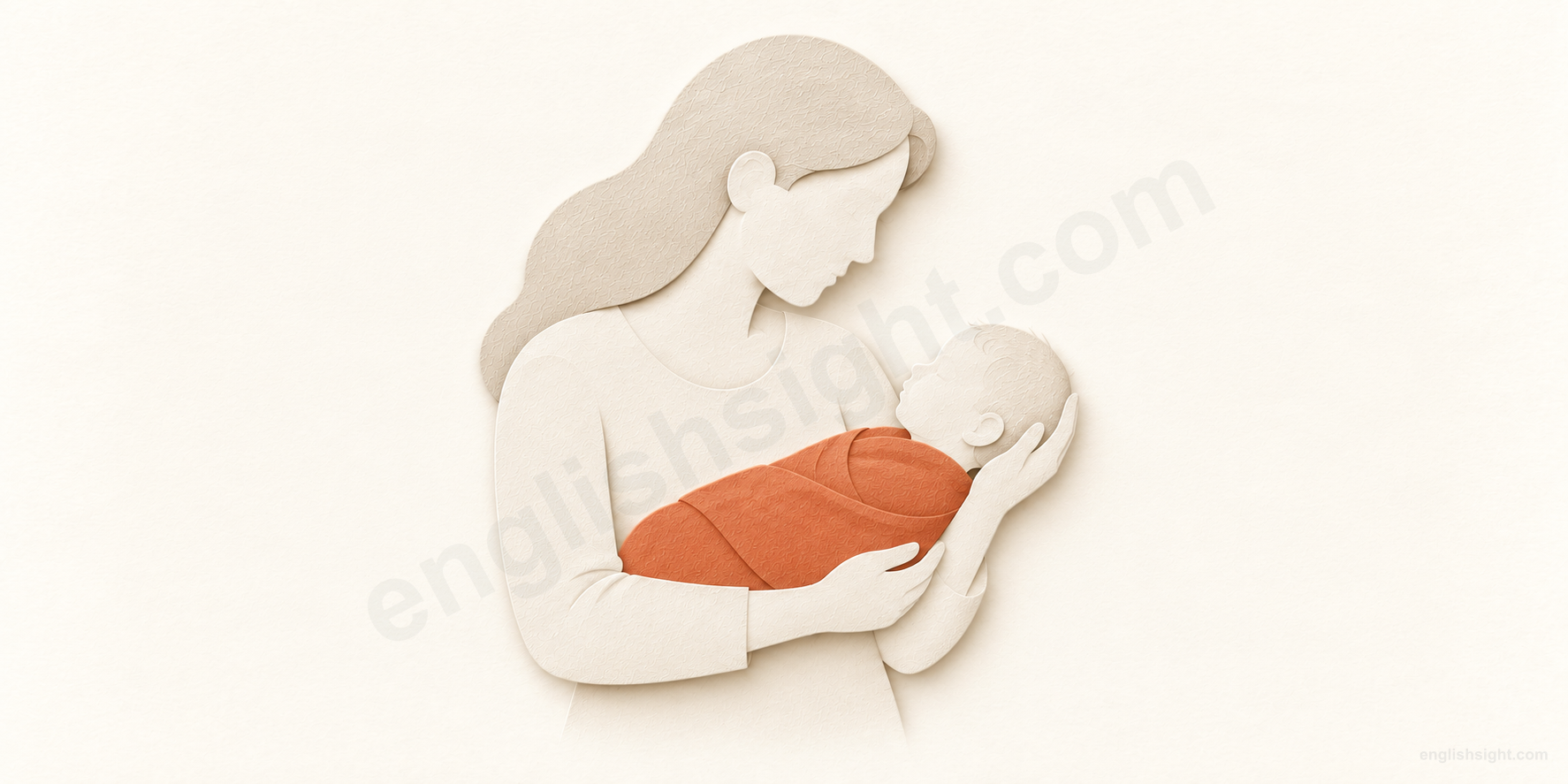
Very young life, and the care we associate with it.
Read baby through age, smallness, care, and familiar expressions.
Early life and supporting care
Early life and supporting care
A very young child rests in a caregiver’s arms.
baby
The infant remains cradled close to the caregiver.
The caregiver supports the infant’s head and wrapped body.
Baby names the very young child; the embrace highlights an association with care.
A baby is a very young child or animal; many extensions evoke smallness, dependence, affection, or special care.
The sketch focuses on an infant supported by a caregiver. Care is an association, not a requirement that every use of baby must involve helplessness. There is no change of ownership or movement between stages.
A baby is a very young child or animal. Other uses draw on different associations: being the youngest, acting dependent, being small, or receiving special affection and care.
These connections are a teaching model, not a rule that predicts every phrase or a picture shared by all English speakers. Some expressions need to be learned as complete units.
01
Young lives and everyday care
Start with age and family life. The surrounding words tell you whether someone is being born, being cared for, or being described.
01
a / the / my + baby; plural babies
a baby / babies
a child at a very early stage of life
Situation
A child is only a few months old.
What the wording conveys
You identify the child as a baby.
Baby names the young child; another verb tells you what happens.
A baby is a very young child. Child covers a wider age range; baby focuses on the early stage. There is no single everyday birthday at which all speakers must stop using the word.
In Please hold the baby, hold supplies the action and baby names its object. Feed the baby and rock the baby to sleep work the same way; baby does not itself mean feed or put to sleep. Change the baby is an everyday way to say change the baby’s nappy or diaper.
In a sentence
Please hold the baby while I put on my coat.
Watch the difference A singular countable noun usually needs a determiner: a baby or our baby, rather than We have baby.
02
be expecting a baby; have a baby; the baby is due / was born
have / be expecting a baby
talk about birth, pregnancy, or becoming a parent
Situation
A family is preparing for a new child.
What the wording conveys
The wording locates the child before or at birth.
Expecting, having, and being born express different stages.
She is expecting a baby normally means she is pregnant. She had a baby last week reports a birth. We’re having a baby in March can announce a couple’s expected new child; it need not mean that both speakers are pregnant.
The baby is due in March gives the expected birth time; The baby was born in March reports the actual birth. Baby can refer to the child before birth too. I have two babies can instead describe the children I have; read the tense and context.
In a sentence
We’re expecting a baby in March.
Watch the difference Do not confuse a due date with an actual birth date, or translate expecting as merely waiting for a visitor.
03
a baby boy / girl; my baby brother / sister
a baby girl / my baby brother
identify a young child or describe a young relative
Situation
You introduce a family’s new child.
What the wording conveys
Listeners learn more about the child.
The following noun identifies the child or family relationship.
A baby girl and a baby boy are babies; girl or boy adds information about the child. My baby brother normally refers to a very young brother.
In affectionate family speech, a relative may still call a grown child or younger sibling their baby. My baby brother is thirty relies on that family viewpoint, not a claim that thirty is an infant’s age.
In a sentence
My baby brother has just learned to crawl.
Watch the difference A baby brother is a person. Baby clothes are things for a baby: similar word order can express a different relationship.
04
a baby + animal noun; an animal’s babies
a baby elephant
a very young animal
Situation
An elephant has recently been born.
What the wording conveys
You describe its early life stage.
Baby can describe an animal’s age without naming its species-specific young.
Baby is not limited to humans. A baby elephant, baby birds, and a bird with her babies refer to very young animals.
Baby + animal name is useful when you do not know a special name for the young. Small alone would only describe size: a small adult elephant is not therefore a baby.
In a sentence
A baby elephant stayed close to its mother.
Watch the difference Do not use baby to mean any small animal regardless of age.
05
baby + product noun: baby food / clothes
baby food / baby clothes
things intended for babies
Situation
You shop for a young child.
What the wording conveys
You choose products made for that age group.
Before a product noun, baby can identify the intended user.
Baby clothes are clothes for babies. Baby food is food prepared for them. The phrase does not say that the clothes or food are themselves newly born.
Contrast a baby elephant, which is an animal at an early life stage. Dictionaries may call baby a noun modifier or an adjective here; the useful question is whether the next noun names a young being or something for one.
In a sentence
We packed baby clothes in a separate bag.
Watch the difference Keep baby singular as a modifier: baby clothes, not babies clothes. The babies’ clothes is a possessive phrase.
06
baby + vegetable noun
baby vegetables
small versions of vegetables or vegetables picked young
Situation
You read a menu or a food label.
What the wording conveys
Baby describes the vegetables’ small form or early harvest.
This food use describes the vegetables, not who should eat them.
Baby spinach and baby carrots use baby before a vegetable name. The label can concern early harvesting or a small version; do not assume every product bearing the word was picked at the same stage.
Baby food is prepared for infants, whereas baby vegetables can be served to adults. This contrast shows why word order alone does not determine the relationship.
The wider small-of-its-type use also occurs in a baby grand, a small kind of grand piano. That is an established instrument name, not a piano intended for an infant.
In a sentence
I added baby spinach to the salad.
Watch the difference Use this descriptive baby before the noun; The spinach is baby is not the normal way to describe it.
02
Age, behavior, affection, and responsibility
These uses pick out different associations with babies. A younger colleague, an upset adult, and a cherished project are different kinds of comparison.
07
the baby of + family / group
the baby of the family
the youngest member, even if already grown up
Situation
Several adult siblings compare their ages.
What the wording conveys
The youngest is called the baby.
The comparison is relative to the group, not an absolute age.
The baby of the family or the baby of the team is the youngest member. An adult can hold that position.
The of-phrase names the group used for comparison. Calling a new employee the baby can sound playful or patronizing; youngest is a clearer neutral choice when that tone is unwanted.
In a sentence
At twenty-eight, Jo is still the baby of the family.
Watch the difference Do not infer that the person is a child or the least capable member.
08
be a baby; don’t be such a baby; cry like a baby
Don’t be such a baby.
criticize someone as childish or easily upset
Situation
An adult complains about a minor inconvenience.
What the wording conveys
Another person dismisses the reaction as immature.
The speaker judges behavior, rather than identifying someone’s age.
Calling an adult a baby can criticize fear, helplessness, or an easily upset reaction. The expression can hurt; describe the problem directly when you want to avoid belittling someone.
Cry like a baby compares the way someone cries, often intensely or openly. I cried like a baby at the ending can be a speaker’s candid description of emotion, without the accusation in Don’t be a baby.
In a sentence
I cried like a baby when the missing dog came home.
Watch the difference A comparison involving tears need not be an insult, but calling another person a baby can be dismissive.
09
baby, + clause; my baby
baby, … / my baby
an intimate or affectionate way to address or refer to someone
Situation
Two partners speak privately.
What the wording conveys
One uses a familiar affectionate name.
The relationship and tone make the address affectionate.
Baby can address a partner or someone deeply loved. It is informal and personal; the person addressed need not be young. Parents may also call a grown child their baby out of affection.
The same address can sound unwelcome, patronizing, or offensive from a stranger. It is not a general polite substitute for someone’s name.
In a sentence
“Good night, baby,” she whispered to her partner.
Watch the difference Do not copy an intimate address from a song into an ordinary conversation with a stranger or colleague.
10
a project / plan + be + someone’s baby
be someone’s baby
be a project someone feels especially responsible for or attached to
Situation
One colleague developed an idea and has guided it closely.
What the wording conveys
Others identify the project as that person’s baby.
Personal creation and investment motivate this informal comparison.
A project that is your baby is something you feel especially responsible for or attached to, often because you developed it. It need not be new or small; the expression can emphasize special responsibility or interest without proving that you created it.
Compare The baby is mine, which could identify a real child. This website is my baby instead uses a possessive description to express personal involvement in a creation.
In a sentence
The community garden is Lila’s baby; she planned it from the start.
Watch the difference This informal phrase does not by itself establish legal ownership or say who must do every task.
03
Treating gently and starting small
The verb describes how someone treats a person or thing. Familiar compounds highlight early language or small beginnings.
11
baby + person; be babied by + person
baby someone
treat someone as if they need excessive protection
Situation
A teenager can perform a task independently.
What the wording conveys
An adult keeps doing everything for them.
The verb turns the infant-care association into a manner of treating someone.
To baby someone is to treat them with the kind of protection or attention associated with a very young child, often more than they need. It can suggest that you are preventing independence.
Use a direct object: Don’t baby him. A passive is possible: He was babied by his relatives. Babying describes treatment in progress; unlike the noun plural babies, it is an -ing verb form.
In a sentence
Please don’t baby me; I can make my own lunch.
Watch the difference Baby someone is not a neutral synonym for babysit: babysit means look after a child for a period.
12
baby + object / body part
baby a car / an injured knee
handle or use something with particular care
Situation
A thing seems delicate, valuable, or easily damaged.
What the wording conveys
Someone treats it gently.
With a thing or body part as object, baby can mean handle carefully.
People can baby a treasured car, a fragile machine, or an injured body part. The object receives gentle treatment; it does not become younger.
Compare babying a capable adult, which often criticizes excessive protection. With an object, the focus may simply be careful handling. Neither use guarantees that the care is necessary or effective.
In a sentence
He babied the old camera and carried it in a padded case.
Watch the difference This informal verb describes treatment; baby is not a medical instruction or a guarantee of repair.
13
take baby steps; baby steps toward / towards + goal
take baby steps
begin with small, manageable actions
Situation
A large task feels difficult.
What the wording conveys
You start with a small action and build gradually.
The size of early steps becomes a comparison for gradual progress.
Baby steps are small measures, often at the start of a long or difficult process. The expression usually appears in the plural and can encourage realistic progress.
Take baby steps toward a goal describes a method, not the age of the person. A baby step can be a single small advance; one small step is the more neutral alternative if the metaphor sounds too playful.
In a sentence
We’re taking baby steps toward a more regular study routine.
Watch the difference Baby steps does not mean no progress, and it does not promise that the whole task will be easy.
14
baby talk; use baby talk with + person
baby talk
an infant’s early speech or special language used to infants
Situation
A child is beginning to speak, or an adult is speaking to that child.
What the wording conveys
You identify the speech style as baby talk.
The compound can concern speech by a baby or speech addressed to one.
Baby talk can name a baby’s developing words and sounds. It can also name the special words or style adults use when talking to babies.
Context identifies the speaker: Her first baby talk concerns the infant; He uses baby talk with the infant concerns the adult. It is an uncountable expression, not a count of conversations.
In a sentence
Grandpa used baby talk when he spoke to the infant.
Watch the difference Baby talk is a noun phrase. In The baby talks, baby is the subject and talks is the verb.
04
Learn the whole expression
These comparisons and idioms have established meanings. The infant image may help you remember them, but baby alone does not supply the full message.
15
sleep / slept like a baby
sleep like a baby
sleep very well
Situation
Someone has had a restful night.
What the wording conveys
They describe their sleep with a familiar comparison.
The whole comparison expresses good sleep.
Sleep like a baby is an informal way of saying that you sleep very well or peacefully. It does not report your age or your sleeping position.
The phrase is conventional, even though real babies may wake frequently. A literal fact about infants is not a reliable test of what an established comparison means.
In a sentence
After the long walk, I slept like a baby.
Watch the difference Do not interpret the idiom as saying that the speaker kept waking up.
16
throw the baby out with the bathwater
throw the baby out with the bathwater
lose something valuable while removing what is unwanted
Situation
A system has useful features as well as serious faults.
What the wording conveys
Rejecting it all would remove both.
The valuable part must be distinguished from the unwanted part.
This idiom warns against discarding something useful when trying to remove what is bad. In the comparison, the baby is the valuable part and the used bathwater is what should go.
It often appears in a warning: Don’t throw the baby out with the bathwater. The situation need not involve a real child or water. Bathwater is also written bath water.
In a sentence
Let’s fix the confusing lessons rather than throw the baby out with the bathwater and close the whole course.
Watch the difference This means losing the good along with the bad, rather than simply making any careless mistake.
17
leave + person + holding the baby; be left holding the baby
be left holding the baby
be left with responsibility others avoid
Situation
A group shares a difficult task.
What the wording conveys
Others leave and one person has to handle it.
The image of care becomes an unwanted responsibility.
In this British informal idiom, someone is left responsible for a task or problem, often unfairly because others have avoided it. Leave someone holding the baby is the corresponding active pattern.
The baby is figurative in a sentence about a report or failed project. In a family story, the same words might be literal. American English commonly uses be left holding the bag for a similar unwanted burden.
In a sentence
When both organizers quit, Mei was left holding the baby.
Watch the difference Ordinary childcare is not automatically the idiom: the figurative use concerns responsibility being passed or abandoned.
18
doing something / it + be + like taking candy from a baby
like taking candy from a baby
extremely easy to accomplish
Situation
A task looks as though it might be hard.
What the wording conveys
Someone finds it surprisingly easy.
The comparison emphasizes ease, rather than naming a real act of taking.
Be like taking candy from a baby is an informal comparison for something very easy. The image evokes someone who cannot offer much resistance, but the idiom does not require an actual baby or actual candy.
Because the image involves an unequal contest, it can sound boastful when used about defeating someone. A neutral alternative is It was very easy.
In a sentence
With the right tool, opening the lid was like taking candy from a baby.
Watch the difference Learn the established comparison as a whole; baby on its own does not mean easy.
Read the age, the relationship, and the grammar
Forms and pronunciation
Baby is pronounced /ˈbeɪbi/. The plural noun is babies; one baby’s blanket belongs to one infant, while the babies’ blankets belong to several. The verb forms are baby, babies, babied, and babying. Keep the y in babying.
Care is not always criticism
Babying a capable person often suggests too much protection. Babying a delicate object may simply mean handling it carefully. A noun such as baby food can name a suitable product without making any judgment about care.
A limited visual connection
Young age, small size, dependency, and affection are related associations, not interchangeable definitions. A grown person can be the baby of a family; a project can remain someone’s baby for years. Learn the whole idiom when the meaning is conventional.
Scope of this lesson
This lesson covers the main modern noun, descriptive modifier, verb, and selected everyday compounds and idioms. It does not inventory every baby compound, demographic label, medical term, slang use, or regional expression. It is a usage selection, not a frequency ranking.
Choose the meaning in context
Use the surrounding words and the speaker’s relationship to choose an interpretation.
1. “At thirty, I’m still the baby of the family.” What does baby mean?
2. A menu says “salad with baby spinach.” What is the likely meaning?
3. “Stop babying me; I can do it myself.” What is the speaker asking?
4. “They’re expecting a baby in July.” What does this normally announce?
5. Two colleagues quit a project and you are “left holding the baby.” What happened?
6. A course has useful lessons and a few poor ones. Which advice fits “Don’t throw the baby out with the bathwater”?
Sources and teaching notes
Dictionary pages support the uses and patterns below. The explanations, examples, and visual teaching model were composed for this lesson.
The visual connection is a teaching aid; English speakers do not all share one mental picture.