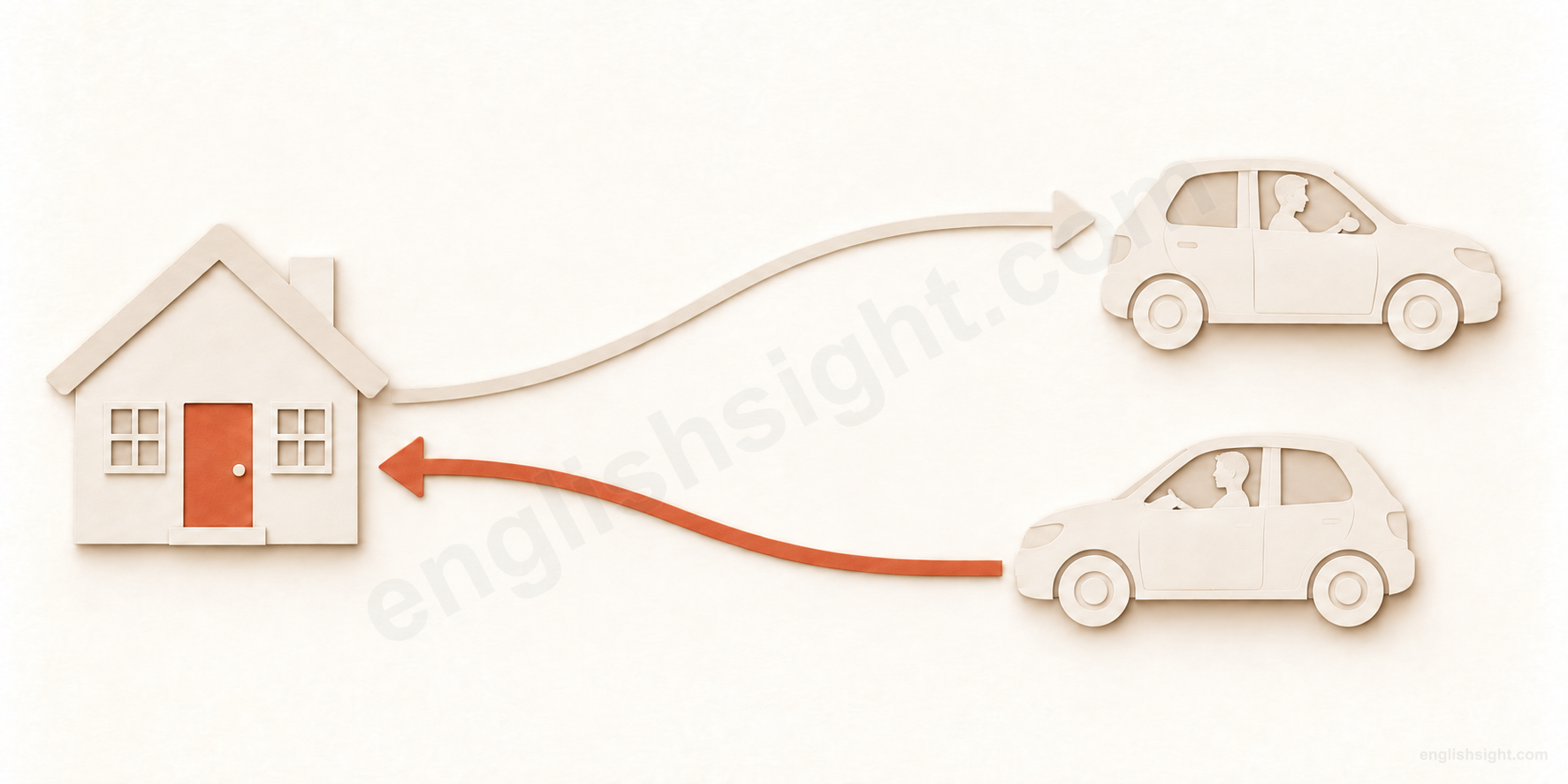
Find the reference point, then distinguish return, direction, support, and fixed expressions.
A return to an earlier point
Connect the return to an earlier point
The car leaves home.
back
The return is towards a place it occupied earlier.
It turns and heads towards the same home again.
Back links the return to the home left earlier. The car travels forwards; returning does not mean reversing.
In its return use, back relates a movement or change to an earlier place or state.
The car leaves home and travels towards the same home again. It can return while driving forwards. Rear surfaces, backward movement, support, and established idioms are separate branches that the lesson explains in words.
Back can name a body part or rear surface, locate something away from a front, or connect an action with an earlier place, state, owner, or action. First ask which reference point the sentence supplies.
The return picture below explains one large family. It does not turn every idiom into a return journey, and it is a teaching model rather than a mental picture shared by every English speaker.
01
Bodies, surfaces, and reference points
A front gives us an orientation. Back can name the opposite side, the rear area, or movement away from the front. It can also locate something at a place previously passed or mentioned. These uses do not necessarily describe a return journey.
01
possessive + back; on your back; with your back to + noun
my back; on your back
the rear part of a person’s or animal’s body
Situation / starting point
A traveler has carried a heavy bag.
Result / interpretation
The rear of her body feels sore.
The body has a front and a back, regardless of where the observer stands.
Your back runs from below your neck towards your hips, opposite your chest and stomach. My back hurts concerns this body area; a broken back can refer more specifically to the spine. Back pain is a noun combination, not a claim about motion.
Lie on your back means rest with your face upward and your back underneath you. Stand with your back to the window describes orientation: you face away from the window. On an animal’s back often means on the upper body surface that carries a rider.
In a sentence
My back aches after carrying that bag.
Watch the difference Use my back or the back, with a determiner. The plural is backs.
02
at the back of + noun; in the back (of a vehicle)
at the back; in the back
the rear area of a room, vehicle, or object
Situation / starting point
You choose a seat far from the front of the bus.
Result / interpretation
You sit in its rear section.
The back is part of the thing being described; behind can locate a separate thing.
At the back of the hall locates you in its rear area. In the back of the car locates you inside the rear passenger space. In American English, in back can be used without the: The children sat in back.
The answer key at the back of a book is near its final pages, not necessarily printed on its outside cover. Compare a tree behind the house: the tree is separate from the house. A room at the back of the house is part of it. Out back is a familiar expression for the area behind a building, especially in American English.
In a sentence
We found two empty seats at the back of the bus.
Watch the difference At the back is not always the same as outside and behind. Choose in when emphasizing the interior of a car.
03
on the back of + object; the back of + chair
on the back of a card; the back of a chair
a reverse surface or the part supporting your body
Situation / starting point
A card has a printed front and an empty reverse side.
Result / interpretation
You use the reverse side for a note.
Back names a surface or component rather than a destination.
On the back of a card, photograph, or envelope means on its other surface relative to the front. The back of your hand is opposite your palm; it is not the part nearer your wrist.
A chair’s back is the upright part you lean against. It can be called a back even when viewed from the front. The object’s function supplies the orientation; back does not simply mean whatever side is hidden from you.
In a sentence
Write the room number on the back of the card.
Watch the difference Write on a surface; use at the back of a book for its final pages.
04
back + noun
back door; back row; back roads
located towards the rear or away from main routes
Situation / starting point
A building has an entrance at its rear.
Result / interpretation
You specify that entrance.
Before a noun, back identifies its rear location.
Back door, back pocket, and back row use back before the noun to contrast with front. The adjective normally stays before a noun: say The door is at the back rather than The door is back when you mean its location.
Back roads are smaller roads away from major routes. This is an established extension, not a statement that the roads run backwards. A back garden is the garden behind a house, a common British expression.
In a sentence
Please use the back door while the front entrance is being painted.
Watch the difference The door is back usually means it has returned, not that it is a rear door.
05
verb + back; back from + noun
step back; look back; lean back
move or direct attention towards the rear
Situation / starting point
You face a hot oven and stand too close.
Result / interpretation
You move away while still facing it.
Movement towards the rear need not return to a place previously occupied.
Step back describes movement away from the direction you face or from a nearby point. Stand back can tell someone to remain at a safe distance. A house set back from the road is situated some distance from it; it is not moving.
Look back can mean turn your gaze behind you; lean back changes the angle of your body. Tie your hair back moves and holds it away from your face. Backwards focuses on direction; back can express direction or return. You can turn round and walk back home facing forward.
In a sentence
Step back from the oven before I open it.
Watch the difference Going back to a town does not mean walking backwards.
06
back and forth; back and forth between + plural noun
back and forth
move repeatedly between two positions
Situation / starting point
A ferry reaches one island and then returns.
Result / interpretation
It repeats the trip in both directions.
Forth supplies the outward direction; back supplies the return.
Back and forth describes repeated movement from one point to another and back. The room need not have a literal front or back. Messages can also go back and forth when people exchange them repeatedly.
This whole expression involves repetition. A single trip there and back describes one outward and one return journey; it does not by itself imply repeated trips.
In a sentence
The ferry runs back and forth between the two islands.
Watch the difference Use between for the two endpoints; do not treat forth as a place name.
07
back to back; back-to-back + noun; back to front
back to back; back to front
opposed orientation, consecutive events, or a reversed item
Situation / starting point
Two people face away from each other.
Result / interpretation
Their backs face or touch each other.
A physical orientation and a scheduling idiom share a form but differ in meaning.
People sitting back to back face opposite directions. Meetings held back to back follow immediately one after the other. Before a noun, write back-to-back meetings; after the verb, The interviews were held back to back has no hyphens.
In British English, a shirt worn back to front has its back where its front should be. American English commonly uses backwards here. Inside out instead means the inner surface is showing, which is a different mistake.
In a sentence
I have two interviews back to back this morning.
Watch the difference Back to back does not always mean a physical arrangement; the noun and situation decide.
08
back + at / in + earlier place; distance + back
back at home; two streets back
locate something at a place previously mentioned or passed
Situation / starting point
A story follows someone away from home, where another person remains.
Result / interpretation
The account shifts to what is happening at home.
The reference point can belong to the story or route rather than to a returning person.
Back at home can shift a story to a place already established: Nora was on the train. Back at home, her brother was feeding the cat. Her brother need not have left or returned; back directs the listener’s attention to that earlier location. Meanwhile often makes the change of scene explicit.
Two streets back locates something at a point already passed along a route: The bakery was two streets back. This says where the bakery was relative to your progress, not that it moved backwards. Compare We went back to the bakery, which describes an actual return journey.
In a sentence
Nora was on the train. Meanwhile, back at home, her brother was feeding the cat.
Watch the difference Back at home can describe a change of scene without saying that anyone has returned home.
02
Return, restoration, and response
Back often connects the present movement or action to an earlier place, owner, state, activity, or action. The verb and its complements tell us what returns.
09
come / go / get + back + (to + place); back home
come back; go back; get back
return to a place previously left
Situation / starting point
You leave home to buy food.
Result / interpretation
Later you return home.
The destination is connected with an earlier location.
Come back presents return towards the speaker or another chosen viewpoint. Go back presents return to a place from the current location. Get back focuses on reaching the place again: What time did you get back?
Be back describes being present again, not necessarily the journey: I’ll be back at six. Use back to school, back in London, and back at the office as the place requires. Home is normally an adverb in go back home, without to. There and back covers an outward trip plus its return.
In a sentence
I left my glasses at home, so I have to go back.
Watch the difference Return already includes this idea; ordinary return home is preferable to the redundant return back home.
10
give / put / bring / take / send + object + back; get + object + back
give it back; put it back; get it back
restore an object to an earlier owner or position
Situation / starting point
A friend lends you a charger.
Result / interpretation
The charger goes to its owner again.
The verb identifies who returns the object, how it moves, or who recovers it.
Give it back returns possession; put it back restores a position. Bring it back normally directs the object towards the chosen viewpoint; take it back carries it to the earlier place. Send it back uses delivery. Get it back means recover it, so the subject is the receiver rather than the returner.
With these separable return combinations, a short noun can often go after back or between the verb and back: give back the key / give the key back. A personal pronoun goes between: give it back. Take something back to a shop also describes returning a purchase; the shop can take it back by accepting the return.
In a sentence
Please give the charger back to Maya when you finish.
Watch the difference Say give it back, not give back it. Returning a purchase does not itself guarantee a refund.
11
be / get / go + back + to / in / at + complement
back to normal; back at work; back in fashion
be in an earlier state or activity again
Situation / starting point
The trains stop during repairs.
Result / interpretation
They run normally again.
The return can be a state change rather than physical travel.
Back to normal marks restoration of an earlier ordinary condition. Get back to work means resume working; go back to sleep means sleep again after waking. To is a preposition before an activity noun or -ing form in go back to studying, not an infinitive marker.
An old style can be back or back in fashion when popular again. Bring something back can cause restoration: The repair brought the machine back into use. Back suggests a prior relevant state; again merely marks repetition and does not always express the same relation.
In a sentence
The heating is fixed, and the rooms are back to normal.
Watch the difference Say go back to studying, not go back to study when the intended meaning is resume the activity. Go back to study can instead express a purpose.
12
come / go / get + back to + topic
come back to a question
resume discussing an earlier topic
Situation / starting point
A discussion moves from cost to design.
Result / interpretation
You return to the question of cost.
The earlier point is a topic, not a physical location.
Can we come back to the cost? directs the conversation towards a point already raised. Get back to the question is similarly a request to resume it. The noun after to identifies the topic.
Back does not mean the earlier answer must be repeated unchanged. You can return to a topic to revise it, add information, or ask a different question. Keep the object after to: get back to it, not get it back to for this meaning.
In a sentence
Before we finish, can we come back to the delivery date?
Watch the difference Distinguish returning to a topic from getting an object back: get back to the report versus get the report back.
13
call + person + back; write back to + person; get back to + person
call back; write back; get back to someone
reply or contact someone again
Situation / starting point
A colleague asks a question you cannot answer yet.
Result / interpretation
You contact the colleague later with information.
A response turns communication towards its earlier source.
Call someone back means telephone them again, often in response to their call. Write back means send a written reply. I’ll get back to you promises later contact, commonly after checking information. To belongs before the person in this last expression.
Come back later asks someone to return at a later time and does not itself promise a reply. Likewise, text me back asks for a response; text me again can ask for another message without identifying it as a reply.
In a sentence
I’ll check the price and get back to you this afternoon.
Watch the difference Say get back to you, not get you back when you mean reply. Call you back has a different object pattern.
14
pay + person + back + (amount); pay back + loan
pay someone back
return borrowed money
Situation / starting point
A friend pays for your train ticket.
Result / interpretation
You repay the amount you borrowed.
Money returns because of an earlier debt.
Pay someone back can identify the lender, the amount, or both: pay Lena back twenty pounds. Pay back the loan treats the debt as the object. Pay it back puts a personal pronoun before the particle.
Get your money back instead describes receiving a refund or recovering money. The verbs select different participants: I paid her back means I gave the repayment; I got my money back means I received the money.
In a sentence
I can pay you back the twenty pounds on Friday.
Watch the difference Do not assume pay back always concerns money: with for an insult or injury, it can concern revenge.
15
hit / fight back; get back at + person; pay + person + back for + harm
hit back; get back at; pay back for
respond to harm with a hostile action
Situation / starting point
Someone publicly humiliates a colleague.
Result / interpretation
The colleague plans a hostile response.
The response is directed at the source of an earlier attack.
Fight back and hit back can describe physical resistance or an angry verbal response. Get back at someone means take revenge. Pay someone back for an insult has a similar hostile meaning, with no debt repayment required.
The whole combination determines the meaning. I’ll get back to you promises contact; I’ll get back at you threatens revenge. Get someone back can also mean recover someone, so it needs context and is not a reliable replacement for either pattern.
In a sentence
She spread the rumor to get back at him for excluding her.
Watch the difference The preposition matters: get back to someone is normally a reply; get back at someone is revenge.
16
take + statement + back; go back on + promise / word
take it back; go back on your word
withdraw a statement or fail to honor a promise
Situation / starting point
You accuse someone and then discover you were wrong.
Result / interpretation
You withdraw the accusation.
Words can be retracted, but a promise can also be broken.
Take back what you said means withdraw it because it was wrong or should not have been said. I take it back can correct a judgment, not erase the sound or its consequences.
Go back on your word means fail to do what you promised. This is different from revisiting your words to explain them. The object stays after on: go back on it. Take someone back has other meanings: allow a partner to return after a separation, or make someone remember earlier experiences.
In a sentence
I said you had lost the key, but I take it back—you left it on my desk.
Watch the difference Take it back and go back on it have different structures and meanings; do not move it before on.
03
Earlier times, memories, and schedules
Time can be described as an ordered sequence. Read each whole expression: looking into the past and postponing a meeting are different uses.
17
back in + past period; period of time + back
back in May; a few years back
locate an event in the past
Situation / starting point
You describe the start of a project.
Result / interpretation
You place it in an earlier month.
Back directs attention to an earlier point in time.
Back in May locates an event in a previous May known from context. A few years back is an informal alternative to a few years ago. Way back adds emphasis on a distant time: way back in 1998.
Back in the day is informal and often introduces a nostalgic account of the past. A past date alone does not show the exact distance from now unless the year is known; back in March need not mean decades ago.
In a sentence
We first discussed this idea back in May.
Watch the difference Say three years back, not back three years ago as a routine combined time phrase.
18
think back to + event; look back on + period; take + person + back to + memory
think back; look back; take me back
recall an earlier experience
Situation / starting point
You hear a song you knew as a child.
Result / interpretation
An old experience becomes vivid again.
Attention, rather than the body, returns to an earlier time.
Think back to your first lesson asks you to recall it. Look back on a period often involves reflection or evaluation. Look back can also be literal looking behind you; the time expression identifies the memory use.
That song takes me back means it evokes memories. The song is the cause, and me is the person remembering. This is an established use of take back; no person is transported through time.
In a sentence
That tune takes me back to our first summer by the sea.
Watch the difference Do not confuse looking back on childhood with looking back at a person standing behind you.
19
date / go + back to + time; people + go back + period
date back to; go back a long way
have an origin or connection in an earlier time
Situation / starting point
An old school has records from the nineteenth century.
Result / interpretation
You describe how far its history reaches.
The subject exists now; its history extends into the past.
The school goes back to 1880 locates its origin or history in that period. Dates back to is a familiar alternative. A present tense verb can describe a still-existing institution even though the date is in the past.
We go back a long way means we have known each other for a long time. In We go back fifteen years, the time span measures the relationship, not a planned journey. Use to before a starting date; use a time span directly in the relationship pattern.
In a sentence
Our friendship goes back more than twenty years.
Watch the difference Goes back to 1880 does not mean the building physically travels to 1880.
20
back + issues / pay / rent / taxes
back issues; back pay
earlier editions or money owed for an earlier period
Situation / starting point
A worker receives money that should have been paid earlier.
Result / interpretation
The overdue wages are finally paid.
Before certain nouns, back points to an earlier period.
A back issue is an earlier edition of a magazine, not a magazine’s back page. Back pay is pay owed for earlier work; back rent and back taxes likewise concern earlier unpaid periods.
These established noun combinations share a past-time relation, but they do not have identical grammar. Issues is a countable plural; pay is normally uncountable. Back payment is not a universal substitute for every one of these combinations.
In a sentence
The company finally paid the workers their back pay.
Watch the difference Distinguish back pay, money still owed from the past, from paying money back, repaying a debt.
21
put + event + back to / by + time; put + clock + back + amount
put a meeting back; put the clock back
postpone an event or set a clock to an earlier reading
Situation / starting point
A meeting is scheduled for ten, but a participant is delayed.
Result / interpretation
The meeting is moved to eleven.
The object determines how the time relation works.
Put the meeting back an hour means postpone it by an hour: ten becomes eleven. A plan can also be put back by an unexpected problem. Specify the new time when clarity matters.
Put the clock back an hour changes its displayed time to an earlier reading: two becomes one. This does not postpone a meeting. The contrast belongs to these established combinations, so a single left-pointing time arrow would be misleading.
In a sentence
We have put the meeting back from ten to eleven.
Watch the difference Back with a meeting means later; back with a clock means an earlier displayed time.
04
Back as a verb: reverse, support, and protect
The verb has its own grammar and established combinations. Moving backwards, supporting a person, and copying a file need separate explanations.
22
back + direction; back + vehicle + into / out of + place
back the car into a space
move or cause something to move backwards
Situation / starting point
A driver lines up a car beside a parking space.
Result / interpretation
The driver reverses into it.
The verb back can describe motion with or without a direct object.
The car backed into the space has the vehicle as subject. She backed the car into the space adds a person causing that motion, with the car as direct object. Back up can also mean reverse: Back it up a little.
Backing is movement towards the vehicle’s rear, whereas driving back to town is a return trip in any driving direction. The verb forms are back, backs, backed, backing; backed ends in the sound /t/.
In a sentence
He backed the van out of the garage slowly.
Watch the difference Back the car is a verb with an object; drive back uses back after another verb.
23
back + person / proposal; be backed by + supporter
back a plan; be backed by investors
support a person, idea, or project
Situation / starting point
A community group proposes a new library.
Result / interpretation
Other people support the proposal.
Backing gives support; it does not necessarily involve physical position.
Back a plan means support or approve it. Back a person can mean give encouragement, practical help, votes, or money, depending on context. Be backed by investors explicitly identifies financial supporters.
This transitive verb takes its object directly: back the proposal. The passive is natural: The project is backed by local businesses. The idea of standing behind someone is a useful teaching connection, but not a complete definition or a claim that supporters are literally behind them.
In a sentence
Several local shops backed the plan for a weekend market.
Watch the difference Back does not always mean fund; say financially backed when money is the point.
24
back + person / statement + up; be backed up by + evidence
back up a claim; back me up
support an account with evidence or confirmation
Situation / starting point
People doubt your description of an accident.
Result / interpretation
A witness confirms what you said.
Support can concern whether a statement is credible.
Back someone up can mean confirm their account or stand by them in a dispute. Back up a claim with records provides evidence for it. Facts can back up a theory without anyone offering emotional encouragement.
Both forms occur in the passive: The claim is backed by documents and The claim is backed up by photographs. A personal pronoun stays between verb and particle: back me up, back it up. Support does not guarantee proof; evaluate the strength of the evidence separately.
In a sentence
The date on the receipt backs up her account of the journey.
Watch the difference Back up a statement is not the computer meaning of copying it for safety.
25
back up + files; back + pronoun + up
back up your files
make a spare copy for recovery
Situation / starting point
Important photos exist on only one device.
Result / interpretation
You make a second copy in case that device fails.
This is a conventional computing use, not a return to an old place.
Back up a file means make a copy that can be used if the original is lost or damaged. A backup is the resulting spare copy or a protective resource. The verb is two words: back up; the common noun backup is one word.
Back the photos up and back up the photos both work. With a pronoun, use back them up. Backed up means copied in this context; it does not necessarily mean restored, synchronized, or sent to cloud storage.
In a sentence
Back up your photos before replacing the phone.
Watch the difference Making a backup and restoring a backup are different operations.
26
traffic / vehicles + back up; be backed up
traffic backs up
vehicles accumulate in a queue
Situation / starting point
A lane closes near a bridge.
Result / interpretation
A queue of vehicles extends along the road.
The queue grows backwards from a blockage without each car reversing.
When traffic backs up, vehicles cannot move forward freely and form a waiting line. Traffic is backed up describes the congested state. This differs from a driver backing up a car, which means reversing it.
Use the subject to choose the interpretation: The driver backed up normally describes backward movement; Traffic backed up at the exit normally describes congestion. Up does not describe upward travel in either case.
In a sentence
Traffic backed up for a mile after one lane closed.
Watch the difference A traffic queue can back up while all cars still face forward.
27
building / garden + back onto + place
the garden backs onto a park
have a rear boundary adjoining or facing something
Situation / starting point
A house has a park beyond its rear garden.
Result / interpretation
You describe what is behind or adjoining it.
The building has a rear relation without moving.
A garden that backs onto a park has the park at its rear boundary. A flat can back onto a street, with its rear facing that street. Onto here describes a location relation, not movement onto the park.
The subject is normally the property or garden. Compare She backed the car onto the drive: that sentence has a driver, an object, and literal reversing. The words look similar but their participants and meanings differ.
In a sentence
Our garden backs onto a small park.
Watch the difference Do not infer movement merely because the expression contains onto.
28
be backed with + material; be backed by + musicians; back + competitor
backed with fabric; backed by a band; back a winner
provide a backing, accompany a performer, or bet on a competitor
Situation / starting point
A maker adds a protective layer behind a photograph.
Result / interpretation
The photograph gains a supporting rear layer.
The object and complement distinguish several established verb senses.
A photograph backed with cloth has a supporting or protective layer on its reverse. A singer backed by a band has musical accompaniment. In each case, backed is commonly used in the passive, but the type of support is different.
Back a horse or team in betting means place money on its success. General support for a team need not involve a bet. Back the wrong horse can figuratively mean support a person or choice that fails, especially in British usage; it does not require an actual horse.
In a sentence
The singer was backed by a piano and a small string group.
Watch the difference Do not read every be backed by phrase as financial support; the following noun supplies the domain.
05
Withdrawal, restraint, and reduction
These combinations concern stepping away, giving up a position, preventing progress, or reducing an amount. They are not interchangeable.
29
back away from + noun; back off; back off from + action
back away; back off
move away or stop putting pressure on someone
Situation / starting point
A person feels threatened by a dog or pressured by another person.
Result / interpretation
They create physical or social distance.
Physical retreat and reduced pressure are related but distinct uses.
Back away from the dog means move backwards away from it. Back off can also mean move away from something threatening. Back away from an unpleasant task can figuratively mean avoid involvement.
Back off! can instead tell someone to stop criticizing, threatening, or interfering. This command is forceful and can sound hostile. Back off from a confrontation means choose not to pursue it. A neutral request such as Please give me some space may fit a gentler situation.
In a sentence
I asked him to back off and let me make the decision.
Watch the difference Back off is not a polite all-purpose replacement for leave. Its tone and meaning depend on context.
30
back down on / from + position; back out of + agreement / doing
back down; back out of an agreement
give up a disputed position or withdraw from a commitment
Situation / starting point
A company promises to join an event, then changes its mind.
Result / interpretation
It withdraws from the agreed participation.
Down concerns a disputed stance; out concerns agreed involvement.
Back down means stop insisting on a demand or position, often under opposition. Back out means decide not to take part after agreeing. A person can back out of helping with an event without ever arguing about a demand.
Compare literal He backed out of the garage, where a moving person or vehicle reverses out. In She backed out of the deal, the deal is an agreement, so the meaning is withdrawal. After of, use a noun or -ing form: backed out of paying.
In a sentence
The sponsor backed out of the event two days before it began.
Watch the difference Back down and back out are not interchangeable merely because both involve a change of intention.
31
hold + object + back; hold back from + -ing
hold back tears; hold someone back
restrain movement, progress, information, or expression
Situation / starting point
A speaker feels tears coming during a difficult announcement.
Result / interpretation
The speaker tries not to let the tears appear.
Back can mark something being kept from emerging or progressing.
Hold back a crowd prevents forward movement. Hold someone back can figuratively prevent their development. Hold back tears or anger means stop an emotion from being visibly expressed; hold back information means keep it from people who need or want it.
Without an object, hold back can mean hesitate to act or speak: She held back from complaining. These differences come from the object and pattern. In all of them, hold supplies the restraint; back is not a command to return something to its owner.
In a sentence
She paused to hold back her tears before continuing.
Watch the difference With a pronoun, use hold it back. Hold back from speaking uses from plus -ing.
32
cut back on + noun / -ing; cut + object + back
cut back on spending
reduce an amount or scale
Situation / starting point
A household spends more than it earns.
Result / interpretation
It reduces some spending.
Reduction does not necessarily restore an exact earlier level.
Cut back on spending means spend less. Cut production back or cut back production means reduce the amount produced. On introduces the area being reduced in cut back on coffee or cut back on eating out.
Cut a bush back means prune its branches to make it smaller. This is a literal cutting use of the same combination, not a return journey. Neither meaning promises complete removal; cut back usually concerns reducing extent or quantity.
In a sentence
We are cutting back on eating out to save for a holiday.
Watch the difference After on, use a noun or -ing form: on spending, not on spend.
33
set + person / project + back + amount; fall back on + resource
set us back; fall back on savings
delay progress, cost money, or use a reserve
Situation / starting point
A repair delays a project and uses unexpected money.
Result / interpretation
The team needs extra time and reserve funds.
Learn the complements: they distinguish delay, cost, and a reserve option.
The fault set us back two days means it delayed our progress by two days. The repair set us back two hundred pounds means it cost that amount; this informal cost sense is different from repaying someone. The amount identifies the interpretation.
Fall back on savings means use savings as a reserve when needed. The resource follows on, and it need not be something previously used. This fixed expression cannot be derived simply as falling backwards onto an object.
In a sentence
When the contract ended, she had some savings to fall back on.
Watch the difference Say fall back on it. In the informal cost sense, use the active pattern It set us back £200; this sense is not normally used in the passive. It means cost us money, not repay us.
06
Familiar expressions built around back
A physical back can suggest vulnerability, support, or what is outside attention. Learn these conventional expressions as wholes; the picture alone cannot predict them.
34
do / say + something + behind + possessive + back
behind someone’s back
without the person’s knowledge, often disloyally
Situation / starting point
A decision concerns Maya, but nobody tells her.
Result / interpretation
Others arrange it without her knowledge.
The idiom uses being outside someone’s view as a model for hidden conduct.
Do something behind someone’s back means do it without their knowledge or permission. It often suggests unfairness or secrecy, especially when talking about them or making a decision that affects them.
Literal hands behind your back describes a body position. The idiom does not require anyone to stand behind the person. When someone’s back is turned can similarly mean when they are absent or unable to notice what is happening.
In a sentence
They changed the agreement behind Maya’s back.
Watch the difference Use the possessive: behind her back, not behind she back.
35
turn + possessive + back on + person / thing
turn your back on someone
face away from someone or reject them
Situation / starting point
A friend needs help from someone who used to support her.
Result / interpretation
That person refuses further involvement.
Turning away is literal in one use and rejection in another.
Turn your back on the camera can describe physical orientation. Turn your back on a friend in need can mean refuse help or abandon the relationship. The person need not literally turn around.
Turn your back on a career or way of life means reject or leave it. Do not assume every physical turn signals rejection: someone can turn their back to reach a cupboard without changing their attitude.
In a sentence
She refused to turn her back on a friend who needed help.
Watch the difference The idiom usually uses on. With your back to the door is a description of orientation.
36
have / have got + possessive + back; watch + possessive + back
have someone’s back; watch your back
protect someone or stay alert to danger
Situation / starting point
A teammate worries about facing criticism alone.
Result / interpretation
You promise support.
The back can stand for a vulnerable side that needs protection.
I’ve got your back is informal reassurance that I will support or protect you. It does not mean I own part of your body. Have your back expresses the same protective relationship.
Watch your back warns someone to be alert to danger, sometimes betrayal. It can sound threatening if spoken by a hostile person. Cover your back means take precautions against later blame, for example keeping a written record.
In a sentence
If anyone questions your account, I’ve got your back.
Watch the difference Match the tone to the situation: watch your back can be a warning or a threat.
37
be on + possessive + back about + noun; get off + possessive + back
be on someone’s back; get off my back
keep pressuring someone or ask them to stop
Situation / starting point
Someone repeatedly asks whether a task is finished.
Result / interpretation
The listener becomes annoyed by the pressure.
The burden image is figurative; no one needs to ride on another person.
Be on someone’s back about something means repeatedly criticize or urge them in an annoying way. Get off my back asks the person to stop doing that.
Both are informal, and Get off my back! can sound rude. The expression describes how the pressure is experienced; it does not prove the task is unnecessary. Compare have someone’s back, which means support rather than nagging.
Get or put someone’s back up is another informal expression: it means annoy them or make them defensive. His dismissive tone put my back up describes my reaction; it is different from backing him up, which means supporting him.
In a sentence
My manager is on my back about the unfinished report.
Watch the difference On my back and got my back describe very different relationships.
38
at / in the back of + possessive + mind
at the back of your mind
present in your awareness without being your main focus
Situation / starting point
You concentrate on work but still worry about tomorrow.
Result / interpretation
The worry remains outside the main focus of attention.
This is a metaphor for attention, not an anatomical location.
A thought at the back of your mind is one you are aware of even when not mainly thinking about it. It is not necessarily a forgotten memory: it may be an unresolved worry or an unspoken possibility.
Push something to the back of your mind means try not to think about it, often because it is unpleasant. This does not guarantee that it disappears. At and in are both used in the awareness expression.
In a sentence
At the back of my mind, I was still worried about the exam.
Watch the difference A thought at the back of your mind is not automatically unconscious or completely forgotten.
39
give + person + a pat on the back; put + possessive + back into + task
a pat on the back; put your back into it
give praise or make a strong effort
Situation / starting point
A team finishes a difficult job.
Result / interpretation
They receive praise for their effort.
These body-based expressions name social approval and effort.
A pat on the back can be a literal friendly touch, but figuratively it means praise or approval. Give yourself a pat on the back invites you to recognize your own achievement.
Put your back into it means use considerable effort and energy, especially in a demanding task. It is an idiom rather than technical advice about safe lifting. Break the back of a task means complete its largest or hardest part; it does not mean the whole task is finished.
In a sentence
The volunteers deserve a pat on the back for organizing the event.
Watch the difference A figurative pat on the back does not require touching anyone.
40
be / go + back to square one; be / get + back on track
back to square one; back on track
lose progress or resume the intended course
Situation / starting point
A failed test forces a team to restart.
Result / interpretation
They return to the starting stage.
The complement decides whether return means lost progress or recovery.
Back to square one means having to start again because a plan has failed or progress has been lost. It does not necessarily mean every piece of knowledge is erased.
Back on track means moving in the intended direction again after a problem. Back to basics means return to essential principles or simple methods. These are established combinations: square one names the start, track the planned course, and basics the fundamentals.
In a sentence
The design failed its safety test, so we are back to square one.
Watch the difference Back to square one is usually a setback; back on track usually describes recovery.
41
put + plan + on the back burner; take a back seat (to + noun)
on the back burner; take a back seat
give something lower priority or accept less control
Situation / starting point
A team has urgent repairs and a less urgent redesign.
Result / interpretation
It leaves the redesign for later.
A secondary position becomes a metaphor for priority or control.
Put a plan on the back burner means leave it for later consideration while other things receive attention. It need not mean cancel it permanently.
Take a back seat means accept a less active or influential role. Something that takes a back seat to safety receives less priority than safety. Sitting in the back seat of a car is literal and does not by itself mean accepting less control in a project.
In a sentence
We put the redesign on the back burner until the repairs are finished.
Watch the difference On the back burner is a fixed expression; replacing burner with door does not keep its meaning.
42
know + thing + like the back of + possessive + hand; like water off a duck’s back
like the back of your hand; water off a duck’s back
know something thoroughly or remain unaffected by criticism
Situation / starting point
A driver has used the same streets for many years.
Result / interpretation
The driver knows the area extremely well.
These are conventional comparisons, not productive rules for every use of back.
Know a place like the back of your hand means be extremely familiar with it. The back of the hand is a familiar surface, but the expression is used for roads, systems, and other things you know well.
Criticism that is like water off a duck’s back has no apparent effect on someone. This does not mean the criticism is correct or that the person listened carefully. A stab in the back, by contrast, means betrayal by someone trusted, not an ineffective comment.
In a sentence
She knows the old town like the back of her hand.
Watch the difference Learn the full comparisons; back alone does not mean familiarity, indifference, or betrayal.
43
have + possessive + back to the wall; be on the back foot
with your back to the wall; on the back foot
face severe pressure or be at a disadvantage
Situation / starting point
A small business has almost no money left.
Result / interpretation
Its remaining choices are severely limited.
The physical image helps memory, but the full expressions carry the idiomatic meaning.
With your back to the wall describes a difficult situation with little room to choose or avoid action. You need not be standing against a wall. Be on the back foot means be at a disadvantage or forced to defend your position.
Both can occur in discussions of work, politics, or sport. They are not exact synonyms: a temporary disadvantage can put you on the back foot without leaving you almost no options.
In a sentence
With our backs to the wall, we had to sell the spare equipment.
Watch the difference Use backs for several people: our backs to the wall.
44
on the back of + success; be glad to see the back of + noun
on the back of success; see the back of something
use an earlier success or feel relieved something has gone
Situation / starting point
A business has a successful product launch.
Result / interpretation
That success helps its next step.
One expression names a foundation for a result; the other names relief at departure.
On the back of strong sales describes something happening because of, or helped by, those sales. Off the back of can similarly refer to a previous event or success; the precise relation comes from context.
Be glad to see the back of something means be relieved that an unwanted thing or person is finally gone, especially in informal British English. Seeing the back of an old car here is about no longer dealing with it, not inspecting its rear surface.
In a sentence
The company expanded on the back of strong sales.
Watch the difference On the back of a card is literal surface location; on the back of success is an established figurative relation.
Read the word class and the whole expression
Back is not a preposition in ordinary return patterns
In go back to school, back is an adverb and to introduces the destination. In the back of the room, back is a noun. In back door, it is an adjective before a noun. In back the plan, it is a verb taking a direct object. American (in) back of the house can mean behind the house.
Return and reverse are different
A person can turn around and walk back facing forward. Walk backwards describes body orientation and direction, whether or not the person returns to an old place. Back is not interchangeable with again in every construction.
Object position belongs to the construction
Say give it back, take it back, back it up, and hold it back. Keep the object after a preposition in get back to her, get back at him, go back on it, and fall back on it. These patterns cannot all be analyzed as one separable phrasal verb.
Scope and specialist senses
The lesson covers modern everyday noun, adjective, adverb, and verb uses. In some sports a back is a player in a rear position: often a defender in football, but American football and rugby use more specific role systems. Technical phonetics, sailing, building, printing, and industrial-vat senses are outside the main course. Compound words such as background and backbone have their own entries.
Choose the intended relation
Use the participants, object, and preposition to choose the interpretation.
1. You turn around and drive forwards towards the home you left. Which sentence can describe this?
2. A customer asks a question. You will investigate and reply later. Which promise fits?
3. You borrowed a key and must return it. Which wording has the ordinary pronoun position?
4. A meeting is put back from ten to eleven. What has happened?
5. A witness says your account of the event is correct. Which expression describes this?
6. Your files are backed up. What does that tell you in a computing context?
7. A room is at the back of the hotel, while a tree is behind the hotel. Which interpretation fits?
8. Traffic backed up near the closed lane. What most likely happened?
9. A sponsor had promised to take part, then withdrew. Which expression fits?
Sources and teaching notes
The word classes, senses, and expressions were checked against the linked publisher pages. The explanations, examples, and diagram are original teaching material. The visual relation is a limited teaching model.
The return diagram explains one family; the other branches and fixed expressions need their own explanations.