Find what is being judged—and what counts as good in that situation.
Compare a condition with a need
Compare what is wanted with what is there
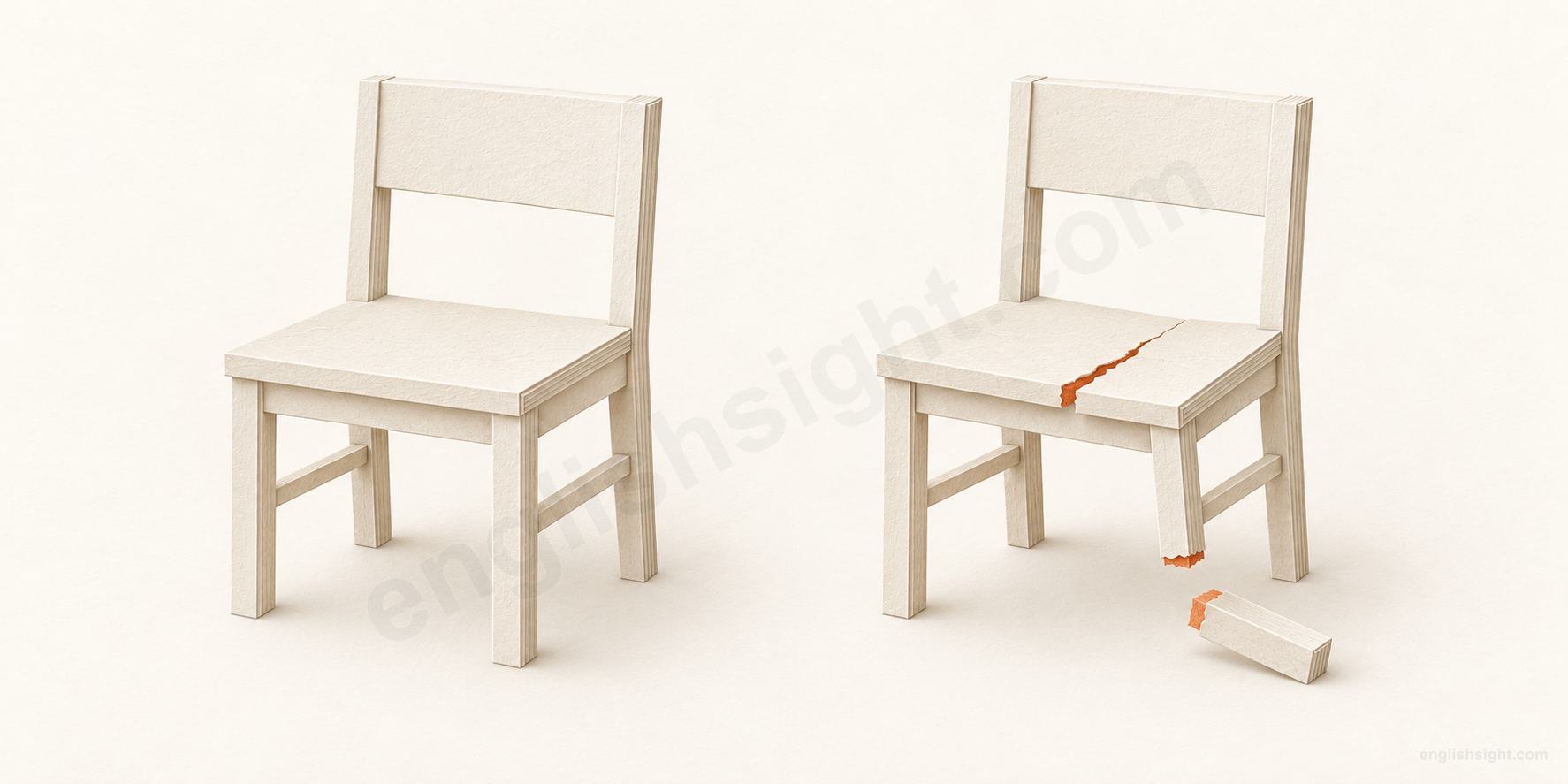
Reference: an intact chair provides support.
bad
Judgment: the damaged chair cannot provide reliable support.
Compare the actual condition with the chair’s purpose.
Bad here judges a chair against its purpose: reliable support.
Bad evaluates a quality, condition, action, or effect against what is wanted or acceptable in context.
The chair comparison illustrates failure to meet a practical need. It is not a claim that every bad thing is broken, that bad always describes a change, or that all meanings follow mechanically from one picture.
Bad marks something as unwelcome, below an acceptable standard, or likely to have unwanted effects. A bad chair, a bad day, and a bad decision are judged on different grounds; they do not all mean morally wrong.
Use the following words and the situation to choose the meaning. Bad at names an area of ability; bad for names an affected person or interest; feel bad about names a cause of regret. Established expressions add meanings of their own.
01
Quality, skill, choices, and experience
Ask what is being evaluated. A bad chair fails its purpose; a bad day is unpleasant; being bad at a task says something about skill.
01
bad + noun; be / look / seem + bad; in bad condition
bad quality / in bad condition
fail the standard needed for a purpose
Situation / expectation
A chair should support someone reliably.
Judgment / effect
Its loose joints make it unsuitable to use.
The relevant standard comes from the object and its purpose.
Bad can appear before a noun or after a linking verb: a bad repair; the repair is bad. It evaluates the result rather than naming a specific defect. Describe the defect as well when it matters.
Bad quality concerns how well something is made or performs. In bad condition concerns its current state: a well-made chair can become damaged. The reference chair in the sketch makes the expected function visible.
In a sentence
The chair is in bad condition: two joints are loose.
Watch the difference Bad need not mean broken: a badly designed but unbroken chair may also be a bad chair.
02
be bad at + noun / -ing; a bad + role noun (driver / teacher)
bad at something / doing something
lack skill in a particular activity
Situation / expectation
You try to remember new names.
Judgment / effect
You often forget them.
At identifies the activity, not the person harmed.
Be bad at takes a noun or an -ing form: bad at spelling; bad at remembering. It reports limited ability in that area, not general worth or moral character.
A bad driver usually means someone who drives poorly. A bad person normally invites a moral judgment. The noun after bad helps choose the interpretation.
In a sentence
I’m bad at remembering names, so I write them down.
Watch the difference Use bad at remembering, not bad in remember. Bad for someone expresses a different relation.
03
a bad idea / decision; a bad time to + verb; it is bad to / that…
a bad idea / decision / time
be unwise or unsuitable in the circumstances
Situation / expectation
You need a quiet discussion.
Judgment / effect
Your friend is about to leave for work.
A choice can be bad because it does not fit the situation.
A bad idea or decision is one you judge unwise, unsuitable, or likely to have unwanted results. It need not be immoral. A bad time to do something is an inconvenient or inappropriate moment.
It is bad to interrupt judges the action; It is bad that nobody listened judges a situation. In Is this a bad time?, time names suitability for the conversation, not a whole difficult period.
In a sentence
Is this a bad time to discuss the repairs?
Watch the difference Compare a bad time to call with have a bad time: the second describes an unpleasant experience.
04
a bad + day / experience / dream / smell; have a bad time
a bad day / bad weather / a bad smell
be unpleasant or full of difficulties
Situation / expectation
Several small problems interrupt your day.
Judgment / effect
You describe the overall experience negatively.
The noun tells us what makes the experience unwelcome.
A bad day may involve delays, disappointments, or stress. Bad weather may interfere with what people want to do. A bad dream is unpleasant or frightening; a bad smell or bad breath is offensive to the nose.
Have a bad time means experience difficulties or little enjoyment. None of these expressions says that a day, a storm, or a smell has moral intentions. Bad is a broad evaluation; precise details explain it.
In a sentence
I had a bad day: I missed the bus and lost my keys.
Watch the difference A bad dream describes its unpleasant content; sleeping badly describes how poorly you slept.
05
bad news for + person / organization; a bad sign; a bad feeling about…
bad news / a bad sign / a bad feeling
point toward an unwelcome situation or outcome
Situation / expectation
A supplier announces another delay.
Judgment / effect
You worry that the shop will miss its opening date.
Information or an impression is evaluated by its implications.
Bad news is unwelcome information. Bad news for someone identifies who faces a difficulty. A bad sign is a clue suggesting trouble; a bad feeling about a plan expresses unease, not proof that it will fail.
News is uncountable: some bad news or a piece of bad news. A bad impression is an unfavorable opinion created in someone’s mind, whereas a bad feeling can be the speaker’s own uneasiness.
In a sentence
The delay is bad news for the shop: it may open a week late.
Watch the difference Say The news is bad, not The news are bad or a bad news.
06
have bad luck with…; Bad luck!
bad luck / Bad luck!
refer to an unfortunate chance outcome
Situation / expectation
Your train is cancelled just before you arrive.
Judgment / effect
You describe your misfortune or acknowledge someone else’s.
Luck concerns chance, not ability or guilt.
Have bad luck describes an unfortunate outcome attributed to chance. Bad luck! can be a short sympathetic response, particularly in British conversation. The person need not have made a mistake.
Bad at choosing trains would judge skill, while bad luck with trains describes things going against you. The evaluation model identifies an unwanted result; luck supplies the idea of chance.
In a sentence
We had bad luck with the trains: our connection was cancelled.
Watch the difference Luck is uncountable here: bad luck, not a bad luck.
02
Conduct, harm, and serious problems
Bad can judge behavior, describe an adverse effect, or mark the severity of something already unpleasant. These are different questions.
07
bad behavior / habits; a bad person / influence; be bad
bad behavior / a bad person
judge conduct as wrong or unacceptable
Situation / expectation
Someone repeatedly lies to take advantage of others.
Judgment / effect
You condemn the behavior.
Moral judgment concerns conduct, not skill or health.
A bad person is ordinarily judged morally; bad behavior names the unacceptable acts themselves. Bad applied to a child or pet can instead mean naughty or disobedient in a particular situation.
A bad habit is a repeated practice judged unwanted or harmful. A bad influence encourages unwanted behavior. Describe the relevant action when you want to criticize conduct without making a sweeping judgment about the person.
In a sentence
Copying other people’s work is a bad habit.
Watch the difference A bad singer may be kind and honest: bad can judge ability rather than character.
08
bad language; a bad word
bad language / a bad word
refer to swearing or offensive vocabulary
Situation / expectation
A program includes repeated swear words.
Judgment / effect
You describe its language as unsuitable for some listeners.
This established collocation judges offensiveness, not grammar.
Bad language normally means swearing or offensive words. A bad word can mean a swear word. Bad grammar, by contrast, concerns errors in sentence structure; the noun changes what is being evaluated.
In I don’t have a bad word to say about that team, bad word means a criticism, and the whole negative sentence expresses approval. Nobody has a bad word to say about her likewise means people speak well of her; it is not a statement about swearing.
In a sentence
The recording contains bad language, so we chose a different clip for the class.
Watch the difference Bad English usually means poor or incorrect English; it does not automatically mean swearing.
09
be bad for + person / thing; it is bad for… to + verb
bad for someone / something
have or risk an adverse effect
Situation / expectation
A business depends on reliable deliveries.
Judgment / effect
Repeated disruption damages its prospects.
For identifies the affected person, thing, or interest.
Bad for can describe physical harm or a disadvantage in work, business, or another activity. It is a relational judgment: the same event may affect different people differently.
Compare I’m bad at running, about skill, with This rough surface is bad for my knees, about effect. In It is bad for business to keep customers waiting, for business identifies the interest affected and the infinitive names the practice.
In a sentence
Repeated delivery failures are bad for a small shop’s reputation.
Watch the difference Bad for you means harmful or disadvantageous to you; it does not mean you lack skill.
10
a bad + illness / injury / accident; the pain is bad
a bad cold / a bad accident
be serious or severe
Situation / expectation
A cold prevents you from working normally.
Judgment / effect
You stress how strongly it affects you.
With an already unpleasant event, bad can mark severity.
A bad cold is a severe cold; a bad accident is a serious accident. The noun already names an unwanted condition, and bad emphasizes its degree or consequences.
Compare a bad singer, whose singing is poor, with a bad cough, which is severe. Bad does not always mean a low amount: a bad cough may involve a lot of coughing.
In a sentence
A bad cold kept me at home all weekend.
Watch the difference Do not interpret a bad accident as an accident performed without skill.
03
Bodies, food, moods, and feelings
The subject and following words distinguish illness, damage, spoilage, irritation, regret, and sympathy.
11
have + a bad + body part
a bad back / knee / tooth
have a painful, weak, or unhealthy body part
Situation / expectation
Your knee hurts when you climb stairs.
Judgment / effect
You explain a physical limitation.
Bad describes the body part’s condition.
A bad back or knee can be injured, painful, weak, or affected by a continuing problem. Bad alone does not identify the cause or provide a diagnosis.
This use often appears before the body-part noun: I have a bad knee. My knee hurts is a more specific description of pain. A bad cold, in contrast, emphasizes the severity of an illness.
In a sentence
I can’t carry that box upstairs; I have a bad knee.
Watch the difference A bad knee does not mean the person is morally bad or bad at using knees.
12
feel / look + bad
feel bad / look bad
feel or appear physically unwell
Situation / expectation
A friend is pale and has little energy.
Judgment / effect
You ask about their physical state.
A linking verb connects the person with a condition.
I feel bad can describe physical illness; You look bad can mean that someone appears unwell. Without health context, these expressions can have other interpretations, so mention symptoms or the situation when needed.
Feel is a linking verb here, so bad describes the subject. I don’t feel well is a clear alternative for health. Look bad can also concern reputation or appearance rather than illness.
In a sentence
I still feel bad this morning, so I’m staying in bed.
Watch the difference Feel bad alone does not tell you whether the feeling is physical illness, guilt, or general distress.
13
be in a bad mood; put + person + in a bad mood; be in / have a bad temper
in a bad mood / a bad temper
be annoyed, irritable, or angry
Situation / expectation
A small delay annoys someone more than usual.
Judgment / effect
You describe their current mood.
A temporary mood differs from a judgment of character.
Be in a bad mood describes a current irritated or unhappy state. Be in a bad temper is similar, especially in British use. Have a bad temper can describe a tendency to become angry easily.
Put someone in a bad mood names what triggers the state. Being in a bad mood does not mean someone is permanently a bad person.
In a sentence
The long wait put him in a bad mood.
Watch the difference Include in and the article: in a bad mood, not on bad mood.
14
feel bad about + noun / -ing; feel bad that + clause; make + person + feel bad
feel bad about something / that…
feel regret, guilt, or sorrow about a situation
Situation / expectation
You promised to call but forgot.
Judgment / effect
You acknowledge your regret.
About introduces what troubles you.
Feel bad about takes a noun or an -ing form: feel bad about the mistake; feel bad about forgetting. Feel bad that introduces a full clause. Guilt is common, but the expression can also express sorrow without blame.
Make someone feel bad means cause that emotional state. It is not a passive form of bad; make supplies the causative grammar. Bad itself is an adjective.
In a sentence
I feel bad about leaving all the cleaning to you.
Watch the difference Do not change about to at: bad at cleaning describes ability, not regret.
15
feel bad for + person
feel bad for someone
feel sympathy for another person
Situation / expectation
A colleague loses an opportunity through no fault of her own.
Judgment / effect
You sympathize with her disappointment.
For identifies the person whose situation you sympathize with.
I feel bad for her puts the focus on someone else’s misfortune. It need not mean you caused the problem. I feel bad about what I said instead focuses on an event that troubles you.
Contrast The delay is bad for her, which describes an adverse effect. With feel, the subject experiences sympathy; without feel, bad for describes what affects her.
In a sentence
I feel bad for Maya; she prepared for weeks and the event was cancelled.
Watch the difference Feel bad for someone does not mean that person is bad at something.
16
food + go / be + bad; have / has gone bad
go bad
become spoiled, especially food
Situation / expectation
Food is left beyond its usable life.
Judgment / effect
It is no longer fit to eat.
Go supplies the change; bad names the resulting state.
Food goes bad when it spoils. Is bad describes the state; has gone bad presents a completed change with a present result. Go is a linking verb here, not movement to a destination.
Tastes bad can simply mean an unpleasant flavor; it does not by itself establish spoilage. A good-tasting food and an unspoiled food are different judgments.
In a sentence
The cream had gone bad before we opened it.
Watch the difference Go bad is not a separable phrasal verb: do not say go the cream bad.
04
Comparison and everyday replies
Read the complete expression. Negation can turn bad into praise, and a short reply can express sympathy, dismissal, or responsibility.
17
worse than…; the worst…; as bad as…; not as bad as…
bad, worse, worst
compare degrees of an unwanted quality
Situation / expectation
Two recordings both have poor sound.
Judgment / effect
One is harder to understand than the other.
The ordinary comparison changes the word itself.
Worse is the comparative of bad; worst is the superlative. Use worse than for a comparison and the worst for the lowest-quality member of a stated or understood set: the worst recording of the three.
As bad as compares equal degrees, while not as bad as says the degree is lower. Worse and worst also serve as comparisons of badly: she sings badly, but I sing worse.
In a sentence
This recording is worse than yesterday’s, but it is not the worst of the three.
Watch the difference Use worse and worst in ordinary comparisons, not more bad, badder, or baddest. Slang has a separate exception.
18
not bad; not too bad; not half bad; not bad for + circumstance
not bad / not too bad / not half bad
give modest or sometimes enthusiastic approval
Situation / expectation
A beginner shows you a successful first attempt.
Judgment / effect
You offer understated praise.
The negative wording can communicate a positive evaluation.
Not bad often means fairly good or better than expected. Not too bad is also a familiar response to How are you? Tone and context affect how much praise the words convey.
Not half bad is an informal expression of approval, not a calculation that something is fifty percent bad. Contrast The damage is not bad, which can simply mean the damage is not severe.
In a sentence
Not bad for a first attempt—the shelves are straight and level.
Watch the difference Not bad does not always mean excellent; do not assign it one fixed strength of praise.
19
that is / it is too bad (that)…; Too bad!; too bad to + verb
That’s too bad. / Too bad!
express regret, or dismiss a complaint
Situation / expectation
A friend says she cannot attend.
Judgment / effect
You respond sympathetically—or refuse to change a decision.
The same short expression can have very different tones.
That’s too bad can mean that is unfortunate: That’s too bad; I was hoping to see you. It’s too bad that the museum is closed similarly expresses disappointment.
A curt Too bad! can reject a complaint without sympathy: You wanted the last seat? Too bad—I reserved it. The situation and tone determine whether it comforts or dismisses. This fixed reply differs from The damage is too bad to repair, where too marks an excessive degree.
In a sentence
That’s too bad; I know you were looking forward to the trip.
Watch the difference A bare Too bad! can sound unsympathetic; it is not a reliably polite consolation.
20
My bad.; That was my bad.
My bad.
admit that a mistake was your fault
Situation / expectation
You send a colleague the wrong file.
Judgment / effect
You acknowledge the error casually.
The whole expression is an informal admission.
My bad means my mistake or that was my fault. It is common in casual conversation, particularly North American English, and can stand alone as a short reply.
The expression can sound too light for a serious mistake. I sent the wrong file, and I’m sorry states both responsibility and an apology more explicitly.
In a sentence
I attached yesterday’s file—my bad. I’ll send the right one now.
Watch the difference My bad is an established noun-like expression; it does not mean I am a bad person.
21
go from bad to worse
go from bad to worse
deteriorate from an already poor situation
Situation / expectation
A delayed train is then cancelled.
Judgment / effect
The problem becomes more serious.
The starting point is already unwelcome.
Go from bad to worse describes further deterioration, often across several developments. It does not start from a good or neutral situation.
Go names the change and from…to… names the two evaluated states. The phrase can describe a journey, finances, a dispute, or another situation without literal movement.
In a sentence
Our journey went from bad to worse when the delayed train was cancelled.
Watch the difference From worse to bad reverses the usual expression and does not mean further deterioration.
22
be in a bad way
in a bad way
be in serious trouble or poor condition
Situation / expectation
A flood damages the village’s only bridge.
Judgment / effect
The bridge needs substantial repairs.
Way refers to a condition, not a route or method.
In a bad way is an informal expression for a poor condition or difficult situation. With a person it can mean very ill or badly injured; with a business it may describe serious financial trouble.
The bridge is in a bad way evaluates its condition. They repaired it in a bad way would concern the method and is not the ordinary idiomatic meaning.
In a sentence
The bridge is in a bad way after the flood and needs major repairs.
Watch the difference Keep the complete phrase: in a bad way. It does not say someone chose the wrong road.
05
Established expressions and wider grammar
Some combinations have meanings that need to be learned together. Their nouns and constructions matter as much as bad.
23
bad blood between + people / groups
bad blood between people
refer to lasting hostility or resentment
Situation / expectation
Two partners argue over an unpaid bill.
Judgment / effect
Resentment remains between them.
The expression concerns a relationship, not bodily fluid.
Bad blood is unfriendly feeling between people or groups, often after a dispute. Between names the parties. The phrase is normally uncountable.
No bad blood denies lasting hostility even if a disagreement occurred. The negative evaluation is familiar, but blood has an established figurative role here; the phrase cannot be explained as spoiled blood.
In a sentence
There is still bad blood between the former partners over the unpaid bill.
Watch the difference Do not use bad blood as an ordinary way to describe a medical blood problem.
24
be in / get into + someone’s bad books
in someone’s bad books
have someone’s disapproval
Situation / expectation
You repeatedly return borrowed tools late.
Judgment / effect
Their owner becomes annoyed with you.
The possessive identifies whose approval you have lost.
Be in someone’s bad books means that the person is displeased with you. Get into someone’s bad books describes entering that situation. Good books expresses the opposite relationship.
This is an informal established expression; there need not be any actual notebook or list. It describes someone’s attitude toward you rather than proving you did something morally wrong.
In a sentence
I’m in Lena’s bad books for returning her tools late again.
Watch the difference Use a possessive and plural books: in her bad books, not in her bad book.
25
be + a bad loser
a bad loser
react poorly to losing
Situation / expectation
A player loses a game.
Judgment / effect
The player blames everyone else and refuses to congratulate the winner.
The judgment concerns the response to defeat.
A bad loser does not accept losing graciously. The phrase concerns behavior after defeat, not simply a low success rate.
Someone may be excellent at a game and still be a bad loser. Someone who often loses but accepts the result calmly is not a bad loser in this idiomatic sense.
In a sentence
He is a bad loser: he blames the referee whenever his team loses.
Watch the difference Bad at chess and a bad loser make different claims.
26
a bad / rotten apple in + group
a bad apple
describe someone whose behavior harms a group
Situation / expectation
A team member encourages others to cheat.
Judgment / effect
Their influence damages the group.
The person is the figurative apple; influence on others matters.
A bad apple is a person regarded as a harmful influence within a group. A rotten apple can express the same idea.
An actual bad apple may simply be spoiled fruit. In a sentence about a club or workplace, the established metaphor usually concerns behavior and its effect on others.
In a sentence
The coach warned that one bad apple could encourage the whole team to cheat.
Watch the difference This is a strong criticism of a person; it is not a neutral description of being less skilled.
27
give + person / group + a bad name; have / get a bad name
give someone / something a bad name
damage a person’s or group’s reputation
Situation / expectation
A few tour operators repeatedly cheat customers.
Judgment / effect
Customers distrust the wider trade.
Name means reputation, rather than the word used to address someone.
Give someone or something a bad name means cause people to think poorly of them. Have or get a bad name concerns possessing or acquiring that reputation.
The criticism may spread beyond the people responsible. The expression describes public opinion; it does not guarantee the opinion is fair.
In a sentence
Dishonest operators give the whole industry a bad name.
Watch the difference This does not mean choosing an unattractive personal name.
28
be in bad taste; leave a bad taste in + someone’s mouth
in bad taste / leave a bad taste in the mouth
be offensive, or leave an unpleasant emotional impression
Situation / expectation
Someone makes a cruel joke during a serious event.
Judgment / effect
Others judge it inappropriate and remember it with discomfort.
Taste can concern social judgment rather than flavor.
A joke in bad taste is offensive or inappropriate for the situation. An experience that leaves a bad taste in your mouth leaves you feeling upset, uneasy, or ashamed afterward.
Contrast The soup tastes bad, about flavor. The joke is in bad taste judges its appropriateness; The argument left a bad taste in my mouth describes a lasting reaction. These are two related but distinct expressions.
In a sentence
The joke was in bad taste, and the awkward laughter left a bad taste in my mouth.
Watch the difference In bad taste is not the ordinary pattern for describing unpleasant food flavor.
29
the bad; take the bad with the good
take the bad with the good
accept disadvantages alongside advantages
Situation / expectation
A job offers creative work but includes tiring travel.
Judgment / effect
You acknowledge both sides of the job.
The bad names negative aspects collectively.
The bad can stand for bad things, events, or aspects without repeating a following noun. Take the bad with the good means accept the disadvantages as well as the advantages.
In this example it does not mean a group of bad people. Context determines whether the bad refers to people or to negative aspects. Do not turn this collective use into ordinary plural bads for everyday disadvantages.
In a sentence
The job gives me freedom, but I have to take the bad with the good, including the travel.
Watch the difference The phrase does not mean the disadvantages stop being disadvantages.
30
a bad check / cheque; a bad debt
a bad check / a bad debt
describe failed payment or money unlikely to be recovered
Situation / expectation
A customer pays with a check the bank cannot honor.
Judgment / effect
The seller has not received usable payment.
Financial collocations specify what has failed.
A bad check is a check that cannot be paid, for example because the account has insufficient funds. British spelling is cheque. The paper need not be physically damaged.
A bad debt is money owed that is unlikely to be repaid or cannot be recovered. An unpaid bill is not automatically a bad debt: it may simply not have been paid yet.
In a sentence
The bank returned the customer’s bad check without paying it.
Watch the difference A bad debt is not merely any loan you dislike; recoverability is the relevant issue.
31
want / need something bad (informal); bad / badder / baddest (slang praise)
want it bad / bad meaning excellent
recognize informal adverb use and a separate slang reversal
Situation / expectation
You hear an enthusiastic comment in a song or conversation.
Judgment / effect
You use context and register to interpret it.
Not every bad is the ordinary negative adjective.
Want it bad uses bad as an informal adverb meaning intensely or very much. In neutral edited prose, want it badly is a safer choice. Similarly, did badly is the neutral way to describe poor performance.
In some slang, especially North American English, bad can praise someone as impressive or excellent; badder and baddest occur in that use. This is not a general rule for reversing the meaning of bad. In ordinary negative comparison use worse and worst.
Feel bad remains a normal adjective pattern. Feel badly is also established for regret or distress; do not claim it can only mean having a defective sense of touch.
In a sentence
I want that part bad, but I’ll keep practicing even if I don’t get it.
Watch the difference Use register and context: a bad accident never becomes a compliment simply because praise with bad exists.
Choose the standard, the construction, and the tone
Bad is broad; explain the problem
A bad meal might taste unpleasant, be poorly prepared, or be spoiled. A bad teacher may lack skill; a bad person is usually a moral judgment. Add details instead of assuming one interpretation fits every noun.
Adjective and adverb
Bad normally describes a noun or follows a linking verb: a bad singer; the sound is bad. Badly normally modifies an action: she sings badly. Informal adverbial bad exists, and feel badly is established for regret or distress; feel bad is a straightforward choice for learners.
Do not invent a verb family
Bad is principally an adjective, with noun and informal adverb uses covered here. It has no ordinary passive, progressive, or separable particle-verb family. In go bad, go supplies change; in make someone feel bad, make supplies causation.
Boundaries of this lesson
This selection covers modern everyday uses and useful recognition items, not all compounds, regional slang, or technical meanings. It does not claim a frequency ranking. Old-fashioned go to the bad and financial to the bad are not expanded; humorous have got it bad, meaning be deeply in love, is left for a broader idiom lesson.
Identify what bad contributes
Use the noun, preposition, and situation to choose the intended meaning.
1. Nora finds spelling difficult. Which sentence judges her ability?
2. You forgot a promise and now regret it. Which sentence expresses that regret?
3. The cream is no longer fit to eat because it has spoiled. Which sentence states that change?
4. A beginner makes a surprisingly good first shelf. You say “Not bad!” What is the likely message?
5. Leo wins most games but shouts at everyone whenever he loses. What does “a bad loser” describe?
6. Your colleague loses her place on a cancelled course. You had no part in the decision. Which sentence expresses sympathy?
7. Two plans are risky, and the second carries even more risk. Choose the ordinary comparison.
Sources and teaching notes
Dictionary senses and constructions were checked against the publisher pages below. The explanations, examples, and visual comparison were written for this lesson. The comparison is a teaching model, not dictionary evidence for a universal mental picture.
The visual comparison illustrates a judgment in context; it does not represent a picture shared by every native speaker.