From staying upright to managing demands, reading amounts, and weighing a decision.
Opposing effects, a steady whole
Opposing effects can keep a whole steady
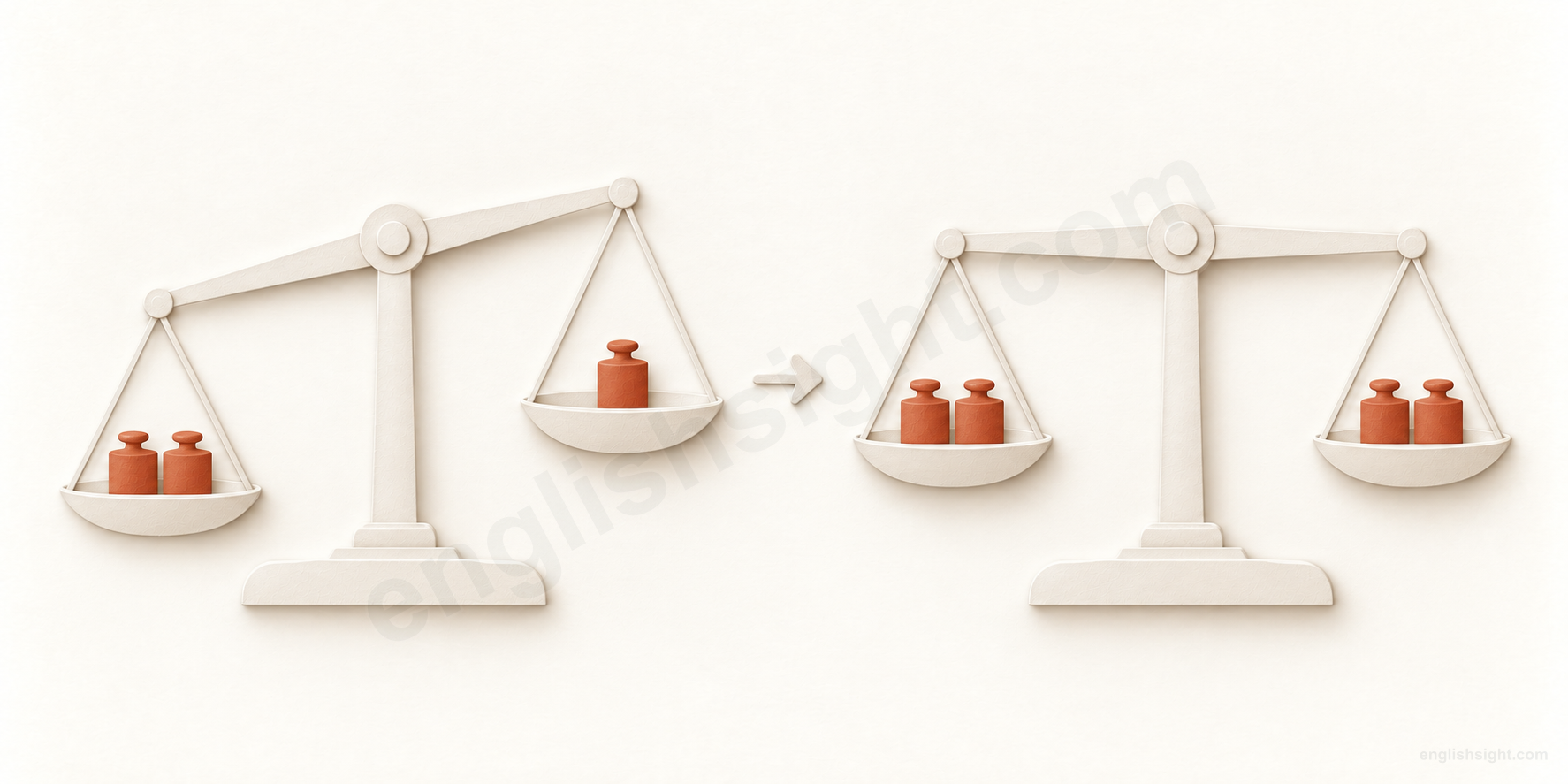
Two identical weights on the left outweigh one on the right, tilting the beam.
balance
With two weights on each side, the beam and pans are level.
A matching weight is added to the right pan.
The added weight counteracts the heavier side and restores balance.
Arrange weights, forces, or demands so their effects keep the whole steady or suitably proportioned.
A level weighing beam illustrates counteracting effects. Everyday balance can involve suitable unequal proportions; an account balance and fixed idioms must be learned in context.
Balance often concerns how different weights, forces, or demands relate: whether something stays steady, whether parts fit together, or which side matters more.
This connection helps organize the uses. Money remaining and fixed expressions need their own explanations; the picture cannot predict every meaning.
01
Stay steady and measure weight
Balance can name bodily steadiness, the action of keeping something from falling, or a weighing instrument.
01
keep / lose / regain + possessive + balance; be / be knocked off balance
keep / lose / regain your balance
remain steady, become unsteady, or recover steadiness
Situation / starting point
A bus starts moving while you are standing.
Result / interpretation
You hold a rail and stay upright.
Balance is the ability or state; the other verb tells us what happens to it.
Keep your balance describes staying steady; lose your balance describes becoming unsteady. Regain your balance means becoming steady again.
Balance is uncountable in this use: good balance or a good sense of balance. Off balance describes an unsteady position: The sudden turn threw me off balance. Falling is a possible consequence, not a required part of losing balance.
In a sentence
I nearly lost my balance when the bus turned.
Watch the difference Say my balance, not a balance, when describing your own steadiness.
02
balance on + support; balance + object + on + support
balance on / balance something on
keep yourself or an object steady on a support
Situation / starting point
A child puts a flat stone on top of a narrow post.
Result / interpretation
The stone stays in place without falling.
The object after balance, when present, is the thing being steadied.
You can balance on one foot without a direct object. You can also balance a stone on a post: the stone is the object, and on names its support. You can also use a reflexive object: He balanced himself on the low wall.
The stone is balanced on the post uses a passive form to describe its placement or resulting position. Balancing can be an ongoing action: She is balancing on one foot. Balance on is a verb plus a prepositional phrase, not a separable particle verb.
In a sentence
She balanced a flat stone on the fence post.
Watch the difference Do not confuse balance the stone with weigh the stone: keeping it steady does not measure its weight.
03
a balance; weigh something on a balance
a balance
an instrument that compares weights
Situation / starting point
An object is placed in one pan of a weighing instrument.
Result / interpretation
Weights in the other pan bring the beam level.
The countable noun names the instrument, not the ability to stand.
A traditional balance has a beam supported at its centre and a pan hanging from each end. Known weights let you determine an unknown weight.
This is the concrete model used in the sketch. The word scales is also used for weighing equipment; not every modern scale has two pans.
In a sentence
We weighed the sample on a small balance.
Watch the difference A balance is a device here; good balance is an ability and has no a.
02
Give different needs their place
Relate different demands, effects, and ingredients. A useful balance need not divide everything into identical amounts.
04
a balance between A and B; a balance of + plural noun; in / out of balance
a balance between / a balance of
a suitable relationship among different parts
Situation / starting point
A course contains many lectures and very little practice.
Result / interpretation
Its designers add practical sessions.
Balance can mean appropriate proportions rather than numerical equality.
Between introduces the things being related: a balance between theory and practice. Of introduces a mixture: a balance of different activities.
In balance describes parts working together suitably; out of balance describes a disturbed relationship. Maintain or restore the balance describes keeping or recovering that relationship. The same language can describe a design, an ecosystem, or emotional steadiness.
In a sentence
The course offers a good balance between theory and practice.
Watch the difference A good balance does not promise that exactly half the time goes to each activity.
05
balance A with B; balance A and B; work-life balance
balance work with family life
manage different demands without neglecting one
Situation / starting point
Work is taking up nearly all your time.
Result / interpretation
You change your schedule to make room for family life.
With connects competing parts; it does not mean putting them on a physical support.
Balance A with B and balance A and B describe managing different needs together. Work-life balance names the relationship between time spent working and time for personal life.
If someone says that managing study and childcare is a balancing act, they mean it needs careful, continuing adjustment. The image is figurative; no literal performance is involved.
In a sentence
I am trying to balance evening classes with caring for my father.
Watch the difference Balance A with B usually emphasizes accommodating both; balance A against B emphasizes comparing them.
06
balance A against B; A must be balanced against B
balance the cost against the benefit
compare competing considerations before deciding
Situation / starting point
A faster service costs more.
Result / interpretation
You consider whether the time saved justifies the extra cost.
Against places one consideration in comparison with another.
Balance A against B means assess their relative importance. You can weigh advantages against disadvantages without making them equal or choosing a compromise.
The passive is useful too: The extra cost must be balanced against the time saved. The cost is the thing assessed, not the person making the decision.
In a sentence
We balanced the higher rent against the shorter journey to work.
Watch the difference The sentence describes an assessment; it does not itself say which option won.
07
A and B balance out; balance out + noun; balance + object + out; be balanced by
balance out
have opposite effects that cancel or compensate for each other
Situation / starting point
A change brings an extra cost and a saving elsewhere.
Result / interpretation
The saving offsets the extra cost.
Out emphasizes the overall result of opposing effects.
Two things can balance out without an object: The gains and losses balance out. One can balance out the other, or balance the other out.
With a pronoun object, say balance it out, not balance out it. Without out, be balanced by also expresses compensation: The extra cost is balanced by lower fuel bills. This is offsetting, not merely considering pros and cons.
In a sentence
The extra delivery charge is small, and the discount balances it out.
Watch the difference Balance out is a separable phrasal verb; balance against uses a preposition and works differently.
08
balanced + noun; be balanced; a well-balanced + noun
a balanced diet / a balanced view
include different elements in suitable proportions or give different sides fair attention
Situation / starting point
A report discusses only the benefits of a plan.
Result / interpretation
The writer also considers its limitations.
Balanced describes the resulting quality.
A balanced diet includes appropriate amounts and varieties of food. A balanced view considers different sides fairly. Neither means every ingredient or every opinion receives an identical share.
Balanced is an adjective in these uses, although the same form is also the past participle of the verb. Compare a balanced report with The report was balanced on the edge of the desk, where a physical object was positioned.
In a sentence
The article gives a balanced view of online learning.
Watch the difference Balance is the noun or verb; balanced is the adjective: a balanced diet, not a balance diet.
09
strike / find a balance between A and B
strike a balance
find an acceptable way to accommodate opposing needs
Situation / starting point
A team needs speed, but accuracy also matters.
Result / interpretation
It chooses a process that allows enough of both.
Strike means achieve in this established expression.
Find a balance and strike a balance both describe arriving at a workable relationship. Between A and B names the competing needs.
The compromise may require unequal time, effort, or resources. Striking a balance is a practical achievement, while balancing A against B can stop at evaluating the choice.
In a sentence
We need to strike a balance between speed and accuracy.
Watch the difference Keep a before balance in strike a balance; strike here does not mean physically hit.
10
redress / restore the balance
redress the balance
correct an existing unfair or unequal situation
Situation / starting point
One school has received much less support than another.
Result / interpretation
Extra resources are directed to the less supported school.
Redress looks back to an imbalance that needs correction.
Redress the balance is a fairly formal way to describe restoring fairness. The balance refers to the relationship already under discussion.
Restore the balance can also describe returning a system to a suitable state. Redress commonly emphasizes correcting an unfair distribution rather than simply finding any convenient mixture.
In a sentence
The new grants should help redress the balance between the two schools.
Watch the difference Use redress the balance, not redress a balance, for the usual fixed expression.
03
Read the amount and the accounts
A balance can be money remaining or money owed. Balancing a budget and balancing records involve different financial tasks.
The account type tells you what the amount represents.
A bank balance is the amount in a bank account. A credit-card balance normally refers to an amount owed. Balance alone does not tell you whether the money is yours to spend or a debt.
You can speak of an account balance or several account balances. This countable financial noun is a recorded amount, not physical steadiness.
In a sentence
I checked my account balance before buying the tickets.
Watch the difference Do not assume every positive-looking balance is available spending money; read which account is being discussed.
12
pay / owe the balance; the balance of + amount; outstanding balance
pay the balance
pay the part of a price that is still owed
Situation / starting point
A repair costs $180, and you have already paid $60.
Result / interpretation
You still need to pay $120.
The balance is the unpaid remainder, not an extra charge.
Pay, owe, and be due commonly occur with balance. After a deposit or partial payment, the balance is what remains to be paid.
In pay the balance of $120, of introduces the amount still owed. An outstanding balance is an amount that has not yet been paid; it need not already be overdue.
In a sentence
I paid a $60 deposit and will pay the $120 balance on Friday.
Watch the difference The balance is not the full price: the $60 deposit plus the $120 balance makes a $180 total.
13
the balance of + amount / funds
the balance of the money
the amount left after another part is used
Situation / starting point
You spend part of the funds on repairs.
Result / interpretation
The rest is kept for equipment.
This remainder need not be owed to anyone.
The balance of a sum can mean whatever remains after some is spent or allocated. Rest or remainder often makes this meaning clearer in everyday conversation.
Collins also records balance for the rest of a non-money amount, especially in its American material. Treat that broader use as recognition vocabulary; it does not mean a fair mixture.
In a sentence
We used $200 for repairs and saved the balance for new equipment.
Watch the difference Pay the balance concerns an unpaid price; save the balance concerns funds remaining. Read the verb and situation.
14
balance the / a budget; a balanced budget
balance the budget
bring planned spending into line with income
Situation / starting point
A club plans to spend more than it expects to receive.
Result / interpretation
It reduces spending or increases income.
Here the task is managing income and expenditure.
Balancing a budget aims to match money going out with money coming in. A balanced budget does not rely on spending more than income.
This differs from merely checking an account balance. You may have money in an account and still plan a budget that spends beyond the period’s income.
In a sentence
We cut travel costs to balance the club’s budget.
Watch the difference A balanced budget says nothing by itself about whether the spending choices are fair or wise.
15
balance the books / accounts; the books balance; a balance sheet
balance the books
make the financial totals agree or match expenditure to income
Situation / starting point
The totals in a club’s financial records disagree.
Result / interpretation
The treasurer checks entries and corrects an error.
Books means financial records, and the task depends on context.
In checking records, balance the books means reconcile the figures; The books don’t balance reports totals that fail to agree. In broader talk, the expression can mean keeping spending within income.
A balance sheet is a financial statement about a business’s financial position. It is a document, not the activity of balancing the books, and not simply the list of payments in a personal banking app.
In a sentence
The books did not balance until we found a payment entered twice.
Watch the difference Do not confuse making records agree with proving a business made a profit.
04
Judge the whole situation
These established expressions describe an overall judgment, uncertainty, surprise, or a change in who has the advantage.
16
on balance, + clause; the balance of evidence / probabilities
on balance
after considering the good and bad points together
Situation / starting point
An option has both advantages and disadvantages.
Result / interpretation
You give your overall judgment.
On balance introduces a conclusion, not a statement of uncertainty.
Use on balance when your conclusion takes the different considerations into account. It can introduce a positive or negative assessment.
The more formal balance of evidence / probabilities concerns which explanation or outcome is better supported or more likely. For example: The balance of evidence supports her explanation. It does not assert absolute proof.
In a sentence
On balance, I would rather take the morning train.
Watch the difference On balance means overall; in the balance means uncertain. The preposition changes the expression.
17
be / hang in the balance
hang in the balance
have an outcome that is still uncertain
Situation / starting point
Funding for the next year has not been decided.
Result / interpretation
The club does not know whether it can continue.
The whole expression describes uncertainty about an important outcome.
The future, a result, or someone’s fate can be in the balance or hang in the balance. The issue remains undecided; it is not necessarily an even numerical contest.
In balance without the describes equilibrium or suitable proportions. In the balance includes the and has this established uncertainty meaning.
In a sentence
The club’s future hangs in the balance until the funding decision.
Watch the difference Do not use hangs on balance or hangs in balance for this idiom.
18
catch / throw + person + off balance; be caught off balance
catch / throw someone off balance
surprise someone so they lose composure or feel unprepared
Situation / starting point
An interviewer asks an unexpected personal question.
Result / interpretation
The speaker hesitates and struggles to respond.
Mental unsteadiness is a figurative extension of physical unsteadiness.
Throw or catch someone off balance can concern surprise or confusion without any physical fall. The surrounding event tells you whether the use is physical or figurative.
Compare The slippery floor threw her off balance with The unexpected invitation threw her off balance. The object pronoun stays after catch or throw: It caught me off balance.
In a sentence
The unexpected question caught me off balance.
Watch the difference Off balance does not always describe an injury or a loss of physical control.
19
tip / swing the balance in someone’s favour / against someone; tip the scales
tip the balance
make one side or option gain an advantage
Situation / starting point
Two candidates seem equally suitable.
Result / interpretation
One candidate’s language skills decide the choice.
A deciding factor moves the result toward one side.
Tip the balance, tip the scales, and swing the balance describe affecting a result in one direction. In someone’s favour names the side helped; against names the side disadvantaged.
The image resembles a scale moving away from level. Unlike strike a balance, this expression emphasizes an advantage or deciding influence, not accommodating both sides.
In a sentence
Her experience abroad tipped the balance in her favour.
Watch the difference The idiom does not require a physical scale or a literal measurement of people.
20
the balance of power between groups; hold / shift the balance of power; the balance of opinion
the balance of power
how strength is distributed, or the influence that can decide between rivals
Situation / starting point
Two larger groups have similar numbers of votes.
Result / interpretation
A smaller group can decide which one has a majority.
Holding the balance of power is different from having all the power.
The balance of power can name how power is distributed among groups or countries. A change in that distribution can shift the balance of power.
A smaller group holds the balance of power when its support can decide between two larger rivals. In related news language, the balance of opinion means the prevailing view: The balance of opinion favours a shorter working week.
In a sentence
The two main parties are tied, so the smaller party holds the balance of power.
Watch the difference A balance of power need not mean equal power; identify whether the phrase names a distribution or a deciding position.
Read the construction and the kind of balance
Forms and pronunciation
The noun and verb are pronounced /ˈbæləns/. Verb forms are balance, balances, balanced, balancing. Drop the final e before -ing; balanced ends in /st/. The verb can be transitive or intransitive, and action uses can be progressive.
Balance, balanced, and equal
Use balance as a noun or verb, and balanced for a quality: a balanced view. Physical stability, an appropriate mixture, and exactly equal amounts are related ideas, but the context determines which one is meant.
The picture has a boundary
The scale is a teaching model, not a shared mental picture claimed for every English speaker. Learn money uses and the complete fixed expressions rather than replacing each occurrence with equal weight.
Scope
This lesson covers modern general uses and selected financial and news expressions. It does not teach technical accounting procedures, chemical equations, dance steps, watch mechanisms, or every compound containing balance.
Choose the meaning in context
Use the whole expression and the situation.
1. Funding is undecided, so the project might close. Which expression fits?
2. A course costs $300. You paid a $90 deposit. What is the balance to pay?
3. A discount offsets an extra fee. Which pronoun position is standard?
4. You assess whether saved time justifies higher rent. Which wording describes the comparison?
5. An unexpected question catches a speaker off balance. Must the speaker fall?
6. A course has a good balance of discussion and practice. Must each occupy exactly half the time?
Sources and teaching notes
Definitions and usage were checked against the sources below. Explanations, example sentences, and the diagram were written for this lesson; the visual connection is a teaching interpretation.
The scale illustrates a useful connection; it is not a picture shared by every native speaker.