Ball: a rounded form, a game, and familiar expressions.
Connect the physical shape to common uses, and keep separate meanings in view.
A compact rounded form
A compact rounded form
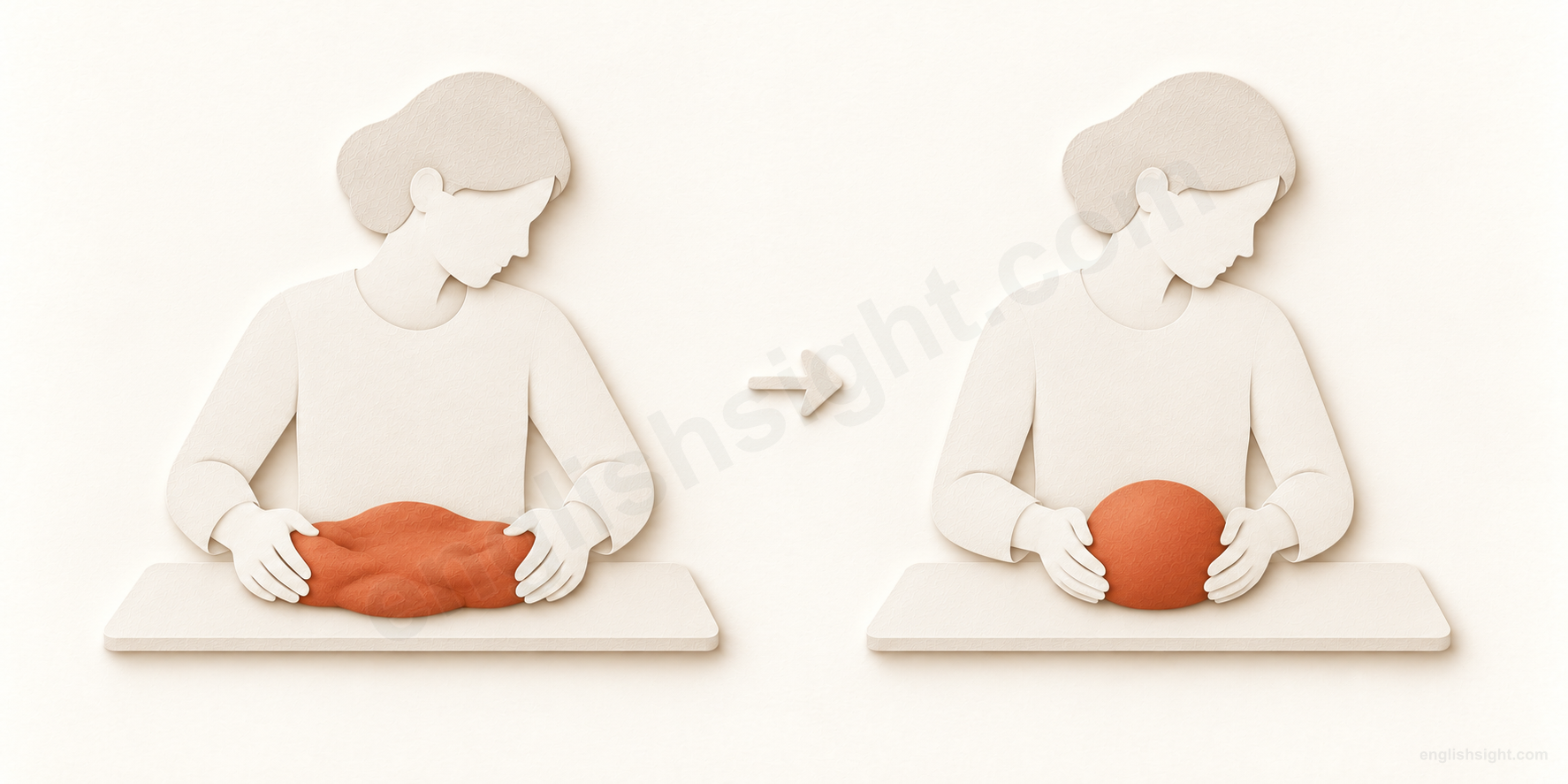
A low, wide lump of dough rests between the person's hands.
ball
The person cups a compact rounded ball of dough.
The hands gather and shape the same dough.
The same dough is gathered into a compact rounded ball.
In its physical shape sense, a ball is a compact rounded object or mass; material can be gathered into that form.
The diagram illustrates the shape and the result of forming it. It does not make roundness a strict rule for every sports ball, or explain the independent dance-event meaning and all idioms.
A ball is often a rounded object or mass with volume: something used in a game, wound from thread, or formed from soft material. The verb ball describes forming that compact shape.
Sport supplies useful comparisons for starting, cooperating, paying attention, and taking responsibility. Their exact meanings belong to established expressions, not to ball alone.
A formal dancing event is also a ball, but it is a separate historical branch. This lesson offers a teaching model, not a claim that every English speaker imagines the same picture.
01
Objects, rounded shapes, and forming a ball
Start with a three-dimensional object or compact rounded form. The material and the surrounding verbs tell you what kind of ball is involved.
01
a / the + ball; sport / material + ball
a ball / tennis balls
an object made for a ball game
Situation / starting point
You need equipment for tennis.
Meaning / outcome
You choose two small tennis balls.
Ball names the object; the sport or material identifies its type.
A ball is countable: a ball, the ball, two balls. Tennis ball and golf ball identify game equipment; rubber ball identifies material. The first noun normally stays singular in tennis balls.
The central model is a rounded object with volume, rather than a flat circle. Everyday sports vocabulary is flexible: an American football is still a ball although it is oval. Ball does not guarantee a perfect sphere.
Kick, throw, catch, hit, bounce, and roll describe different actions with the object. The action comes from the verb: catching a ball is not the same as throwing it.
Original example
Could you bring two tennis balls to the park?
Watch the difference Say a ball or some balls when you mean objects; ball alone is not the usual singular object phrase.
02
a ball of + material; form / roll + object + into a ball
a ball of wool / dough
material gathered into a rounded mass
Situation / starting point
Some dough lies on the board.
Meaning / outcome
You shape it into separate rounded portions.
Ball counts a shaped amount; of introduces its material.
A ball of wool or yarn is wound thread; a ball of dough is a rounded portion. The material does not have to be hard, hollow, or able to bounce.
Compare three balls of dough with three doughs: balls counts the portions while dough normally names the material. Form the dough into a ball describes a result, not movement inside a sports ball.
A ball of fire can describe a rounded mass of flame. A ball of energy or fire can also describe an energetic person; that description is figurative, not a claim about their body shape.
Original example
Roll each piece of dough into a ball.
Watch the difference Of names what the ball consists of; into marks the resulting shape.
03
curl (up) / roll oneself + into a ball
curl up into a ball
pull the body into a compact rounded position
Situation / starting point
The cat is stretched out.
Meaning / outcome
It draws its legs and head close to its body.
The whole body takes a ball-like shape; no separate ball is present.
Curl up into a ball describes a posture. Up belongs to curl up, while into a ball names the resulting shape. The subject is the person or animal changing position.
You can also say roll yourself into a ball. These phrases use resemblance: a curled body need not become a geometrically exact sphere.
Original example
The cat curled up into a ball beside the radiator.
Watch the difference Do not read into a ball as inside a separate object here.
04
the ball of + foot / thumb; the balls of + feet
the ball of your foot / thumb
a rounded padded area of the body
Situation / starting point
You rise onto the front of your feet.
Meaning / outcome
Your weight is over the pads behind your toes.
Anatomical ball names a rounded area, not the entire foot or thumb.
The ball of the foot is the padded part of the sole behind the toes, in front of the arch. You may stand or balance on the balls of your feet.
The ball of the thumb is the fleshy rounded area at its base. Foot and thumb identify the location; these are conventional anatomical expressions, not instructions to make the body perfectly round.
Original example
She balanced on the balls of her feet to reach the shelf.
Watch the difference The heel is at the back of the foot; it is not the ball of the foot.
05
ball + object + (up); ball up + noun; ball (something) into + shape
ball (up) the paper / ball into fists
form or become a compact rounded shape
Situation / starting point
A sheet of paper is spread out.
Meaning / outcome
It is squeezed into a small rounded lump.
As a verb, ball describes forming the shape named by the noun.
Ball the paper up and ball up the paper both mean gather or squeeze it into a rounded form. With a pronoun, say ball it up, not ball up it. Crumple it into a ball is a useful alternative.
Ball can take an object: Nora balled her hands into fists. It can also occur without one: Nora’s hands balled into fists. The first describes what she did to her hands; the second describes their change.
The forms are ball, balls, balled, balling. A passive is possible: The paper was balled up. This is an action verb, so She is balling up the paper is possible too.
Original example
He balled the scrap of paper up and put it in the bin.
Watch the difference Keep ball it up together in that order; the ordinary verb is not limited to sports.
02
Games, passes, and deliveries
In sport, ball can name the object, a particular pass or delivery, or a technical call. Read the sport as well as the word.
06
play ball (with someone); play with + a / the ball
play ball / play with a ball
take part in a ball game or use a ball in play
Situation / starting point
Children want an outdoor game.
Meaning / outcome
They throw and catch together.
Without an article, play ball can name the activity.
Play ball is especially North American for playing a ball game, often baseball. Play with a ball clearly describes using the object in play, without identifying an organized sport.
Play tennis names the sport; play with a tennis ball names the equipment being used. Neither sentence automatically describes formal competition. The cooperative idiom play ball appears in the next group.
Original example
We played ball with the children after lunch.
Watch the difference Play a ball can describe playing a particular ball in sport; it is not the general pattern for playing a game.
07
adjective + ball; play / send + a ball; number + balls
a good ball / a high ball
a particular pass, hit, throw, or delivery
Situation / starting point
A player sees a teammate ahead.
Meaning / outcome
A well-placed pass reaches the teammate.
Ball can refer to an instance of play involving the object.
In sports commentary, a good ball may praise the pass or delivery, not the quality of the equipment. A high ball describes how it travels.
In cricket, a ball can count a single delivery: six balls can describe six deliveries rather than six different pieces of equipment. Detailed scoring rules depend on the sport and are beyond this vocabulary lesson.
Original example
That was a lovely ball through to Maya.
Watch the difference A good ball can mean good equipment in a shop; match commentary makes the pass interpretation likely.
08
a ball / a strike; call + a pitch + a ball
a ball, not a strike
a baseball pitch called outside the strike zone when the batter does not swing
Situation / starting point
A pitch misses the strike zone.
Meaning / outcome
The batter leaves it, and it is called a ball.
Here ball is a technical call on a pitch, not a different kind of object.
In baseball, a ball is normally a pitch outside the strike zone that the batter does not swing at. A ball and a strike are different calls in the count.
The same baseball is used for both pitches; the call does not name its shape or material. This unit explains the vocabulary distinction, not every rule or exceptional call.
Original example
The batter did not swing, and the umpire called the pitch a ball.
Watch the difference A pitch outside the zone is not automatically a ball if the batter swings.
03
Action, attention, and responsibility
Many established expressions borrow a ball-game situation to talk about work and decisions. Learn each whole phrase; the diagram cannot predict its meaning.
09
get / set / start / keep + the ball + rolling
get / set / start / keep the ball rolling
begin an activity or maintain its progress
Situation / starting point
The meeting has not started its discussion.
Meaning / outcome
One question gives everyone a starting point.
Starting the ball rolling begins activity; keeping it rolling maintains it.
Get, set, or start the ball rolling means take the first step so that something begins. The subject initiates the activity; no physical ball is needed.
Keep the ball rolling means maintain progress after the start. Rolling suggests continuing motion, but the idiomatic activity might be a discussion, application, or project.
Learn the phrase with the ball. It is not a phrasal verb ball rolling, and changing rolling to any other action word will not reliably preserve the meaning.
Original example
I’ll ask the first question to get the ball rolling.
Watch the difference Keep the ball rolling is about continuation; get it rolling is about starting.
10
the ball + be + in + possessive + court
the ball is in your court
it is your responsibility to take the next step
Situation / starting point
I have sent you my proposal.
Meaning / outcome
You now need to decide or respond.
Your court identifies whose turn it is to act.
The phrase assigns the next move to someone. In The ball is in their court, they are expected to respond or decide; it does not say that they caused a problem.
The court is a playing area in the sporting comparison, not necessarily a law court. This expression can be neutral, encouraging, or a reminder, depending on tone.
Original example
We’ve sent the revised offer, so the ball is in their court.
Watch the difference Use in their court, not on their court, for this idiom.
11
be + on the ball; have + something / a lot + on the ball
be on the ball
be alert, understand events, and react promptly
Situation / starting point
An invoice contains a mistake.
Meaning / outcome
An attentive colleague spots it before payment.
On the ball praises attention and quick understanding.
An employee who is on the ball notices what matters and deals with it efficiently. This is an informal compliment, not a literal location on top of a sports ball.
Compare have a lot on the ball, an informal US expression emphasizing intelligence or ability: Our new analyst has a lot on the ball. Being on the ball stresses alertness to what is happening.
Original example
Nora was on the ball and noticed the duplicate payment.
Watch the difference Do not replace on with in here; in the ball has no such idiomatic meaning.
12
keep + possessive + eye + on the ball; take + possessive + eye + off the ball
keep your eye on / take your eye off the ball
maintain or lose attention to what matters
Situation / starting point
A team is distracted by a minor detail.
Meaning / outcome
It risks missing the main deadline.
The whole expression transfers visual attention in sport to attention in a task.
Keep your eye on the ball means stay focused on the important matter. Literally, a player watches the moving ball; figuratively, a worker or team monitors the priority.
Take your eye off the ball means stop paying enough attention, with the danger or result that something goes wrong. It is stronger than simply choosing to look at something else.
Original example
We must keep our eye on the ball as the deadline approaches.
Watch the difference On marks continued focus; off marks lost focus. The idiom does not require actual eye movement.
13
drop the ball (on + task)
drop the ball
fail to handle a responsibility properly
Situation / starting point
I was supposed to book the room.
Meaning / outcome
I forgot, and the meeting has nowhere to take place.
The idiom admits or criticizes a failure of responsibility.
In informal use, especially North American English, dropping the ball means making a consequential mistake or failing to do your part. A forgotten booking or missed follow-up can fit.
I dropped the ball on the booking takes responsibility for that failure. It does not mean I deliberately cancelled the booking. Literal dropping is still possible when a real object falls from someone’s hands.
Original example
I dropped the ball on the booking, so we need another room.
Watch the difference Do not use this idiom merely to say you intentionally stopped a task; it suggests a lapse.
14
play ball (with + person / group)
play ball (with someone)
cooperate with another person or group
Situation / starting point
We ask the supplier to change the delivery date.
Meaning / outcome
They agree to help make the change.
The idiom treats cooperation as willingness to join the same game.
Play ball can mean cooperate, especially when someone wants an agreement or help. The supplier won’t play ball means they are refusing to cooperate, not refusing to play a sport.
With names the person or group being cooperated with. The phrase is informal and can suggest pressure: telling someone to play ball may sound demanding. Cooperate is a more neutral alternative.
Original example
The supplier wouldn’t play ball when we asked to change the date.
Watch the difference Compare We played ball in the park, where the literal game reading is natural.
15
keep + several / all the + balls + in the air
keep several balls in the air
manage several activities or commitments at the same time
Situation / starting point
Several projects all need attention.
Meaning / outcome
You keep each one moving without neglecting the others.
Multiple balls stand for multiple demands, as in juggling.
This expression pictures a juggler attending to several moving objects. In work or daily life, the balls are tasks, roles, or commitments, not literal equipment.
You can keep several balls or all the balls in the air. Juggle several tasks is a direct alternative. The phrase describes managing competing demands; it does not prove that every task is finished or easy.
Original example
With two projects and a move to organize, I’m keeping several balls in the air.
Watch the difference The plural matters to the comparison: there is more than one demand to manage.
16
take / pick up + the ball + and run with it; carry the ball
take / pick up the ball and run with it
take an existing idea forward and develop it
Situation / starting point
Someone suggests a neighborhood book exchange.
Meaning / outcome
You organize the shelves, volunteers, and opening day.
The idea already exists; another person actively develops it.
Take the ball and run with it or pick up the ball and run with it, especially in North American use, describes developing an idea or plan. The person does more than merely accept the suggestion.
Carry the ball is a related informal US expression meaning take responsibility for getting something done. It emphasizes responsibility, while run with it emphasizes taking an idea forward. Neither is a rule that ball alone means responsibility.
Original example
The club liked my idea, and Lena took the ball and ran with it.
Watch the difference Use ran in the past: took the ball and ran with it, not took the ball and run with it.
17
be + a (whole) new / different ball game
a whole new / different ball game
a situation requiring a different approach
Situation / starting point
You have taught one student at a time.
Meaning / outcome
You now need to teach a class of thirty.
Changed conditions make previous methods insufficient.
A new or different ball game is a situation so different that you need to think or act differently. Whole adds emphasis: a whole new ball game.
The expression need not involve sport or a competition. It compares the practical demands of two situations; it does not simply mean another event of exactly the same kind.
Original example
Teaching thirty students is a whole different ball game from teaching one.
Watch the difference Keep a before the singular noun phrase: a whole new ball game.
18
be / feel like + a ball and chain
a ball and chain
a burden that limits freedom
Situation / starting point
A costly commitment ties up your time and money.
Meaning / outcome
You feel unable to make another choice.
This idiom compares a restriction to a heavy weight attached by a chain.
A ball and chain can describe a problem or responsibility that holds someone back. The round object in this image is a weight, not a game ball, so rolling and passing are not the point.
The expression is strongly negative. Calling a person a ball and chain can be insulting; for a neutral description, say the commitment limits my options.
Original example
The expensive lease became a ball and chain for the small business.
Watch the difference Do not use this as a friendly description of someone’s responsibilities unless the negative tone is intended.
19
the whole ball of wax
the whole ball of wax
the entire thing, including all its parts
Situation / starting point
A service includes design, printing, and delivery.
Meaning / outcome
One company handles all of it.
The fixed phrase names the complete package.
The whole ball of wax is informal North American English for everything involved. It is a set expression; the subject need not contain any actual wax.
For a neutral alternative, use the whole thing or everything. Learning this phrase does not mean you can replace wax with any material and keep the same idiomatic meaning.
Original example
They handle the design, printing, delivery—the whole ball of wax.
Watch the difference Use the whole ball of wax as a fixed expression, not a literal definition of ball.
04
Dancing, enjoyment, and register
The dancing-event meaning is a separate branch. Informal expressions and rude uses also need their own context.
20
hold / attend / go to + a ball; at + the ball; ball + gown
a charity ball / go to the ball
a formal social event with dancing
Situation / starting point
An organization plans a formal evening fundraiser.
Meaning / outcome
Guests attend in formal clothes and dance.
A ball can be an event, independently of the rounded-object branch.
A ball is a formal dance event. A charity ball raises money for a cause; a masked ball involves guests wearing masks. You go to a ball and are at the ball during the event.
This sense has a different historical origin from the rounded-object noun. Do not explain it as everyone dancing in a circle. A ball gown is a formal dress for such an occasion; the noun ball modifies gown.
Original example
The hospital is holding a charity ball next month.
Watch the difference A dance can be an activity or an event; a ball normally suggests a formal event.
21
have + a ball (doing something)
have a ball
enjoy yourself very much
Situation / starting point
Friends spend an evening playing silly games.
Meaning / outcome
They have a wonderful time.
The whole phrase expresses enjoyment; dancing is optional.
Have a ball is an informal way to say have a great time. It can describe a holiday, a game, a meal, or many other enjoyable experiences, not only attending a formal ball.
We had a ball looks back on the enjoyment; You’ll have a ball predicts it. Have a ball! can encourage someone to enjoy an outing. The article a belongs to the familiar expression.
Original example
We had a ball making costumes for the school play.
Watch the difference Compare We have a ball in the cupboard, which is ordinary possession of an object. Context decides.
22
ball up + noun; ball + noun / pronoun + up
ball something up
make something confused or disorganized
Situation / starting point
Two sets of travel dates are entered incorrectly.
Meaning / outcome
The resulting arrangements no longer fit together.
This US slang meaning is conventional and is not physical rounding.
In US slang, ball up can mean muddle or bungle. Ball up the arrangements and ball the arrangements up describe making them confused; with a pronoun use ball them up.
Compare ball up a piece of paper, which changes a physical shape. A schedule or set of records points to the figurative meaning. Mess up the arrangements is an easier, widely understood informal alternative.
Original example
I balled up the travel arrangements by entering the wrong dates.
Watch the difference This meaning is slang and is not the best default for neutral formal writing.
23
balls; have the balls to + verb; Balls!
balls: body, courage, or nonsense
recognize impolite uses and choose neutral alternatives
Situation / starting point
You hear informal or angry speech.
Meaning / outcome
You use context to recognize a rude body term or figurative use.
The plural can have several impolite meanings; it is not always sports vocabulary.
Balls can mean testicles. In have the balls to do something it can mean having enough nerve or courage. Balls! can also dismiss something as nonsense, especially in British usage.
These uses can offend and do not suit every conversation. Neutral alternatives include testicles, have the courage to, and That’s nonsense. Their register is part of the meaning; do not treat them as interchangeable polite words.
Original example
He didn’t have the balls to admit his mistake.
Watch the difference This example is for recognition of register, not a neutral model for addressing strangers or colleagues.
Choose by context, construction, and tone
A circle, a sphere, and a ball
A circle is a flat geometric shape; a sphere is a precise three-dimensional shape. Ball is the everyday object or mass word and can include roundish or oval game equipment. Not every round thing is naturally called a ball.
Noun and verb grammar
The main nouns are countable: a ball, balls. Ball used before another noun does not become a general adjective meaning round. The forming verb has transitive and intransitive uses, a possible progressive and passive, and a separable ball up construction; no broad causative or complement family needs to be invented.
Independent branches and selected scope
Formal dancing and having a good time need their own treatment. Sports details, specialist compounds, and regional slang extend beyond this selection. The US informal verb ball meaning play basketball and a vulgar sexual verb are recognized in the sources but are not developed into beginner practice here.
Read the whole expression
Choose the sentence that fits the stated situation. The answers turn on shape, grammar, or the established phrase.
1. You want a rounded portion of dough. Which instruction expresses the result?
2. You want someone to squeeze a sheet of paper into a lump. Which pronoun order is standard?
3. You have sent an offer and now await the other team’s decision. Which statement fits?
4. A discussion is already under way. You ask another question so it continues. What are you doing?
5. Your friends loved a day of board games. No one danced. Which sentence still fits?
6. An umpire calls an unswung-at pitch outside the strike zone a ball. What does ball name here?
Sources and teaching notes
Modern senses and expressions were checked against the linked dictionary entries. All explanations and example sentences were written for this lesson. The shape diagram is a teaching aid, with its limits stated above.
The diagram illustrates a connection in the physical shape family; it is not a shared mental picture claimed for every speaker.