Connect supporting parts, operating places, and underlying information—then learn the established expressions.
A supporting part or starting point
A supporting part or starting point
A base ready to support.
base
The added structure rests on its base.
Build on the same base.
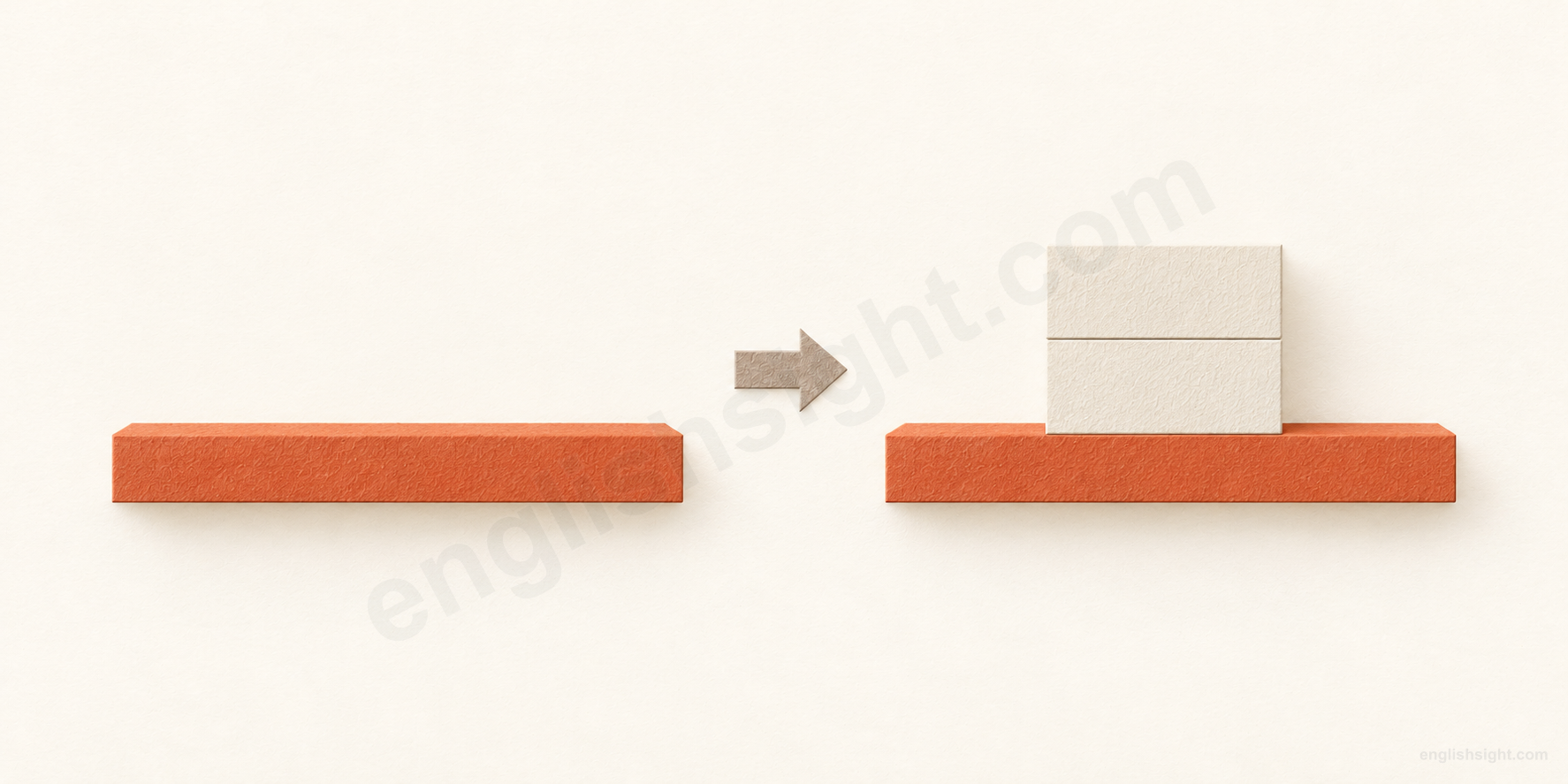
The orange base stays underneath what is built on it. The arrow illustrates building; base itself does not require a change.
A base is the supporting part or starting point on or from which something stands, develops, or operates.
The sketch shows one base first on its own and then supporting a structure. The added blocks illustrate building on a base; base itself does not mean that a change must occur. Some uses identify only a lower part, and other branches require separate learning.
A useful thread through many uses of base is support or a starting point: a lamp rests on its base, an expedition works from a base, and a decision can be based on evidence. Ask what depends on what, and whether that dependence is physical, practical, or informational.
This is a teaching connection, not a claim that every English speaker imagines the same picture. Baseball, chemistry, and the literary adjective have their own established uses; the picture cannot predict every expression.
01
Supporting parts, layers, and ingredients
Start with something that rests on a lower part or is made by adding to an initial layer or material. The precise relationship depends on the object.
01
the base of + object; a solid / heavy / wide base
the base of a lamp
the part that supports an object
Starting situation
A tall lamp needs support.
What the expression identifies
Its broad lower part holds it upright.
The base is the supporting part; the whole lamp is not its base.
Here base names a physical component. A lamp base, a bed base, and the base of a column are lower supporting parts. In a compound such as lamp base, the noun before base tells us what the support belongs to; of expresses that relationship in the base of a lamp.
Bottom simply identifies the lowest part or surface; base often highlights support or construction. They overlap, but a supporting stand is more naturally called a base than a bottom.
In geometry, the base of a triangle is the side chosen as the reference for its height. It need not be the side currently at the bottom of the page.
In a sentence
Choose a lamp with a wide base so it is less likely to tip over.
Watch the difference Use a base for one support and bases for several. Basis is not the normal word for the foot of a lamp.
02
at the base of + hill / wall / body part
at the base of
at the lower part or point where something joins
Starting situation
You describe where a path starts.
What the expression identifies
You locate it next to the lower part of a hill.
At locates something near the base; of identifies the thing whose base it is.
The base of a hill or wall is its lower region. The base of the thumb is where the thumb joins the hand. A base in these descriptions need not be a separate support you could remove.
At the base of the wall locates an object or event there. The base of the pan instead names the pan’s lower surface. Compare Water collected at the base of the wall with Clean the base of the pan.
In a sentence
A narrow path starts at the base of the hill.
Watch the difference Do not interpret every base as a military site or as a load-bearing platform.
03
a biscuit / pastry base; a base layer; a base for + noun / -ing
a base layer
an initial layer that other material rests on
Starting situation
You prepare a cheesecake.
What the expression identifies
The filling rests on a biscuit layer.
One layer is the foundation for the layers added above it.
A cake or pizza base is a lower food layer that carries what goes on top. It is part of the finished food, rather than the tin or plate supporting it.
A base coat prepares a surface for another coat. Base layer similarly identifies a first layer in a layered arrangement; context supplies whether you mean paint, food, clothing, or another material.
In a sentence
Press the crumbs into the tin to make a base for the cheesecake.
Watch the difference A base layer need not be the largest ingredient by quantity. Position or preparation can be the important relationship.
04
use + ingredient + as a base for + dish; a sauce with a tomato base
use something as a base
use an initial or main ingredient to make a mixture
Starting situation
You have plain yogurt.
What the expression identifies
You add herbs to make a dip.
The base is a starting material that other ingredients modify.
The ingredient supplies the main starting material. A soup base or sauce base is something you build a recipe around, rather than the underside of a bowl.
As a base says what role the ingredient plays. For the dip identifies what you are making. This can resemble building on a supporting layer, but the ingredients may be mixed together rather than stacked.
In a sentence
Use plain yogurt as a base for the dip, then add the herbs.
Watch the difference A tomato base is the main material; a tomato at the base of a bowl is a tomato located at its bottom.
02
A place to operate from
A base gives activities a main location. It may be a home, a travel stop, an office, or a military installation; it need not be permanent.
05
a base for + noun / -ing; use + place + as a base; set up a base
a base for exploring
a main place to stay or work from
Starting situation
You plan day trips around a region.
What the expression identifies
You choose one town to stay in between trips.
Activities start from a central location.
A base organizes your activity around a place. It may be a temporary travel location or a long-term business location. The word alone does not mean home ownership or a company’s legal headquarters.
For exploring describes the activity; from which to explore is another pattern: a convenient base from which to explore the coast. A home base is the main place you return to, even when you travel elsewhere.
A base camp is the camp from which an expedition makes its trips or climbs. It is an operating starting point, not necessarily the highest camp reached. For example: The climbers returned to base camp to collect more supplies.
In a sentence
We used the village as a base for exploring the coast.
Watch the difference A base for exploring names the place; a basis for a decision names the reasons or facts supporting that decision.
06
an army / air / naval base; at / on a base; return / go back to base
return to base
go back to an operating location
Starting situation
Aircraft have completed a flight.
What the expression identifies
They return to their operating airfield.
A military base is a facility or location for military operations.
Army base, naval base, and air base specify the service or type of operation. A base may include buildings, equipment, and personnel; it is not just a platform under something.
Return to base is an established expression that can omit the article. When referring to a particular installation, return to the base is also possible. On the base can mean within its grounds; at the base gives the location more generally.
In a sentence
The aircraft returned to base before sunset.
Watch the difference The article-free return to base pattern does not mean articles can be dropped from every countable use: say They built a base.
07
be based in + city / country; be based at + site; base + team + in / at + place
be based in / at
have a main working or operating location
Starting situation
A team works across several countries.
What the expression identifies
You identify the city it mainly operates from.
The location after in or at is the operating base.
Be based in commonly introduces a city or country. Be based at often introduces a particular office, airport, or other site. These are ordinary location choices, not two different meanings of base.
The active verb is transitive: The company based its design team in Seoul. The corresponding passive focuses on the team. Based here does not say that every member is physically in the office at this moment.
You may also hear based out of a place: The crew is based out of Miami. Here out of names the location from which the crew operates; it does not mean that the crew is stationed outside Miami. Based in or at is a straightforward choice for giving a location.
In a sentence
Our design team is based in Seoul, but it works with clients worldwide.
Watch the difference Compare based in Seoul, a location, with based on a survey, a source of information.
08
base yourself / ourselves + in / at + place
base yourself somewhere
choose a place to stay and operate from
Starting situation
You will visit several nearby cities.
What the expression identifies
You select one city as your temporary centre.
The subject and object refer to the same person.
Base ourselves makes the choice of an operating location explicit. Ourselves refers back to we. Change the reflexive with the subject: I based myself there; they based themselves there.
You can also say We were based in Bristol without highlighting who arranged it. The reflexive version is especially useful when describing your own travel or working arrangements.
In a sentence
We based ourselves in Bristol and took day trips by train.
Watch the difference For choosing your own location, say base yourself there, not simply base there.
03
Support, evidence, and a starting amount
People, resources, information, and an initial amount can provide a base. With the verb, distinguish the thing being developed from what it relies on.
09
a customer / client / fan base; build / expand / grow a base
a customer / fan base
the group that supplies customers or support
Starting situation
A shop begins with a small regular audience.
What the expression identifies
More people become regular customers.
The base consists of people whose custom or support sustains the activity.
Customer base and client base describe the group of customers a business serves, often with a focus on regular custom. Fan base describes the people who follow a performer, team, or other public figure.
A growing base means the group is becoming larger. It is not the same thing as a customer database: the database stores information, while the base here is the people themselves.
In a sentence
The bakery expanded its customer base by offering local deliveries.
Watch the difference A base is a group in this use. It is not a building where customers gather.
10
a broad base of support; a political / power / tax / manufacturing base
a base of support
the people or resources an activity relies on
Starting situation
A candidate depends on a small group.
What the expression identifies
Support spreads to more groups.
The base supplies continuing support, power, income, or productive capacity.
A political base or power base is a source of sustained influence or support. A manufacturing base is the productive sector or capacity that supports an economy. These are sources an activity can draw on.
A tax base concerns what can be taxed, such as relevant income, assets, or the people and businesses paying a tax. Broadening it means bringing more within that scope; it does not simply mean raising the tax rate.
In a sentence
The proposal has a broad base of support among local residents.
Watch the difference Broad describes the range or extent of the support or resources. It need not describe anything physically wide.
11
a solid / firm / sound base for + noun / -ing; build on a base
a solid base for
a foundation from which something can develop
Starting situation
You learn the essential skills first.
What the expression identifies
You can build more advanced skills on them.
The supporting part is knowledge, experience, or another resource.
A base can be an existing body of skills, resources, or ideas that makes further progress possible. Solid evaluates its strength or usefulness; it is not literally hard material.
Basis often fits reasons, grounds, or principles: What is the basis for your claim? Foundation often suggests strong, lasting support. Base overlaps with both, but familiar collocations matter: on a daily basis is a fixed pattern, not on a daily base.
In a sentence
This course gives you a solid base for further study.
Watch the difference A solid base is not a promise of success; what you build on it still matters.
12
base + decision / estimate / story + on / upon + source
base a decision on evidence
use something as the grounds or starting material for something else
Starting situation
You have evidence and must make a decision.
What the expression identifies
The evidence guides the decision.
The object after base is what you form; the object after on is what it relies on.
The subject chooses the basis. We base A on B means B supplies grounds, a model, or starting material for A. It does not mean A supports B.
On is the usual neutral choice; upon is also possible and can sound more formal. With a pronoun, keep it before on: We based it on the figures. This is not a movable particle like the up in pick it up.
In a sentence
We based our estimate on last year’s sales figures.
Watch the difference Base your decision on facts, not base on your decision facts or base your decision in facts.
13
be based on / upon + evidence / story / model; based on + noun
be based on a true story
have something as a source or foundation
Starting situation
A writer uses real events as material.
What the expression identifies
A film develops those events into a story.
The subject is the thing developed, and on introduces its source.
The passive or participial pattern puts the resulting thing first: The film is based on a true story. Compare the active The writer based the film on a true story. A report based on interviews uses the same relationship after a noun.
Based on does not guarantee an exact copy, a sound argument, or complete truth. Its force depends on the source and context. A false assumption can also be the basis of a decision.
Based off or based off of is also used for the same source relationship, as in a game based off a film. Some readers find this newer wording too informal or object to it. Based on is the safer choice in formal writing.
In a sentence
The film is based on a true story, although some scenes were invented.
Watch the difference A company based in Madrid operates there. A film based on a novel takes material from it. Do not exchange in and on.
14
noun + -based + noun; be based in / on + noun
water-based / London-based
built around a named material, method, or location
Starting situation
You compare paints or describe an organization.
What the expression identifies
The word before -based specifies its material or operating centre.
The first element tells you what kind of base is meant.
Water-based describes the material used as the medium. Evidence-based describes reliance on evidence, and London-based describes a main location. The same ending does not make all three relationships spatial.
Before another noun, these combinations are normally hyphenated: a London-based team. Compare the full location phrase The team is based in London. The compact form leaves the relationship to the meaning of the first element and the context.
In a sentence
We chose a water-based paint for the bedroom.
Watch the difference Keep -based in the compounds taught here: evidence-based research, not evidence-base research. With base as a separate noun, paint with a water base is also possible.
15
base pay / salary / wage; base price / model
base pay
the starting amount before extra payments are added
Starting situation
A job offer separates salary from bonuses.
What the expression identifies
You identify the salary amount excluding those extras.
Base identifies an initial amount, not the final total.
Base pay is especially common in North American English; basic pay is a common British alternative. Overtime, commission, or bonuses may add to it, depending on the arrangement.
The same starting-point idea appears in a base price, before optional extras, and a base model, the standard version before upgrades. The precise inclusions must be checked in the offer or description.
In a sentence
The job offers base pay of $3,000 a month, plus a performance bonus.
Watch the difference Base pay does not mean take-home pay after deductions. It also does not necessarily mean the legal minimum wage.
04
Baseball and established expressions
Baseball uses base for a position a runner reaches. Several everyday idioms have conventional meanings that need learning as whole expressions.
16
reach / run to / steal a base; first / second / third base; on base
first / second / third base
a position a baseball runner must reach
Starting situation
A player hits the ball.
What the expression identifies
She reaches second base.
A base is a position in the sequence of play, rather than a supporting layer.
Baseball has four base positions, including home plate. First, second, and third base name particular positions, so ordinary expressions such as run to second base have no article.
A runner on base has reached a base without being out. Reaching one base is not itself a complete run: the player must complete the required circuit to score. Learn the sports meaning before using it to remember related idioms.
In a sentence
She hit the ball and ran to second base.
Watch the difference The plural is bases. Do not confuse baseball bases with a basis for an argument.
17
touch base (with + person) (about / on + topic)
touch base with someone
make contact to catch up or exchange information
Starting situation
You and a colleague have been working separately.
What the expression identifies
You arrange a short contact to exchange updates.
The whole expression refers to communication, not physical touch.
Touch base is informal and common in work conversations as well as personal contact. It can refer to speaking, messaging, or writing; a physical meeting is not required.
With names the person, while about or on can introduce the topic. We touched base yesterday changes touch for tense and keeps base in the familiar singular form.
In a sentence
Let’s touch base with Maya tomorrow about the schedule.
Watch the difference Do not say touch someone base. Use touch base with them.
18
cover all the bases; cover all bases; touch all the bases
cover all the bases
deal with every important part or possibility
Starting situation
You prepare for an outdoor event.
What the expression identifies
You check food, access, equipment, and bad weather.
All the bases means the matters that need attention.
This informal idiom concerns thorough preparation or coverage. The bases are the relevant requirements, people, or possibilities; they are not physical buildings.
Cover all bases is a variant without the. Touch all the bases can also mean dealing with everything involved. Compare touch base with someone, which usually means making contact, not completing an entire checklist.
In a sentence
We booked an indoor backup venue to make sure we had covered all the bases.
Watch the difference Use plural bases for the several matters covered. The idiom does not guarantee that no unexpected problem will occur.
19
be off base (about + topic); be way off base
be way off base
be mistaken or badly wrong
Starting situation
Someone guesses why a delivery failed.
What the expression identifies
You explain that their explanation is wrong.
Off base evaluates an idea or judgment in this informal idiom.
This use is informal and especially North American. Way intensifies how wrong the judgment is. It can sound blunt, so consider the tone when correcting someone.
There are also literal contexts: a runner off base is not touching the base, and off-base housing is outside a military base. The surrounding nouns and situation distinguish these from the mistaken-judgment idiom.
In a sentence
You’re way off base if you think I cancelled the order.
Watch the difference Off base does not mean basic, unimportant, or lacking a literal supporting platform.
20
not get to first base (with + person / thing)
not get to first base
fail to get past the initial stage
Starting situation
You try to negotiate a project.
What the expression identifies
You cannot even reach an initial agreement.
The baseball position supplies an image for the first stage of progress.
This informal expression is especially North American. In work or projects it describes failure to make an effective start, rather than failure after substantial progress.
With can introduce the project or person involved. In relationship contexts, first base can have a romantic or sexual meaning; do not assume that every occurrence concerns a business project.
In a sentence
We didn’t get to first base with the plan because nobody agreed on the budget.
Watch the difference This idiom says more than simply not finishing. It emphasizes failure at an early stage.
05
Terms and a separate adjective
These uses help with school, science, grammar, and reading. They are selected recognition uses, not a complete technical dictionary.
21
in base ten / two; a base-ten / base-two system
base ten / base two
the number around which a place-value counting system is organized
Starting situation
You compare decimal and binary notation.
What the expression identifies
You identify the counting system in use.
A numerical base defines how place values are organized.
In base ten, the available digits run from 0 to 9; in base two they are 0 and 1. The base names the system, not a bottom layer of a written number.
Written 10 has different values in different systems: in base two it represents the quantity two. This lesson introduces the vocabulary, rather than teaching all of number notation.
In a sentence
We usually write numbers in base ten, but computers often use base two.
Watch the difference Do not confuse a number-system base with the geometric base of a triangle or the general word basis.
22
a base; acids and bases; an acid–base reaction
an acid and a base
two categories of chemical substance
Starting situation
A chemistry lesson discusses acids.
What the expression identifies
It contrasts them with bases.
Base has a technical chemical meaning that must be learned separately.
In introductory chemistry, a base is a substance that can react with an acid to form a salt. An alkali is a water-soluble base; base is the broader term.
This is a chemical category, not a claim that the substance sits at the bottom of a container. More advanced definitions of acid and base depend on the chemical theory in use.
In a sentence
The lesson compares the properties of acids and bases.
Watch the difference Do not infer a chemical substance’s properties from the supporting-platform diagram.
23
the base form of + verb; modal + base form
the base form of a verb
the uninflected starting form used in grammar descriptions
Starting situation
You compare play, plays, and played.
What the expression identifies
You identify play as the starting form.
The grammatical base is the form before inflectional changes.
Grammar books use base form for a simple form from which inflected forms are described. For the English verb play, compare play, plays, played, and playing.
In can swim, swim is the base form. In to swim, to accompanies that same verb form but is not part of the base word itself. This is a technical label, not an instruction to replace all verb forms with the simplest one.
In a sentence
After can, use the base form: she can swim.
Watch the difference She can swims is incorrect. The third-person ending belongs in she swims, without can.
24
base motives / instincts; baser / basest
base motives
morally low or dishonourable motives
Starting situation
A story examines why someone betrayed a friend.
What the expression identifies
It describes the person’s reasons as morally contemptible.
This adjective evaluates morality; it is a separate branch from a supporting base.
Base as a moral adjective is formal or literary. Baser and basest compare degrees of moral lowness. It is strongly negative, unlike basic, which means fundamental or simple.
Base metal is an established term for a metal of comparatively low value, such as copper, contrasted with precious metals. It does not accuse the metal of immorality. Modern everyday descriptions of a simple task normally use basic, not base.
In a sentence
The novel shows how base motives can destroy a friendship.
Watch the difference A basic need is fundamental; a base motive is dishonourable. The two adjectives are not interchangeable.
Keep the relationship and the construction clear
Base, basis, basic, and bass
Base is pronounced /beɪs/. Its noun plural bases is /ˈbeɪsɪz/. Basis, meaning a ground or principle, has plural bases pronounced /ˈbeɪsiːz/. Basic is the usual adjective for simple or fundamental. Musical bass has the same sound as base, but a different spelling and meaning.
Follow the complement
Base A on B describes reliance or source; base a team in a city describes location. A base for exploring identifies an operating place, and a base of support identifies a source of support. The preposition is part of the construction, not a freely interchangeable decoration.
Verb forms and scope
The verb forms are base, bases, based, and basing; based is pronounced /beɪst/. Both active and passive patterns occur. We are basing the estimate on new figures can describe a current process, while We are based in Oslo normally describes a location. There is no general base + person + to-infinitive causative pattern. This lesson selects common uses and a few useful recognition terms, rather than every technical or historical sense.
Choose the relationship
Use the scene and the whole construction to decide what base contributes.
1. The firm operates mainly from Lisbon. Which sentence gives its location?
2. You used a survey to decide what to sell. Which sentence puts the decision and its source in the correct order?
3. A colleague says, “Let’s touch base tomorrow.” What do they propose?
4. An offer lists base pay plus commission. What is base pay?
5. You mean that food and shelter are fundamental human needs. Which wording fits?
Sources and teaching notes
Usage and coverage were checked against the dictionary pages below. Explanations and examples are original; the visual connection is a teaching interpretation.
The diagram is a teaching model of support and a starting point.