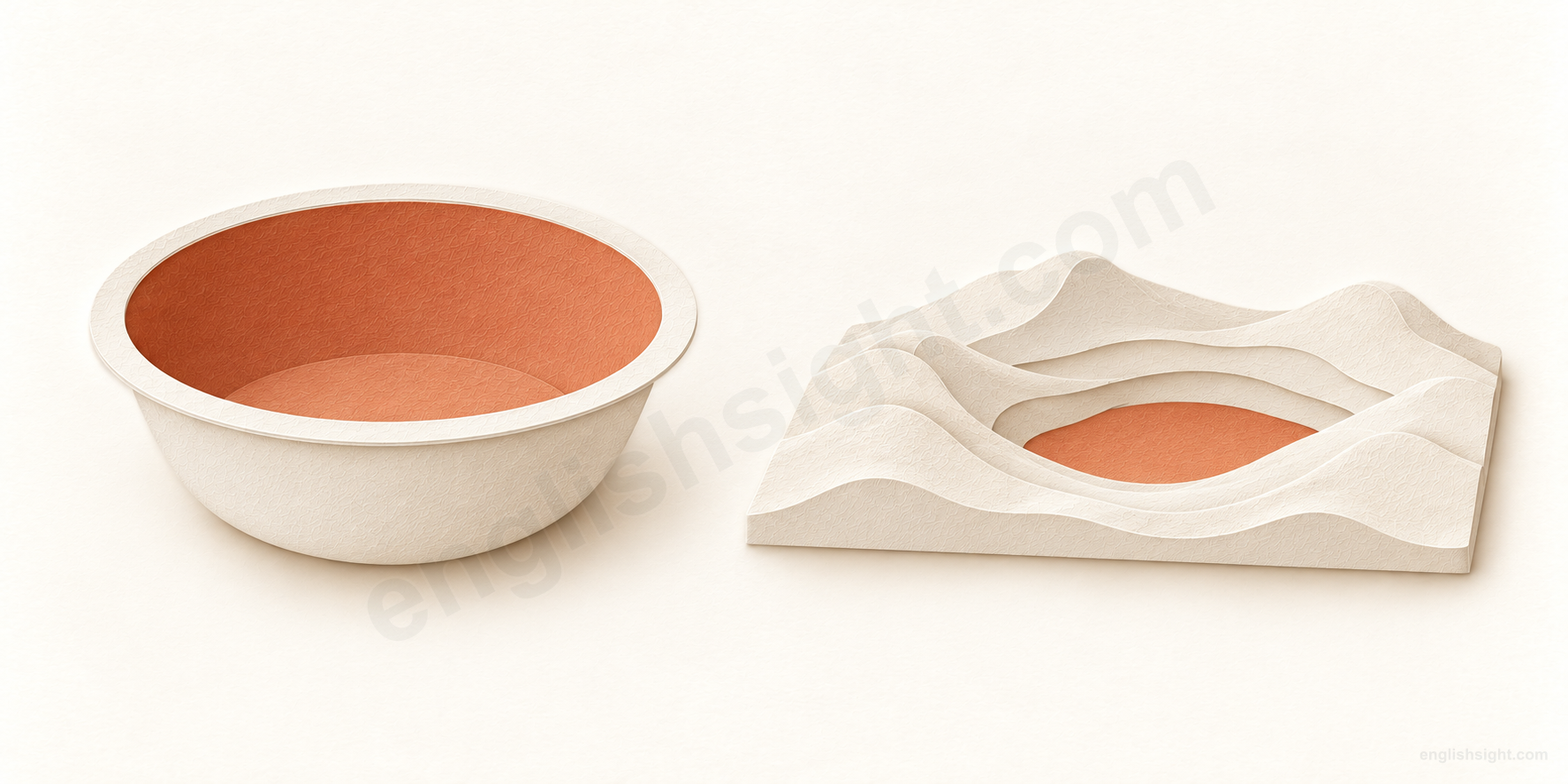
Connect a washing bowl, a river’s drainage area, and a sheltered water space—without confusing them.
Sides around a lower interior
Sides around a lower interior
A broad open basin has an interior below its rim.
basin
Raised land surrounds a dry lower area.
Compare the lower interior and its surrounding sides.
A container and a land basin share a hollow shape. These are two examples, not stages of a change.
A basin is a hollow container or area; several uses involve holding, collecting, or draining water within surrounding boundaries.
This is a relationship of shape and containment, not a required sequence of actions. A river basin is defined by drainage, and a geographical basin can be dry.
Basin is a countable noun: one basin, two basins. Say /ˈbeɪsən/, with the stress on the first syllable. At home it often names a bowl or washing fixture; in geography and boating it can name a much larger area.
A useful teaching connection is a hollow or receiving space within surrounding sides or boundaries. The context tells you whether those boundaries belong to a vessel, land, or a sheltered area of water. The connection helps memory; it does not replace the established meaning of each expression.
01
Basins at home
Name the washing fixture or portable vessel, then distinguish its purpose from its contents.
01
a / the + (bathroom) basin; wash something in the basin
the bathroom basin
a fixed bowl for washing your hands or face
Situation
You want to wash your hands in the bathroom.
What is described?
You use the bowl below the tap.
Here basin names the washing fixture, not the whole room.
In British English, basin or washbasin can name the bathroom fixture supplied by taps. Sink is also used in British English and is the usual North American choice. The surrounding words identify the setting: a bathroom basin, a cracked basin, or the basin beside the shower. Hand basin is another British term, especially for a small fixed bowl for washing your hands.
In Wash your hands in the basin, in names where the washing happens. At the basin places you beside the fixture. Basin is a countable noun: a basin, the basin, two basins. It is the hollow bowl that matters here; the word does not promise a particular colour or material.
In a sentence
There is a small basin beside the shower.
Watch the difference A basin is a fixture or container, not a word for the bathroom itself.
02
fill a basin with + contents; pour + liquid + into a basin; empty the basin
fill a basin with water
put water into a broad open container
Situation
You need somewhere to soak a cloth.
What is described?
The container holds the water and the cloth.
The container and its contents have different grammatical roles.
A portable basin is a broad open container with an inward-curving or sloping interior. You can carry an empty basin, set it down, and use it for washing or soaking. Unlike the fixed bathroom fixture, it need not have taps or a drain.
Fill the basin with water makes the basin the object of fill and introduces the contents with with. Pour water into the basin makes water the object of pour; into marks its destination. Empty the basin means remove its contents. These meanings come from the verbs and prepositions, not from a special verb sense of basin.
In a sentence
She filled a plastic basin with warm water and soaked the cloth.
Watch the difference Say fill the basin with water, not fill the basin of water when describing the action.
03
a pudding basin; put / mix + ingredients + in a basin
a pudding basin
a deep round bowl used in food preparation or cooking
Situation
A recipe calls for a vessel for the pudding mixture.
What is described?
The mixture goes into the cooking bowl.
The first noun tells you the basin’s intended use.
In British recipes, basin can refer to a bowl used to prepare food. Mixing bowl is an alternative when the task is mixing. A pudding basin is a named type of deep round bowl used for mixing ingredients or cooking a pudding.
In pudding basin, pudding modifies basin: the phrase names the vessel, not a portion of food. Compare a basin of pudding, which describes what is inside. The hollow-container connection remains, but the recipe gives the purpose. The expression does not mean a bathroom sink used as cookware.
In a sentence
Spoon the mixture into a greased pudding basin.
Watch the difference A pudding basin names a kind of bowl; it does not guarantee that pudding is already inside.
04
a basin of + contents; two basins of water; a basinful of water
a basin of water
water measured or described by the container holding it
Situation
Someone asks how much water to bring.
What is described?
You bring the contents of one basin.
Of links the container measure to its contents.
A basin of water can refer to the container together with its water or focus on the amount held in it. Bring a basin of water normally asks for both; She spilled a basin of water focuses on the liquid. A basinful of water also names a container-sized quantity.
It is not an exact unit like a litre: basins differ in size. Two basins of water counts two such quantities, while water itself remains uncountable. Compare a water basin, which classifies a container or feature by its use or connection with water, without saying that it currently contains water.
In a sentence
We carried two basins of water out to the garden.
Watch the difference Keep of for the contents: a basin of water. Do not turn ordinary water into a plural waters here.
02
Basins on a map
Distinguish land defined by drainage from land defined by its low, hollow shape.
05
a river / drainage basin; the basin of + river name; in the + river name + basin
a river basin
the land whose water drains into a river and its branches
Situation
Rain falls across a region crossed by many streams.
What is described?
The streams feed the same river system.
The basin includes the surrounding land, not just the river channel.
A river basin is a drainage area. Streams and tributaries connect its land to a river system. This is why a town can be in a river basin without standing in the river. Drainage basin emphasizes where the water drains; the basin of a river is another way to express the relationship. The broader term drainage basin can also describe land draining to a lake or sea.
The bowl connection helps you remember gathering water, but a river basin is not a sealed bowl full of still water. Water may leave through the river. Learn the map term as a whole, and distinguish the area from the river, which is the flowing watercourse.
In a sentence
Several towns in the river basin were affected by the heavy rain.
Watch the difference A river basin is larger in meaning than the river itself and does not mean a lake.
06
a desert / ocean basin; a basin surrounded by + higher ground
a desert basin / an ocean basin
a hollow or relatively low part of the earth’s surface
Situation
Higher ground or the wider earth’s surface provides a reference.
What is described?
A lower area forms a broad hollow.
This sense is about the shape of the surface; water is not required.
In geographical descriptions, basin can name a low, hollow region. A desert basin may be dry; an ocean basin is an enormous depression occupied by ocean water. Size changes, but the contrast between a lower interior and its surroundings is useful in both.
This shape-based sense differs from river basin, which identifies land by drainage. Do not decide that every low hollow feeds one named river. In names such as the Pacific Basin, context can also concern the wider region associated with that ocean rather than only its underwater floor.
In a sentence
The road descends into a dry basin surrounded by hills.
Watch the difference Basin alone does not mean a place must contain water or have an outlet.
03
Sheltered and collected water
Recognize two established compounds in boating and drainage contexts.
07
a yacht / dock basin; boats moored in the basin
a yacht basin
a partly enclosed area of water where boats can be kept
Situation
Boats need a sheltered place to moor.
What is described?
They lie within a protected water area.
The boundaries shelter a water space rather than form a household bowl.
A yacht basin is a sheltered water area for yachts. In harbour or port descriptions, basin can identify an enclosed or partly enclosed section where vessels moor or dock. It may connect to open water; complete closure is not required.
The first noun specifies the use, as in yacht basin. This is an established waterway sense, connected to containment and boundaries rather than the literal size or material of a bowl. A harbour can include more than one basin, so the words need not identify exactly the same area.
In a sentence
The yachts stayed in the sheltered basin during the storm.
Watch the difference In a boating context, basin names the water area, not the boats or a container aboard them.
08
a catch basin; clear / clean a catch basin
a catch basin
a drainage receptacle that collects runoff, often retaining debris
Situation
Rainwater runs along a street gutter.
What is described?
It enters a collection chamber connected to drainage.
Catch basin is a compound noun with a specific drainage use.
A catch basin can be a chamber where gutter water enters a sewer system and material that would obstruct the pipes is retained. The term can also name a reservoir or well collecting surface runoff. Here basin keeps the idea of a receiving hollow.
Learn catch basin together when reading about street maintenance or drainage. Catch describes its collecting function; it is not an instruction to catch a household bowl. Compare drainage basin in geography: that is a land area, whereas this compound can identify a built collection structure.
In a sentence
Workers removed leaves from the catch basin after the storm.
Watch the difference A catch basin and a river’s drainage basin are different kinds of thing despite their shared connection with runoff.
Choose the meaning from the setting
Basin, bowl, and sink
Bowl is a flexible everyday name for a rounded container. Basin often suggests washing or holding liquid, and British recipes also use it for food preparation. Bathroom basin and sink overlap; a kitchen sink is usually called a sink. Do not replace every bowl or sink with basin automatically.
The word does not supply the whole action
Fill, empty, wash, pour, and drain describe actions involving a basin. Basin itself is taught here as a noun. These verb–noun combinations are not phrasal verbs or separate verb senses of basin.
Spelling and scope
The plural is basins. Do not confuse it with basis, meaning a foundation or starting point, whose plural is bases. Geological rock-layer basins and specialist botanical uses are outside the detailed teaching scope; this is a selection of useful modern uses, not every technical meaning.
Identify the basin
Use the situation and the whole expression to decide what is meant.
1. In a British hotel, someone points to the bathroom basin. What are they pointing to?
2. You want to describe putting water in an empty container. Which pattern fits?
3. A town is in a river basin. What does that tell you?
4. A report describes a dry desert basin. Is the expression contradictory?
5. A recipe asks for a pudding basin. What do you need?
Sources and teaching notes
Dictionary entries support the senses and usage distinctions below. The explanations and examples are original; the shared-shape model is a teaching connection, not a dictionary definition for every compound.
The diagram illustrates a teaching connection, not an image shared by every native speaker.