Connect the wash, the water, and the container—then learn the wider uses in context.
Washing in held water
Washing in held water
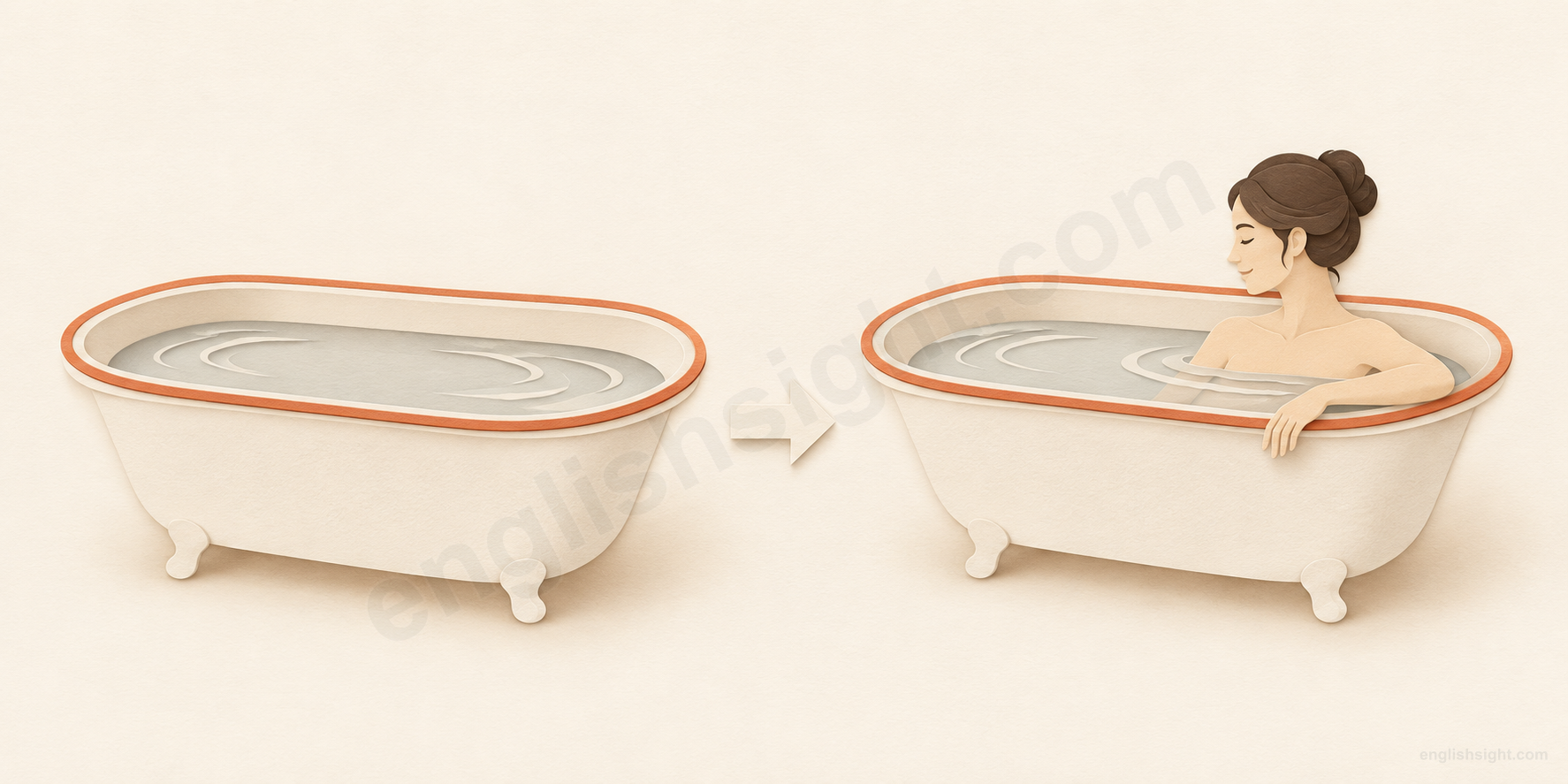
Water is ready in the tub; no one is in it yet.
bath
The person sits in the held water, with one arm resting on the rim.
The arrow leads from prepared water to someone soaking in it.
Bath connects the wash or soak with its water and container.
A bath is a wash or soak in held water; the same word can name the water or its container.
This is a teaching connection for the central uses. Compounds such as sponge bath and established idioms have their own limits; no single picture predicts every use.
A bath usually brings together a person, water held in a tub, and time spent washing or soaking. English can name the activity, its water, or its container with the same word.
Use that connection as a learning model, then read the whole expression. A housing advertisement and a financial idiom need different interpretations.
01
Washing, water, and the tub
Start with the wash itself, then distinguish the container, the water, preparation, and helping someone else.
01
have / take / need + a bath
have / take a bath
wash or soak your body in water
Situation
You want to wash before bed.
What it means here
You spend time sitting or lying in bath water.
Bath names the washing occasion; have and take supply the verb.
Have a bath is especially familiar in British English; take a bath is especially familiar in North American English and is also understood elsewhere. Neither expression means carrying the container away.
For one washing occasion, bath is countable: a bath, another bath, two baths. A hot bath and a quick bath describe the water temperature or the occasion. Need a bath expresses a need to wash.
A shower normally washes you with water falling or spraying onto you. In an ordinary bath, you sit or lie in water held in a tub. These are different washing arrangements.
In a sentence
I’ll take a quick bath before bed.
Watch the difference Say take a bath, with a; do a bath is not the usual expression for washing yourself.
02
a / the + bath; install / clean / replace + a bath
a bath / bathtub
the container you wash in
Situation
You are choosing bathroom fittings.
What it means here
You compare the sizes of two tubs.
Here bath is a physical object that can be installed, cleaned, or replaced.
In British English, a bath can be the large container itself. Bathtub or informal tub makes that meaning clear in North American English; bathtub is also understood in Britain.
We need a new bath concerns the object. I need a bath usually concerns washing. New and the practical situation help select the meaning; there is no need to invent two unrelated pictures.
In a sentence
The new bath is too wide for this bathroom.
Watch the difference A bathroom is the room; a British bath can be just the tub inside it.
03
be / soak + in the bath; get into / out of the bath
in the bath
be in the tub, usually washing or soaking
Situation
Someone calls while you are soaking.
What it means here
You explain why you cannot answer the door.
In locates you in the tub; a bath in have a bath counts an activity.
In the bath is ordinary British wording for being in the tub. In the bathtub or in the tub is a clear North American alternative. Get into the bath and get out of the bath describe entering and leaving it.
The is natural when the household tub is understood. Compare I’m in the bathroom: that only locates you in the room and does not say you are in water.
Bath also comes before nouns to show their use or association: a bath towel dries you after washing, a bath mat is associated with the bathing area, and bath time names the time for a bath. Bath stays singular in these combinations.
In a sentence
I can’t come to the door; I’m in the bath.
Watch the difference In the bath does not simply mean anywhere inside the bathroom.
04
run / draw + a bath; run + someone + a bath; run a bath for + someone
run / draw a bath
prepare bath water by filling the tub
Situation
The tub has not been filled.
What it means here
Water is ready for someone to bathe in.
Run refers to letting the water flow; it does not describe running on foot.
Run a bath means fill the tub for bathing. Run someone a bath and run a bath for someone name the person you prepare it for. Draw a bath is another established expression for preparing the water.
The bath in Your bath is ready can mean the prepared water. Fill the bath focuses on the container being filled; run a bath focuses on preparing a bath. Preparation does not itself say anyone has washed yet.
In a sentence
I’ll run you a bath while you find a clean towel.
Watch the difference Run you a bath means prepare it for you; give you a bath means wash you.
05
give + someone / an animal + a bath; be given a bath
give someone a bath
wash another person or an animal
Situation
The dog is muddy after a walk.
What it means here
You wash the dog.
The recipient is the one being washed, not simply the person who receives water.
Give the baby a bath describes washing the baby. It is useful when talking about care for a child, a person who needs help, or an animal. Give a bath to someone is also grammatical.
The baby was given a bath is a natural passive when the recipient matters more than the helper. Compare I ran the baby a bath, which says only that I prepared water.
In a sentence
We gave the dog a bath after the muddy walk.
Watch the difference Give someone a bath does not mean hand over an empty bathtub.
06
some / a bottle of + bubble bath; have / take + a bubble bath
bubble bath / a bubble bath
a bath product, or a washing occasion with bubbles
Situation
You add a foaming product to the water.
What it means here
You have a bath with bubbles on the surface.
The article helps distinguish the product from one bath taken with it.
Bubble bath without a usually means the product you add to bath water: We’ve run out of bubble bath. A bubble bath is one bathing occasion using it.
The modifier bubble identifies a kind of bath, while the whole compound also has an established product meaning. A bottle of bubble bath packages the product; two bubble baths counts occasions.
In a sentence
She bought some bubble bath for a relaxing bath at home.
Watch the difference Some bubble bath can mean some product; a bubble bath normally means the bath itself.
02
Forms and wider settings
Regional wording and modifiers tell you whether bath refers to washing, a room, a public place, or a liquid used in a process.
07
bath + someone (British); bathe + someone (North American)
bath the baby / bathe the baby
use a regional verb for washing in a bath
Situation
A parent is describing the evening routine.
What it means here
The parent says who washes the child.
British bath and North American bathe can describe the same care activity.
British English uses bath as a verb, especially bath someone. North American English generally uses bathe for this. Give someone a bath is a useful alternative across varieties.
British bath can also be intransitive, meaning have a bath, though Oxford marks this use old-fashioned. For your own routine, I have a bath or I take a bath is a straightforward choice.
Bath has forms baths, bathed, bathing. The British verb keeps /θ/: bathed is /bɑːθt/ or /bæθt/. Bathe is /beɪð/; its bathed is /beɪðd/. The written forms bathed and bathing therefore do not tell you which verb you are hearing.
Bathe also has uses beyond taking a bath, including washing a body part and literary covering with light. Do not transfer every bathe meaning to bath.
In a sentence
In Britain, you may hear a parent say, “I usually bath the baby before dinner.”
Watch the difference Bath and bathe are different spellings and pronunciations, even where their meanings overlap.
08
give + someone + a sponge bath
a sponge bath
wash the body with a wet sponge or cloth instead of soaking in a tub
Situation
A person cannot get out of bed.
What it means here
A helper washes the person without putting them in a tub.
A compound may name a washing method that differs from the central tub picture.
Sponge bath is especially North American wording for washing with a wet sponge or cloth without putting the person in water. It is often used when someone cannot get out of bed, but being confined to bed is not required. The washing is still a bath in a broader sense even though there is no immersion.
Give someone a sponge bath uses the same recipient pattern as give someone a bath. Sponge specifies the method; it is not a tub made from sponge.
In a sentence
The nurse gave him a sponge bath while he was unable to leave bed.
Watch the difference The central picture is a starting point: not every expression containing bath requires immersion.
09
number + bath(s); a half bath
two beds, two baths
bathrooms, especially in North American home descriptions
Situation
You read an apartment advertisement.
What it means here
You learn how many bathrooms the property has.
In a housing description, bath can count rooms rather than tubs.
North American descriptions often use bath as a short form of bathroom. Two baths can therefore mean two bathrooms, not two bathing occasions or two separate tubs.
A half bath contains a toilet and washbasin, without a bath or shower. Half describes a bathroom category, not half a tub. Look at the description or floor plan rather than assuming each listed bath includes a bathtub.
In a sentence
The apartment has two bedrooms and two baths.
Watch the difference This room meaning is regional and context-dependent; do not read every plural baths as bathrooms.
10
Roman / public + baths; the baths
Roman baths / the baths
public bathing facilities, a bathing resort, or an older British term for a swimming pool
Situation
You visit an old public bathing site.
What it means here
You describe the facilities where people once washed.
Baths can name a place that provided bathing, rather than several washes.
Roman baths are public bathing facilities from Roman times. The plural usually refers to a complex or establishment; it does not require you to count individual tubs.
Baths can also refer to bathing facilities or a bathing resort at a spa, so the place meaning is not limited to ancient sites. The setting tells you whether people are visiting facilities, taking a wash, or swimming.
In older British usage, the baths can also mean the public swimming pool. Oxford marks this swimming use old-fashioned. Swimming pool is clearer in ordinary modern conversation.
In a sentence
We spent the morning exploring the Roman baths.
Watch the difference Baths may describe a place. Capitalized Bath is also a city name, a separate proper noun.
11
a water / dye bath; place + something + in a bath
a water bath / a dye bath
a contained liquid or arrangement used to treat something or control temperature
Situation
Something needs contact with a liquid or controlled surrounding heat.
What it means here
It is placed in the appropriate bath.
The broader connection is surrounding contact with a medium, not washing a person.
A dye bath holds dye in which material is placed for coloring. A water bath can use surrounding water to control the temperature of something placed in it. The context tells you whether bath names the liquid, the vessel, or the arrangement.
These are specialist extensions worth recognizing in instructions. Bath alone does not tell you what liquid, temperature, or treatment is appropriate; the modifier and the full instructions supply that information.
In a sentence
The cloth was placed in a dye bath to turn it blue.
Watch the difference The tub-washing picture does not mean an industrial bath contains ordinary bath water.
03
Expressions beyond washing
These established expressions have meanings that the physical bath picture cannot predict by itself.
12
take a bath (on + investment / deal)
take a bath on an investment
lose a large amount of money
Situation
An investment sells for much less than it cost.
What it means here
The investor suffers a substantial loss.
This established informal expression is financial, with no actual washing.
In North American informal usage, take a bath can mean suffer a large financial loss. On often introduces the investment or deal involved.
Compare I took a bath after work, where a washing context selects the literal meaning. A financial topic selects the idiom; take does not independently mean lose money in every phrase.
In a sentence
They took a bath on the shares they sold last month.
Watch the difference A money loss is an idiomatic reading, not the automatic meaning of every take a bath.
13
throw the baby out with the bathwater / bath water
throw the baby out with the bathwater
discard valuable things while removing unwanted ones
Situation
A system has useful features as well as faults.
What it means here
Someone risks rejecting the useful parts along with the problems.
The whole expression warns against throwing away the good with the bad.
This idiom often appears in a warning: Don’t throw the baby out with the bathwater. The baby represents something worth keeping; the used water represents what can be discarded.
Bath water is also written as two words. The lesson uses bathwater in the example; the meaning of the whole expression is the same. It is a figurative warning, not an instruction about childcare.
In a sentence
We should fix the old system, not throw the baby out with the bathwater.
Watch the difference Learning bath alone will not give you the full idiomatic meaning; learn the whole expression.
14
take an early bath
take an early bath
leave an activity before it is finished
Situation
A football player commits a foul and receives a red card.
What it means here
The player must leave the field before the match ends.
In this British idiom, early marks a premature exit, not simply an earlier wash.
Take an early bath is a British idiom for stopping participation and leaving before an activity is finished. For example, a football player sent off after a foul can be said to take an early bath. The phrase can also describe a premature departure outside sport; context tells you whether the exit is imposed.
It can also be literal: I’ll take an early bath so the bathroom is free later describes a washing schedule. Use the surrounding story to decide whether anyone actually bathes.
In a sentence
The defender took an early bath after receiving a red card.
Watch the difference This is regionally marked idiomatic wording; leave early is a clearer neutral alternative.
Choose the intended meaning
Count the occasion; identify the object
Have a bath counts a washing occasion; clean the bath usually targets the tub in British English; your bath is ready can refer to prepared water. Read the verb and setting together.
Noun sounds and verb forms
Bath is /bɑːθ/ in many British accents and /bæθ/ in American English. The plural noun baths is often /bɑːðz/ or /bæðz/; /θs/ variants also occur. The British verb baths keeps /θs/. Bathe is /beɪð/, with a different vowel and final consonant.
Scope and related words
This lesson covers the central noun, regional verb, useful compounds, wider recognition senses, and selected idioms. Bath as a noun modifier is not a phrasal verb. Body-part washing, swimming, and literary light uses of bathe belong to that related verb; the city Bath and the ancient unit of measure are separate entries.
Read the whole situation
Choose the expression or interpretation that fits the context.
1. You fill the tub for your partner, who has not washed yet. What did you do?
2. An American apartment advertisement says “two beds, two baths.” What does baths mean here?
3. You need to buy the foaming product for the water. Which sentence fits?
4. An investor says, “We took a bath on those shares.” What happened?
5. Which is a clear everyday way, across varieties of English, to say you washed the baby?
Sources and teaching notes
The sources below support the meanings, regional labels, patterns, and idioms. Explanations and examples are original; the central visual connection is a teaching model.
The diagram illustrates a useful connection, not a picture shared by every native speaker.