Use beautiful for what gives you pleasure or earns your admiration—in appearance, experience, character, or skill.
Something appreciated by someone
An object of appreciation and someone who appreciates it
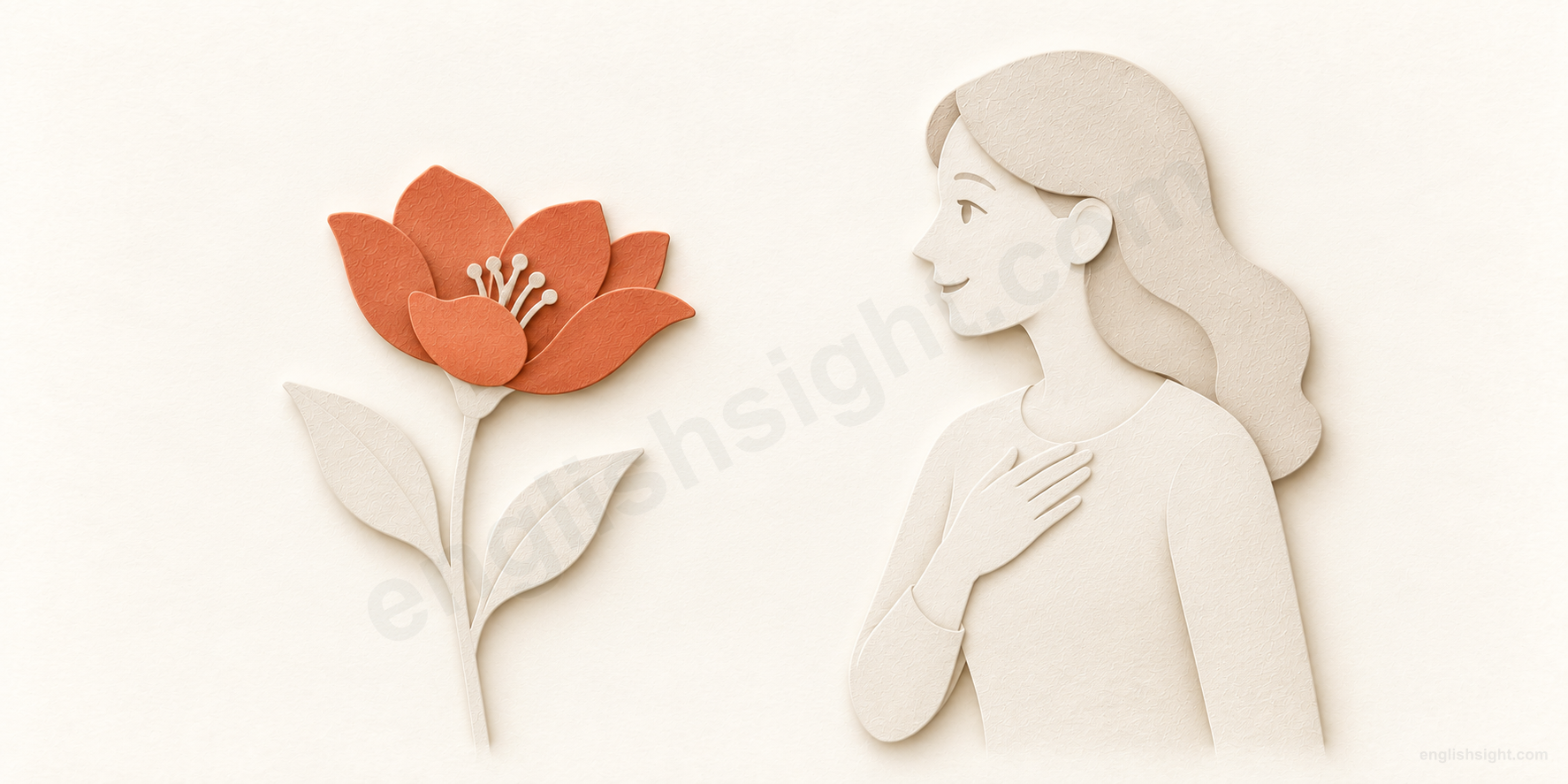
An open flower is in front of an observer.
beautiful
She finds the flower’s appearance beautiful.
She looks at the blossom and smiles in appreciation.
She admires the flower’s appearance; beautiful expresses her appreciation.
Someone finds the qualities of a person, thing, or experience deeply pleasing or admirable.
Beautiful expresses an evaluation, not a movement or a necessary change of state. The flower illustrates visual beauty; the lesson extends to sounds, experiences, kindness, and skill.
Beautiful is usually an adjective. It tells us how a person, thing, or experience strikes someone: its qualities invite strong appreciation. The pleasure may come through the eyes or ears, or from thinking about an action or result.
The sketch shows a person admiring a flower. It is one example of the relationship between something appreciated and an appreciator, not a claim that all English speakers picture the same flower or agree about beauty.
01
What we find beautiful
The thing being praised may be a face, a sound, an experience, a kind action, or a skilled performance. The noun and situation tell you which quality matters.
01
beautiful + person / feature / place / object
a beautiful face / view
give strong pleasure through appearance
Situation
You notice the colors and shapes of a garden.
What you appreciate
You admire how the garden looks.
Beautiful expresses appreciation, rather than an objective measurement.
Use beautiful for a person, a feature, a place, or an object whose appearance you admire. A beautiful smile praises the smile; a beautiful dress praises the dress. Neither statement necessarily describes the person’s character.
Pretty often suggests a lighter or more delicate attractiveness. Beautiful can express stronger admiration and applies widely to landscapes, art, and people. Handsome is a conventional choice for an attractive man, but beautiful is also possible for men and boys; these are usage tendencies, not rules about who may be beautiful.
The flower and observer in the sketch illustrate one act of appreciation. A different person may prefer a different flower. The word does not require agreement from everyone.
In a sentence
The old bridge is beautiful in the evening light.
Watch the difference A beautiful person may refer to looks or character. Let the surrounding words show which you mean.
02
beautiful + sound / music; sound + beautiful
a beautiful voice / melody
give pleasure to the senses beyond sight
Situation
You listen to a musician in the station.
What you appreciate
You admire the quality of the sound.
Beauty can be heard as well as seen.
A voice, a song, and music can be beautiful because listening to them gives pleasure or moves you. You are evaluating the sound or the musical experience, not the singer’s face.
Her voice sounds beautiful describes the voice. She sings beautifully describes how she sings. A beautiful melody can also be sad: beautiful does not require a cheerful subject or mood.
In a sentence
Her voice sounded beautiful in the small hall.
Watch the difference Use beautiful music without a or plural -s when music is an uncountable noun.
03
a beautiful + day / morning / evening / time
a beautiful day / evening
describe a very pleasant time or experience
Situation
You spend a relaxed afternoon outdoors with friends.
What you appreciate
You remember the afternoon with pleasure.
The praise can concern the experience as a whole.
A beautiful day often has weather you enjoy; a beautiful evening may describe pleasant weather, a happy occasion, or both. The context supplies the details.
It was a beautiful evening can praise the whole experience. It does not mean that time itself had a visible shape. This is a broad positive evaluation, so use more precise words if you need to report the temperature, date, or actual conditions.
In a sentence
We spent a beautiful afternoon by the lake.
Watch the difference Do not assume beautiful weather means hot weather. A clear, cold day can also be beautiful.
04
a beautiful person; a beautiful thing to say / do
a beautiful person / thing to do
admire someone’s character or a generous action
Situation
A neighbor quietly helps a family through a hard week.
What you appreciate
You praise the care shown in the action.
The admired quality can be moral or emotional rather than visual.
Calling someone a beautiful person can praise their kindness and warmth. Saying She is beautiful inside makes that character judgment explicit. Without context, beautiful person can also concern appearance.
That was a beautiful thing to do praises an action as caring or generous. Thing here means an act, not a physical object; to do identifies the act being evaluated. A beautiful message may similarly be touching because of what it says.
In a sentence
Staying with him all night was a beautiful thing to do.
Watch the difference A beautiful face does not by itself mean a kind personality. The object of the praise matters.
A player places a difficult shot exactly where intended.
What you appreciate
You admire the control and execution.
Beautiful can praise how well something is done.
A beautiful shot, a beautiful performance, or a beautiful piece of work can praise skill and an impressive result. The object does not need to be decorative. A beautiful solution may impress you because it solves a problem so neatly.
Beautiful timing praises the choice of the right moment. The admiration remains, but the noun supplies what is admired: accuracy, coordination, judgment, or elegance. These are ordinary combinations, not separate phrasal verbs.
In a sentence
That was a beautiful shot into the far corner.
Watch the difference Beautiful work praises the work; beautiful worker would normally describe the person, often their appearance.
02
Build a description
Put beautiful in the right place, compare degrees of beauty, and distinguish a quality from the way an action is performed.
06
beautiful + noun; be / look + beautiful; make / find + object + beautiful; something beautiful
look beautiful / make something beautiful
describe a quality and who or what has it
Situation
You arrange a room for a celebration.
What you appreciate
You describe the room’s appearance.
Beautiful describes a noun or a subject/object complement.
Put beautiful before a noun: a beautiful room. After a linking verb, it describes the subject: The room is beautiful; You look beautiful. Look here links you to a description; it does not mean looking at an object.
Make the room beautiful means cause the room to have that quality. Beautiful describes the room, not the way you make something. I find the room beautiful presents my judgment of it; to me in The room is beautiful to me also identifies an evaluator.
Something beautiful puts the adjective after something: We saw something beautiful. In beautiful to look at, the subject is what someone looks at: The garden is beautiful to look at. Do not add another it after at in that sentence.
In a sentence
The flowers made the room beautiful.
Watch the difference Write a beautiful room, not a room beautiful in an ordinary noun phrase. Something beautiful uses a different word-order pattern.
07
more beautiful than; the most beautiful; as beautiful as; so beautiful that; such a beautiful + noun
more beautiful / the most beautiful
compare or emphasize the degree of beauty
Situation
You compare two walks through the same valley.
What you appreciate
You prefer the view on one route.
Beautiful allows degrees; more and most form its comparisons.
Use more beautiful than for a comparison and the most beautiful for the highest degree within a group: This is the most beautiful view on the island. Do not add -er or -est to beautiful.
Very beautiful, so beautiful, and absolutely beautiful can strengthen praise. As beautiful as says the two things are equal in beauty; not as beautiful as says one has less. None of these expressions turns beauty into an objective measurement.
So beautiful that… introduces a result: The view was so beautiful that we stopped talking. In such a beautiful view, such goes before the whole noun phrase, including a. These are general adjective constructions, not new senses of beautiful.
In a sentence
The coast is even more beautiful in the early morning.
Watch the difference Use more beautiful, not beautifuler or more beautifuler. Say such a beautiful place, not so a beautiful place.
distinguish an admired quality from the manner of an action
Situation
You hear someone performing a song.
What you appreciate
You choose whether to praise the voice or the singing.
Beautiful is an adjective; beautifully is the related adverb.
Her voice is beautiful gives the voice a quality. She sings beautifully tells how she sings. In a beautifully decorated room, beautifully modifies decorated; beautiful in a beautiful room directly describes room.
It all worked beautifully can mean everything worked very well. The adverb is useful to contrast with beautiful, but it is a separate word. The same distinction explains You look beautiful versus You dance beautifully.
In a sentence
The choir sang beautifully at the concert.
Watch the difference Say She sings beautifully in standard English, not She sings beautiful. After linking look, say You look beautiful.
03
React and recognize fixed expressions
Learn the whole expression when beautiful becomes an exclamation or belongs to a familiar social or sporting label.
09
What a beautiful + singular count noun!; What beautiful + plural / uncountable noun!; How beautiful!
What a beautiful…! / How beautiful!
express admiration directly
Situation
You unexpectedly see a striking landscape.
What you appreciate
You react with admiration.
Exclamative grammar turns a description into an enthusiastic reaction.
What a beautiful view! uses what plus a noun phrase. How beautiful! uses how plus an adjective. How beautiful the view is! is a fuller version; it keeps statement order after beautiful.
With an uncountable noun, omit a: What beautiful music! With a plural, say What beautiful flowers! These forms express your reaction rather than ask for information.
In a sentence
What a beautiful garden you have!
Watch the difference Use How beautiful the garden is!, not How beautiful is the garden! when making this exclamation.
10
Beautiful!; Beautiful. + an ironic follow-up
Beautiful!
show approval, or express displeasure ironically
Situation
A colleague tells you a difficult problem has been solved.
What you appreciate
You give a brief approving response.
Tone and situation determine whether the praise is sincere.
Beautiful! can stand alone as a pleased reaction to good news or a successful result. It need not concern anyone’s appearance. In grammatical descriptions this standalone use may be called an interjection.
After bad news, Beautiful! can be ironic: “The printer has broken again.” “Beautiful. Just what we needed.” Here the apparent praise expresses frustration. The negative meaning comes from the situation and tone, not from a new adjective meaning ugly.
In a sentence
“The repair is finished, and it cost nothing.” “Beautiful!”
Watch the difference A written Beautiful! can be ambiguous without context. Do not assume the speaker is always sincere.
11
the beautiful people + plural verb
the beautiful people
refer to a glamorous, fashionable social set
Situation
A magazine describes a party attended by celebrities.
What you appreciate
It uses a label for the fashionable elite.
This established social label goes beyond attractive faces.
The beautiful people can refer to rich or famous people associated with glamorous social life. In this expression, the group’s social position and lifestyle matter; the writer is not simply counting good-looking guests.
Compare There were beautiful people at the wedding, which can simply describe attractive or admirable people. In a party report, the beautiful people may be the established social label. Context still matters: the same words can have an ordinary literal reading.
In a sentence
The magazine follows the parties of the beautiful people.
Watch the difference Do not use this label as a general synonym for every group of kind or attractive people.
12
the beautiful game
the beautiful game
refer to association football, or soccer
Situation
A sports writer discusses the appeal of football.
What you appreciate
The writer uses an admiring nickname for the sport.
The whole expression names a particular sport.
The beautiful game is a familiar name for football, called soccer in American English. It is especially associated with British football talk and writing. Learn the phrase as a whole.
A beautiful game of tennis can be an ordinary description of an impressive tennis match. The established nickname the beautiful game refers to football; beautiful alone does not mean football.
In a sentence
For many fans, the beautiful game is part of family life.
Watch the difference The fixed nickname refers to soccer, rather than American football or every attractive sporting event.
Keep the object of praise clear
Beauty and goodness are different judgments
A beautiful face praises appearance; a beautiful action may praise kindness. A person’s appearance does not establish their character, and beautiful does not mean useful, safe, or correct in every context.
Related words and grammar
Beautiful is pronounced /ˈbjuːtɪfəl/, with stress on the first syllable. The final syllable is weak. Write beautiful with one final l. Beauty is the related noun; beautifully is the adverb; beautify is a verb. Beautiful itself has no tense, passive, causative verb forms, or phrasal-verb family. In make it beautiful, make supplies the causative grammar.
Scope of this lesson
The selection covers everyday adjective uses, practical description patterns, reactions, and two recognizable fixed expressions. Literary the beautiful, meaning beauty or beautiful things collectively, and historical or specialist uses are not developed here.
Choose what the sentence praises
Read the situation, then choose the natural form or intended meaning.
1. You want to praise the sound of someone’s voice, rather than their appearance. Which sentence does this?
2. Complete the standard sentence: The children sang ___.
3. Someone says, “Helping that family was a beautiful thing to do.” What are they most likely praising?
4. Which is the standard comparison?
5. A worker hears that all the saved files are lost and replies, “Beautiful. Now we must start again.” What does beautiful most likely express here?
6. In a British sports column, what does the established nickname the beautiful game refer to?
Sources and teaching notes
Dictionary entries were consulted for the meanings, usage distinctions, and expressions below. Explanations, examples, and the sketch are original teaching material; the appreciation model is a teaching interpretation.
The sketch illustrates appreciation; it does not represent a single image shared by every native speaker.