Use because to explain an event, a choice, or the basis for a claim.
A statement and the reason you give
Connect a statement to its reason
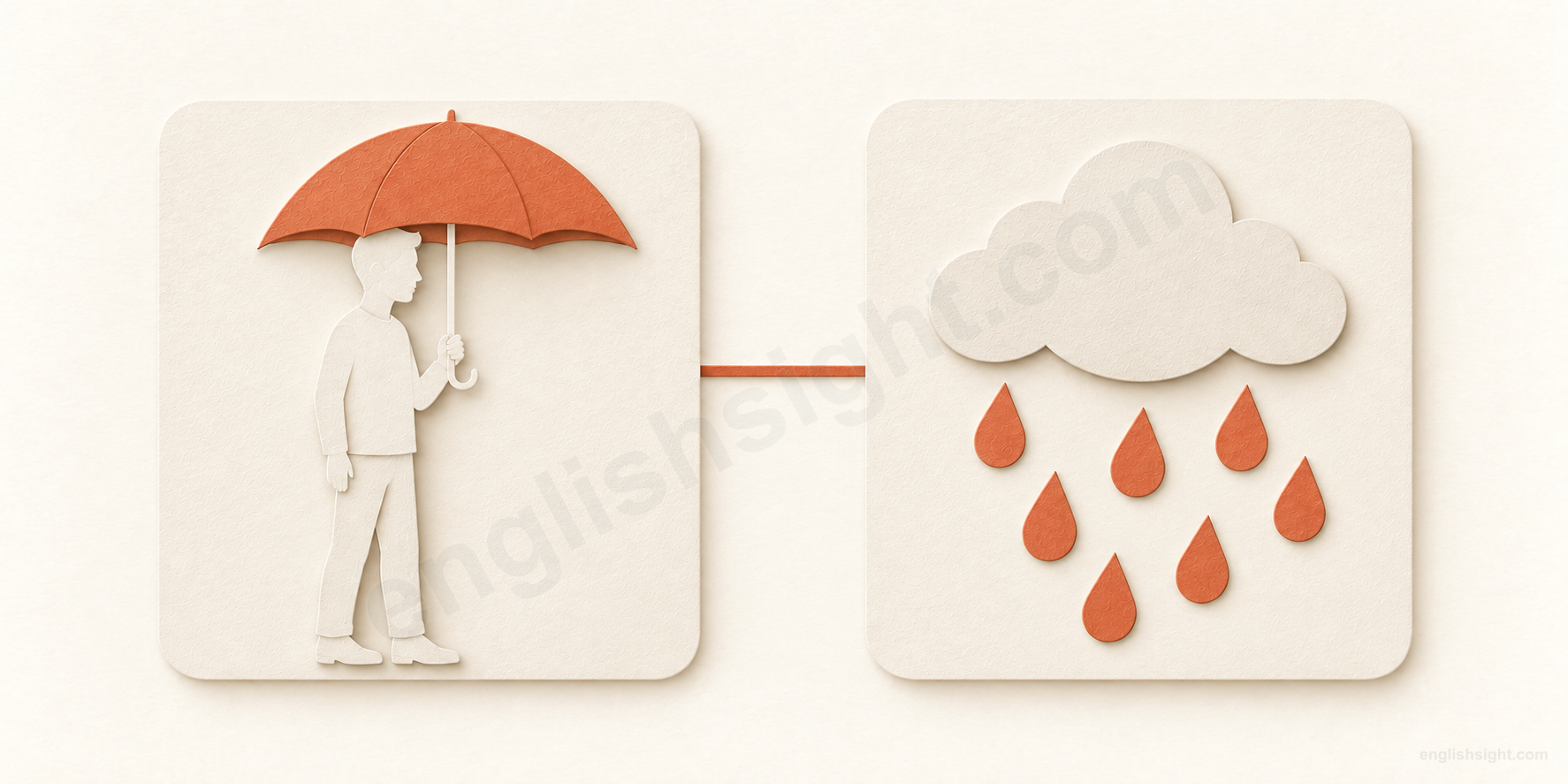
A person uses an open umbrella.
because
Rain is the reason given for using the umbrella.
The line connects the action to the reason given.
Rain explains the umbrella use; the panels show an explanatory link, not a time sequence.
Present something, then identify the reason you give for it. The because-clause carries that reason even when it comes first.
The line represents an explanatory relationship, not movement or a timeline. A reason can explain an event or support a judgment.
Because points to the part that answers why. Sometimes it names what caused something; sometimes it gives a motive or explains why the speaker believes a statement.
This lesson uses a simple explanatory link as a teaching model. It is not a claim about a picture that all English speakers share, and it is not a test that an explanation is true.
01
Give a reason or support a claim
Distinguish what caused an event from the evidence for saying something. Both can answer a kind of why-question.
01
main clause + because + subject + verb
because + a reason
explain why something happens or why someone chooses it
Situation / question
The bus service has stopped.
What is explained
You explain your decision to walk.
The because-clause supplies the reason for the main statement.
In I walked because the buses had stopped, I is the subject of walked; the buses is the subject of had stopped. Each clause has its own subject and verb. The two subjects need not be the same.
The reason may be a physical cause, a feeling, or a motive. I saved the file because I wanted a copy gives a motive; it does not say whether the plan succeeded. Because itself sets no tense: choose the verb forms to fit the events.
In a sentence
I walked home because the buses had stopped.
Watch the difference Do not add that after ordinary because: because the buses had stopped, not because that the buses had stopped.
02
because + reason clause, + main clause
Because…, …
put the reason before the main statement
Situation / question
The road is closed.
What is explained
You present that fact before describing your plan.
Changing clause order changes presentation, not which clause gives the reason.
A sentence can begin with because. Give the reason first, normally followed by a comma, and then finish the main clause. Because the road is closed by itself is usually incomplete in continuous formal writing.
In We will take the train because the road is closed, the reason comes second and normally needs no comma when it is closely integrated. Do not pair because with a second result-linking so in the simple pattern: choose Because A, B or A, so B.
In a sentence
Because the road is closed, we will take the train.
Watch the difference Starting with because is fine; leaving a dependent clause unfinished is the separate issue.
03
“Why + question?” “Because + subject + verb.”
“Why…?” “Because…”
answer a request for a reason
Situation / question
Someone asks why you saved a receipt.
What is explained
You supply only the reason, since the action is already known.
A conversational answer can omit the main clause.
A because-clause is a natural answer to Why…? The question supplies the missing context. This is different from accidentally leaving a sentence unfinished in an essay.
Use normal statement order inside the answer: because I need it, not because do I need it. Why asks for the reason; because introduces the answer.
In a sentence
“Why did you keep the receipt?” “Because I may need to return the shoes.”
Watch the difference A short answer can be complete as a conversational turn even though it is not an independent main clause.
04
claim + because + supporting evidence; question / utterance + because + reason for speaking
because + evidence
explain the basis for a claim or for speaking
Situation / question
You see a light under the office door.
What is explained
You infer that someone is still inside.
The reason can support your judgment rather than cause the situation.
In Someone must still be in the office, because the light is on, the light is evidence for the speaker’s conclusion. It does not cause a person to remain in the office.
Compare I left the light on because I was still working: now working explains the action. Ask whether the reason explains an event or explains why the speaker makes a claim. The diagram covers both explanatory links; it does not prove either claim true.
In informal conversation, because can also explain why you ask or say something: Are you coming tomorrow? Because I need to arrange the seats. The need to arrange seats explains the question, not the other person’s decision to come. This is a reason for speaking rather than a cause of the situation being discussed.
In a sentence
Someone must still be in the office, because the light is on.
Watch the difference Because does not guarantee that the evidence is conclusive or that the speaker’s explanation is correct.
02
Choose the grammar after the connector
A clause, a named cause, and an explicit reason statement use different structures.
05
because of + noun phrase / object pronoun
because of the delay / you / that
name the cause with a noun or pronoun
Situation / question
A delivery is delayed.
What is explained
You identify the delay as the reason for a schedule change.
Of makes the following reason a noun phrase rather than a finite clause.
Because of is a two-word preposition: because of the delay, because of you, because of that. Use an object pronoun after of: because of him, not because of he. That can refer to a whole earlier situation.
Compare We started late because the delivery was delayed with We started late because of the delay. The causal relationship is similar, but the grammar after the connector changes. A person named after because of may be responsible for either a benefit or a problem; blame is not built into the phrase.
Because of what you said is also possible: what you said names the relevant information. Because of the fact that the road was closed uses the noun phrase the fact that…; the shorter because the road was closed usually says the same thing more directly.
In a sentence
We started late because of the delivery delay.
Watch the difference Say because of the delay or because the delivery was delayed; not because of the delivery was delayed.
06
because of + -ing expression
because of having to…
use an activity or situation as the reason
Situation / question
You have to work late.
What is explained
You explain why you missed the call.
After of, an -ing expression can name the relevant activity.
Because of having to work late treats having to work late as the reason. Here the understood person who has to work is also the person who missed the call.
A full because-clause often makes the participants clearer: I missed your call because I had to work late. An -ing expression can also have a stated subject: Because of my colleague’s being there, I said nothing. Here my colleague is the person present, and I is the person who stayed quiet. The simpler because my colleague was there is often more natural in conversation. When no subject is stated in the -ing expression, make sure the intended participant is clear from context.
In a sentence
I missed your call because of having to work late.
Watch the difference Use because I had to work, not because of have to work.
07
this / that / it + be + because + clause
That is because…
explain a situation just mentioned
Situation / question
The room stays cool.
What is explained
You identify the thick walls as the explanation.
That points back to the situation that needs explaining.
That is because… gives the reason for a preceding statement. This is because… and It is because… can serve the same purpose when the reference is clear.
Compare The walls are thick. That is why the room stays cool. After because comes the reason; after why comes the result being explained. Keep this direction in mind when choosing between the two patterns.
In a sentence
The room stays cool. That is because the walls are thick.
Watch the difference Do not reverse the facts: That is because introduces the explanation, not the consequence.
08
the reason + (why) + clause + be + that / because + clause
The reason is that / because…
identify the reason explicitly
Situation / question
Someone wants a clear explanation of a departure.
What is explained
You name the earlier appointment as the reason.
The whole reason clause can follow the linking verb is.
The reason I left early is that I had another appointment is an unobtrusive choice for edited writing. You will also hear and read The reason I left early is because I had another appointment.
The reason is because is established usage, not a pattern that must always be called ungrammatical. Some editors dislike the apparent repetition of reason and because; use is that when you want to avoid that objection. A shorter option is I left early because I had another appointment.
In a sentence
The reason I left early is that I had another appointment.
Watch the difference Do not teach an absolute ban on the reason is because; distinguish an editorial preference from actual usage.
03
Limit, reject, or strengthen a reason
Words such as partly, not, and just determine what the explanation commits you to.
09
partly / mainly / only / simply / just + because + clause
partly / mainly / only because…
show how much a reason explains
Situation / question
You enjoyed a course for several reasons.
What is explained
You identify the instructor as one contributing reason.
The modifier limits or emphasizes the reason, not the meaning of because itself.
Partly because makes the reason one contributor. Mainly because presents it as the principal reason. Only because presents it as the sole reason in the context: I agreed only because you asked.
Simply because and just because can emphasize a straightforward or sufficient motive: I went simply because I wanted to. These are combinations with focusing adverbs, not new causal senses or phrasal verbs. Only because does not automatically mean that the speaker was happy about the action.
In a sentence
I enjoyed the course partly because the instructor gave clear feedback.
Watch the difference Partly is not only: partly leaves room for other contributing reasons.
10
main clause + not because + rejected reason + but because + actual reason
not because…, but because…
reject one explanation and give another
Situation / question
Someone thinks price drove your choice.
What is explained
You correct that explanation while confirming the purchase.
The negative can reject a reason without denying the action.
I bought it not because it was cheap, but because it was comfortable says that I did buy it. The price explanation is rejected; comfort is supplied instead. But introduces the correction.
Be careful with I didn’t buy it because it was cheap: context and stress may suggest either that I did not buy it, or that I bought it for some other reason. Make the intended meaning explicit: Because it was cheap and poorly made, I didn’t buy it; or I bought it, but not because it was cheap.
In a sentence
I bought the chair not because it was cheap, but because it was comfortable.
Watch the difference Do not read not because as automatically denying the main event. Clarify negative sentences when scope matters.
11
just because + fact + does not mean + conclusion; do not… just because…
Just because… doesn’t mean…
reject an automatic conclusion
Situation / question
An app is free.
What is explained
You warn that its quality is still an open question.
One fact alone is not enough to establish the proposed conclusion.
Just because the app is free doesn’t mean it is badly made rejects the inference from free to bad. It does not claim that every free app is good. The negative main part is essential to this warning.
Do not refuse help just because someone is new similarly rejects that fact as a sufficient reason for refusing. Compare I joined just because I was curious, which gives a simple motive without rejecting an inference. The surrounding clause makes the difference.
In a sentence
Just because the app is free doesn’t mean it is badly made.
Watch the difference Just does not mean recently here, and the construction does not deny the fact introduced after because.
12
adjective evaluation + (all) the more so because + clause
all the more so because…
add a reason that strengthens an evaluation
Situation / question
The team’s finish is already impressive.
What is explained
Their lack of support makes it more impressive.
So refers back to the quality being strengthened.
In impressive, all the more so because…, so stands for impressive. The reason makes that evaluation stronger. The expression does not mean that the team finished a larger number of times.
The shorter all the more impressive because… names the adjective again. This fixed comparative frame adds emphasis; because still introduces the supporting reason.
In a sentence
The team’s finish was impressive, all the more so because they had no outside support.
Watch the difference The more belongs to the evaluation; it does not make the reason itself more certain.
04
Recognize tone and informal shortcuts
Some familiar replies and compressed patterns carry a social tone beyond the basic reason link.
13
“Why…?” “Because I say so.”
Because I say so.
give an instruction itself as the reason to obey
Situation / question
A child asks why a rule applies.
What is explained
The adult insists without offering a further explanation.
The full expression appeals to authority rather than adding evidence.
Because I say so treats the speaker’s instruction as sufficient justification. So stands for the instruction or decision already under discussion.
The reply can sound impatient or authoritarian. If you want cooperation, give the practical reason instead: Because the floor is wet. The tone comes from the whole reply and the situation, not from because alone.
In a sentence
“Why do I have to stop?” “Because I say so.”
Watch the difference This is not a neutral way to explain a rule to a colleague.
14
informal because + noun
because + noun: because technology
recognize a deliberately compressed informal explanation
Situation / question
A device fails without a clear diagnosis.
What is explained
You jokingly blame technology in general.
The missing clause is a stylistic shortcut, not the ordinary beginner pattern.
Informal because can directly precede a noun, often as a joke or a vague explanation: because technology. Merriam-Webster records this as a preposition, separately from conjunction because.
It can signal that the speaker is leaving the detailed reason unstated. For a clear report, write The screen froze because of a software fault or The screen froze because the software failed. Do not use this playful pattern as a model for every noun phrase.
In a sentence
The screen froze again, because technology.
Watch the difference In neutral writing, use because of a noun phrase or because followed by a full clause.
Keep the reason, grammar, and tone distinct
Because, so, since, and as
Because introduces a reason: I stayed indoors because it was raining. So introduces the resulting action: It was raining, so I stayed indoors. Since and as can also introduce reasons, but they have time meanings too; context matters. Because is a clear choice when you want to state a direct reason.
Spelling and forms
Because is one word and does not inflect. Collins records informal British ’cos / cos and the American spelling ’cause for reduced because; use because in neutral writing. It is not a verb, so tense, passive voice, and causative verb patterns belong to the verbs in its clauses, not to because.
A link is not proof
People may give incomplete, mistaken, or disputed reasons. Because does not guarantee a scientific cause, a sufficient justification, or the only possible explanation. Negation and focusing words need the whole sentence to be interpreted.
Choose the reason and the right form
Read the whole sentence, especially the words around because.
1. Choose the neutral form when the reason is the noun phrase the storm.
2. “Someone must be inside, because the light is on.” What does the light explain?
3. “I bought it not because it was cheap, but because it was comfortable.” Which interpretation fits?
4. “Just because the app is free doesn’t mean it is badly made.” What is being rejected?
5. Choose a complete neutral sentence that puts the reason first.
Sources and teaching notes
The dictionary and grammar sources below support the usage distinctions. The explanations, examples, and geometric model were written for this lesson. The visual model is a teaching interpretation.
This sketch models an explanatory link; it does not describe a picture shared by every native speaker.