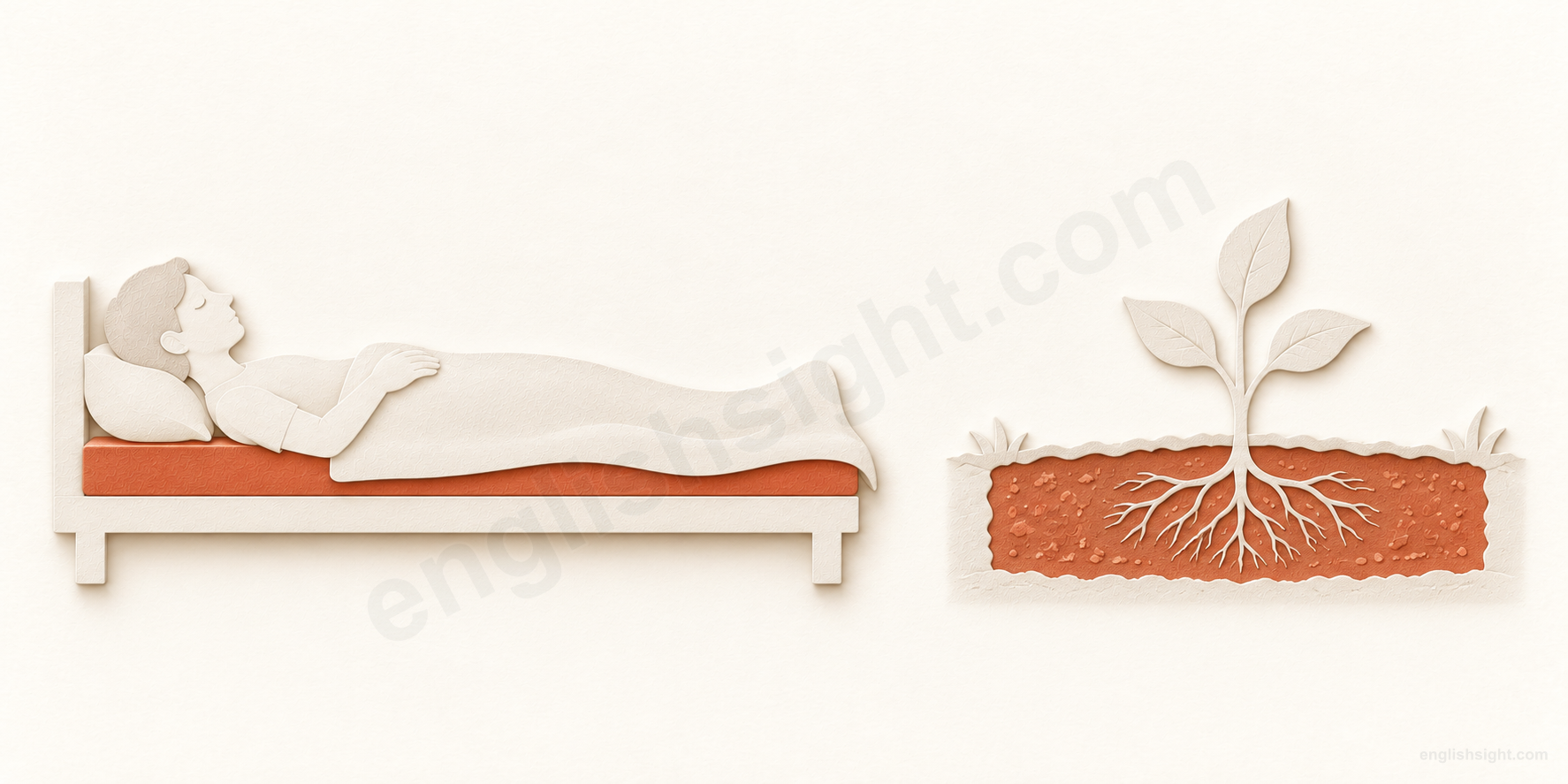
Follow bed from sleeping places to growing areas, supporting layers, and established expressions.
What rests on or in a base?
What rests on or in a base?
At left, a person rests on a mattress supported by a bed frame.
bed
At right, a plant grows with its roots inside a garden bed of soil.
The two examples compare supporting places; they do not show a change over time.
A person rests on a bed; a plant grows in a garden bed.
A bed can be a sleeping place, a growing area, or a layer beneath something. The useful connection is a place or base on or in which someone or something lies, rests, or grows.
The two examples show support and position, not an action changing from before to after. The connection organizes several noun meanings; it does not mechanically explain the idioms or every specialized use.
The most familiar bed is where someone lies down to sleep. English also uses bed for certain growing areas, bottoms, and layers. Notice what rests on the place, grows in it, or forms a base beneath something else.
This is a way to organize established uses, not a rule for inventing new ones. A chair, shelf, or ordinary floor does not become a bed just because it supports something. Idioms have their own meanings, and different speakers need not imagine the same picture.
01
Sleeping, getting up, and looking after a bed
Start with the familiar sleeping place. Articles and prepositions distinguish furniture from the activity of going to rest.
01
a / the / possessive + bed; number + beds
a bed / two beds
a place, usually a piece of furniture, for lying down to sleep
Situation or starting point
You need somewhere comfortable to sleep.
Meaning or resulting situation
A bed provides the sleeping place.
Bed names the whole sleeping place, not just one cushion or covering.
A bed usually includes a frame and mattress, with bedding added for comfort. A mattress is the padded part you lie on; a pillow supports your head. Bed is the ordinary name for the whole piece of furniture.
When counting furniture, use a bed and beds. A single bed is intended for one sleeper; a double bed is intended for two. A bed need not be conventional furniture: a dog’s bed or a temporary bed of blankets can serve the same sleeping function.
The head of the bed is the end where your head normally rests; the foot is the opposite end. These are parts of a bed, not parts of the person named by bed.
In a sentence
The small room has two beds and one desk.
Watch the difference Say two beds, not two bed. A bedroom is a room; it may contain more than one bed.
02
be / stay / lie in bed; sit / lie / put something on the bed
in bed / on the bed
resting in the sleeping place versus being on its surface
Situation or starting point
Maya has settled down for the night; her bag is on top of the covers.
Meaning or resulting situation
Maya is in bed, and the bag is on the bed.
In bed presents the resting situation; on the bed presents a surface or location.
In bed normally describes someone lying or resting there, often under the covers. It does not mean asleep: I’m in bed reading is natural. We normally use no article in this activity expression.
On the bed usually locates something on the surface, often on top of the covers: leave the coat on the bed. A person can sit or lie on the bed too. This is a useful contrast, not a rule that every in-bed situation must involve a blanket.
In my bed, in the spare bed, and in a hospital bed identify a particular sleeping place. Articles and possessives are possible when that identification matters; they are not simply banned after in.
In a sentence
Maya is reading in bed, and her bag is on the bed beside her.
Watch the difference Do not use on bed for the ordinary surface expression: say on the bed or on my bed.
03
go to bed; time for bed; before bed / before going to bed
go to bed / time for bed
begin the routine of going to the sleeping place to rest
Situation or starting point
You finish your evening activities.
Meaning or resulting situation
You go to your sleeping place, whether or not you fall asleep immediately.
Going to bed and falling asleep are different events.
Go to bed is an established no-article expression for retiring to rest. Bed does not name a town or a room here. Go to the bed instead can simply describe walking over to a particular piece of furniture.
I went to bed at ten but didn’t go to sleep until eleven is consistent: getting ready and lying down happened before sleep began. Fall asleep also names the start of sleep.
Time for bed and before bed use bed to refer to the sleep routine. Before going to bed has the same practical reference, with the activity expressed in full.
In a sentence
I went to bed early, but I read for an hour before I fell asleep.
Watch the difference For your usual sleep routine, say go to bed, not go to the bed or go to a bed.
04
get into / in bed; get out of bed; be out of bed
get into bed / get out of bed
enter or leave the resting position in a bed
Situation or starting point
The alarm rings while you are still lying down.
Meaning or resulting situation
You leave the bed and stand up.
Into marks entry; out of marks departure.
Get into bed describes moving into the place where you will lie or rest, often beneath the covers. Get in bed is also used, especially in American conversation. In bed describes the resulting situation.
Get out of bed describes leaving it. Out of bed can describe the resulting state: Are you out of bed yet? Stay in bed describes continuing to rest there.
These combinations contain the noun bed after a preposition; bed is not the verb. In get into bed, get has the tense: she got into bed, not she get into bedded.
In a sentence
When the alarm rang, I got out of bed and opened the curtains.
Watch the difference Keep of in out of bed. Get out the bed normally does not mean leave your sleeping place.
05
put + person + to bed; person + be put to bed
put someone to bed
help or arrange for someone to settle in bed for sleep
Situation or starting point
A child is ready to finish the day.
Meaning or resulting situation
A caregiver settles the child in bed.
The object is the person whose sleep routine you help with.
Putting a child to bed may include washing, changing clothes, reading, and settling the child down. The phrase describes the whole familiar caregiving task, not necessarily physically lifting the child.
Use put them to bed with a pronoun in the person’s position. The passive is possible: The children were put to bed early. The person is receiving help or being settled; bed remains a noun.
Put someone in bed can describe physically placing them there. Put someone to bed normally emphasizes the routine or purpose of resting. Neither expression guarantees that the person falls asleep immediately.
In a sentence
After the story, Jo put the children to bed.
Watch the difference Say put them to bed, not put to bed them. A problem as object creates a different, figurative expression.
06
make the / your / a bed; make up a bed / make a bed up; strip the bed
make the bed
arrange the bed coverings neatly or prepare them for sleeping
Situation or starting point
The sheets and covers are untidy.
Meaning or resulting situation
The bedding is arranged and ready.
Make concerns preparing the sleeping place, not usually building its frame.
Make the bed means arranging its sheets, blankets, duvet, and pillows. You can make your bed after getting up or make a bed ready for a guest. The object is the bed being prepared.
This use of make is a conventional household expression. It does not normally mean manufacture furniture; build a bed or assemble a bed frame makes that intention clearer.
Strip the bed means remove its sheets and other bedding for washing or replacement. The reverse tasks belong to one household routine, but strip does not mean dismantle the frame here.
Make up a bed means prepare a bed for use, including a temporary sleeping place: We made up a bed for our guest in the study. You can make up the spare bed or make the spare bed up; with a pronoun, use make it up. Here bed is the object of make up, not a verb.
In a sentence
Please make your bed before you leave for school.
Watch the difference Use make the bed for arranging the bedding; do the bed is not the usual neutral expression.
02
Places to stay and places for care
A bed can stand for somewhere to spend a night or for capacity to accommodate a guest or patient. These uses extend beyond counting pieces of furniture.
07
give / offer someone a bed for the night
a bed for the night
somewhere to sleep overnight
Situation or starting point
A visitor needs to stay overnight.
Meaning or resulting situation
A host offers a place to sleep.
Bed can stand for accommodation rather than a particular item for sale.
Offer someone a bed for the night means provide a sleeping place. The speaker may be offering a spare room or a simple temporary arrangement; the focus is shelter for sleeping.
Have a bed available can similarly describe availability in a hostel or other accommodation. Context decides whether you are counting sleeping places or discussing a piece of furniture.
A bed for the night is not the same as a bedroom for the night: the second explicitly promises use of a room. Do not assume that the first promises a private room.
In a sentence
If you miss the last train, we can offer you a bed for the night.
Watch the difference This offer concerns an overnight stay; it does not mean giving the guest ownership of a bed.
08
bed and breakfast (service); a bed and breakfast / a B&B (place)
bed and breakfast / a B&B
overnight accommodation with breakfast, or a place offering it
Situation or starting point
You compare places to stay during a trip.
Meaning or resulting situation
You choose accommodation that includes a morning meal.
The full expression names a service and can also name an establishment.
Bed and breakfast describes accommodation with a meal the next morning, often in a private house or small hotel. As a service, it is uncountable: The price includes bed and breakfast.
A bed and breakfast, often written a B&B, is a place providing that service. It is countable: We stayed at a B&B. This is a conventional compound, not an instruction to buy furniture and then eat.
Breakfast is the meal named by the expression. Do not assume that lunch or dinner is included; those details need to be checked separately.
In a sentence
We stayed at a small B&B near the station.
Watch the difference Use a with a countable establishment: a B&B. The service itself can appear without an article.
09
number + hospital beds; a shortage of beds
hospital beds
places available for patients to stay and receive hospital care
Situation or starting point
More patients need admission than the ward can accommodate.
Meaning or resulting situation
The report describes a shortage of beds.
Bed numbers can represent the capacity to accommodate people.
A hospital with a hundred beds can accommodate that number of patients as inpatients. The word uses the sleeping place to stand for a place in the institution, including the care associated with admission.
A shortage of hospital beds therefore usually concerns capacity for patients, not just a shopping list for furniture. A physical hospital bed is also a real object; context separates the two readings.
Hotels and similar institutions can also report their number of beds to indicate how many guests they can accommodate. Beds and rooms are not interchangeable counts.
In a sentence
The new ward will add twenty hospital beds.
Watch the difference Twenty beds does not necessarily mean twenty separate rooms.
10
stay / be confined to bed; take to possessive + bed; be on bed rest
stay in bed / take to your bed / bed rest
remain in bed to rest, often because of illness
Situation or starting point
Someone feels ill and stops their usual activities.
Meaning or resulting situation
They remain in bed rather than getting up.
Context adds illness; in bed alone does not mean ill.
Stay in bed says that a person continues to rest there. In bed with the flu names the illness; with is followed by a condition, not a companion in this example.
Take to your bed means go to bed and remain there because you are ill. It is less neutral in everyday conversation than go back to bed or stay in bed, but useful to recognize.
Bed rest is an uncountable noun for a period of resting in bed during recovery. On bed rest describes that situation. Confined to bed means unable or not permitted to leave it. These are descriptions of language, not recommendations about treatment.
In a sentence
Nina stayed in bed with the flu while her sister answered the door.
Watch the difference In bed with the flu means illness; in bed with a person can carry a different implication.
11
wet the / your bed
wet the bed
urinate accidentally while in bed
Situation or starting point
A child is asleep at night.
Meaning or resulting situation
The bedding becomes wet after an accident.
This established expression names an accident, not ordinary water spilling.
Wet the bed and wet your bed describe accidentally passing urine while sleeping or in bed. Wet is the verb and bed is its object; the phrase is commonly used when talking about children.
The associated noun is bed-wetting. The expression does not mean deliberately pouring water on the bed. To describe that ordinary event, say spilled water on the bed.
Use the phrase factually and sensitively. It describes what happened; it does not in itself say why the accident happened.
In a sentence
The little boy wet the bed during the night.
Watch the difference Wet bed by itself is not the full verb phrase. Use an article or possessive: wet the bed.
03
Growing areas, bottoms, and supporting bases
Outside the bedroom, bed names established kinds of areas, layers, and supporting surfaces. Ask what lies on the base, grows in the area, or is found at the bottom.
12
a flower / vegetable / raised bed; a bed of + plants
a flower bed / a vegetable bed
an area of ground used for growing plants
Situation or starting point
A gardener prepares one part of the garden for planting.
Meaning or resulting situation
Flowers or vegetables grow in that defined area.
The bed is the growing area, not a piece of bedroom furniture.
A garden bed is an area of soil used for particular plants. Flower bed and vegetable bed identify what is grown there. Plant flowers in a bed is natural because their roots go into the soil.
A bed of roses can mean a literal growing area containing rose plants. In Life isn’t a bed of roses, the same words form a separate idiom about ease and comfort.
A raised bed is a growing area whose soil is higher than the surrounding ground, often held within a border. The useful connection is an area that holds and supports growth, not a claim that plants sleep.
In a sentence
We planted carrots in the new vegetable bed.
Watch the difference A flower bed is an area for plants; a bed of flowers can describe an area or mass of flowers. Context matters.
13
the bed of a river / lake; the river bed / riverbed; the seabed
the river bed / the seabed
the ground at the bottom of a river or sea
Situation or starting point
Water flows above a layer of ground.
Meaning or resulting situation
You identify the ground beneath the water.
Bed names the bottom ground, even when the water has gone.
A river bed is the ground over which the river flows; the seabed is the bottom of the sea. A lake can have a bed too. These are established geographical uses of the base-layer idea.
The bed of a dry river is still its bed. The meaning identifies the ground’s relation to the river, not a requirement that it is always covered by water.
You may see riverbed and seabed written as single words. Do not confuse a riverbed with a waterbed, which is a kind of bed for sleeping with a water-filled mattress.
In a sentence
After the long drought, we could walk along the dry river bed.
Watch the difference The river bank is at the side; the river bed is at the bottom.
14
an oyster / mussel bed; beds of + plants / shellfish
oyster beds / beds of reeds
areas where particular shellfish or plants occur together
Situation or starting point
A group of oysters occupies one area underwater.
Meaning or resulting situation
That area is described as an oyster bed.
The living things characterize an area, not a sleeping platform.
An oyster bed or mussel bed is an area where many of those shellfish live or are cultivated. The expression names the area as well as the concentration of life there.
Beds of reeds similarly refers to areas or dense groups of those plants growing together. Here of identifies the organisms present; it does not say the bed is furniture made from them.
This is related to the growing-area meaning, but shellfish beds need not be a gardener’s prepared plot. Do not make preparation by people a rule for every bed.
In a sentence
The shallow bay contains several oyster beds.
Watch the difference The expression does not mean that one oyster has its own tiny sleeping bed.
15
on a bed of + material; lay something on a bed of + material
on a bed of rice / a bed of sand
on a layer of material that forms a base for something else
Situation or starting point
A layer of rice is spread on a plate.
Meaning or resulting situation
Food is placed on top of that layer.
The material after of forms the lower layer.
Serve fish on a bed of rice means put the fish on top of a layer of rice. The rice is the bed; the fish is what lies above it. Bed describes arrangement, not sleep.
The same established supporting-layer sense appears outside food: paving stones can rest on a bed of sand or concrete. The material forms a base underneath the objects.
Read the whole noun phrase. A bed of rice is a layer made of rice, whereas a flower bed is an area in which plants grow. The preposition of alone does not choose between all the senses.
In a sentence
The café serves roasted vegetables on a bed of rice.
Watch the difference In this example, rice is underneath the vegetables; bed does not name the plate.
16
a truck / pickup bed; the bed of a truck; put something in the truck bed
a truck bed / the bed of a pickup
the part of a truck where a load is carried
Situation or starting point
Someone needs to carry boxes in a pickup truck.
Meaning or resulting situation
The boxes are placed in the loading area behind the cab.
Here bed names a surface or area that supports cargo.
In American English, the bed of a truck is its load-carrying part or floor. On a pickup, this is the area behind the cab where people put tools, boxes, and other cargo.
Truck bed and pickup bed name this part of the vehicle. The cargo rests on its supporting surface; bed does not imply a mattress or a place intended for sleep.
With a pickup’s bounded loading area, in the truck bed is natural. On the bed can emphasize the supporting surface, particularly with a flatbed. Choose the preposition for the shape and location you mean.
In a sentence
We loaded the boxes into the bed of the pickup.
Watch the difference A truck bed is the loading part of the vehicle. A sleeping bed inside a camper is a different use.
17
a bed of + clay / rock; plural + beds
a bed of clay / rock beds
a distinct layer of clay, rock, or similar material in the ground
Situation or starting point
Different materials form layers underground.
Meaning or resulting situation
One particular layer is identified as a bed.
This is a geological layer, whether or not another object is placed on it.
A bed of clay can be one layer within a larger mass of ground or rock. This geographical or geological sense is useful when reading about landscapes, excavation, or rock formations.
Unlike a bed of rice on a plate, it does not imply that someone spread the material there. The layer may have formed naturally.
The shared teaching connection is an extended layer. This is a separate dictionary sense, so supporting another object is not a requirement in every example.
In a sentence
The workers found a thin bed of clay below the gravel.
Watch the difference Here bed means a layer of material, not a hole in the ground or a place for sleeping.
04
Settling down and fixing into place
Bed also works as a verb. Learn bed down and bed in as complete patterns, and distinguish them from a noun following an ordinary preposition.
18
bed down in / on + place; bed down for the night; bed + person + down
bed down for the night
settle in a place to sleep, often a temporary or unusual place
Situation or starting point
Travellers need somewhere to sleep without their usual beds.
Meaning or resulting situation
They arrange a temporary sleeping place and settle there.
Bed is now a verb; down belongs to the established phrasal verb.
Bed down often describes sleeping somewhere other than your usual sleeping place, such as a floor, barn, or shelter. A normal bed is not required. We bedded down on the floor is a complete clause with no person as object.
Bed someone down means provide or arrange a sleeping place for them: We bedded the visitors down in the spare room. With a pronoun, bed them down puts it between the verb and particle.
The verb forms are bed, beds, bedded, and bedding, with a doubled d. Compare went to bed, where went carries the tense and bed is a noun.
In a sentence
When the road closed, we bedded down on the village hall floor.
Watch the difference Bedded down means settled to sleep; it does not mean that a bed was pushed downward.
19
something beds in; bed something in / bed in something; bed it in
bed in / bed a new system in
become settled and work effectively, or help something do so
Situation or starting point
A new arrangement is still unfamiliar.
Meaning or resulting situation
It becomes established and works more smoothly.
This British use extends settling into place to people or systems.
A new system needs time to bed in means it needs time to become established and function effectively. This is especially British usage, often found in work or sports discussion.
You can also bed a system in or bed in a system: help it settle into operation. With a pronoun, use bed it in. The metaphor concerns becoming settled; nobody is sleeping in the system.
In the engineers bedded the stone in sand, in introduces the material holding a physical object. In the new system bedded in, in is part of a phrasal verb and no following material is required.
In a sentence
The new booking system will need a few weeks to bed in.
Watch the difference This sense is not a general substitute for sleep. Use ordinary settle in when describing arrival in a new home.
20
bed + object + in + material; object + be bedded in + material
bed something in sand / soil
set something firmly into material that holds it in place
Situation or starting point
An object or plant roots need a stable position.
Meaning or resulting situation
The surrounding material holds them firmly.
The verb expresses fixing into place; the material follows in.
Bed a stone in sand means set it into the sand so it sits firmly. Bed roots in soil similarly refers to positioning them securely. This verb is more typical of practical building or gardening instructions than everyday talk about going to sleep.
The passive is natural when the object’s position matters: The stones were bedded in sand. Bedded is the past participle; in sand tells you what surrounds or supports them.
Do not treat every occurrence of bed plus in as the same phrasal verb. Compare a system bedding in, which has an established figurative meaning about becoming effective.
In a sentence
The paving stones were bedded firmly in sand.
Watch the difference Bedded in is not the same as buried completely; part of the object may remain visible.
05
Established expressions and implied meanings
These expressions use shared associations with sleep, comfort, or closeness. Their meanings belong to the whole phrase and cannot be predicted from the drawing alone.
21
something is not / has not been a bed of roses
not a bed of roses
not an easy or pleasant situation
Situation or starting point
Someone expects an experience to be comfortable.
Meaning or resulting situation
The speaker points out its difficulties.
The whole phrase contrasts an imagined pleasant place with a difficult situation.
A bed of roses can literally mean an area of rose plants. In Running a shop isn’t a bed of roses, it is an idiom for a pleasant, easy life or situation.
The phrase often appears with not or never: it warns that there are difficulties. It does not necessarily mean that everything about the situation is bad.
This meaning is conventional. Imagining roses can help you remember it, but neither flowers nor the physical structure of a bed can predict every use.
In a sentence
Working for yourself is rewarding, but it isn’t a bed of roses.
Watch the difference Use a bed of roses for this idiom, not a bed of rose or a rose bed.
22
get up on the wrong side of the bed; get out of bed on the wrong side
get up on the wrong side of the bed
be in a bad mood for no obvious reason
Situation or starting point
Someone reacts irritably throughout the morning.
Meaning or resulting situation
Another person comments on the unexplained bad mood.
Wrong side is figurative, not a diagnosis about which side someone used.
Get up on the wrong side of the bed is the North American form recorded by Oxford. Get out of bed on the wrong side is the British form. Both refer to being unusually bad-tempered without an obvious reason.
The expression is informal and may be teasing. It can sound dismissive if the person has a real reason to be upset, so attend to the situation.
The person may have left the bed normally. The whole phrase carries the mood meaning; wrong does not identify a physically incorrect side of a bed.
In a sentence
You seem annoyed by everything—did you get up on the wrong side of the bed?
Watch the difference Do not interpret this as a request to move the bed or use the other side tomorrow.
23
you have made your bed and must lie in / on it
You’ve made your bed; now lie in it.
you must accept the consequences of your own choices
Situation or starting point
Someone chooses a course of action.
Meaning or resulting situation
They face a result they would prefer to avoid.
Making the bed stands for making the choice; lying in it stands for accepting its result.
The saying treats someone’s present situation as a bed they prepared for themselves. It tells them to accept responsibility for what follows from their actions.
You’ve made your bed and you must lie in it is a fuller version; lie on it is also recorded. The wording can sound severe or unsympathetic, especially when a person needs help.
Compare the ordinary household instruction I’ve made your bed. Without the saying’s context, that simply means I prepared the bedding for you.
In a sentence
“I bought the cheapest ticket without checking it. Now I can’t change the date.” “You’ve made your bed; now lie in it.”
Watch the difference This saying expresses a judgment about responsibility; it is not neutral practical advice about sleep.
24
put + issue / matter / task + to bed; put it to bed
put an issue to bed
resolve or finish dealing with something so it can be left alone
Situation or starting point
A question or dispute keeps coming back.
Meaning or resulting situation
People settle it and stop discussing it for now.
The object is an issue, task, or dispute rather than a sleeper.
Put something to bed is an informal expression, especially associated with British English, for dealing with it conclusively. Put the matter to bed can mean settle it so that it no longer needs attention.
It may echo the idea of settling something down, but its meaning comes from the whole expression. The object is not literally laid on a mattress. Put it to bed keeps the pronoun before to bed.
In journalism, put a newspaper or edition to bed has a more specific meaning: complete its preparation for printing. This is a recognized professional use, distinct from settling an argument.
In a sentence
Let’s agree on the final date and put this issue to bed.
Watch the difference An issue put to bed has been dealt with; it has not necessarily been forgotten or proved unimportant.
25
go to bed with + person; be in bed (sexual context)
go to bed with someone / in bed
in some contexts, refer indirectly to sexual activity
Situation or starting point
Adults discuss whether two people had a sexual relationship.
Meaning or resulting situation
A bed-related expression supplies an indirect reference.
The sexual implication comes from the established expression and context.
Go to bed with someone commonly means have sex with that person. In a discussion of sexual relationships, in bed can also refer to sexual activity rather than just someone’s resting location.
These expressions do not prove that a literal bed was involved. Equally, being in bed beside another person does not always imply sex: family care, illness, or an explicit sleeping arrangement can make the literal reading clear.
The bare verb bed someone has a sexual sense too, but Oxford labels it old-fashioned. Recognize it in older or stylized writing; go to bed with someone is the more useful everyday expression.
Get someone into bed can mean persuade that person to have sex with you. In a romantic plot, He hoped to get her into bed reports that intention; it does not say that she agreed. Helping a child get into bed has the ordinary sleeping-place meaning, so read the participants and context.
In a sentence
The novel hints that the two adults went to bed together after the party.
Watch the difference With a person and with an illness are different complements: in bed with the flu is about being ill.
26
be in bed with + person / organization
be in bed with an organization
cooperate closely with someone, often in a way the speaker distrusts
Situation or starting point
Two organizations are said to have unusually close ties.
Meaning or resulting situation
A critic describes them as in bed with each other.
Intimacy is a metaphor for a close, possibly secret alliance.
Be in bed with a company, government, or other group can mean cooperate very closely with it, especially secretly. It is informal and often carries criticism or suspicion.
An accusation that a regulator is in bed with an industry suggests an improper closeness. The phrase reports the speaker’s attitude; it does not itself establish that wrongdoing occurred.
For a neutral relationship, works with or cooperates with is clearer. This figurative use is separate from both sharing a physical bed and the sexual implication of go to bed with a person.
Get into bed with a company describes entering an arrangement to work together: The publisher refused to get into bed with a gambling company. This expression commonly conveys disapproval too. Be in bed with describes the relationship; get into bed with describes starting it.
In a sentence
Critics accused the committee of being in bed with the companies it was meant to supervise.
Watch the difference Do not use in bed with as a neutral substitute for every business partnership.
Read the article, preposition, and whole expression
One noun, several established families
Sleeping furniture, garden areas, water bottoms, and material layers are related teaching branches, not interchangeable labels. A bed of rice is a layer of rice; a bed of roses may be a literal planting area or a conventional idiom.
Articles depend on the use
In bed, go to bed, before bed, and time for bed normally have no article when they concern rest. A bed, the bed, and my bed identify or count sleeping places. Do not turn the no-article pattern into a ban on in my bed or in a hospital bed.
Noun phrases are not all phrasal verbs
In go to bed and put someone to bed, bed is a noun. In bed down and bed in, bed is a verb. Noun plural beds and verb forms bed, beds, bedded, bedding share spelling but perform different grammatical jobs.
State, action, and passive
Be in bed describes a situation; get into bed describes entry; go to sleep describes the start of sleep. The transitive verbs can have passives, such as The stones were bedded in sand and The children were put to bed. Wet the bed is normally used actively.
Scope and tone
The lesson covers the main modern noun families, useful sleep routines, and selected established expressions. It includes a little geological and practical vocabulary for recognition. Detailed machine, printing, anatomy, and engineering terminology, rare regional meanings, and a catalogue of every bed compound are outside its scope.
Choose the meaning that fits
Use the situation and the full expression, not just the word bed.
1. You leave a coat on top of the covers. Which sentence describes its location naturally?
2. You got into bed at ten, read until eleven, and then began sleeping. Which account fits?
3. The menu says fish is served on a bed of rice. Where is the rice?
4. A manager says, “Let’s put this dispute to bed.” What does the manager want?
5. A British colleague says, “The new system needs time to bed in.” What is meant?
6. A report says a regulator is “in bed with” an industry. What tone does that suggest?
Sources and teaching notes
The sources below were used to check meanings, constructions, and usage labels. Explanations, examples, and the diagram are original teaching material. The visual connection is a teaching model, not a claim about a shared mental image.
The diagram connects what rests or grows with its supporting place. It does not predict the meaning of every expression.