Name the insect, then recognize the expressions that go beyond it.
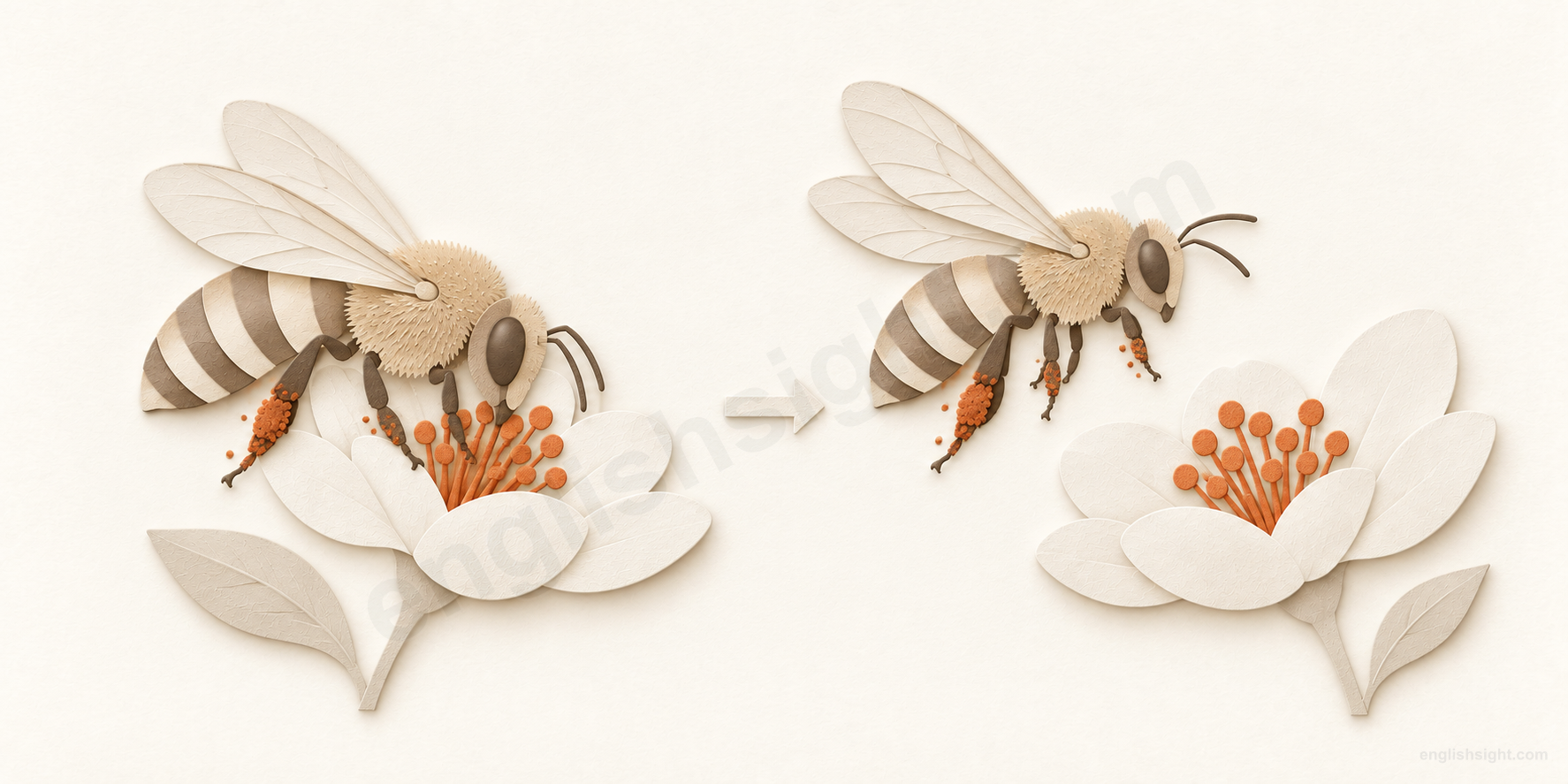
An insect visiting a flower
An insect and its relationship with flowers
A bee feeds at a flower.
bee
It flies toward another flower carrying pollen.
Pollen clings to its body and legs.
A bee visits flowers for food and can carry pollen between them. Event senses and idioms are learned separately.
A bee visits flowers to collect food; in doing so, it can carry pollen between flowers.
This concrete relationship helps identify the insect. It is not a rule that generates every idiom, and not every bee lives in a hive or makes honey.
Bee /biː/ is usually a countable noun for an insect that feeds on nectar and pollen. Honeybees are a familiar example, but bee is a wider category.
English also uses bee for some group events and in fixed expressions. These need their own explanations: a spelling bee contains no actual bees.
01
Talking about the insect
Count bees, describe their activity, and distinguish the insect from its sting, home, and kinds.
01
a bee; the bee; two bees; bees + plural verb
a bee / bees
one insect or more than one
Situation
You notice an insect on a flower.
What you mean
You identify it as a bee.
Bee names an animal; it does not describe an action.
Use a bee for one unspecified insect, the bee for an identifiable one, and bees for more than one. The bare plural bees can also refer to bees in general: Bees visit flowers.
Bee sounds exactly like be and the letter B, but the grammar and spelling differ. In A bee is outside, bee is a noun; in Be quiet, be is a verb.
In a sentence
A bee has landed on the yellow flower.
Watch the difference Say I saw a bee, not I saw bee. The regular plural is bees, pronounced /biːz/.
02
bees + buzz; bees + pollinate + flowers
bees buzz / pollinate flowers
describe sounds and flower visits
Situation
You hear a low sound near the flowers.
What you mean
You describe what the insects are doing.
The verb supplies the activity; bee identifies its participant.
Bees buzz describes their characteristic sound. A bee buzzed past my ear adds movement through past; buzz is the verb, not a special meaning of bee.
Bees feed on nectar and pollen. When they carry pollen between flowers, they help pollinate them. Visiting a flower and making honey are different processes.
In a sentence
We could hear bees buzzing among the flowers.
Watch the difference A buzzing sound alone does not identify a bee: other insects can buzz too.
03
a bee sting; a bee stung + person; person + was stung by a bee
a bee sting / be stung by a bee
name the injury or describe what caused it
Situation
A bee stings your hand.
What you mean
You explain the painful event.
Bee sting names the sting; by a bee identifies the insect in a passive clause.
In a bee sting, bee modifies the noun sting. In A bee stung me, stung is the past of the verb sting. The insect is the subject doing the stinging.
I was stung by a bee makes the affected person the subject. This is a passive of sting, not a passive form of bee. A bee can sting is a possibility, not a prediction that every bee will sting.
In a sentence
A bee stung me while I was opening the window.
Watch the difference Bee bite and bee sting are not interchangeable names for the same event; use sting for this familiar description.
04
a swarm of bees; bees swarm; keep bees
a swarm of bees / keep bees
describe a group or care for bees
Situation
Many bees have gathered near a tree.
What you mean
You name the group rather than one insect.
Swarm is the group noun; bees tells you its members.
A swarm of bees refers to a large group together. Bees swarmed around the branch uses swarm as a verb. Neither use means a group of people at a spelling competition.
Keep bees means care for bees, typically for honey or pollination. A beekeeper is the person doing this; a beehive, or hive, is a structure made for bees to live in. These related words name different things.
In a sentence
My neighbor keeps bees in two hives behind the orchard.
Watch the difference A hive is a home or structure; a swarm is a group of insects. Do not use one as a general substitute for the other.
05
a honeybee; a bumblebee; a solitary bee
honeybee / bumblebee / solitary bee
specify a kind of bee
Situation
You want to be more precise than bee.
What you mean
You name a kind with its own characteristics.
Bee is the broad category, not a synonym for honeybee in every context.
Honeybee identifies a bee that makes honey. Bumblebee names another familiar kind. A solitary bee does not live in the organized colonies familiar from honeybees.
Learner definitions often describe the familiar striped, honey-producing insect. Do not turn that convenient description into a claim that all bee species have identical colors or social lives. Bees and wasps are related insects, but the words are not synonyms.
In a sentence
The guide showed us a solitary bee nesting in a small hole.
Watch the difference Use bee for the general category and a more specific name when the distinction matters.
06
the queen bee; the queen bee of + group
queen bee
the egg-producing female, or a socially dominant woman
Situation
You read about a colony or a social group.
What you mean
The context determines whether the description is literal.
The compound has both an insect sense and a separate figurative use.
In a colony, the queen bee is the female that produces eggs for the group. Queen describes her reproductive role here; it is not a claim that she gives human-style orders.
Figuratively, a queen bee is a woman who behaves as the most important person in a place or group. It can sound critical. In She acts like the queen bee of the club, the club supplies the human social setting.
In a sentence
The beekeeper pointed out the queen bee inside the hive.
Watch the difference Calling someone a queen bee is not a neutral professional title or an automatic compliment.
02
People gathering for an activity
Especially in North American English, bee can name an organized group activity. The word before bee tells you what people do.
07
a quilting / sewing bee; hold / organize + a bee
a quilting bee / a sewing bee
a gathering to do a shared task
Situation
Neighbors bring fabric and sewing equipment.
What you mean
They work together at a social gathering.
This bee is an event, not an insect.
Especially in North American English, a bee is a gathering for a particular activity. Quilting bee and sewing bee name meetings where people work together on those tasks.
This is a separate dictionary use, not a rule that any busy event can be called a bee. Learn established combinations instead of replacing meeting with bee everywhere.
In a sentence
The neighbors organized a quilting bee at the community hall.
Watch the difference In this context, quilting identifies the activity; bee names the gathering.
08
enter / compete in / win + a spelling bee
a spelling bee
a competition in spelling words
Situation
Children take turns spelling words aloud.
What you mean
They compete to spell correctly.
Spelling identifies the contest; bee supplies the event sense.
A spelling bee is a spelling competition, especially familiar in North American school settings. A participant can enter it, compete in it, or win it.
Spelling is part of the compound noun here. It does not mean that a bee is learning to write, and it is not an -ing form describing an insect.
In a sentence
Maya won the school spelling bee on Friday.
Watch the difference Use a spelling bee for the event, not a bee spelling.
03
Comparisons and fixed expressions
Some expressions draw on activity or social roles; others have conventional meanings that cannot be read literally.
09
be + (as) busy as a bee; be + a busy bee
as busy as a bee / a busy bee
very busy, or a person with many tasks
Situation
A friend has been cooking and cleaning all morning.
What you mean
You describe that person’s activity informally.
The comparison borrows the image of an active insect.
As busy as a bee describes someone as very busy. The first as may be omitted: busy as a bee. It is a comparison, not a statement about the person’s species.
A busy bee is a person who works hard or has many things to do. You’ve been a busy bee! can be friendly or playful; tone and context matter.
In a sentence
You’ve been a busy bee getting everything ready for the party.
Watch the difference A busy bee is a noun phrase for a person; as busy as a bee describes how busy someone is.
10
have / have got + a bee in + possessive + bonnet + about + topic
have a bee in your bonnet about something
keep returning to an idea you feel strongly about
Situation
Someone brings up the same complaint again.
What you mean
You describe their persistent preoccupation.
The whole idiom means a recurring concern or idea.
Have a bee in your bonnet about something means think or talk about it repeatedly because you consider it important. It can suggest that other people find the concern excessive.
Change the possessive to match the person: I’ve got a bee in my bonnet; she has a bee in her bonnet. Collins notes that the expression is old-fashioned in American English. No actual bonnet is required.
In a sentence
He has a bee in his bonnet about the new parking rules.
Watch the difference This does not simply mean being busy or having any passing idea. Learn the full phrase.
11
person / thing + be + the bee’s knees
the bee’s knees
an excellent person or thing
Situation
You enthusiastically praise a new device.
What you mean
You say it is exceptionally good.
This fixed expression is praise, not insect anatomy.
The bee’s knees means an excellent person or thing. It is informal, and can sound playful or old-fashioned; Collins labels its American slang use old-fashioned.
The object being praised can be singular or plural: This camera is the bee’s knees; These headphones are the bee’s knees. The fixed expression itself stays the same.
In a sentence
These new headphones are the bee’s knees.
Watch the difference Keep the and the possessive bee’s. Bees’ knees would literally refer to the knees of multiple bees.
12
tell someone about / talk about + the birds and the bees
the birds and the bees
a humorous indirect reference to facts about sex and reproduction
Situation
Someone mentions a parent’s explanatory talk.
What you mean
The phrase refers indirectly to sex education.
The meaning belongs to the complete expression.
The birds and the bees is a humorous or indirect expression for basic facts about sex and reproduction, especially when explained to children.
In a story about a family conversation, a talk about the birds and the bees can mean that topic. In a nature report, the same words may literally name animals; context decides.
In a sentence
The novel includes an awkward talk about the birds and the bees.
Watch the difference Do not infer this meaning from bees alone, or use the euphemism when precise scientific wording is needed.
Keep the insect and the expression distinct
Forms and grammar
Bee is a countable noun: a bee, bees. Bee’s marks a singular possessive; bees’ marks a plural possessive. In bee sting, bee is a noun modifier, not a possessive. The ordinary lesson has no bee verb, particle verbs, or causative family; passive examples belong to verbs such as sting.
Nature is broader than the familiar honeybee
The picture shows one recognizable bee visiting one flower. It does not imply that every bee is striped, social, honey-producing, or capable of stinging in the same way.
A teaching image has limits
Activity helps motivate the busy-bee comparison, but the event sense and fixed idioms must be learned in context. The picture is a teaching aid, not a claim about what every native speaker visualizes.
Read the whole expression
Choose the meaning or form that fits each situation.
1. You saw exactly one insect. Which sentence is complete in ordinary English?
2. Maya entered a spelling bee. What did she enter?
3. Lee keeps raising the same issue and feels very strongly about it. Which expression fits?
4. You want to name the injury caused by one bee, using bee as a noun modifier. Which form fits?
Sources and teaching notes
Dictionary meanings and usage labels were checked against the sources below. Explanations and examples are original; the diagram illustrates the insect sense and does not derive the idioms.
This diagram helps explain a connection; it is not a picture shared by every native speaker.