Place an event earlier, an item ahead, or a matter in front of someone.
On the earlier side of a reference point
On the earlier side of a reference point
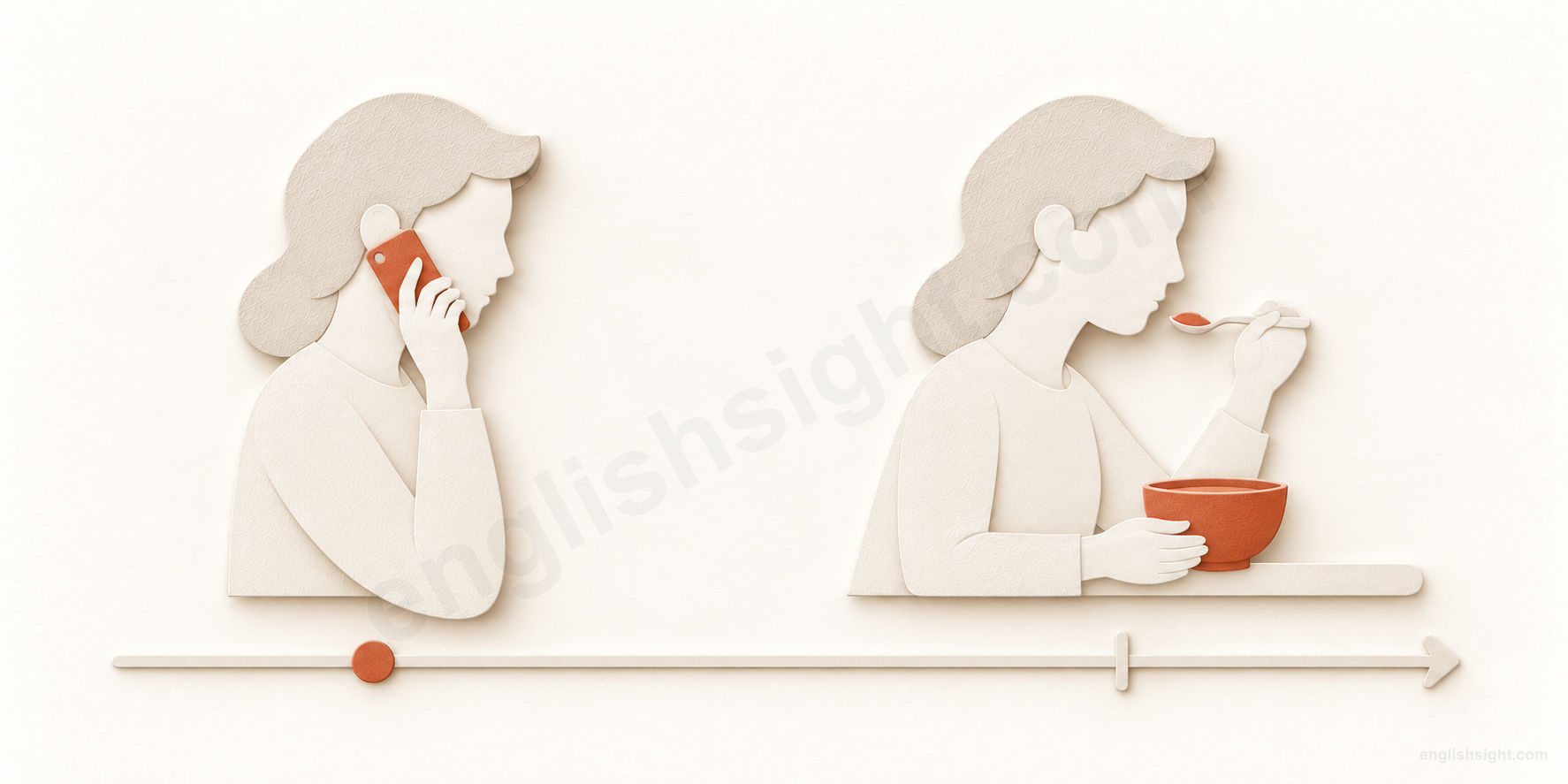
She makes a phone call first.
before
Lunch is the later reference event.
Time moves from the call toward lunch.
She calls before lunch. The arrow shows time order, not cause.
Find the reference first. Then ask whether before expresses time, order, or presence.
The arrow orders two points; it does not mean that one event causes the other. Formal presence and future-facing uses need their own context.
Before relates something to a reference point. In time, it usually puts an event earlier than that point; in an ordered list, it puts an item ahead. Other uses concern presence, responsibility, or what lies ahead.
The sketch is a memory aid for ordering. It does not explain every fixed expression or describe a picture shared by all native speakers.
01
Time and reference points
Use a noun, a clause, or context to supply the reference. Word order can change the meaning of a phrase.
01
before + noun / pronoun; duration + before + reference
before lunch
earlier than a named time or event
Situation / first point
Lunch is the reference event.
Reference / interpretation
The file is sent earlier.
Before compares times; it does not specify a continuous activity.
The noun names the reference: before lunch, before dark, before me. Before me can mean earlier than I do; it need not be spatial.
Two hours before lunch measures the gap. Just before means a short gap. Before tax refers to an amount at the stage preceding tax deductions.
In a sentence
Please send the file before lunch.
Watch the difference Before noon excludes noon itself; by noon normally includes that deadline.
02
before + subject + verb
before I leave
earlier than the event in a clause
Situation / first point
Calling and leaving are planned.
Reference / interpretation
The call comes first.
The clause supplies the reference event.
Before I leave has its own subject and verb. It can come first: Before I leave, I’ll call you. Sentence order does not change event order.
For an ordinary future time clause, use leave, not will leave. A past narrative uses past forms: I called before I left.
In a sentence
I’ll call you before I leave.
Watch the difference Do not use before to plus a verb: say before I leave or before leaving.
03
before + -ing; before being + past participle
before leaving
do one action earlier than another
Situation / first point
You are about to leave.
Reference / interpretation
You check the windows first.
The understood subject normally matches the subject of the main clause.
Before leaving usually means before you leave in this instruction. If a different person leaves, name them in a full clause.
Before being published, the report was checked describes a passive event: the report receives the action. Before itself is not a passive verb.
In a sentence
Check the windows before leaving.
Watch the difference Use before leaving, not before leave; avoid making the windows the implied person leaving.
04
verb + before; ever / never + perfect + before
have done it before
on an earlier occasion
Situation / first point
You are describing your experience.
Reference / interpretation
There was no earlier occasion of using it.
The reference is understood from context.
Before can stand alone as an adverb. Have you been here before? asks about earlier experience; it does not name an exact date. Things are better than before compares now with an earlier situation; as before means in the same way as earlier.
Two years ago counts back from now; two years before counts back from a stated or understood time. Beforehand means in advance of an event and is a separate word.
Informally, I’ve been there before can mean that I understand a situation from experience, without referring to a literal place. I’ve heard it all before can dismiss familiar promises or excuses as unconvincing. Before marks earlier experience; the full expressions supply these conversational meanings.
In a sentence
I’ve never used this machine before.
Watch the difference Use the past simple with an exact finished time: I used it yesterday. Before does not always require a perfect tense.
05
the day / night / week before; the day before yesterday
the day before
a period earlier than a reference date
Situation / first point
Friday is the date being discussed.
Reference / interpretation
Her arrival was on Thursday.
The reference can be in a story rather than today.
The day before means the previous day relative to the time under discussion. The night before works in the same way.
The day before yesterday is two days back from today. The week before last is the week preceding last week.
In a sentence
We arrived on Friday; she had arrived the day before.
Watch the difference Do not automatically translate the day before as yesterday; first locate the reference day.
06
before long; long / shortly / just before + reference
before long / long before
soon, versus much earlier
Situation / first point
The children go to bed.
Reference / interpretation
They fall asleep after a short time.
Changing the word order changes the reference.
Before long means soon, in a past story or a future prediction. Long before means much earlier than a reference: They had left long before we arrived.
Shortly before and just before describe a short interval earlier than a reference, not soon after the present moment.
In a sentence
Before long, the children were asleep.
Watch the difference Before long and long before are not interchangeable.
07
not before + time; not … before + clause
not before nine
exclude a time earlier than the limit
Situation / first point
There is an earliest opening time.
Reference / interpretation
Earlier opening is ruled out.
Negation changes an earlier-than relation into a lower limit.
Not before nine means no earlier than nine; it does not promise opening exactly at nine. I didn’t see it before Tuesday says no earlier sighting occurred.
By nine gives a latest deadline. Until nine describes continuing up to nine: Keep the doors closed until nine.
In a sentence
Do not open the doors before nine.
Watch the difference Before, by, and until are not freely interchangeable.
02
Waiting, prevention, and necessary steps
The whole construction tells us whether an event is delayed, prevented, required, or rejected.
08
it is / was + duration + before + clause; it won’t be long before…
It was an hour before…
time passes until an event happens
Situation / first point
You start waiting for a bus.
Reference / interpretation
The bus comes an hour later.
The duration measures the wait, not how early the bus is.
It was an hour before… means an hour passed first. It won’t be long before… predicts a short wait. Only a matter of time before… presents the event as expected eventually.
And not before time! means something should have happened sooner. It expresses impatience or criticism; it is not the neutral earliest-time pattern not before nine.
In a sentence
It was an hour before the bus came.
Watch the difference Read the whole it was … before construction; do not reverse the order.
09
imperative + before + clause; before + subject + could + verb
before it breaks / before I could…
act while there is still time
Situation / first point
The battery may run out.
Reference / interpretation
You are urged to save the work first.
The later event may be feared rather than guaranteed.
A warning with before asks for action soon enough to avoid trouble. It does not assert that the battery will certainly die. Before I forget, … introduces something you want to mention while you still remember it.
Before I could answer, she left means she left while I had not yet had the chance to answer. It may imply the answer never happened.
In a sentence
Save a copy before the battery dies.
Watch the difference A before-clause does not always report an event that actually happened.
10
must / need to + verb + before + subject + can + verb
before you can…
complete a necessary step first
Situation / first point
The file is available to signed-in users.
Reference / interpretation
Signing in makes downloading possible.
Necessity comes from the full statement and the situation.
Before orders the steps; need to and the access rule establish the requirement. A simple sentence with before need not express necessity.
Compare I had tea before I downloaded it: tea is merely earlier, not a download requirement.
In a sentence
You need to sign in before you can download the file.
Watch the difference Do not treat every before-clause as an if-condition.
11
would + verb + before + clause / -ing
I’d resign before…
reject an alternative very strongly
Situation / first point
Someone wants you to conceal a mistake.
Reference / interpretation
You say you would choose resignation instead.
This established use ranks unacceptable alternatives.
Before can mean rather than in a forceful declaration. The sentence expresses refusal, not a prediction that both events will happen in order.
The wording is emphatic and can sound dramatic. I would rather resign than hide it is a more explicit comparison.
In a sentence
I’d resign before I agreed to hide that mistake.
Watch the difference Ordinary temporal before and this emphatic preference use need different readings.
03
Order, priority, and presence
Before also orders items and values, places people in front of others, and presents matters for attention.
12
come / go before + item; before + landmark
A comes before B
earlier in an order or along a route
Situation / first point
You follow the road toward the bridge.
Reference / interpretation
You reach the pharmacy first.
A direction of travel or ordering rule supplies the reference.
A comes before B in the alphabet concerns order, not clock time. Your name is before mine concerns positions on a list.
On a route, before the bridge means before you reach it. Approaching from the opposite direction can change which place comes first.
In a sentence
The pharmacy is just before the bridge on your right.
Watch the difference Before is not a fixed compass direction.
13
put + A + before + B; A comes before B
put safety before speed
treat one thing as more important
Situation / first point
Speed and safety may conflict.
Reference / interpretation
Safety gets priority.
The order is a ranking of values.
Put A before B means give A greater importance. A comes before B presents the same priority without naming the person making it.
Before anything else can introduce the first or most important concern. Context distinguishes practical sequence from importance.
In a sentence
We put safety before speed.
Watch the difference Before does not itself mean prefer in every context; list order alone need not show value.
14
stand / sit / kneel + before + noun
stand before a door
be physically in front of something
Situation / first point
She is near the entrance.
Reference / interpretation
Her position is in front of the door.
This spatial use is relatively formal or literary.
Before a door can locate a person in front of it. In front of the door is usually the more neutral everyday wording.
Before the house could also mean earlier than the house in a suitable context. The verb and situation decide the reading.
In a sentence
She stood before the open door.
Watch the difference For an ordinary seat ahead of yours, in front of me is clearer than before me.
15
appear before + authority; bring + person + before + authority; matter + be before + body
appear before a judge
be present for a hearing or under consideration
Situation / first point
A proposal has been submitted.
Reference / interpretation
The committee is considering it.
Before marks whose attention or authority is involved.
Appear before a judge concerns a hearing; be brought before a judge can be passive because bring is a verb. Put or lay a proposal before a committee means present it for consideration.
Perform before an audience means perform in their presence. Before my very eyes emphasizes that I personally witnessed it; it does not mean earlier than my eyes.
A proposal can also go before a committee: it is presented for discussion or a decision. This is different from coming before another item in a list.
In a sentence
The proposal is now before the committee.
Watch the difference A matter before a committee need not be physically placed in front of its members.
16
have + task / time + before + person; lie before + person
have a task before us
face something still ahead
Situation / first point
The week has not yet been lived through.
Reference / interpretation
Its challenges lie ahead of us.
The person faces the future as if facing a path.
A task before us is something we still need to do. A whole summer lay before her describes time she still had available.
Here before us can point to the future, unlike before Monday, which points to a time earlier than Monday. The complement changes the relation.
In a sentence
We have a difficult week before us.
Watch the difference Do not read every use of before as past time.
04
Familiar expressions to learn together
These phrases add established meanings. Keep their wording and read the situation rather than translating word by word.
17
before + person + know / knew + it / where-clause
before you know it / where you are
very quickly or suddenly
Situation / first point
Events move faster than you follow.
Reference / interpretation
You suddenly find yourself back at the station.
The whole expression emphasizes the speed of events.
This idiom says events happened very quickly or unexpectedly. It does not necessarily describe being lost or not knowing your location.
Person and tense can change: before you know where you are, before we knew where we were. Learn the whole expression, not a special meaning of before alone. Before you know it is another familiar form: I’ll be back before you know it.
In a sentence
We were back at the station before we knew where we were.
Watch the difference This is an idiomatic exaggeration, not a literal test of geographical knowledge.
18
be before + possessive + time; age / die before + possessive + time
before my time
earlier than your experience, or earlier than normally expected
Situation / first point
The show belongs to an earlier period.
Reference / interpretation
You were not around to know it then.
The possessive makes a person’s life or experience the reference.
Before my time can mean before I was born, could remember, or joined an organization. In the radio-show example, it refers to my experience, not to advanced ideas.
Age or die before your time means prematurely. For advanced ideas, ahead of your time is the clearer established expression; context matters.
In a sentence
That radio show was before my time.
Watch the difference Do not confuse a person’s earlier life boundary with the idea of being ahead of an era.
19
put the cart before the horse
put the cart before the horse
do things in the wrong practical order
Situation / first point
A booking is made while the budget is unsettled.
Reference / interpretation
A necessary earlier decision has been skipped.
The full idiom criticizes an order of actions.
A horse normally pulls a cart; the reversed arrangement is the memory image. The idiom means doing a later step before a step that ought to come first.
It can criticize planning even when no horse, cart, or movement is involved. Before still orders the items; the whole image supplies the judgment.
In a sentence
Booking the venue before agreeing on a budget is putting the cart before the horse.
Watch the difference Use the established wording with the: the cart before the horse.
20
look before you leap
look before you leap
consider risks before acting
Situation / first point
You are about to commit to an agreement.
Reference / interpretation
You are advised to examine the consequences first.
The proverb turns an earlier action into advice.
Looking before jumping is a memorable image for checking risks before a decision. The advice applies to purchases, plans, and commitments without any actual jump.
Before provides the sequence. The full proverb, not before alone, supplies the warning to think carefully.
In a sentence
Read the contract carefully—look before you leap.
Watch the difference This is general advice, not an instruction that you must physically jump afterward.
Choose the construction, not just a translation
Three main grammatical jobs
Before /bɪˈfɔː(r)/ is normally a preposition before a noun or -ing form, a conjunction before a clause, or an adverb with an understood reference. These uses have no verb tense, passive, or separable particle pattern of their own.
Limits of the sketch
Earlier does not mean better or more important. Priority, presence, and future tasks require their own contexts. Other longer proverbs, less common literary uses, and compounds such as before-and-after are outside the main teaching units.
Choose the intended relation
Find the reference and check the whole construction.
1. You will phone first, and then leave. Which sentence is the normal future time-clause pattern?
2. You expect an answer soon. Which phrase fits?
3. The doors must stay closed until nine. Which instruction gives that earliest opening time?
4. The case is before a committee. What is the intended meaning?
Sources and teaching notes
Dictionary meanings and patterns were checked against the sources below. Explanations, examples, and the diagram are original teaching material; the visual connection is a memory aid.
This diagram supports learning; it is not a mental picture shared by every native speaker.