Behavior names a way of acting or responding in a situation, from everyday conduct to the operation of a system.
A situation, and a way of responding
A situation, and a way of responding
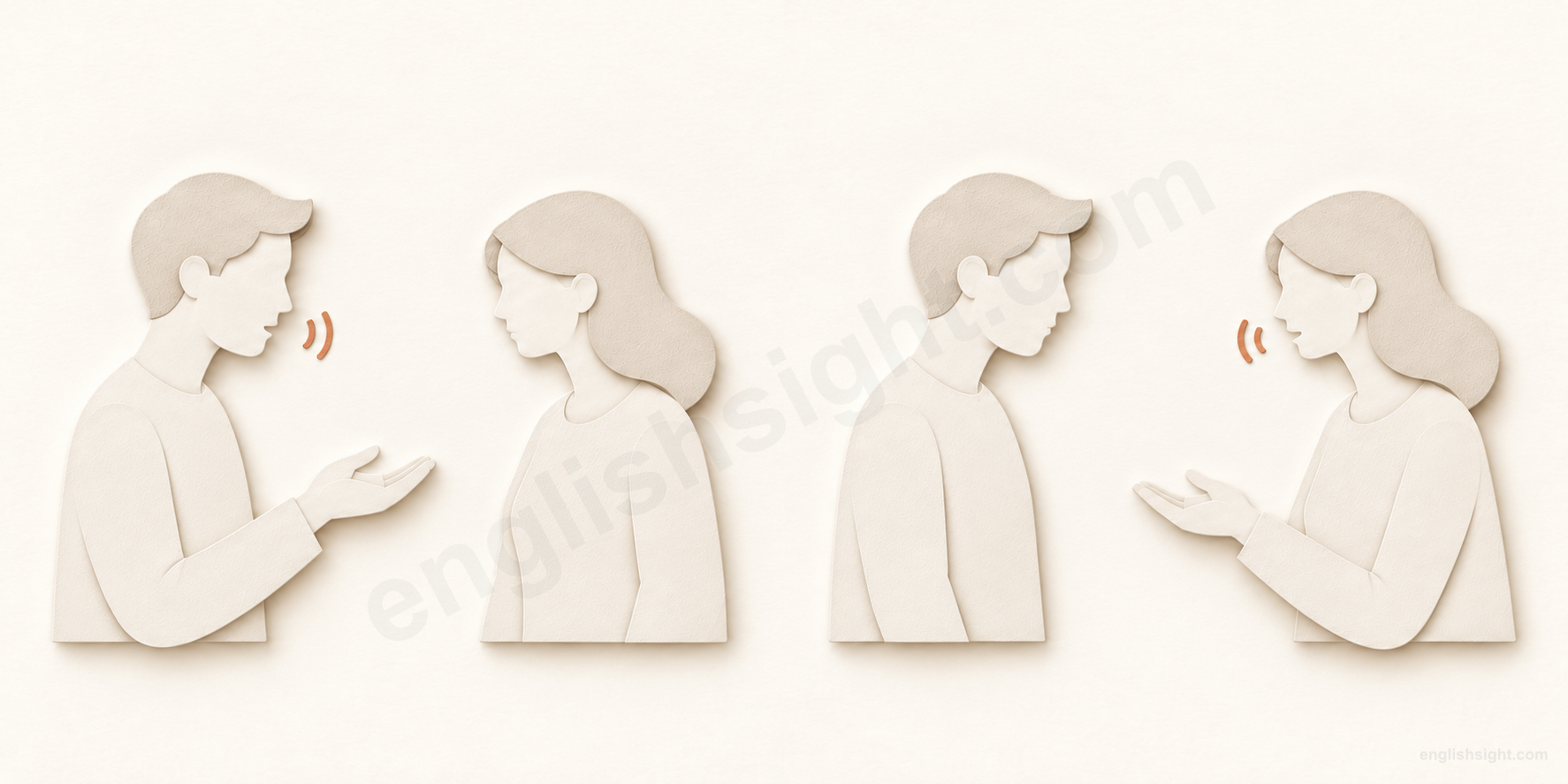
The man speaks while the woman listens.
behavior
The woman speaks while the man listens.
They switch speaking and listening roles.
Taking turns is one example of behavior: how people act and respond.
Behavior is the way someone or something acts or responds in a situation.
For people, behavior often concerns how they act toward others. For animals, materials, or systems, it can describe responses or functioning without any idea of manners, intention, or moral judgment.
You can hear someone interrupt, see a dog hide, or notice a program stop responding. Behavior lets you talk about how a person, animal, or thing acts in the circumstances. It does not tell you by itself whether that behavior is good or bad.
Behavior is the usual American spelling; behaviour is the usual British spelling. They are the same noun, pronounced /bɪˈheɪvjər/ in American English and /bɪˈheɪvjə(r)/ in British English. This lesson uses behavior in its examples.
The picture offers one example of behavior: two people taking turns in a conversation. It is a teaching aid, not a claim that all English speakers share one mental picture.
01
Talking about everyday conduct
Name someone’s behavior, identify who it affects, evaluate it, and use an established expression for especially careful manners.
01
possessive + behavior; behavior at + event / place
someone’s behavior
the way a person acts on an occasion or more generally
Situation
You remember how a guest acted during a meal.
What happens / what you notice
You comment on the way the guest acted.
The noun describes conduct rather than naming the person’s identity.
Someone’s behavior packages the way that person acts as a noun phrase. It can refer to a single occasion, such as behavior at dinner, or to conduct over time, such as behavior at work.
Behavior is normally uncountable in this everyday use: her behavior is, not her behaviors are. Use an action or something she did when you need to identify one separate act.
Compare Her behavior was strange with She behaved strangely. The first uses a noun and an adjective; the second uses the related verb behave and an adverb.
In a sentence
His behavior at dinner surprised everyone.
Watch the difference Say His behavior surprised me, not His behave surprised me.
02
someone’s behavior toward / towards + person
behavior toward someone
how someone acts in relation to another person
Situation
A colleague speaks sharply to you.
What happens / what you notice
You describe how that colleague treats you.
Toward names the person the conduct is directed at.
His behavior toward me identifies me as the person affected by his conduct. Towards is also correct and is especially common in British English; toward is especially common in American English.
Compare the behavior of the staff: of the staff identifies whose behavior it is. The staff’s behavior toward visitors identifies both the people acting and the people they act toward.
The preposition does not create a new sense of behavior. It supplies the relationship: who acts toward whom.
In a sentence
I was upset by his behavior toward the new assistant.
Watch the difference Use toward or towards for the person affected, rather than His behavior of the assistant.
People talk loudly while others are trying to listen.
What happens / what you notice
You judge the disruption unacceptable.
The adjective contributes the evaluation; behavior itself is neutral.
Good or bad behavior evaluates conduct. Rude, aggressive, disruptive, responsible, and unacceptable specify different qualities; they are not interchangeable names for one fixed type.
Disruptive behavior interferes with an activity. Aggressive behavior can involve threatening or attacking. Antisocial behavior is conduct that harms or seriously annoys others; in public-order contexts it is stronger than simply preferring to be alone.
Show or display behavior reports that a quality appears in someone’s actions. Exhibit behavior is a more formal alternative. This is not normally do good behavior; say show good behavior or behave well.
In a sentence
The school does not accept aggressive behavior toward other students.
Watch the difference Criticizing behavior does not automatically describe someone’s permanent personality.
04
be + on + possessive + best behavior
be on your best behavior
make a special effort to behave politely and properly
Situation
You are about to meet someone you want to impress.
What happens / what you notice
You take particular care over your manners.
On your best behavior is an established expression, not a physical position.
Be on your best behavior means behave as politely and properly as you can. It often appears before an important visit, meeting, or social occasion.
Change the possessive to match the person: I’m on my best behavior; the children were on their best behavior. Be on your best behavior! can be a direct instruction.
The expression concerns careful conduct, not being the most talented person or improving a machine’s performance. Its full meaning and the preposition on should be learned together.
In a sentence
We were on our best behavior when we met her grandparents.
Watch the difference Keep on and the possessive: on my best behavior, not in best behavior.
05
a code of behavior; standards of behavior; behavior + problems / issues
a code of behavior
a set of expectations about how people should act
Situation
A club agrees on rules for its members.
What happens / what you notice
The rules specify expected conduct.
Of behavior tells us what the code regulates.
A code of behavior is a set of rules or standards for conduct. Behavior stays uncountable: the countable noun is code. Standards of behavior similarly names expectations about conduct.
Behavior problems or behavior issues are difficulties involving how someone acts. Here behavior is a noun used before another noun; problems or issues carries the plural ending.
A rule can define unacceptable behavior without explaining why it happens. Keep the expected standard separate from claims about motives.
In a sentence
The club has a code of behavior for all members.
Watch the difference The article belongs to code: a code of behavior does not make behavior countable.
02
Changing and identifying patterns
Describe a change, a repeated pattern, or a distinct type of behavior. These choices explain when the noun stays uncountable and when a plural is useful.
06
change / control / influence + behavior; a change in + behavior
change / control / influence behavior
alter, regulate, or affect the way someone acts
Situation
A child repeatedly interrupts a group activity.
What happens / what you notice
Adults try to help the child act differently.
The verb tells us what happens to the behavior.
Change your behavior means begin acting differently. A change in behavior names the difference as a noun. Improve behavior adds the judgment that the new conduct is better.
Control your behavior means regulate how you act. Influence someone’s behavior means affect it; influence does not guarantee complete control or the result you want.
Encourage or reward good behavior describes ways of supporting it. In these combinations, behavior supplies what is changed or encouraged; the other verb supplies the intervention.
In a sentence
Clear routines can help children control their behavior in class.
Watch the difference Influencing someone’s behavior does not mean forcing a particular result; influence is not complete control.
07
a pattern of behavior; behavior patterns; learned behavior
a pattern of behavior
a recurring way of acting across occasions
Situation
Someone repeatedly leaves a task unfinished when it becomes difficult.
What happens / what you notice
You notice the same response occurring again.
Pattern marks recurrence; behavior alone does not always imply repetition.
A pattern of behavior connects actions across occasions. One surprising action can be part of someone’s behavior on a particular day, but calling something a pattern normally suggests recurrence.
Behavior patterns is an alternative order: behavior classifies the patterns. In patterns of behavior and behavior patterns, patterns is the countable noun.
Learned behavior is acquired through experience rather than being described as inborn. A pattern may be learned, but the phrase pattern of behavior by itself does not explain its cause.
In a sentence
We noticed a pattern of behavior: he stopped working whenever a task became difficult.
Watch the difference One isolated event is not enough on its own to establish a recurring pattern.
08
a / an + adjective + behavior; number + behaviors
a behavior / different behaviors
a distinct type or recurring pattern of acting
Situation
Researchers separate several kinds of response.
What happens / what you notice
They describe each kind as a behavior.
The countable use identifies distinguishable types, rather than conduct as a whole.
Behavior is not always uncountable. A behavior or several behaviors can refer to identifiable types or repeated patterns of acting, especially in research, health, psychology, and education.
Compare We studied their behavior, a broad subject of observation, with We identified three behaviors, a classification into three distinguishable types. Both can be correct, but they organize the information differently.
In everyday conversation about one person’s manners, His behavior was rude is the usual choice. For one concrete act, He did something rude is often clearer than He did a behavior.
In a sentence
The study identified two learned behaviors in the dogs.
Watch the difference Use the plural after two: two behaviors. Do not impose a blanket rule that behavior can never be countable.
03
Observing people, animals, and systems
Behavior extends beyond manners. It can describe how groups choose, how animals respond, and how something functions under particular conditions.
09
human / animal behavior; the behavior of + person / animal
human / animal behavior
how people or animals act and respond
Situation
You observe how birds respond when people approach.
What happens / what you notice
You describe their actions without judging their manners.
In an observational context, behavior can be a neutral object of study.
Human behavior and animal behavior name broad subjects of observation. The behavior of birds narrows the subject to the animals being studied.
Hiding, approaching, feeding, and interacting can all contribute to a description of behavior. The term does not require deliberate choice, and animal behavior does not mean an animal’s politeness.
Context decides whether you are describing one response or a broader pattern. The core idea remains how the organism acts in its circumstances.
In a sentence
The children watched the birds’ behavior as people approached the nest.
Watch the difference Do not assume behavior means misconduct: neutral scientific observation is an ordinary use.
10
consumer / buying / online + behavior
consumer behavior
how people choose, buy, or use goods and services
Situation
A shop wants to know how customers make choices.
What happens / what you notice
It examines purchasing patterns and responses.
Consumer identifies the people and activity being studied.
Consumer behavior is how people act as buyers or users, including their choices and purchasing habits. It need not describe whether they are polite in a shop.
The noun consumer classifies the behavior. This is a transparent compound, not a separate idiom or a phrasal verb. Online behavior works similarly when describing what people do online.
A survey about people’s opinions measures what they report thinking. Their actual buying behavior concerns what they do; the two may differ.
In a sentence
The shop studies consumer behavior before changing its prices.
Watch the difference Consumer behavior is wider than good manners toward shop staff.
11
the behavior of + thing; behavior under / at + conditions
the behavior of a system or material
how something functions or responds under particular conditions
Situation
An engineer lowers the temperature around a battery.
What happens / what you notice
The battery’s performance changes.
A thing can have behavior without being alive or having intentions.
The behavior of a machine, material, chemical, or system means how it functions or responds under the conditions being discussed. The word extends the idea of acting or responding beyond people and animals.
With a material, the observation might concern bending under a load; with software, it might concern what happens after an input. Expected or unexpected behavior describes the result relative to an expectation, not good or bad manners.
Behavior under pressure or behavior at low temperatures names conditions. The prepositional phrase supplies the environment; behavior names the way the thing responds in it.
In a sentence
The engineer measured the battery’s behavior at low temperatures.
Watch the difference The technical use does not imply consciousness, intention, or politeness.
Choose the noun and the context carefully
Behavior, an action, and an attitude
An action is something someone does; behavior describes how someone acts and can cover one occasion or a recurring pattern. An attitude is a way of thinking or feeling. Behavior may provide clues about an attitude, but it does not prove what someone privately thinks. Conduct overlaps with behavior and often sounds more formal when discussing standards.
A noun, not a verb
Say Her behavior worries me or She behaves strangely. Behavior does not take verb endings: not She behaviors strangely. The related forms are behave, behaves, behaved, and behaving; behavioral is an adjective, and misbehavior names bad conduct. These are related words, not additional senses or particle verbs of behavior.
Number depends on what you mean
For everyday conduct, use uncountable behavior: bad behavior, some unusual behavior, or a change in behavior. A behavior and behaviors can identify particular patterns or types, especially in psychology, health, education, and research. Do not turn every individual act into a behavior when an action or something someone did is clearer.
Description is not diagnosis
Strange, aggressive, suspicious, and unacceptable behavior express different observations or judgments. A description of behavior does not by itself establish a cause, a medical condition, or someone’s whole character.
Choose the meaning and pattern
Use the situation to decide what behavior refers to and which form fits.
1. You want to criticize how someone acted at dinner, without naming a particular type studied by researchers. Which sentence is natural?
2. A colleague is polite to customers but rude to you. Which wording identifies you as the person affected?
3. Before meeting your partner’s family, you promise to be especially polite. Which expression fits?
4. An engineer studies how a battery responds to cold temperatures. What does behavior mean here?
5. Researchers identify two distinct recurring response patterns. Which sentence uses the countable sense?
Sources and teaching notes
Usage and constructions were checked against the dictionary pages below. Explanations and examples are original. The diagram illustrates a teaching connection, not a dictionary claim about a universal mental image.
The diagram shows an example of behavior; it does not represent a picture shared by every native speaker.