Recognize the instrument, follow its sound, and learn the expressions as whole patterns.
An object, its ringing, and its signal
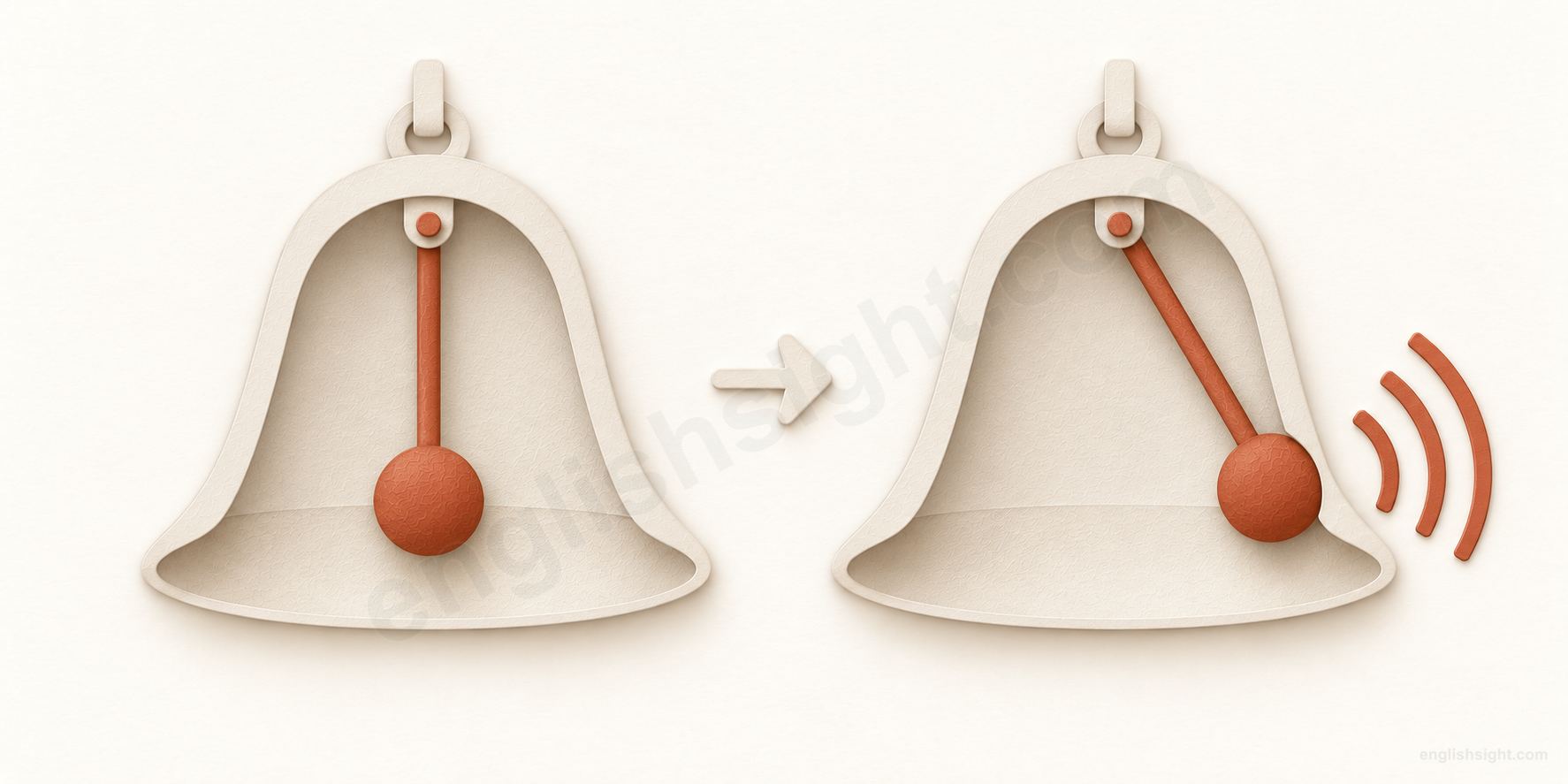
A strike produces ringing
The clapper hangs clear of the bell’s sides.
bell
The bell rings; curved lines represent its sound.
The clapper swings right and strikes the inner wall.
A strike sets the bell ringing; the situation gives the sound its purpose.
A physical bell resonates when struck; its ringing can draw attention or mark an event.
The diagram shows the sound-making mechanism, not every kind of signal device. Shape uses depend on resemblance; fixed expressions must be learned in context.
Bell /bel/ most often names an instrument or device and, in context, the sound or signal it produces. Ring the bell describes making it sound; the bell rang describes the event.
Some uses follow shape, such as the bell of a trumpet. Others belong to fixed expressions: a familiar name rings a bell, while a suspicious request sets alarm bells ringing. The sketch provides one useful physical starting point, not a rule that predicts all idioms or a claim about every speaker’s mental picture.
01
Objects, signals, and shapes
Start with an instrument, then distinguish the device, its sound, its signal, and things resembling its shape.
01
a bell; plural bells; a church / bicycle bell
a bell / church bells
a hollow instrument that rings when struck
Situation / starting point
A small metal object hangs from a ribbon.
What happens / what is meant
Its moving clapper hits the inside and produces a ringing tone.
Bell names the instrument; ring names what it does.
A bell is a countable noun: one bell, two bells. Church bells, handbells, and little bells on an animal’s collar differ in size and purpose. A clapper is the part hanging inside many bells that strikes the side; some bells are struck from outside instead.
The central sketch shows the physical sound-making relation. A bell can make music, mark time, warn people, or simply decorate something. It need not be an alarm. A bell tower houses bells; a tower is not itself a bell.
In a sentence
A tiny bell hung from the goat’s collar.
Watch the difference Do not use bell as the ordinary verb for making it ring: ring the bell is the usual instruction.
02
ring / press the bell; at / after the bell
the doorbell / the school bell
a device whose sound calls attention or marks an event
Situation / starting point
A visitor is outside a closed door.
What happens / what is meant
The bell signals that someone wants attention.
The signal function remains even when the device is electrical.
A doorbell can be an electrical device rather than the cup-shaped object in the sketch. Ring the bell at a door asks someone inside to notice you. Press the bell commonly means press its button; it does not describe squeezing a metal bell.
A school bell or dinner bell signals a scheduled activity. The bell can also refer to the audible signal: We left at the bell means we left when it sounded. The surrounding situation tells you whether it marks a beginning, an ending, a visitor, or a warning.
In a sentence
Please ring the bell beside the entrance.
Watch the difference A bell is a device or its sound; an alarm is a warning system or warning and may use a siren, light, or vibration instead.
03
someone rings / rang / has rung the bell; the bell rings / rang
ring the bell / the bell rings
make the instrument sound, or describe it sounding
Situation / starting point
Someone operates the bell.
What happens / what is meant
People hear it ringing.
The bell can be ring’s object or its subject.
In Mia rang the bell, Mia causes the sound. In The bell rang, the bell is the grammatical subject. Ring changes to rang in the simple past and rung after have: Someone has rung the bell. These are forms of ring, not forms of bell.
The bell went is a familiar way, especially in British school contexts, to say the signal sounded. An alarm bell went off means it started sounding; off here does not mean it became silent. Bells may chime with a musical tone, tinkle lightly, clang loudly, or toll with slow repeated strokes. A peal of bells refers to a ringing sequence or sound.
In a sentence
The bell rang while I was putting my books away.
Watch the difference Do not write I belled the door when you mean I rang the doorbell.
04
the bell of + instrument; bell-shaped + noun
the bell of a trumpet / bell-shaped
the flared shape, rather than a separate ringing instrument
Situation / starting point
A tube widens towards its open end.
What happens / what is meant
Its end resembles the spreading mouth of a bell.
The shape supplies this branch of meaning.
The bell of a trumpet is its broad open end. It is part of a wind instrument, not a little separate bell attached to it. Here resemblance in shape matters, not a clapper striking metal.
Bell-shaped describes a similar outline: a narrow upper part opening into a wider lower part, as in a bell-shaped flower. Keep the compound together with a hyphen in this written form. The diagram’s outline can help you recognize this use, but the flower does not have to make any sound.
In a sentence
She pointed the bell of the trumpet towards the audience.
Watch the difference Do not infer ringing or warning from bell-shaped: the word describes form.
05
a red / green / yellow bell pepper; plural bell peppers
a bell pepper
a named vegetable used raw or cooked
Situation / starting point
You are choosing vegetables for a salad.
What happens / what is meant
You choose a red, green, or yellow pepper.
The complete compound names a food, not a ringing object.
Bell pepper is a food name used especially in North American English. British English often uses pepper for this vegetable; sweet pepper is another name. You may eat it raw or cook it. In a shopping list, two bell peppers names two vegetables.
Learn the two-word compound together. Bell is not a separate ingredient, and a recipe that says bell pepper is not asking for an instrument. Shape can help as a memory association, but the established food name tells you what to buy.
In a sentence
Slice a red bell pepper for the salad.
Watch the difference The plural ending goes on pepper: bell peppers, not bells pepper.
02
Recognition, warning, and comparisons
Read the whole expression: familiarity, suspicion, clarity, and good condition are different messages.
06
something rings a bell; ring a bell with someone
ring a bell
seem familiar or bring a partial memory to mind
Situation / starting point
You hear a name but cannot place it.
What happens / what is meant
You have a feeling that you encountered it before.
Something familiar triggers recognition; no physical sound is needed.
The informal expression That name rings a bell reports recognition, often without enough detail to identify where you heard it. A person’s name, a place, a description, or a tune can be the subject. Does that ring a bell? asks whether the listener recognizes the information.
The expression uses the indefinite article: a bell. The sound of a bell is a useful memory comparison, but the phrase’s meaning is established by usage. It does not mean that the information is necessarily true, important, or dangerous.
In a sentence
That café name rings a bell, but I can’t remember the street.
Watch the difference Ring the bell usually refers to an actual known bell; ring a bell can express vague recognition. Context can also make a bell literal.
07
alarm bells ring; set alarm bells ringing
set alarm bells ringing
make people suspect danger or a problem
Situation / starting point
A seller asks for payment through an unusual link.
What happens / what is meant
You become concerned that something may be wrong.
The warning response can be figurative.
An alarm bell can literally warn of danger. Figuratively, alarm bells ring when a detail makes you suspicious or worried. That request set alarm bells ringing means it caused that reaction; Alarm bells started ringing in my head describes your own growing concern.
Here set introduces a cause and ringing describes the response. This is a construction with a noun phrase and an -ing complement, not a phrasal verb bell off. Compare That name rings a bell: that expresses familiarity, while alarm bells emphasize a possible problem.
In a sentence
The demand for my password set alarm bells ringing.
Watch the difference Alarm bells express a warning reaction, not proof that wrongdoing has occurred.
08
be / sound + (as) clear as a bell
(as) clear as a bell
extremely clear
Situation / starting point
A distant speaker begins talking through a microphone.
What happens / what is meant
Every word can be heard distinctly.
Clear is the quality being intensified in the comparison.
Clear as a bell is a fixed simile that emphasizes clarity. It readily describes a voice or a recording that is easy to hear distinctly. The first as may be omitted: Her voice was clear as a bell.
The phrase can extend beyond sound to something very clear or distinct, such as an image or a memory. The sentence supplies the relevant kind of clarity. A loud but distorted recording is not necessarily clear as a bell.
In a sentence
Her voice came through the speaker as clear as a bell.
Watch the difference This is about clarity, not simply high volume.
09
be + (as) sound as a bell
(as) sound as a bell
healthy or in excellent condition
Situation / starting point
An old instrument is checked for damage.
What happens / what is meant
It is found to be in good condition.
Sound is an adjective meaning healthy or undamaged here.
Sound as a bell is an informal fixed comparison for a person, animal, or thing in very good condition. In The frame is sound as a bell, sound describes condition. It is not the noun meaning something you hear.
Compare clear as a bell, which stresses clarity, with sound as a bell, which stresses health or condition. Learn the whole expression; replacing sound with noisy would lose the intended meaning.
In a sentence
The bicycle is old, but its frame is still sound as a bell.
Watch the difference Do not interpret sound as a bell as a statement about how much noise something makes.
03
Calls, interruptions, and everyday idioms
These established expressions handle social situations and product comparisons. Keep their wording and tone in view.
10
give + someone + a bell
give someone a bell
call someone on the phone
Situation / starting point
You want a friend to contact you after work.
What happens / what is meant
The friend makes a phone call.
The whole informal expression names a call.
Give me a bell is an informal British request to phone you. The person after give is the person to be called: I’ll give Anna a bell means I will phone Anna. Bell remains a noun in the expression.
Use give, gave, or given according to the tense: She gave me a bell yesterday. Give me a call is a widely understood alternative without the specifically British wording. The expression does not mean sending a message or physically handing over a bell in an ordinary phone context.
In a sentence
Give me a bell when you get to the station.
Watch the difference Keep a before bell. For a neutral international instruction, say Call me.
11
be saved by the bell; Saved by the bell!
saved by the bell
helped out of difficulty by a timely interruption
Situation / starting point
You face an awkward question.
What happens / what is meant
Another event interrupts before you have to answer.
Relief comes from the timing of an outside event.
Saved by the bell is often a humorous way to say an interruption got you out of trouble just in time. There need not be an actual bell: an arriving visitor or an unexpected phone call may provide the escape.
The expression also has a literal sporting application when an end-of-round bell saves a boxer from being knocked out. In everyday conversation, learn be saved by the bell as a complete passive expression; bell itself is still a noun.
In a sentence
I was saved by the bell when a visitor arrived before I had to explain the mistake.
Watch the difference The phrase suggests timely relief; it does not necessarily mean the underlying problem is permanently solved.
12
with / without + (all) the bells and whistles
bells and whistles
extra features beyond the basic functions
Situation / starting point
Two devices do the same essential job.
What happens / what is meant
One adds attractive options and special functions.
The plural fixed phrase labels extras, not sounds.
Bells and whistles are additional features, often on a product or piece of software. With all the bells and whistles means with the full set of extras. Without the bells and whistles emphasizes a simpler version.
The phrase is informal and can be admiring or mildly critical. Someone may enjoy the extras or think they distract from the basics. It does not automatically say the extras are useless, but it does distinguish them from essential functions.
In a sentence
I need a reliable printer, not one with all the bells and whistles.
Watch the difference Keep the plural forms and the conjunction and; a bell and a whistle would normally name two actual objects.
13
hear wedding bells
hear wedding bells
expect that a couple will marry
Situation / starting point
Two friends have become a close couple.
What happens / what is meant
Someone playfully predicts a wedding.
Wedding bells can stand for marriage through association.
Wedding bells literally may ring at a wedding. Figuratively, I can hear wedding bells suggests that a couple seem likely to marry. The expression can be playful speculation rather than an announcement of an engagement.
This connection comes from the association of bells with some wedding traditions. It does not mean every wedding includes bells, or that hearing any bell predicts a marriage.
In a sentence
They have only just started dating, and you’re already hearing wedding bells!
Watch the difference Distinguish a playful prediction from confirmed wedding plans.
14
be there / come + with bells on
with bells on
eagerly and ready to enjoy an event
Situation / starting point
A friend invites you to a celebration.
What happens / what is meant
You accept with enthusiasm.
This informal reply conveys eagerness.
I’ll be there with bells on is an enthusiastic acceptance. The phrase modifies how willingly you will attend; it does not normally promise a costume with actual bells.
It fits a friendly invitation more naturally than a formal attendance notice. It is a fixed expression, so do not derive it from every use of with or expect on to name a physical position here.
In a sentence
“Are you coming to the party?” “I’ll be there with bells on.”
Watch the difference This is an informal idiom, not a general way to say that something has extra features.
15
Pull the other one (—it’s got bells on)!
pull the other one—it’s got bells on
say you do not believe a claim
Situation / starting point
Someone tells you an implausible story.
What happens / what is meant
You respond with teasing disbelief.
The full British expression is an idiomatic reply.
Pull the other one—it’s got bells on is a British informal response meaning that you do not believe what you have just heard. Pull the other one can stand alone; the bells clause adds a humorous flourish.
This is a fixed saying rather than an instruction to pull a real object. It can sound teasing, dismissive, or rude according to tone and the relationship. In a serious conversation, I find that hard to believe is usually clearer.
In a sentence
“I finished the whole report in two minutes.” “Pull the other one—it’s got bells on!”
Watch the difference Do not confuse this skeptical response with with bells on, which usually expresses enthusiasm.
04
Recognize the less usual verb
The verb bell exists, but ring is the verb you normally need when asking someone to make a bell sound.
16
bell + animal; something bells out; bell + tube end
bell an animal / bell out
attach a bell, or form a bell shape
Situation / starting point
An animal has no bell on its collar.
What happens / what is meant
A bell is fitted to it.
The less usual verb differs from the everyday instruction ring the bell.
Bell is also a verb: to bell an animal is to fit it with a bell. The forms are bells, belled, and belling, with a doubled l in belled and belling. For everyday instructions, put a bell on the collar is often more immediately clear.
In descriptions of shape or technical work, a tube can bell out, or a worker can bell its end: the end flares like a bell. These are recognition uses, not a productive set of everyday phrasal verbs to memorize. They do not mean that the tube starts ringing.
In a sentence
The farmer belled the goat before letting it into the field.
Watch the difference Bell, ring, and bellow are not interchangeable. The separate literary animal-cry sense is outside this lesson.
Keep the noun, verb, and idiom apart
Counting and forms
Use a bell or the bell for a singular countable noun, and bells for the plural. Bell before another noun can classify it, as in bell tower. Ring the bell uses ring, with past rang and participle rung; the separate verb bell has belled and belling.
A signal is understood in context
A bell may call attention, mark time, or warn; it does not always indicate danger. Alarm bells may be figurative, and a name that rings a bell may merely sound familiar.
Learn fixed expressions whole
Ring a bell, give someone a bell, saved by the bell, and bells and whistles are established patterns. Their meaning does not follow by replacing a or the, changing the number, or translating each component separately.
Coverage boundary
Specialist shipboard time, architecture and biology terminology, historical or literary animal cries, and the surname Bell are not developed here. Bell the cat and violent regional sayings are outside the everyday core. Compounds such as diving bell, bell curve, and bell-bottoms have their own vocabulary entries; recognizing bell’s shape does not give their full definitions.
Choose the intended meaning
Look for the object, the situation, and the complete expression.
1. A name seems familiar, but you cannot place the person. Which sentence fits?
2. A British friend says, “Give me a bell when you arrive.” What do they want?
3. A musician points to the bell of a trumpet. What is it?
4. Someone operated the entrance bell a moment ago. Complete: “Someone has ___ the bell.”
5. A simple app does everything you need “without the bells and whistles.” What is missing?
6. A mechanic says an old frame is “sound as a bell.” What are they describing?
Sources and teaching notes
Dictionary entries below support the uses and restrictions. Explanations and examples are original. The diagram is a teaching aid; shape extensions and fixed idioms need their own explanations.
This diagram helps explain a connection; it is not a picture shared by every native speaker.