Separate a bent shape, a past action, and the established expressions built around bent.
A shape that is not straight
A shape that is not straight
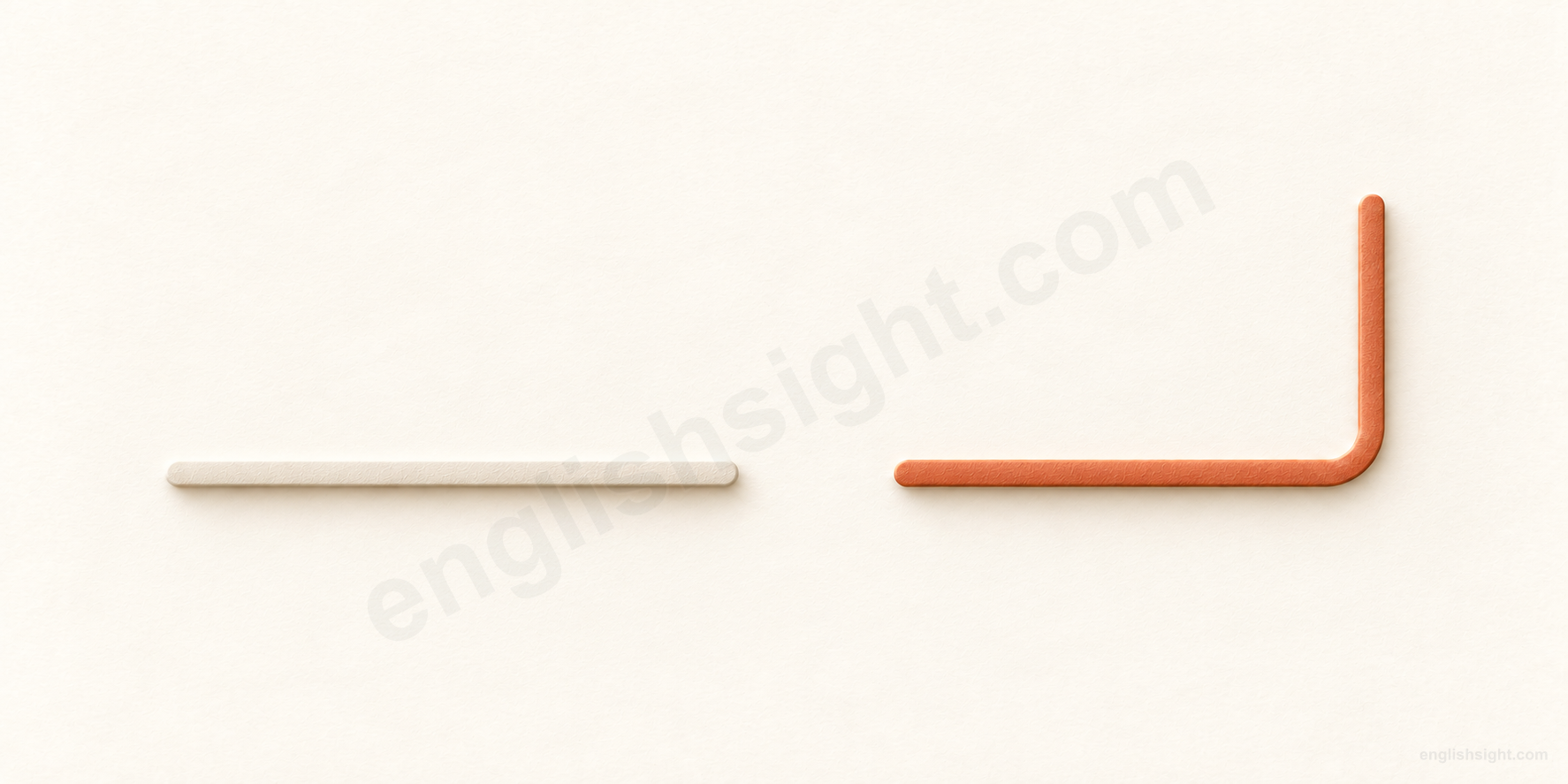
The reference wire is straight.
bent
The orange wire is bent.
The wire on the right turns upward through a rounded right angle.
Bent names a shape here, without saying who bent the wire or whether it is damaged.
Bent describes something whose shape has a curve or an angle instead of being straight.
The picture compares shapes. Bent can name a state without asserting when it changed, who changed it, or whether it is damaged. Determination, inclination, and idioms need their own constructions.
A bent wire is not straight; bent knees are held at an angle. Start with that physical state, then check whether bent is describing a shape or functioning as the past form of bend.
Bent on a plan and a bent for an activity involve determination or inclination. These are useful connections for learning, not a rule that predicts every expression or a claim that all English speakers imagine the same picture.
01
Shapes and body positions
Bent describes a curved or angled state. The object and context tell you whether it is damaged, deliberately shaped, or simply positioned that way.
01
a bent + noun; be / become / get + bent
a bent wire
a wire with a curve or angle in it
Situation / reference
You compare a wire with a straight reference.
State / interpretation
The wire has an angle in its shape.
Bent describes the shape, without naming who changed it.
Put bent before a noun or after be: a bent wire; The wire is bent. Slightly bent describes a small departure from straight. Badly bent can describe serious distortion.
A bent bicycle wheel may need repair, while a bent piece of wire may be exactly the shape you want. Bent does not itself mean broken. Curved emphasizes a smooth curve; bent can also describe a sharp angle.
In a sentence
The key is bent, so it no longer fits the lock.
Watch the difference Use bend for the base verb: Don’t bend the key. Bent is the adjective or the past form.
02
keep + body part + bent; with + body part + bent
keep your knees bent
maintain a body part in an angled position
Situation / reference
Someone is holding their legs in a position.
State / interpretation
The knees remain at an angle rather than straight.
The joint can be bent temporarily and intentionally.
In Keep your knees bent, knees is the object of keep and bent describes its maintained state. With your elbows bent likewise describes a position, rather than a completed movement.
Compare Bend your knees, an instruction to change their position. Bent knees need not be injured: the context may simply be posture, movement, or a description of a photograph.
In a sentence
In the photograph, Maya is sitting with her knees bent.
Watch the difference Do not treat every bent body part as damaged or permanently misshapen.
03
be bent over + noun; a bent + person
bent over the desk
leaning forward above something
Situation / reference
A person is working at a desk.
State / interpretation
Their upper body leans forward over the work.
Over relates the leaning body to the thing below it.
She was bent over her desk describes her posture at that time. She bent over describes a movement. Over the desk adds the position or focus of the activity; it does not mean crossing to the other side.
A bent old man can describe a persistently stooped posture, particularly in written description. Name the posture accurately rather than assuming every older person has it. A temporary lean over a desk is different.
In a sentence
Leo was bent over the desk, checking the tiny print.
Watch the difference Bent over is not automatically an idiom about defeat or submission; it can describe an ordinary physical position.
04
be bent double; be bent (over) double with + cause
bent double
with the upper body folded far forward
Situation / reference
Something makes someone lean very far forward.
State / interpretation
The upper body is close to the legs.
Double intensifies the folded body position, rather than counting two people.
Bent double describes a deep forward bend. It can occur with laughter, pain, or work that requires stooping. With laughter or with pain supplies the cause; the posture alone does not tell you which.
Bent over double is another form, especially in American English. A person bent double with laughter is laughing so hard that they fold forward; they are not literally becoming twice their size.
In a sentence
At the funniest part of the story, we were bent double with laughter.
Watch the difference Ordinary bent over need not mean the deep fold expressed by bent double.
02
When bent is a verb form
Bend has the forms bend, bent, bent. Compare an action in the past, an event viewed through its result, and a description of a route.
05
subject + bent + object; subject + bent down / over / forward
bent the wire / bent down
a past act of bending
Situation / reference
You are telling someone what happened yesterday.
State / interpretation
You report the change or movement using bent.
The simple past can have an object or describe the subject’s own movement.
I bent the wire names what I changed. I bent down says that I lowered my upper body, perhaps to reach the floor. Down gives direction; to pick it up explains the purpose.
The regular present is bend or bends; the ordinary past is bent. After did, use the base form: Did you bend it? This contrasts with Is it bent?, which asks about its present shape.
In a sentence
I bent down to pick up the wire, then bent it into a small hook.
Watch the difference Say I bent it yesterday, not I bend it yesterday or I bended it yesterday.
06
have / has / had + bent; be + bent + by + cause
has bent / was bent by…
use bent after have or in a passive construction
Situation / reference
A force changes a metal frame.
State / interpretation
You describe the resulting event with a participle.
The auxiliary tells you how the event is presented.
The impact has bent the frame uses have plus bent to connect an event to the present. The frame was bent by the impact uses be plus bent to make the frame the subject of a passive event.
The frame is bent can simply describe its shape, without presenting an agent or a time of change. Context distinguishes a state from an event. The frame is bending describes a change in progress.
In a sentence
The frame was bent by the falling branch.
Watch the difference After will alone, use the base form: It will bend. Bent can follow another auxiliary in It will be bent or It will have bent.
07
road / river + bent + direction / around + place
the road bent to the left
a road followed a curved course
Situation / reference
A route continues ahead.
State / interpretation
Its course turns rather than remaining straight.
A static route can be described with the past-tense verb bent.
The road bent left describes the layout of the road within a past-tense account. It need not report a road physically changing its shape while you watch. The river bent around the hill works similarly.
Use bends in a present description of the route. A bend in the road is a related noun phrase: the curve is a bend, not a bent.
In a sentence
Beyond the bridge, the road bent to the left.
Watch the difference Distinguish the past verb bent from the countable noun bend: There is a sharp bend ahead.
03
Determination and natural leanings
These established uses concern a person’s purpose, interests, abilities, or outlook. Learn the whole construction and its preposition.
08
be / seem bent on (or upon) + noun / -ing
be bent on doing something
be firmly determined to carry out a plan
Situation / reference
Someone has chosen a goal.
State / interpretation
They remain firmly committed to pursuing it.
On introduces the goal, rather than a surface supporting a bent object.
Bent on leaving means firmly determined to leave. On is a preposition, so use a noun or an -ing form: bent on revenge; bent on winning. Upon is a more formal variant.
This expression often presents determination critically, especially for a harmful or unwise plan. It can also describe a harmless goal. Determined to is a useful neutral alternative. It says nothing certain about eventual success.
In a sentence
He seems bent on arguing about every small detail.
Watch the difference Say bent on leaving or determined to leave, not bent on to leave.
09
be hell-bent on + noun / -ing
hell-bent on…
extremely determined despite possible bad consequences
Situation / reference
Other people question a plan or warn against it.
State / interpretation
The person insists on pursuing it anyway.
Hell-bent strengthens the determination in bent on.
Hell-bent on buying the car can suggest that warnings about the price will not change the person’s mind. The word often carries criticism or concern about the consequences.
This is emphatic conversational language. For a calm report of someone’s intention, determined to or strongly committed to may fit better. The expression is conventional, not a statement about a literal destination.
In a sentence
Even after the mechanic’s warning, Sam was hell-bent on buying the car.
Watch the difference Do not use hell-bent as a polite substitute for every instance of interested in.
10
have / show a bent for + field / activity
have a bent for something
have a natural interest or aptitude
Situation / reference
Someone is repeatedly drawn to an activity.
State / interpretation
You describe their natural leaning or aptitude.
A bent is a noun here, and for names the field.
A bent for design suggests a natural leaning toward it, sometimes including ability. Bent does not certify professional skill: a beginner can show this inclination.
Compare She is bent on designing a house: that describes a particular determination. She has a bent for design describes a more general disposition. Have, show, and with commonly introduce the noun.
In a sentence
Nora has a natural bent for solving mechanical problems.
Watch the difference Keep the article: has a bent for design. Do not substitute is bent for design.
11
of / with a(n) + adjective + bent; have a(n) + adjective + bent
of an artistic / political bent
having a particular tendency or outlook
Situation / reference
You want to characterize someone’s usual interests or views.
State / interpretation
A modifier identifies the kind of leaning.
The adjective before bent tells us what sort of disposition is meant.
People of an artistic bent are inclined toward artistic activities. An organization with a conservative bent tends toward a particular outlook. This noun construction often sounds more formal than interested in art or generally conservative.
A political bent concerns viewpoints, not necessarily a special talent. The shared idea is a leaning, while context determines whether interest, aptitude, or beliefs matter.
In a sentence
The workshop attracts people of an artistic bent.
Watch the difference Of an artistic bent describes disposition; bent on art is not its usual equivalent.
04
Feelings, honesty, and extra effort
Read these expressions in context. An emotional reaction, corruption, a relaxed rule, a distorted account, and exceptional effort are different meanings.
12
be / get bent out of shape about / over + something
get bent out of shape
become upset, anxious, or angry
Situation / reference
A small mistake or disagreement happens.
State / interpretation
Someone reacts with strong distress or irritation.
The whole expression describes an emotional reaction in informal North American English.
Someone can be bent out of shape about a delay or get bent out of shape over a comment. Get presents becoming upset; be describes the state. The phrase does not describe their body or fitness.
Compare The metal bracket is bent out of shape: that is a literal distortion of an object. Telling someone Don’t get bent out of shape can sound dismissive of their concern, so consider the relationship and situation.
In a sentence
Alex got bent out of shape over a minor change to the schedule.
Watch the difference Out of shape alone commonly means physically unfit. Learn bent out of shape as a whole for this emotional meaning.
13
a bent + official / officer; someone is bent
a bent official
a dishonest or corrupt person in authority
Situation / reference
An official is expected to carry out duties honestly.
State / interpretation
Their conduct involves corruption.
Bent has an established informal British meaning about dishonesty.
A bent police officer is corrupt, not merely leaning forward. This is a serious negative description, especially of someone entrusted with authority. Dishonest or corrupt is clearer in neutral or international contexts.
The physical contrast with straight can help as a memory link, but shape does not establish someone’s character. Learn this as a conventional meaning with a regional and informal label.
In a sentence
The novel follows a journalist investigating a bent official.
Watch the difference Context matters when bent describes a person: posture and corruption are separate readings.
14
bend / bent the rules (for + person)
bent the rules
applied rules more flexibly for a particular case
Situation / reference
A rule would normally prevent something.
State / interpretation
Someone makes an exception or relaxes its application.
Rules are treated as flexible constraints in this conventional metaphor.
They bent the rules for us means they applied a rule flexibly to accommodate us. It may be a small exception, but calling it bending does not guarantee that the action was permitted or fair.
Break the rules directly presents a violation. Bend the rules often portrays a departure as limited or flexible. Whether that description is justified depends on the actual situation.
In a sentence
The organizer bent the rules and accepted our form a day late.
Watch the difference This is a verb expression: present bend, past bent. It does not have the same grammar as be bent on.
15
bend / bent the truth; bend / bent the facts
bent the truth
gave an account that was not completely true
Situation / reference
Someone wants an account to sound better.
State / interpretation
They alter or soften facts in a misleading way.
The truth is figuratively distorted, rather than physically curved.
Bending the truth means departing from complete accuracy. It can involve selective or altered details; calling it bending can make the dishonesty sound smaller than calling it lying.
Compare bent the rules: that concerns applying a requirement. Bent the truth concerns the accuracy of what someone says. One expression cannot automatically substitute for the other.
In a sentence
He bent the truth when he said he had managed the entire project.
Watch the difference The phrase does not mean changing what actually happened; it concerns how events are represented.
16
bend / bent over backwards (or backward) to + verb
bent over backwards to help
made an exceptional effort to help or be fair
Situation / reference
A request requires extra work or flexibility.
State / interpretation
Someone makes a very great effort to accommodate it.
The whole idiom expresses effort, not a required body movement.
We bent over backwards to help says that we made a great effort, often beyond what would normally be expected. The to-infinitive explains the aim. It does not guarantee success or say that rules were broken.
Backward is also used, especially in American English. Compare She bent over to lift a box, which can simply describe a physical movement. The full combination bend over backwards (or backward) carries the effort meaning.
In a sentence
We bent over backwards to find a time that suited everyone.
Watch the difference Do not infer an emotional meaning merely from bent over; read the complete expression.
Check the form, the preposition, and the context
A state and an action are different
The wire is bent describes its shape. I bent the wire reports an action. The wire was bent by a falling branch presents a passive event. Bent is pronounced /bent/ in each case; bend is /bend/.
On and for build different constructions
She is bent on winning expresses determination. She has a bent for music expresses a natural leaning or aptitude. On takes a noun or an -ing form; it is not the to of determined to win.
Register can change the meaning
Corrupt bent is informal and chiefly British; bent out of shape is informal North American usage. Dictionaries also record an offensive British use for gay people. Recognize that label if encountered, but do not use it to describe someone; gay is the neutral word.
Scope and related forms
This lesson centers on the modern adjective and inclination noun, with useful past-tense and participle patterns from bend. It does not attempt the complete bend dictionary. The fixed expression on bended knee(s) preserves bended; it does not make I bended it the ordinary past form. Botanical bent, engineering supports, old endurance senses, and other regional slang are outside the learning scope.
Choose the meaning that fits
Use the object, the auxiliary, and the complete expression as clues.
1. You are describing a key’s present shape, without reporting who changed it. Which sentence fits?
2. A child is naturally interested in mechanical tasks and shows aptitude for them. Which sentence describes that disposition?
3. Which question uses the ordinary past-tense question pattern?
4. Alex got bent out of shape over a small scheduling change. What happened?
5. The staff bent over backwards to help us. What does this tell us?
Sources and teaching notes
The sources below support the meanings, constructions, and register labels. Explanations and examples are original; the shape comparison and connections are teaching aids.
The shape comparison is a teaching aid, not a shared mental picture attributed to every native speaker.