Talk about berries in nature, at the market, and in the kitchen.
One berry among several
A small fruit, counted individually
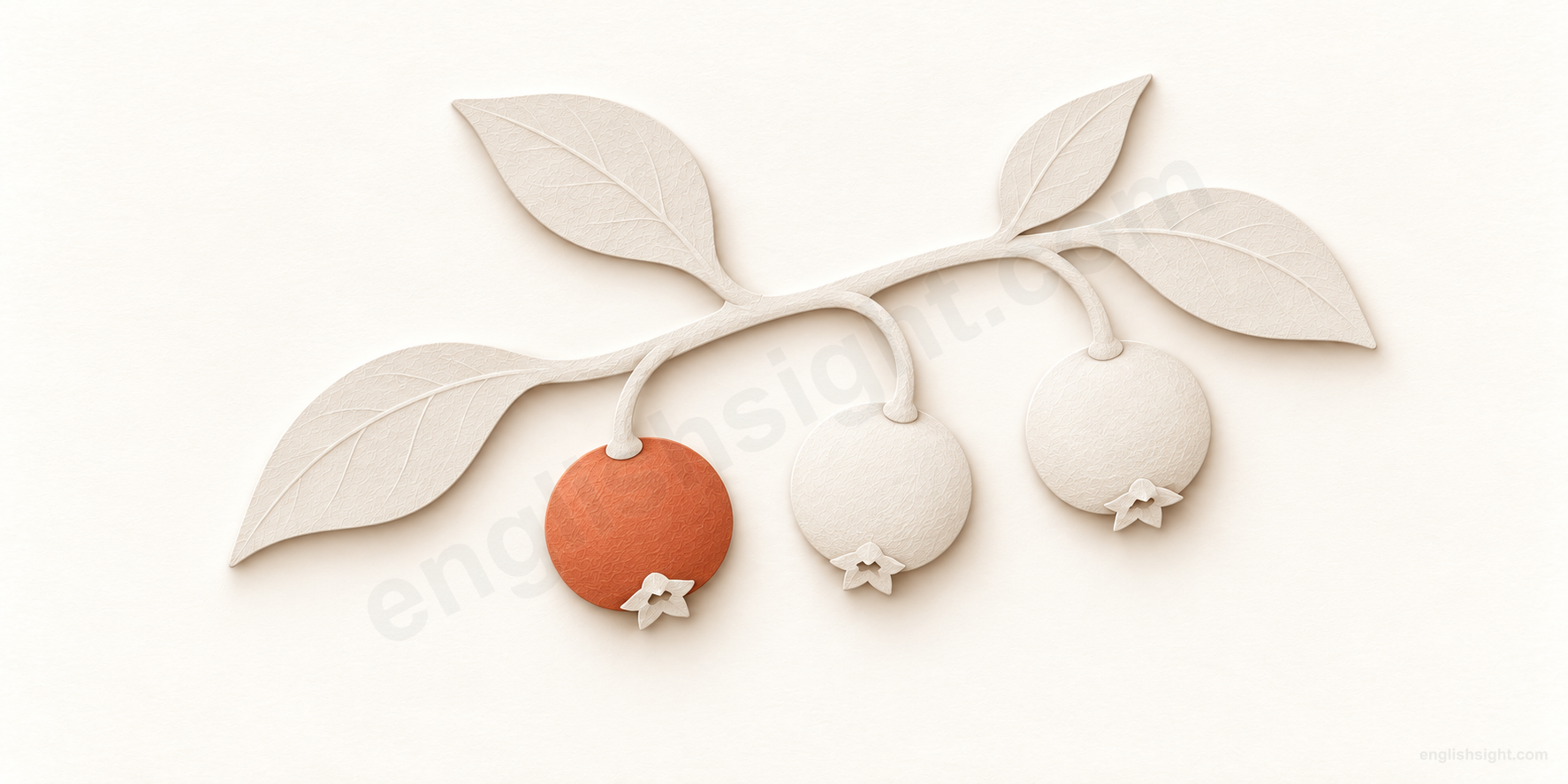
Small round fruits hang from a leafy twig.
berry
One is a berry; all three are berries.
Focus on one fruit, highlighted in terracotta.
One berry is highlighted among several berries on the same twig.
In everyday English, a berry is an individual small, fleshy fruit; several such fruits are berries.
The picture shows fruits attached to a plant and highlights one of them. It illustrates the everyday noun, not a rule for identifying every edible fruit or every botanical berry.
In everyday English, a berry is an individual small, fleshy fruit. The plural berries covers familiar fruits without requiring one exact botanical structure. Start with the fruit, then let the surrounding words tell you its kind, condition, or use.
This lesson focuses on the everyday countable noun. It also explains the technical botanical sense, the related verb, and a fixed comparison without pretending they are all separate everyday senses.
01
Recognizing and counting the fruit
Start with individual small fruits, then choose a general name, a specific kind, or an amount.
01
a / the + berry; adjective + berry
a berry
an individual small, fleshy fruit
Situation
Small fruits hang from a plant.
What you describe
You refer to one fruit as a berry.
Berry names a kind of fruit; it does not promise that the fruit is edible.
In ordinary conversation, berry covers small, fleshy fruits such as blueberries, raspberries, and strawberries. They need not all have the same shape or internal structure.
A berry may grow on a bush, a tree, or another kind of plant. The name does not by itself tell you its color, sweetness, or whether people can eat it. Edible berries and poisonous berries are both possible expressions.
In a sentence
A bird carried a red berry away from the bush.
Watch the difference Berry is more specific than fruit: an ordinary large apple is not normally called a berry.
02
a berry; number / some / a few + berries; a bowl of berries
one berry, several berries
count individual fruits or describe a quantity
Situation
You have more than one small fruit.
What you describe
You use berries and a plural verb.
The plural changes final y to ies: berry → berries.
Berry is countable: one berry, two berries, a few berries. A singular countable noun normally needs a determiner, as in a berry or this berry. For an unspecified amount, use some berries or a bowl of berries.
Say The berries are ripe. In A bowl of berries is on the table, the singular bowl controls is. Fruit often names food collectively: some fruit can include several berries. Some berry is not the usual way to ask for whole berries.
In a sentence
There are only three berries left in the bowl.
Watch the difference Write berries, not berrys. Berries is a plural, not the possessive berry’s.
Mixed describes the assortment; berry still names the fruit.
Mixed berries can combine, for example, blueberries and raspberries. It is a practical food description, not a new species or a special grammatical form.
Names such as blueberry, blackberry, strawberry, and raspberry identify particular kinds and are written as single words. Their plurals also end in -berries: blueberries and strawberries. Learn each name as a whole; the first part is not always a literal description.
In a sentence
I added mixed berries to my yogurt.
Watch the difference Mixed berries means a mixture of kinds; it does not mean that every individual berry has several flavors.
02
Growing, picking, and preparing berries
The surrounding words describe the fruit’s condition, what people do with it, or its role in a dish. These are useful combinations, not separate meanings of berry.
Ripe, fresh, and frozen describe different features.
Ripe berries have reached the stage when the fruit is ready to be picked or eaten. Berries ripen describes that development; a bush produces or bears berries describes fruit growing on the plant.
Fresh berries are sold or used without being frozen or dried; frozen berries have been preserved by freezing. Fresh does not mean the same thing as ripe: storage condition and stage of development are different. Juicy describes fruit containing plenty of juice.
In a sentence
The recipe works with either fresh or frozen berries.
Watch the difference Ripe does not mean every berry has turned red; different kinds have different ripe colors.
05
pick berries (from a bush); go berry picking; wild berries
pick berries
remove berries from the plant to collect them
Situation
Berries are still attached to a plant.
What you describe
Someone gathers them.
Pick supplies the gathering action; berries names what is gathered.
Pick berries means gather them from the plants. Pick berries from a bush names the source. Go berry picking describes taking part in the activity; it does not say how many berries you bring home.
Wild berries grow without being cultivated. Wild describes where or how the plants grow, not whether their fruit is edible. In a shop, pick the best berries can instead mean select the best ones: the situation tells you which sense of pick applies.
In a sentence
We picked berries at a farm on Saturday.
Watch the difference Berry picking is an activity phrase, not a phrasal verb. Berries is the object of pick in pick berries.
06
berry + food / drink noun; food made with berries
berry compote
use berry before another noun to identify the fruit ingredient
Situation
Berries are prepared as part of a dish.
What you describe
Berry describes the kind of dish or flavor.
In berry compote, compote is the main noun.
A berry compote is a dish of berries cooked with sugar or syrup. Here berry works as a noun modifier. The same useful pattern appears in berry jam and a berry smoothie: the following noun tells you what the food or drink is.
Keep berry singular in these ordinary combinations, even when the dish contains many berries. Compare a berry smoothie with a smoothie made with berries. A bowl of berries names a container and its contents, rather than a berry-based kind of bowl.
In a sentence
She served warm berry compote with the pancakes.
Watch the difference Say berry jam in this pattern, not berries jam. The plural of berry smoothie is berry smoothies.
03
Special uses and expressions to recognize
Botany uses a stricter definition. The verb and fixed comparison below need their own explanations; the sketch cannot predict them.
07
a berry in the botanical sense
a berry in botany
a fruit category defined by its structure
Situation
You move from food talk to a biology lesson.
What you describe
Berry has a technical classification meaning.
Everyday fruit names and botanical categories do not match exactly.
In botany, a berry is a fruit that develops from a single ovary and has a fleshy fruit wall. A grape or tomato is a berry in this technical sense, even though people do not usually put tomatoes in a bowl of mixed berries.
The ordinary word also covers strawberries and raspberries, which do not have that simple botanical structure. This is a difference between two uses of a word, not a reason to correct ordinary food names. The branch sketch illustrates the everyday use only.
In a sentence
In botany, a tomato is classified as a berry.
Watch the difference A name ending in -berry is not proof of botanical classification.
08
go / went berrying; a plant berries
go berrying
go looking for or gathering berries
Situation
People plan a fruit-gathering outing.
What you describe
They describe the activity as berrying.
The noun also has a related intransitive verb.
Go berrying means go in search of berries to gather. This is an alternative to go berry picking. The verb forms are berries, berried, and berrying; in berrying, the y stays.
Dictionaries also record berry meaning produce berries, as in The shrub berries in autumn. For everyday conversation, The shrub produces berries is a clear alternative. These intransitive uses have no direct object; say pick berries, rather than berry the berries.
In a sentence
My grandparents used to go berrying near the lake.
Watch the difference Berried can be a verb form in a sentence, but it is not the plural of the fruit noun.
09
(as) brown as a berry
(as) brown as a berry
very suntanned
Situation
Someone has spent time in the sun.
What you describe
A speaker describes that person’s tan with a fixed comparison.
The whole comparison describes a tan, not the color of every berry.
Brown as a berry, also as brown as a berry, describes someone whose skin has become very brown in the sun. It is a set comparison worth recognizing in descriptions and conversation.
The person is the subject of be or look; the as-phrase supplies the comparison. You cannot infer this meaning just from the literal fruit. For straightforward wording, use very tanned.
In a sentence
After a summer outdoors, he was as brown as a berry.
Watch the difference This expression is about tanning, not a general label for a person’s natural skin color.
Keep the boundaries clear
Berry and fruit
Fruit is the broader category. Some fruit can mean a quantity of fruit as food; some berries refers to individual small fruits. The precise kind matters when shopping or following a recipe.
Berry and bury
Berry is pronounced /ˈberi/, with two syllables and stress on the first. Oxford lists bury as a homophone. Bury is the verb for putting something under the ground; it is a different word with different spelling.
A name is not a guarantee
The everyday category includes fruit people eat and fruit they do not. The botanical category follows structure. Neither the name nor the simplified drawing establishes edibility.
What this lesson leaves out
Special uses for dry seeds or kernels, animal eggs, and rose hips are recorded in larger dictionaries but are not expanded here. The berries is also old-fashioned American slang for someone or something attractive or unusual; it is not a neutral modern alternative to berries as food. Proper names such as Berry belong elsewhere.
Choose the expression that fits
Use the situation and the whole noun phrase to decide.
1. You can see two separate fruits. Which sentence uses the correct plural?
2. You order a smoothie made with several berries. Which phrase follows the usual noun-modifier pattern?
3. Someone says, “We went berrying.” What did they do?
4. A biology book calls a tomato a berry. How should you understand that?
Sources and teaching notes
Publisher entries below were consulted for senses, forms, collocations, and scope. Explanations and examples are original; the drawing is a teaching aid. Collocation example pages supply usage evidence, not frequency rankings.
The picture is a teaching illustration, not a claim about a mental image shared by every English speaker.