Feathers, wings, and the expressions built around them.
Name the animal first; then read each comparison and fixed expression in context.
Feathers and wings, with or without flight
One animal group, different ways of living
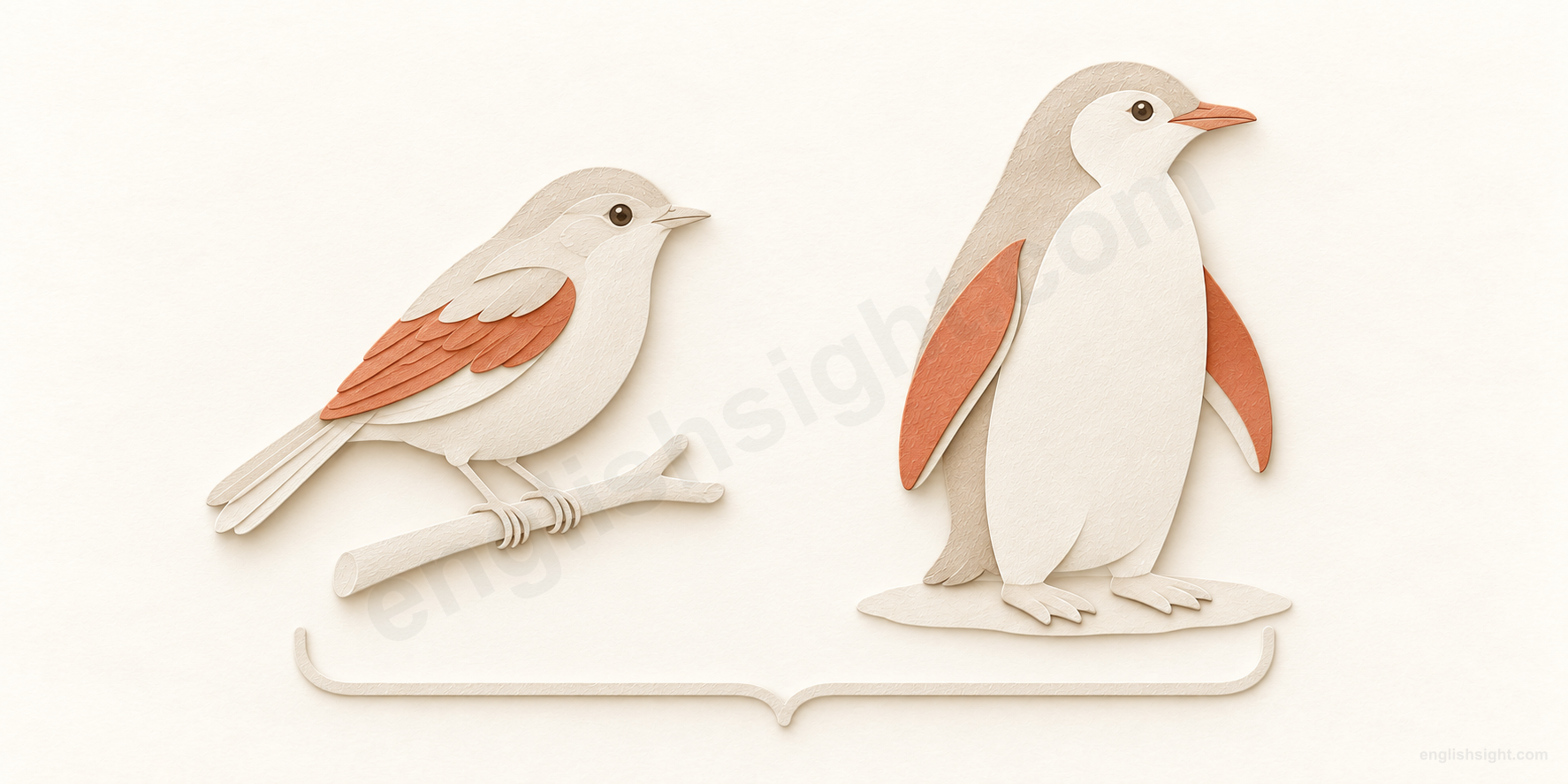
A small songbird perches on a branch.
bird
A flightless penguin is also a bird.
Feathers and wings place both animals in the same group.
Both are birds. Wings do not guarantee flight.
Bird names a feathered animal with wings; flight is common, but it is not required.
The two animals illustrate membership in the same category, not a before-and-after change. The animal image anchors the literal noun; it does not predict the meanings or tone of every idiom.
Bird usually names an animal, not an action: feathers and wings identify the group, while a bird may perch, swim, walk, or fly. The ordinary plural is birds.
English also uses birds in descriptions of people, comparisons, and sayings. Some connections are easy to remember through an image; others belong to a fixed phrase and must be learned as a whole.
01
The animal and its everyday surroundings
Start with the countable animal name. Descriptions, compound nouns, and the activity of watching birds then build on that literal meaning.
01
a / the + bird; number + birds; birds + plural verb
a bird / birds
a feathered animal with wings
Situation / starting point
You notice an animal on the fence.
What the expression communicates
You identify what kind of animal it is.
Bird names an animal category; the animal need not be flying.
Bird is a countable noun: a bird, one bird, two birds. Use a determiner with an ordinary singular reference: I saw a bird. The plural birds can describe the group generally: Birds have feathers.
A robin, an eagle, a chicken, and a penguin are all birds. Most birds can fly, but flight is not a requirement: a penguin is a flightless bird. A bat can fly, but it is not a bird.
Birds lay eggs, but this describes reproduction in the group; it does not mean every individual bird lays eggs. In an everyday description, verbs such as sing, peck, and nest describe what a bird does, rather than different meanings of bird.
In a sentence
A small bird is pecking at seeds beside the fence.
Watch the difference Say I saw a bird, not I saw bird. Flying does not by itself make an animal a bird.
02
adjective + bird; bird of prey → birds of prey; game bird → game birds
a flightless bird / a bird of prey / a game bird
specify a kind of bird
Situation / starting point
You know that an animal is a bird.
What the expression communicates
You add information about flight, hunting, or its use as game.
Different modifiers classify the same animal category in different ways.
A flightless bird cannot fly. A bird of prey, such as a hawk, hunts other animals for food. The plural is birds of prey: add -s to bird, not prey.
A game bird is a bird hunted for food or sport, such as a pheasant. Game here does not mean a toy or a bird playing. A bird of prey hunts; a game bird is hunted. These categories describe different relationships, not opposite grammatical forms.
In a cooking conversation, the bird can refer to a whole chicken, turkey, or other bird being prepared as food: Put the bird in the oven. The context supplies the particular species; bird is not the ordinary mass noun for every kind of meat.
In a sentence
The guide pointed out two birds of prey above the cliffs.
Watch the difference Use birds of prey, not bird of preys. A game bird is not a sports object.
03
bird + noun; a bird’s + noun; birds’ + noun
a bird feeder / a bird’s nest / bird flu
express a connection with birds
Situation / starting point
You need to name an object, a nest, or an illness.
What the expression communicates
The following noun tells us what kind of thing is being discussed.
Bird can modify another noun; bird’s and birds’ mark possessive relationships.
A bird feeder is a container or device used to offer food to birds. Bird modifies feeder and normally stays singular even if many birds use it. Bird flu similarly names an illness associated with birds; flu is the head noun and is uncountable in this name.
A bird’s nest refers to the nest of one bird; birds’ nests refers to nests associated with more than one bird. The apostrophe belongs after the -s for the plural possessive. A bird nest is also possible as a noun compound describing the type of nest.
These are noun constructions. The relation can be for birds, belonging to birds, or associated with birds; do not assume that bird + noun always means the same relation.
In a sentence
We hung a bird feeder near the window.
Watch the difference A bird feeder can serve several birds; do not automatically pluralize the first noun to birds feeder.
04
go bird-watching / birding; bird + place phrase
go bird-watching / go birding
watch and identify wild birds as an activity
Situation / starting point
You plan a morning outdoors with binoculars.
What the expression communicates
You spend time observing birds in their surroundings.
Birding is an activity name; bird can also be an intransitive verb.
Bird-watching, also written birdwatching, is the hobby of observing wild birds. Say go bird-watching. Birding is another activity name: We went birding before breakfast.
Bird can be a verb among people who pursue this hobby: They bird along the coast. Its forms are bird, birds, birded, birding. This use is intransitive: the place is introduced by a phrase such as along the coast, rather than treated as an object.
Watch the birds is an ordinary verb phrase and can describe one brief act of looking. Go bird-watching presents the activity as an outing or hobby. The verb bird is more specialized than the basic animal noun.
In a sentence
We went bird-watching by the lake before breakfast.
Watch the difference Birding is not a general verb for flying, and it does not mean feeding a pet bird.
02
Describing people
Some expressions compare people to birds or use bird as an informal label. Learn the whole description and its tone, rather than substituting bird for person everywhere.
05
be + an odd / a rare bird; adjective + old bird
an odd bird / a rare bird / a tough old bird
describe an unusual or distinctive person
Situation / starting point
Someone has an unusual character or quality.
What the expression communicates
You describe that person with an informal bird expression.
The adjective and context determine the description of the person.
An odd bird is a person who seems unusual. A rare bird is someone, or sometimes something, that is uncommon or exceptional. In a nature report, a rare bird may instead be an actual bird that is seldom seen.
A tough old bird describes a resilient person, often an older one. A wise old bird emphasizes judgment or experience. Old bird can sound humorous or dated; its friendliness depends on the relationship and tone.
This is an established informal use of an animal name for a person. It is not an instruction to replace person with bird in neutral introductions. An odd bird can sound critical; an unusual person is more direct.
In a sentence
Mara is a rare bird: a scientist who also designs stage costumes.
Watch the difference A rare bird may be an animal or a person; use the surrounding sentence to decide.
06
be + an early bird; early-bird + discount / ticket
an early bird / an early-bird discount
someone who gets up or acts early; an offer for early action
Situation / starting point
One person is ready before the others.
What the expression communicates
That person gets an early start or qualifies for an early offer.
Early bird can describe a person’s routine or timing in a particular situation.
An early bird may get up early or arrive, book, or act before other people. I’m an early bird can describe a regular morning habit; You’re an early bird today can comment on one early arrival.
Before a noun, early-bird often describes an offer available to people who book, buy, or arrive early: an early-bird discount or early-bird tickets. It need not mean buying early in the morning; the deadline may be months before an event.
This expression uses an association between birds and early activity. It does not imply that every real bird is awake at dawn, or that early action always succeeds.
In a sentence
We bought early-bird tickets before the price increased.
Watch the difference Check what early means in the offer: an early date and an early hour are different.
07
a / the + bird; plural birds, in British slang
bird meaning a woman
recognize a potentially offensive British slang label
Situation / starting point
You hear an informal British conversation.
What the expression communicates
You recognize that bird refers to a woman, not an animal.
This slang label can sound dated and disrespectful.
In British slang, bird can refer to a girl or young woman, sometimes a girlfriend. Dictionaries flag that this use can cause offence. It is useful to recognize in speech or older stories, but woman or girlfriend is a safer neutral choice.
This is a separate established label, not a meaning you can predict from feathers or flight. It should also be distinguished from a phrase such as a tough old bird, which can describe people more generally.
In a sentence
In the old comedy, a character calls his girlfriend “his bird.”
Watch the difference Do not use bird as your ordinary polite word for a woman.
03
Comparisons and viewpoints
These familiar expressions select a particular idea associated with birds. They are language conventions, not biological rules.
08
be / feel + (as) free as a bird
(as) free as a bird
feel completely free of restrictions or worries
Situation / starting point
An obligation or restriction has ended.
What the expression communicates
You feel able to choose what to do.
The comparison emphasizes freedom, not the ability to fly.
Free as a bird and as free as a bird describe a feeling or state of freedom. The usual comparison is with a bird able to move about without being tied down.
Free is an adjective: feel free as a bird or be as free as a bird. In this expression free concerns freedom, not a zero price. The comparison is a memorable convention, not a claim about every wild or captive bird.
In a sentence
With the exams finished, I felt as free as a bird.
Watch the difference Free as a bird does not mean that a ticket or product costs nothing.
09
eat / ate / have eaten + like a bird
eat like a bird
eat only a small amount
Situation / starting point
A person takes very little food at meals.
What the expression communicates
You describe the small amount they eat.
The expression concerns quantity, not the kind of food.
Eat like a bird conventionally means eat very little. It can describe someone’s usual appetite or the small amount eaten on a particular occasion. Like introduces the comparison; it does not turn bird into a verb.
The phrase does not mean eat seeds or peck with your mouth. Treat it as an idiom rather than a scientific rule about how much birds eat. In a literal wildlife discussion, like a bird could instead be an actual comparison of behavior, so context still matters.
In a sentence
At lunch, Theo ate like a bird and left most of his sandwich.
Watch the difference Eating like a bird does not specify a vegetarian diet or any particular food.
10
a bird’s-eye view of + place / subject
a bird’s-eye view
a view from above, or a broad overview
Situation / starting point
You look down from a high place or step back from details.
What the expression communicates
You see the wider layout or main outline.
A high viewpoint can be literal; an overview can be figurative.
A bird’s-eye view of a place is a view looking down from above. A tower or an aerial photograph can provide it; no actual bird is needed.
A bird’s-eye view of a subject gives the overall picture without much detail: The opening chapter gives a bird’s-eye view of the industry. The broader perspective links the two uses, but the subject of the overview need not be physical.
The phrase is a noun phrase headed by view. In the usual hyphenated spelling, bird’s-eye modifies view; keep the apostrophe in bird’s. It does not mean a close inspection of an individual bird’s eye.
In a sentence
From the tower, we had a bird’s-eye view of the old town.
Watch the difference The figurative overview is broad and brief; it does not promise a detailed analysis.
04
Sayings about similarity, effort, and opportunity
Read each saying as a complete message. A picture can help you remember it, but bird alone does not contain the meaning of the whole proverb.
11
people + be + birds of a feather; Birds of a feather flock together.
birds of a feather (flock together)
people of a similar kind tend to associate
Situation / starting point
Two people share interests, beliefs, or characteristics.
What the expression communicates
You connect their similarity with the company they keep.
The expression groups similar people, not necessarily identical people.
Birds of a feather describes people with similar characteristics or interests: Those two are birds of a feather. The full proverb Birds of a feather flock together says that similar people tend to spend time together.
Feather suggests a shared kind of plumage; flock together adds the idea of gathering. These associations can help remember the saying, but they are not proof about people’s behavior.
The saying may be affectionate, neutral, or critical in context. Similar interests do not imply agreement on everything, and the proverb does not guarantee that similar people will become friends.
In a sentence
Both collect old maps and spend weekends in archives; they’re birds of a feather.
Watch the difference Use the plural birds of a feather for the usual description of two or more similar people.
12
kill two birds with one stone + by + -ing
kill two birds with one stone
achieve two aims through one action
Situation / starting point
You have two tasks or goals.
What the expression communicates
One action helps you accomplish both.
Two results come from one piece of effort.
This fixed expression describes efficiency: one action achieves two things you wanted. The birds represent the two aims, and the single stone represents the shared action in the saying’s image.
The ordinary idiomatic use is not about harming animals. In I’ll kill two birds with one stone by walking to the shop, the walk might provide exercise and let you buy food. Keep with one stone as part of the established phrase.
In a sentence
I can kill two birds with one stone by cycling to work: save money and get exercise.
Watch the difference Two tasks performed separately do not illustrate the point; one action must serve both aims.
13
A bird in the hand is worth two in the bush.; be + a bird in the hand
a bird in the hand is worth two in the bush
value a certain benefit over an uncertain larger gain
Situation / starting point
You already have a definite offer.
What the expression communicates
You hesitate to risk it for something better but uncertain.
The contrast is between having something now and merely hoping for more.
The proverb recommends keeping a secure benefit rather than risking it for a more attractive possibility. A bird in the hand can itself mean something already obtained or certain.
In a job discussion, the bird in the hand might be a firm offer, while a hoped-for offer is uncertain. The hand suggests secure possession; the bush suggests birds not yet caught. This explains the saying’s comparison, not a general new meaning of bird.
This is advice about a trade-off, not a mathematical rule that certainty is always twice as valuable. A person can disagree with the advice when the risk is worth taking.
In a sentence
I’m tempted to wait for a better offer, but this contract is a bird in the hand.
Watch the difference Two in the bush refers to a possible gain, not to two additional benefits you already possess.
14
The early bird catches the worm.
the early bird catches the worm
acting promptly can give you an advantage
Situation / starting point
An opportunity is available before many people act.
What the expression communicates
The person who starts early may obtain it first.
Early action is linked to opportunity, not just to waking up.
This proverb encourages an early start. The bird represents someone who acts promptly, and the worm represents the desired opportunity or reward.
You might say it when advising someone to apply soon or arrive before a queue forms. It can concern an early date, not only an early morning. Compare an early bird, which labels a person; the proverb adds a claim about an advantage.
It is practical advice, not a guarantee of success. Use catches with the singular subject the early bird in the familiar present-tense form.
In a sentence
Apply as soon as registration opens—the early bird catches the worm.
Watch the difference The proverb is not restricted to breakfast, worms, or getting out of bed.
05
Conversation, recognition, and context
These fixed expressions can hide a source of news, refer indirectly to a topic, or express an attitude. Context also distinguishes the animal from a sports object.
15
A little bird told me + (that) + clause
a little bird told me
hint that you know something without naming the source
Situation / starting point
You have heard news from someone.
What the expression communicates
You playfully keep the person’s identity private.
The speaker withholds the source; a real bird did not deliver the news.
A little bird told me is a playful way to say you have heard some news but are not saying who told you. It can introduce a clause with or without that.
The phrase says nothing definite about whether the news is true. It is informal, and Collins notes that it can sound old-fashioned in American English. It does not literally mean that a child, a small person, or a bird must be the source.
In a sentence
A little bird told me you’re planning a surprise party.
Watch the difference Do not use this playful expression when a precise, accountable source is needed.
16
the bird has / had flown
the bird has flown
the person being sought has already left or escaped
Situation / starting point
Someone goes to a place to find a person.
What the expression communicates
The person has gone before they arrive.
An absent person is compared to a bird that has escaped.
The bird has flown means the person in question has escaped or disappeared. It often fits a story in which someone arrives too late to find them; Collins labels the British use informal.
Has flown connects the earlier departure with the present absence. In a past narrative, had flown can put departure before another past event: When the detective arrived, the bird had flown.
The image of a bird leaving helps explain the comparison, but the expression does not mean that a person traveled by plane. If actual birds are being discussed, the same words can of course be literal.
In a sentence
The officers reached the flat, but the bird had flown.
Watch the difference Use flown after has or had; flew is the simple past, not the past participle.
17
talk about / explain + the birds and (the) bees
the birds and the bees
an indirect reference to sex and reproduction
Situation / starting point
An adult refers to a conversation about reproduction.
What the expression communicates
They name the topic indirectly rather than describing wildlife.
This is a conventional euphemism, not a lesson about two animal groups.
The birds and the bees refers indirectly, often humorously, to sex and reproduction, especially when the information is explained to children. The second the can be omitted: the birds and bees.
Common surrounding patterns include talk about the birds and the bees and explain the birds and the bees to someone. The whole phrase supplies the indirect meaning. Outside that use, a sentence about actual birds and bees may simply concern wildlife.
In a sentence
The memoir describes an awkward family conversation about the birds and the bees.
Watch the difference This idiom does not mean ordinary small talk about nature.
18
thing / activity + be + (strictly) for the birds
be for the birds
be worthless, foolish, or not worth taking seriously
Situation / starting point
A person dismisses a proposal or activity.
What the expression communicates
They express a negative opinion of its value.
The full phrase gives a dismissive judgment.
For the birds is an informal, especially American, expression used to dismiss something as worthless, silly, or a waste of time. It commonly follows be: That plan is for the birds.
This established meaning cannot be calculated from for plus the animal noun. Compare I left these seeds for the birds, where for really does identify the intended recipients.
The idiom sounds blunt and dismissive. I don’t think that plan will work is a more specific and less colorful way to disagree.
In a sentence
Paying a monthly fee for a broken app is for the birds.
Watch the difference For the birds can be literal; seeds for the birds usually means food intended for actual animals.
19
give / flip + someone + the bird; get the bird
give / flip someone the bird; get the bird
recognize an offensive gesture or a hostile response
Situation / starting point
Someone reacts to another person with hostility.
What the expression communicates
The wording names an insult or an unfriendly reception.
The gesture meaning and the British booing meaning must be distinguished.
In American slang, flip someone the bird means raise the middle finger as an offensive gesture. Give someone the bird can also refer to that gesture. In He flipped me the bird, me identifies the recipient of the insult; the bird is part of the fixed expression.
British give someone the bird can instead mean jeer at, hiss at, or rudely reject someone. A performer who gets the bird is booed by the audience. For example: The singer got the bird after insulting the crowd. The British expression get the bird can also mean be dismissed from a job: After repeated absences, he got the bird from his employer. This reading needs an employment context.
These are fixed noun idioms with verbs give, flip, or get, not phrasal verbs built from bird. The wording reports rude behavior and does not make the insult polite. Look for a described hand movement, an audience reaction, or a job situation before choosing a meaning.
In a sentence
The driver flipped him the bird through the open window.
Watch the difference A person giving someone the bird is not usually handing over an animal. Do not confuse the gesture with British booing or dismissal.
20
hit / serve + the bird, in badminton
hit the bird
hit the shuttlecock in badminton
Situation / starting point
Two players are playing badminton.
What the expression communicates
One player strikes the object over the net.
In a badminton context, bird may name the shuttlecock.
Bird can mean the shuttlecock in badminton, particularly in North American usage. Birdie is another informal name for that object. Here the game supplies the context; no animal is being hit.
This use is separate from game bird, which means a bird hunted for food or sport. For clear communication across regions, shuttlecock names the badminton object directly. Do not assume bird is the ordinary word for a ball in other sports.
In a sentence
She hit the bird over the badminton net.
Watch the difference Game bird and a badminton bird refer to different things; the word game does not make them equivalent.
Keep the category, grammar, and context separate
A noun does not imply an action
A bird can be asleep, swimming, or unable to fly and still be a bird. A flying bat or aircraft is not literally a bird. Do not define the animal category only through flight.
Forms and grammar
The noun is countable: bird / birds, a bird’s wing / birds’ wings. A singular noun normally needs a determiner; generic plural birds can stand alone. Bird used before another noun normally stays singular. The hobby verb bird is intransitive and has the forms birds, birded, birding; passive and causative families are not needed for that use. There is no everyday particle-verb family to build from this noun.
Conventional comparisons have limits
The expressions about freedom, appetite, and opportunity select different associations. They do not show a single hidden meaning from which every bird phrase follows. The teaching diagram is an aid to understanding, not a picture shared by every native speaker.
Recognition and scope
British do bird can mean spend time in prison; bird can also be specialist slang for an aircraft or satellite, a clay shooting target, and other objects. In golf, bird can be another word for birdie, a score one stroke under par on a hole. These are outside the main practice here. Historical bird meaning a young bird, proper names, specialized cookery, and extended species lists are not expanded. The lesson is a selection of useful modern uses, not a frequency ranking or an exhaustive dictionary.
Choose the meaning from the context
Read the situation and the whole phrase. The same animal word can have a literal use or belong to an established expression.
1. A penguin has feathers and wings but cannot fly. Which sentence is accurate?
2. A guide shows you three hawks. Which plural form names the category correctly?
3. A conference in July offers cheaper tickets if you book before April. What does early-bird mean here?
4. You walk to the library, both exercising and returning your books in the same trip. Which saying fits?
5. Someone says, “A little bird told me you got the job.” What are they doing?
6. A report promises a bird’s-eye view of the industry. What should you expect?
7. “I put these seeds outside for the birds.” Which reading best fits?
Sources and teaching notes
Definitions, usage labels, and expressions were checked against the publisher pages below. The explanations and sentences are original teaching material. Connections to the image are teaching interpretations, not additional dictionary senses.
The diagram anchors the animal category; each idiom still needs its own explanation.