Use birth for a baby’s arrival, someone’s origins, and the start of something new.
An arrival marks a beginning
An arrival marks a beginning
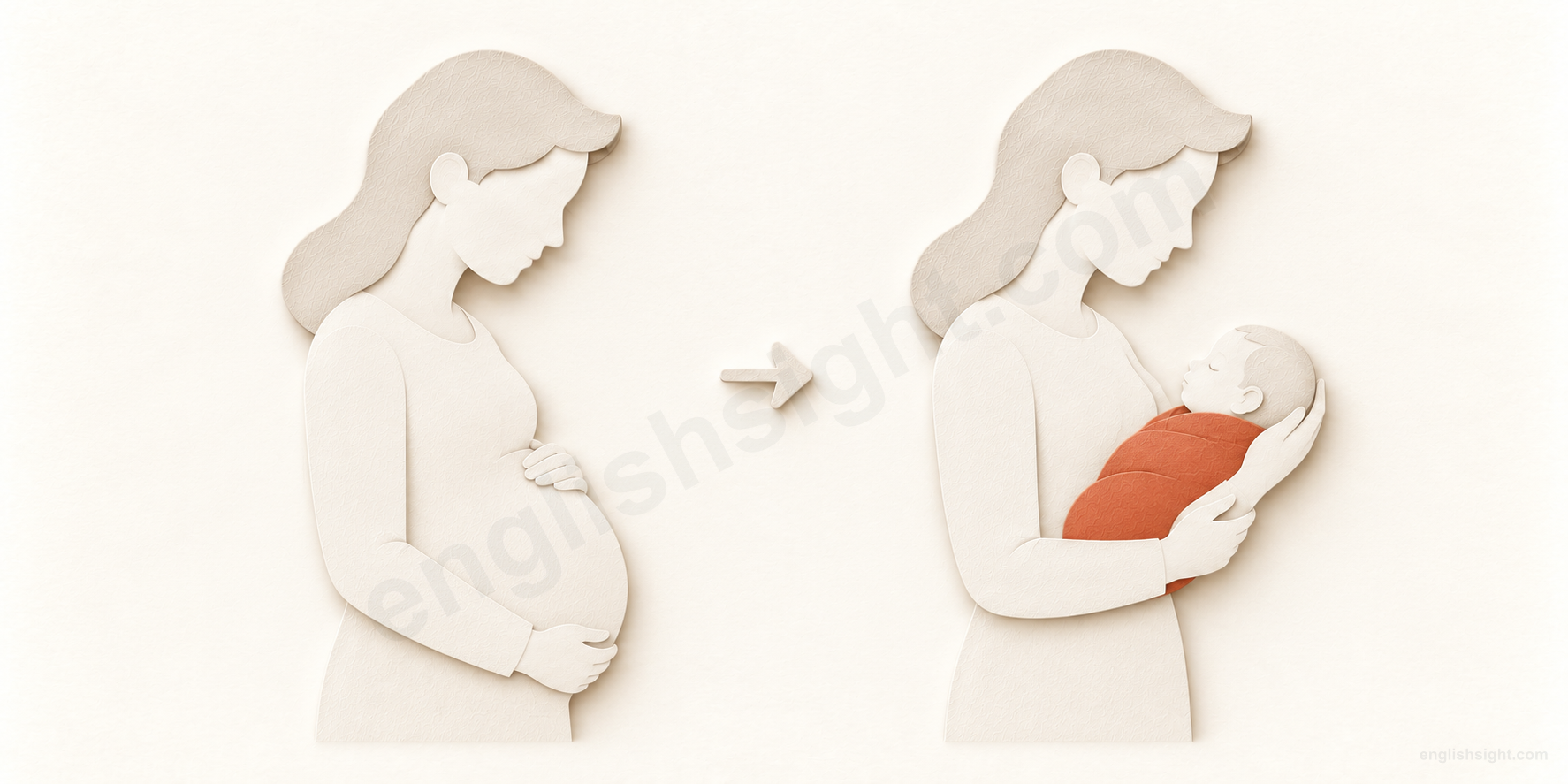
The mother is pregnant; the baby has not yet been born.
birth
The newborn is now outside the mother's body, supported in her arms.
The baby is born.
Before and after birth: the baby's arrival marks a new beginning.
Birth marks a baby’s arrival from its mother’s body; figuratively, it marks the beginning of something new.
A baby already develops before birth. This model focuses on being born, not on conception or a claim about when life begins. Origin and fixed compounds need the explanations below.
Birth usually names the event or process of a baby being born. It also helps us talk about the date, place, family, and circumstances connected with that event.
English extends the idea of an arrival to the birth of an idea or a movement. Learn the whole combination: at birth, by birth, birth mother, and birth control do different jobs.
01
The arrival of a baby
Name the event, say who gives birth, and distinguish the moment of birth from the time that follows it.
01
the birth of + person; a/an + adjective + birth; births
the birth of a baby
the event or process of a baby being born
Situation / starting point
A family is waiting for a baby to be born.
What is described
They announce the baby’s arrival.
Birth names the event; the baby is the one being born.
Use the birth of someone to identify whose arrival you mean: the birth of our son. Birth can name a process as well as an event. A difficult birth describes how it happened.
Count separate events with a birth or births: The clinic recorded twelve births. Without an article, birth can refer to the process in general, as in preparing for birth. The choice depends on whether you mean an individual event or the process.
In a sentence
We celebrated the birth of our niece with a small family meal.
Watch the difference Birth is a noun here. To make the baby the subject, say Our niece was born, not Our niece was birth.
02
someone gives / gave / has given birth (to + baby or young animal)
give birth (to a baby)
bring a baby or young animal into the world
Situation / starting point
A pregnant woman is about to have a baby.
What is described
The baby is born.
The person giving birth and the baby being born have different grammatical roles.
In Lina gave birth to a son, Lina is the person who gives birth and a son names the baby. Use to before the baby, or leave that part out: Lina gave birth yesterday. The expression also applies to animals, as in The cat gave birth to four kittens.
Give changes with tense: gives birth, gave birth, has given birth, is giving birth. Birth stays singular without an article in this fixed expression. Compare Her son was born yesterday: the child is now the subject. Have a baby is a less formal alternative in many everyday situations.
In a sentence
Lina gave birth to twins on Monday.
Watch the difference Say gave birth to twins, not gave a birth or gave birth twins. This is a fixed verb–noun expression, not a separable phrasal verb.
03
be / weigh + description + at birth; be present at the birth
at birth
at the time a baby is born
Situation / starting point
Someone asks about a baby’s condition at the beginning.
What is described
You describe the condition at that time.
At selects the birth event as a time point.
At birth answers when a condition or measurement applied. It can describe size, weight, or another state then, without telling us whether that state continued.
At the birth has a different focus when you mean attendance at a particular event: Her partner was present at the birth. The article points to that specific birth; at birth is the familiar expression for the time of being born.
In a sentence
Noah had very dark hair at birth.
Watch the difference At birth does not by itself mean throughout someone’s life. It also does not mean every birthday.
04
from birth (to + later stage); have / has + past participle + since birth
from birth / since birth
starting when someone was born
Situation / starting point
You describe a situation that began at a person’s birth.
What is described
The description extends into a later period.
From and since add a starting point and a stretch of time.
From birth places the beginning of a period at birth: The study followed the children from birth to age five. It can describe a completed period, so it does not necessarily mean until now.
Since birth often connects that starting point with the present: She has lived here since birth. The present perfect fits a situation continuing now; had lived there since birth would connect it with a later point in the past. The time relationship comes from the preposition and tense, not from a new sense of birth.
In a sentence
Amir has lived in this village since birth.
Watch the difference For a continuing situation, use has lived here since birth, not lives here since birth. Contrast at birth, which focuses on that time.
05
have a home / hospital birth; a premature / difficult birth; a birth plan
a home birth / a premature birth
describe where or under what circumstances a birth happens
Situation / starting point
A conversation concerns the place or timing of childbirth.
What is described
A modifier specifies the kind of birth.
Home identifies a place; premature identifies earlier-than-expected timing.
A home birth happens at home. Compare a hospital birth: the modifier changes the setting, not who is born. Have a home birth describes someone’s childbirth experience.
A premature birth happens before the usual or expected time in pregnancy. A difficult birth describes difficulty during the process. These are combinations with the event noun, not separate meanings of birth. A birth plan is a plan about preferences for childbirth.
In a sentence
The memoir describes her home birth in a mountain village.
Watch the difference Home birth names the setting of childbirth; it does not mean a baby’s first visit home.
02
Names, dates, and official records
Birth connects a person’s beginning with the information recorded about it. These expressions are useful on forms and in family histories.
06
someone’s date / place / country of birth; birth date; DOB
date and place of birth
the exact date and location of someone’s birth
Situation / starting point
A form asks for personal details.
What is described
You supply when and where you were born.
Of birth links each requested detail to the same event.
Date of birth normally includes the day, month, and year. On forms, DOB abbreviates date of birth. Place of birth asks where you were born; country of birth narrows that to the country.
Your birthday is normally the day and month celebrated each year. Your date of birth identifies the original date including the year. On forms, birth date is another way to label that information. Place of birth and current address can be different.
In a sentence
The application asks for your full name, date of birth, and place of birth.
Watch the difference Use date of birth, not date of born. Born is used with a subject and be: I was born in June.
07
register a birth; birth records; a copy of + possessive + birth certificate
register a birth / birth certificate
record a birth officially or name the document confirming it
Situation / starting point
A baby has been born.
What is described
The event is entered in records, and a document can confirm its details.
A record of a birth is separate from the birth itself.
Register a birth means put the birth into an official record. Birth records are the stored details of births. Register takes a birth as its object; a birth certificate is a countable document.
A birth certificate records when and where someone was born. You can request a copy of your birth certificate. Birth stays singular before certificate even in the plural birth certificates. The lesson explains the language; procedures and document contents vary by place.
In a sentence
I found a copy of my grandfather’s birth certificate in the old file.
Watch the difference A birth certificate is a document, not a celebration or a record of every birthday.
08
someone’s birth name; someone’s birth name was + name
birth name
the name a person was given at birth
Situation / starting point
A biography uses a name different from the person’s current name.
What is described
It identifies the earlier name given at birth.
Birth specifies when the name was given, not which name someone uses now.
A birth name can differ from a current name or a stage name. It may include more than a surname, depending on the context.
The expression reports naming history. It does not mean a person’s current name is less valid. When addressing someone, use the name they ask you to use.
In a sentence
The singer’s birth name was Daniel Reed, but he performs as Dan Rivers.
Watch the difference Birth name is not automatically the same as a previous married name or every earlier name a person has used.
03
Origin and family relationships
Birth can refer to where someone comes from, the family they were born into, or a biological relationship. Read the whole expression to choose the intended meaning.
09
be + origin description + by birth; the country / land of + possessive + birth
by birth / the country of your birth
origin connected with being born in a place or family
Situation / starting point
Someone’s origins differ from where they live now.
What is described
You explain their background at birth.
By birth points to origin, rather than a later move or choice.
A person described as Italian by birth has an Italian origin through birthplace or family. The exact connection depends on context. The country of her birth identifies where she was born.
This is a phrase about origins. It does not alone tell us someone’s current address, everyday language, or present nationality. If birthplace is the only point you need, She was born in Italy is more precise.
In a sentence
Elena is Italian by birth and has made her home in Norway.
Watch the difference Do not read by birth as since birth: by explains origin, while since introduces a starting time.
10
be of noble / humble birth; a person of + description + birth
of noble birth
born into a family with a particular social position
Situation / starting point
A history describes a family’s position in society.
What is described
It classifies someone by the family they were born into.
Birth refers to family background rather than an individual’s achievements.
Of noble birth describes someone born into a noble family. Of humble birth describes a family background with little social rank or wealth. These expressions are especially useful for reading history and biographies.
This branch uses birth for inherited social background. It does not say anything about a person’s value, ability, or character. In everyday introductions, a direct description of someone’s family is often clearer.
In a sentence
The novel’s hero is of humble birth and later becomes a respected judge.
Watch the difference Of noble birth does not mean born behaving nobly; the phrase concerns family status.
11
someone’s birth mother / birth father / birth parents
birth mother / birth father / birth parents
identify a biological family relationship, often in adoption contexts
Situation / starting point
A family history distinguishes biological and adoptive relationships.
What is described
The expression identifies the biological relationship being discussed.
Birth before a family word classifies the relationship, not the quality of parenting.
Birth mother refers to the woman who gave birth to someone, especially when the child was adopted. Birth father refers to a biological father. Birth parents is the corresponding plural expression.
Here birth modifies a noun; dictionaries may label it an adjective or describe the combination separately. Contrast adoptive parents, who become parents through adoption. The distinction does not tell us who raised the person, how close the relationships are, or whom they call Mum or Dad.
In a sentence
As an adult, Maya chose to contact her birth mother.
Watch the difference Birth mother is not a synonym for midwife, and birth father is not the person who helps deliver a baby.
04
When something new begins
English extends birth to the beginning of ideas, organizations, and ways of life. The connection is a metaphor, not a claim that these things are babies.
12
the birth of + idea / movement / organization / new era
the birth of an idea
the beginning of something new
Situation / starting point
An idea or organization has not yet taken shape.
What is described
It begins to exist in a recognizable form.
The image of arrival extends to a new idea, movement, or institution.
The birth of an idea, a nation, or a movement presents its beginning as a significant arrival. There is no literal baby. The thing after of is what begins.
This use often appears in history, commentary, and accounts of creative work. Start or beginning is usually plainer. The metaphor need not identify one exact moment, and it does not imply that nothing led up to that beginning.
In a sentence
A conversation on the last train marked the birth of their idea for a community café.
Watch the difference The birth of the project concerns its beginning, not automatically its completion or success.
13
something gives / gave birth to + idea / organization / movement
give birth to an idea
cause something new to begin
Situation / starting point
An experience or event provides the source of a new development.
What is described
A new idea or organization results.
The subject is the source; the noun after to is what begins.
In figurative give birth to, the subject can be an event, conversation, or experience rather than a person giving birth. The full expression means originate or bring something into existence.
Contrast the birth of the club, which names the beginning, with The meeting gave birth to the club, which identifies a cause. This is an established metaphor, not a rule that every give plus a noun means create.
In a sentence
Their shared frustration gave birth to a plan for a local repair service.
Watch the difference Keep to before the result. The phrase describes origin; it does not merely mean handing an existing idea to another person.
14
the birth pangs of + new development; experience / go through birth pangs
birth pangs
pains of childbirth, or difficulties while something new is being created
Situation / starting point
A new organization is taking shape but has early problems.
What is described
Someone compares those problems to childbirth pains.
Pangs adds difficulty to the image of a beginning.
Literally, birth pangs are pains associated with childbirth. Figuratively, the birth pangs of a new organization are the difficulties involved in bringing it into existence.
The figurative use is expressive and often appears in commentary. It concerns formation or early development, rather than every later setback. The baby-arrival model helps explain the metaphor, but pangs contributes the pain and struggle.
In a sentence
The new arts centre went through birth pangs as the team struggled to agree on its role.
Watch the difference Learn the expression birth pangs for pains or early difficulties; a singular birth pang is also possible. It does not mean a baby feeling pain because of its age.
15
birth + object; births / birthed / birthing
birth / birthed
use birth as a verb meaning bring into existence or give birth
Situation / starting point
A writer chooses an expressive verb for an origin story.
What is described
The sentence presents someone or something as creating a new result.
Birth can be a verb, but give birth and begin are easier neutral choices.
You may meet birthed in a sentence such as The workshop birthed a new project. The verb takes the created thing as its object. Forms are births, birthed, and birthing; this noun lesson includes the verb so you can recognize it.
Dictionaries differ in their treatment: Collins marks its British childbearing verb as rare, while Merriam-Webster also lists a figurative originate sense and an intransitive use. For ordinary news about a baby, say gave birth or was born. Do not replace was born with was birthed as a general learner rule.
In a sentence
The review says the weekend workshop “birthed a new theatre company.”
Watch the difference The noun plural births and the verb form births have the same spelling. Grammar tells you which is being used.
05
Population and health vocabulary
In established combinations, birth identifies what a rate, method, measurement, or condition concerns. The other word supplies much of the meaning.
16
a high / low birth rate; the birth rate rises / falls
birth rate
a population measure of how many babies are born
Situation / starting point
A report compares births with the size of a population.
What is described
It gives a rate that can rise or fall.
Rate measures births relative to a population and time period.
A birth rate is commonly expressed as births per thousand people in a year. A high or low birth rate describes that measure; a rising or falling birth rate describes its change.
The number of births is a count; the birth rate relates births to the population. A larger population can have more births without having a higher birth rate. Birth remains singular in birth rates.
In a sentence
The article compares birth rates in towns with very different populations.
Watch the difference Do not confuse a birth rate with a single baby’s heart rate or with the raw total of births.
17
use birth control; a method / form of birth control; birth-control pills
birth control
contraception used to prevent pregnancy and plan childbearing
Situation / starting point
A conversation concerns preventing pregnancy.
What is described
Birth control names the general practice or methods involved.
This fixed combination concerns preventing pregnancy, not controlling labour.
Use birth control as an uncountable expression: information about birth control, a method of birth control, or use birth control. A birth-control pill is one kind of contraceptive, not the meaning of the whole category.
The compound has an established meaning. It does not mean a midwife directing the process of childbirth or a rule for children’s behaviour.
In a sentence
The leaflet explains several methods of birth control.
Watch the difference Say a method of birth control, not a birth control when you mean one method.
18
someone’s birth weight; a low / high birth weight
birth weight
how much a baby weighs when first born
Situation / starting point
A record gives a baby’s first weight measurement.
What is described
The measurement is labelled birth weight.
Birth fixes the time of the weight measurement.
A baby’s birth weight is the weight recorded when the baby is newly born. The phrase is a compact way to say weight at birth.
Compare Her birth weight was 3.2 kilograms with She weighs 5 kilograms now. The first measurement belongs to the beginning, even though the baby’s weight later changes. Birth weights can compare several babies’ measurements.
In a sentence
The baby book lists her birth weight as 3.2 kilograms.
Watch the difference Birth weight is the measurement, not the baby’s current weight or the mother’s weight.
19
a birth defect; be born with + a birth defect; birth defects
birth defect
a problem in body structure or function that is present at birth
Situation / starting point
A text describes a condition present when a baby was born.
What is described
It uses the established term birth defect.
The term identifies a condition present at birth; it does not itself identify a cause.
Birth defect is a countable term used in health information: a birth defect, birth defects. It refers to a problem present at birth, rather than an injury acquired later.
Do not infer from the phrase alone that the condition was caused during childbirth or inherited from a parent. Here birth specifies when it is present. In personal conversation, a specific condition name may be clearer than this broad term.
In a sentence
The report studies how families of children with birth defects find support.
Watch the difference The term describes a condition, not a person. Present at birth does not by itself mean caused by the process of giving birth.
Keep the event, the person, and the construction distinct
Birth, born, and give birth
Birth is normally a noun: her birth. Use be born for the person arriving: She was born in May. Born is the past participle of bear used in this pattern, not the past tense of birth. Compare Her mother gave birth in May: her mother is now the subject of give birth.
One event, a process, or an origin
A difficult birth and twelve births count events. At birth and give birth use no article in their usual patterns. The birth of a movement names its beginning; by birth and of noble birth describe origins. These are choices of meaning and construction, not one article rule for every phrase.
Compounds contribute their own meanings
In birth certificate and birth rate, birth modifies another noun and stays singular. Birth mother and birth control have established meanings that cannot be recovered just by translating birth alone. The noun has no phrasal-verb family; give birth to is a fixed phrase with the verb give.
Pronunciation and spelling
Birth is pronounced /bɜːθ/ in British English and /bɜːrθ/ in American English. The final sound is the unvoiced th sound, as in think. Birth and berth sound alike in these varieties, but berth means a sleeping place on transport or a place for a ship.
Scope and the teaching picture
The diagram is a teaching model for a birth event, not a picture shared by all English speakers. This lesson covers common modern meanings and selected compounds, with a recognition note on the verb. It does not explain every medical term, historical sense, regional use, or word built from birth.
Choose the meaning and the pattern
Read the situation, then choose the expression that fits.
1. Lina’s baby arrived yesterday. Which sentence correctly makes Lina the subject?
2. A record only tells you that a baby had dark hair when first born. It says nothing about later hair colour. Which phrase fits?
3. You want to describe Elena’s Italian origin, not how long she has lived somewhere. Which expression fits?
4. A form asks for your date of birth. What information normally belongs there?
5. In “Their conversation gave birth to a plan,” what does gave birth to mean?
6. A leaflet discusses methods of birth control. What is its topic?
7. In a biography about adoption, who is someone’s birth mother?
Sources and teaching notes
The dictionary pages below support the meanings and patterns. Explanations and examples are original; the before-and-after picture is a teaching model.
This picture explains a connection; it does not represent a mental image shared by every English speaker.