Understand pieces, amounts, degrees, familiar expressions, and the other words spelled bit.
A small portion in a larger context
Focus on a small portion
The whole sheet
bit
A bit of the sheet
Focus on a small portion.
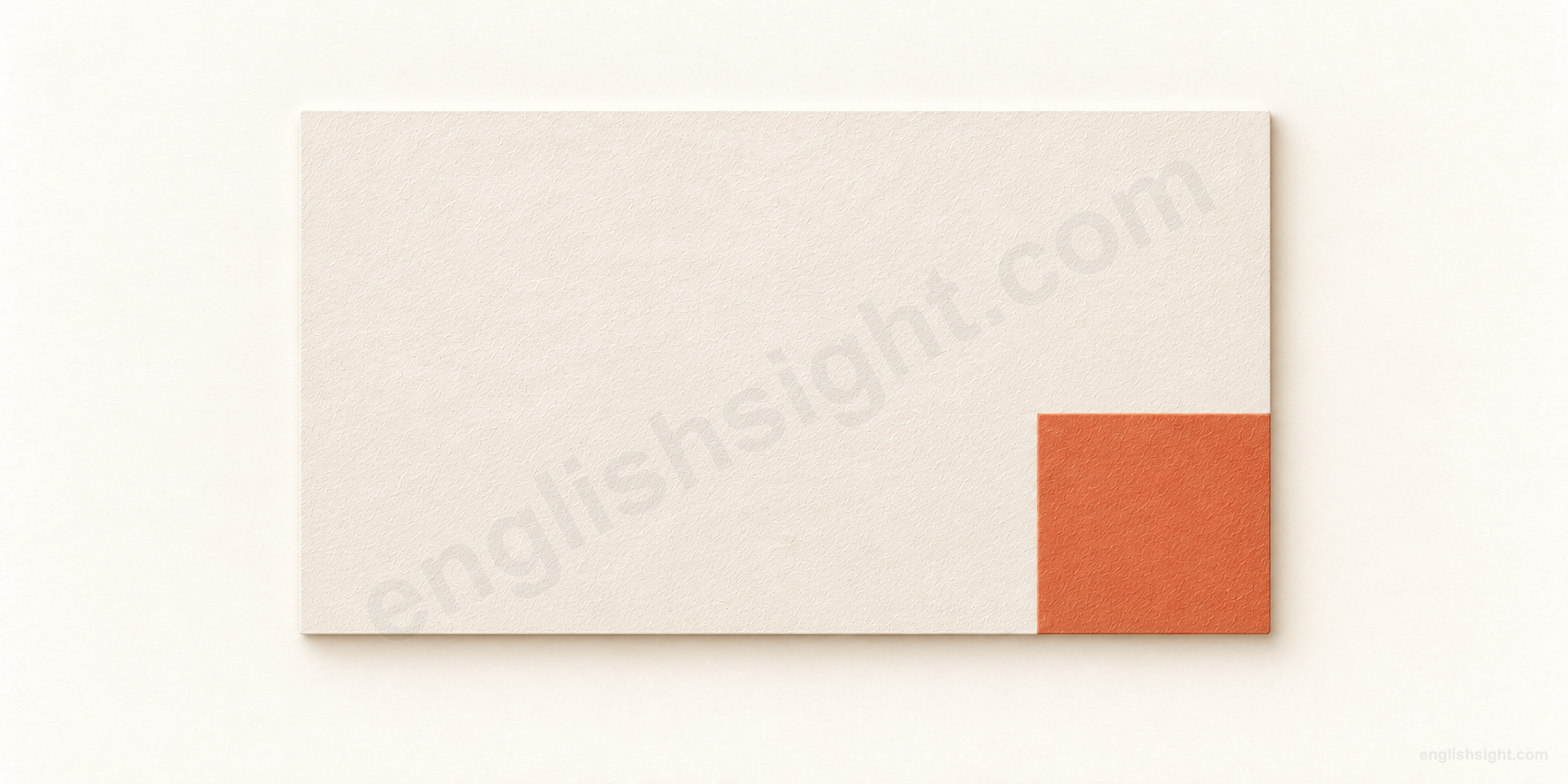
The orange region picks out a small portion while the sheet remains whole. This models the main part-and-amount uses of bit.
In its main amount-and-part family, bit picks out a small portion, amount, or extent rather than specifying the whole.
The sheet models a whole-to-portion relationship, not a required action of cutting or breaking. It helps with the main family; technical object names, fixed idioms, and the past form of bite need their own explanations.
A bit often presents something as a small part, amount, or extent within a larger context. That portion might be paper, time, help, information, or a degree of coldness.
The surrounding expression can change the message: quite a bit can mean a lot, not a bit means none at all, and a computer bit has a precise technical meaning. Begin with the connection, then read the full pattern.
01
Pieces, amounts, and parts
Start with a small portion of material, an amount, or an identifiable part of something. What follows of tells you what kind of portion you mean.
01
a bit of + material / identified whole; bits of + material
a bit of paper / bits of glass
a small piece of a material or object
Context
A scrap of paper is caught under a chair.
What the expression conveys
You identify the scrap as a small portion of paper.
Bit names the portion; of names its material or source.
A bit of paper can be a small scrap, without a precise size or shape. Two bits of paper counts the scraps, not sheets. A piece is a more neutral choice; bit often sounds conversational.
With a particular whole, use its identifying words: a bit of the apple means a small part of that apple. A broken-off piece is possible, but bit does not itself say that someone broke or cut anything.
In a sentence
There is a tiny bit of green paper under your chair.
Watch the difference Make bit plural when counting pieces: three bits of paper, not three bit of paper.
02
a (little) bit of + uncountable noun; a bit when the noun is understood
a bit of milk / work / luck
some of something, presented as a small amount
Context
Your tea needs a small addition of milk.
What the expression conveys
You ask for an amount without measuring it.
The quantity need not be a separate physical piece.
A bit of milk, time, or work treats an uncountable thing as a small amount. A little is a close alternative; a bit of is informal. With a bit of luck means if we have some luck.
A bit of time suggests there is some time available. Very little time emphasizes how limited it is. Neither expression gives an exact number of minutes.
Use a few for a small number of whole countable things: a few coins. A bit of money measures an amount instead. If the thing is understood, you can omit of and the noun: “Any milk left?” “A bit.”
In a sentence
Could you put a bit of milk in my tea?
Watch the difference Keep of before milk, but say a bit cold without of before an adjective.
03
one / a useful bit of + advice / information / news; bits of + uncountable noun
a bit of advice / information
one item of something normally expressed by an uncountable noun
Context
A friend offers a useful suggestion.
What the expression conveys
You count it as one item of advice.
Bit supplies a countable unit without changing advice or information.
A bit of advice can introduce a single suggestion. Bits of information can be separate facts. The unit may be quite important; bit does not mean the information has little value.
Compare one bit of advice is helpful with these bits of advice are helpful. Agreement follows bit or bits. In neutral or formal writing, a piece of advice or an item of information is often a clearer choice.
In a sentence
The most useful bit of advice was to save a copy first.
Watch the difference Say two bits of information, not two informations. A bit of advice is not an advice.
04
the + descriptive word + bit of + whole; the bit about + topic
the best bit / the bit about…
an identifiable part of a larger event, text, or experience
Context
You are discussing a long film.
What the expression conveys
You single out the section you enjoyed most.
A part can be abstract and need not be physically detached.
The best bit of a film is the part you like best. The bit about the train identifies a section by its subject. This use is especially characteristic of informal British English; part is a widely neutral alternative.
A bit of the story means some of it. The bit of the story that made me laugh points to a particular section. The article and the following description help the listener identify it.
In a sentence
My favorite bit of the film was the scene on the roof.
Watch the difference Bit can mean a section here, so do not assume it refers to a tiny physical object.
05
some / a few bits and pieces; bits and bobs
bits and pieces / bits and bobs
a collection of assorted small things
Context
A drawer contains buttons, clips, and spare parts.
What the expression conveys
You refer to the collection without listing every item.
The items can be whole small objects, not fragments of one object.
Bits and pieces is an informal way to group miscellaneous items. Bits and bobs is a familiar British alternative. The words do not divide the collection into one category of bits and another of pieces.
The expression can also cover small, assorted tasks or fragments of information: I heard bits and pieces of the conversation. Context tells you whether the items are physical.
In a sentence
I keep spare buttons and other bits and pieces in this drawer.
Watch the difference Small objects in this collection do not have to be broken or useless.
02
Small degrees, bigger amounts, and tact
A bit can modify a description or an action. The full expression matters: quite a bit can be substantial, and apparently mild words can soften a strong complaint.
06
a (little) bit + adjective; a bit like + noun phrase; a bit on the + adjective + side
a bit cold / a little bit nervous
to a small extent, or expressed in a mild way
Context
The room feels cooler than you would like.
What the expression conveys
You describe the degree of coldness mildly.
A bit modifies a description instead of naming a piece.
A bit cold means somewhat cold. There is no of before the adjective. A little bit cold is another conversational form. After a question, the adjective may be understood: “Nervous?” “A bit.”
The phrase can soften criticism: That sounds a bit harsh is less blunt than That is harsh. It does not provide an exact measurement. A bit like a castle expresses a limited resemblance, rather than a piece of a castle.
A bit on the expensive side is a tactful way to say something is somewhat too expensive. On the…side contributes the evaluation; bit supplies the degree. This adjective pattern is different from the slang expression a bit on the side.
In a sentence
The room is a bit cold, so I will close the window.
Watch the difference Use a bit cold, not a bit of cold. In British English a bit is especially common; a little or a little bit is often preferred in North American English.
07
verb + a bit; move / walk + a bit (further)
help a bit / move a bit
affect something to a limited extent or move a short distance
Context
A chair is slightly too close to the doorway.
What the expression conveys
A small movement creates enough room.
The verb supplies the action; a bit supplies its small extent.
Move the chair a bit asks for a short movement, not a different piece of the chair. Turn the music down a bit asks for a small change in volume. Help a bit describes a limited contribution.
With actions, a bit can concern degree, distance, or time. Walking a bit might mean a short distance or a short time; a bit further makes the distance reading clear. Bit is not a verb particle.
In a sentence
Could you move the chair a bit to the left?
Watch the difference A bit does not specify a direction. To the left, further, or the surrounding situation supplies it.
08
a bit + comparative; a bit more / less + uncountable noun; a bit too + adjective
a bit better / more / less
a small difference between two amounts or degrees
Context
You compare this morning’s condition with yesterday’s.
What the expression conveys
You report a modest improvement.
The comparative gives the direction of comparison; a bit gives its size.
A bit better means better by a small degree. A bit more time means a small additional amount of time; a bit less noise means a small reduction. Bit does not itself mean improvement.
Compare I feel a bit better with I feel a bit worse. The same a bit works in both directions. A bit too big also describes degree, but too says the size exceeds what is wanted.
In a sentence
I feel a bit better this morning, but I still need to rest.
Watch the difference Say a bit better, not a bit more better. Better is already the comparative of good.
09
a bit of a / an + singular countable description
a bit of a problem
rather a problem, often presented less directly
Context
A practical difficulty has appeared.
What the expression conveys
You describe it with softened wording.
The whole expression modifies how you classify or judge the situation.
We have a bit of a problem usually means we have something of a problem. It does not describe a physically separate piece of one. This informal construction is especially familiar in British English and often accompanies an unwelcome judgment.
Keep the second article before a singular countable description: a bit of a problem, a bit of an obstacle. Compare a bit of a cake, which can literally mean a small portion of a cake; the noun and context decide.
In a sentence
The missing key is a bit of a problem because the spare is inside.
Watch the difference A bit of problem is not the usual form for one difficulty; use a bit of a problem.
10
quite a bit / a fair bit / a good bit; quite a bit of + noun; quite a bit + comparative
quite a bit / a fair bit / a good bit
a fairly large amount or a considerable degree
Context
You compare a costly repair with a cheaper one.
What the expression conveys
You emphasize that the price difference is substantial.
The established combination can describe a lot, despite the word bit.
Quite a bit of money is a substantial amount. Quite a bit cheaper describes a considerable difference. Quite a bit can also stand alone when the quantity or action is understood.
A fair bit and a good bit also describe appreciable amounts in informal speech. Compare It helped a bit with It helped quite a bit: the second normally reports more help. Read these combinations as units rather than calculating bit plus quite.
In a sentence
Repairing the old bike cost quite a bit more than we expected.
Watch the difference Quite a bit does not normally mean only a tiny amount. For whole countable items, quite a few bikes is the natural quantity expression.
11
take a bit of + -ing phrase; just a bit! as an emphatic response
take a bit of getting used to
require some, sometimes considerable, time or effort to become familiar
Context
A new keyboard layout slows you down.
What the expression conveys
You acknowledge that adapting will take effort.
Mild quantity wording can understate a substantial difficulty.
This takes a bit of getting used to says becoming comfortable with it is not immediate. In context, the speaker may mean that it takes quite a lot of time or adjustment.
The -ing phrase names the process: getting used to the layout. Here of follows bit, and used to contains the preposition to. In British conversation, a stressed “Just a bit!” can likewise agree that something is very difficult or extreme, rather than slight.
In a sentence
This keyboard layout takes a bit of getting used to, especially when I type quickly.
Watch the difference Do not assume that bit always makes a difficulty trivial. Context and tone may turn mild wording into understatement.
03
A short time now or later
Compare the time spent doing something with the delay before something happens. For and in answer different questions.
12
wait / talk + a bit; verb + for a bit
wait a bit / stay for a bit
do something for a short period
Context
A friend stops at your home.
What the expression conveys
The visit lasts a short while.
A bit measures duration, not a delay before starting.
Wait a bit and wait for a bit can both describe a short wait. Stay for a bit describes a short stay. These conversational phrases leave the length open; it may be minutes or longer depending on the situation.
For introduces the duration. Compare I will work for a bit with I will work in a bit: the first describes how long I will work; the second locates the start a short time from now.
In a sentence
Maya stayed for a bit and helped us choose the photos.
Watch the difference For a bit does not by itself mean later. It answers how long, not how soon.
13
future event + in a bit; see you in a bit
see you in a bit
after a short time from now
Context
You will finish a small task before joining a friend.
What the expression conveys
You expect to meet after a short delay.
In places the event later; bit keeps the delay vague.
I will call you in a bit promises a call fairly soon, without fixing a time. It does not say that the call itself will be short. The same timing appears in See you in a bit.
For a bit measures duration instead. If a precise time matters, say in ten minutes or at six rather than relying on the listener to interpret a bit.
In a sentence
I am finishing this email; I will call you in a bit.
Watch the difference I will call in a bit and I will talk for a bit answer different timing questions.
04
Progress, contributions, comparisons, and replies
Learn these combinations as expressions. Their grammar shows whether you mean gradual progress, a share of work, full equality, complete denial, or an unreasonable demand.
14
bit by bit + clause; verb + bit by bit
bit by bit
gradually, in small stages
Context
A long task is not yet finished.
What the expression conveys
Repeated small steps make progress.
The repeated unit creates a sequence of small advances.
Bit by bit describes progress through stages. The stages can be physical pieces or changes in understanding: Bit by bit, the instructions began to make sense.
It contrasts with all at once. It does not specify a fixed rate or promise that the task will be completed. The phrase normally has no article and does not change for a plural subject.
In a sentence
We restored the garden bit by bit over several weekends.
Watch the difference Say bit by bit, not a bit by a bit, for the established expression.
15
do + my / your / her / our / their + bit; do your bit by + -ing
do your bit
contribute your share to a shared task or purpose
Context
Several people are cleaning a shared space.
What the expression conveys
You help by completing one useful part.
Your bit is a contribution to the larger effort.
Do your bit is an informal invitation to help a collective effort. Your part may be small, but it contributes to the shared aim. By + -ing can explain the contribution.
Change the possessive with the contributor: I did my bit; they did their bit. Compare I did a bit of cleaning, which reports some cleaning without necessarily presenting it as a share of a collective task.
Every little bit helps encourages even a small contribution: “I can only give ten minutes.” “Every little bit helps.” It values each contribution, whereas do your bit asks someone to contribute their share.
In a sentence
We did our bit by clearing the tables after the community lunch.
Watch the difference The expression concerns helping; it does not mean doing every part of the job yourself.
16
every bit as + adjective / adverb + as + comparison
every bit as good as
fully equal in the quality being compared
Context
A cheaper option might be expected to perform worse.
What the expression conveys
You emphasize that it matches the other option.
Every bit emphasizes full equality, not a small difference.
Every bit as useful as means just as useful as. The quality can be positive or negative: every bit as difficult as is also possible. As…as supplies the comparison.
Compare a bit better than, which marks a small difference. In every bit of the meal, every bit instead refers to all portions of a whole; there is no as…as comparison.
In a sentence
The small library is every bit as useful as the larger one.
Watch the difference Keep as on both sides of the quality: as useful as, not as useful than.
17
not a bit + adjective; not the least / slightest bit + adjective; negative verb + one bit
not a bit / not one bit / not the least bit
not at all
Context
Someone expects you to be worried.
What the expression conveys
You deny even a small degree of worry.
Negation excludes the smallest degree and therefore strengthens the denial.
I am not a bit worried is a strong negative, not a claim that I am somewhat worried. Not the least bit worried and I do not mind one bit work in the same emphatic direction. Not a bit can also be a short reply.
British informal not a blind bit of difference similarly means no difference at all. Compare not a bit tired with a bit tired: adding not removes even the small degree.
In a sentence
I do not mind one bit if we have to leave early.
Watch the difference Keep a negative verb in I do not mind one bit. I mind a bit gives the opposite message.
18
expected statement / question + not a bit of it!
not a bit of it!
emphatically reject an expectation or suggestion
Context
People expect a runner to stop after falling behind.
What the expression conveys
The runner continues, contrary to that expectation.
It refers to the proposed situation, not to a physical portion.
Not a bit of it! is a British informal response meaning that the expected or suggested thing is not true. It often introduces a contrast with what actually happened.
It is a complete conversational expression. Compare not a bit of the cake, which can literally deny having any of a particular cake; the following noun makes that a different construction.
In a sentence
We thought Jo would stop after the first lap, but not a bit of it—she kept running.
Watch the difference Do not use this phrase to mean a small amount remains. It strongly rejects the idea just mentioned.
19
be a bit much; it is a bit much to + verb; it is a bit much + -ing clause
a bit much
unreasonable or excessive
Context
Someone expects a favor at an inconvenient hour.
What the expression conveys
You object to the demand.
Mild wording can carry a clear complaint.
That is a bit much is an informal judgment that something goes too far. In British speech it can express annoyance while sounding less direct than That is unreasonable.
It is not a numerical quantity between little and much. Contrast a bit more work, which requests an additional amount, with It is a bit much to expect this, which challenges the expectation.
In a sentence
It is a bit much to expect us to answer work messages at midnight.
Watch the difference A bit much can be a strong objection. Do not assume the speaker is only mildly inconvenienced.
05
Coming apart and strong feelings
Bits can be literal fragments. In familiar informal expressions, similar wording describes intense pleasure, affection, or distress.
20
fall to bits; verb + object + to bits; be in bits
fall to bits / smash or take something to bits
come apart, break something, or separate it into small pieces
Context
An object is whole or assembled.
What the expression conveys
It is in several pieces.
To introduces the resulting fragmented condition.
A toy fell to bits says it came apart. Someone smashed it to bits says an action broke it. Someone took it to bits can mean careful dismantling rather than accidental destruction.
The verb supplies how the change happened; to bits supplies the result. In The clock is in bits on the table, in describes the existing state instead. These are result and state phrases, not a verb bit.
In a sentence
We took the old clock to bits and laid the parts on a cloth.
Watch the difference To bits does not always imply an explosion or permanent damage; take to bits can describe deliberate disassembly.
21
be thrilled to bits + with / at / that / to-infinitive; love + someone + to bits
thrilled to bits / love someone to bits
extremely pleased, or love someone very much
Context
A welcome event causes strong happiness.
What the expression conveys
You emphasize how pleased you are.
The complete expression intensifies a feeling; nobody literally breaks apart.
Thrilled to bits means extremely pleased in informal speech. Thrilled to pieces is another form, especially in American English. The cause can follow with, at, that, or a to-infinitive, depending on the sentence.
Love someone to bits means love them very much. These familiar combinations carry the intensity; do not attach to bits to any adjective and expect a natural expression. They are separate from literal breakage.
In a sentence
Our neighbors were thrilled to bits with the photos of their new baby.
Watch the difference Thrilled to bits is positive. In bits about bad news normally describes distress instead.
22
person + be in bits + about / over + upsetting situation
be in bits
be very upset or emotionally distressed
Context
A person receives upsetting news.
What the expression conveys
They feel overwhelmed by it.
A fragmented state becomes a metaphor for emotional distress.
She is in bits is British informal wording for being very upset. With a person as subject and upsetting circumstances, it normally concerns feelings, not physical injury.
Compare The radio is in bits, which can literally describe its separate parts. To bits describes a result or an established intensifier; in bits describes a state. The preposition and the subject both matter.
In a sentence
Sam was in bits after hearing that his old school was closing.
Watch the difference Do not confuse being in bits with being a bit upset: the first describes strong distress, the second sounds milder.
06
A routine, a role, or a whole style
In entertainment and informal talk, bit can identify a short routine, a small acting role, or a recognizable set of behaviors.
23
a comedy bit; do / perform a bit about + topic
a comedy bit / do a bit about…
a short routine or segment performed for an audience
Context
A comedian has a longer show.
What the expression conveys
One short routine is identified by its topic.
A bit can be a planned performance, not an accidental fragment.
In entertainment, a bit can be a short comic routine. A bit about airport queues names its topic. The performer may do the same bit in several shows.
Compare the funniest bit of the show, which might simply mean a section an audience member enjoyed. A comedy bit identifies a performance unit. It is different again from an actor having a bit part.
In a sentence
The comedian did a clever bit about trying to remember passwords.
Watch the difference A bit in this sense is a routine; it need not be a single joke or a small acting role.
24
have / play a bit part in + production; a bit player
a bit part / a bit player
a small acting role, or an actor with such a role
Context
A film needs an actor for a brief appearance.
What the expression conveys
The actor plays a minor role.
Bit limits the size of the role within the production.
A bit part is a small role in a film or play. An actor who appears briefly in such a role can be called a bit player. The expression concerns the size of the role, not the actor’s talent.
Bit modifies part or player within the expression. Do not generalize it as a substitute for small before any noun: a small house is the normal wording, not a bit house.
In a sentence
She had a bit part as a ticket seller in her first film.
Watch the difference Playing a bit part and performing a comedy bit describe different things: a minor role versus a short routine.
25
the (whole) + descriptive noun / phrase + bit; do the + role + bit
the whole…bit / do the…bit
a recognizable set of behaviors, ideas, or activities
Context
Someone adopts a familiar style or role.
What the expression conveys
You group its associated behavior together, often dismissively.
Bit can label a whole performance or package of behavior.
The whole celebrity bit can refer to the attention, poses, and other behavior associated with being a celebrity. Do the offended guest bit presents someone’s behavior as a familiar routine.
This informal wording can sound critical or dismissive. Compare the best bit of the holiday, which simply selects a section. Whole…bit need not mean a small amount at all.
In a sentence
He arrived with dark glasses and bodyguards—the whole celebrity bit.
Watch the difference Calling someone’s behavior a bit may sound as if you think it is an act. Choose more neutral wording when that is not your intention.
07
Computers, tools, horses, and bite
These established meanings need their own definitions. A binary bit, a drill bit, a horse’s bit, and the past tense of bite cannot be predicted just by picturing a small portion.
26
one bit; several bits; a binary digit
a bit / binary digit
a basic unit of computer information with one of two values
Context
A computer needs to represent a two-way distinction.
What the expression conveys
One stored value can distinguish the two alternatives.
In computing, bit is a technical unit, not a vague amount.
A computer bit has one of two binary values, conventionally 0 or 1. Think of one yes-or-no choice as a learning analogy; the physical storage need not look like an ordinary switch.
This technical word was formed from binary digit. Compare a bit of information in everyday speech, which can mean one fact of any complexity. The everyday phrase does not specify a binary storage unit.
In a sentence
This setting uses one bit: 0 means off, and 1 means on.
Watch the difference A bit of news and a computer bit use different senses. The technical unit is countable: one bit, two bits.
27
fit / change / replace a drill bit; a bit for + material
a drill bit
the working tool fitted into a drill to make a hole
Context
You need a hole of a particular size.
What the expression conveys
You fit the appropriate cutting tool into the drill.
Bit names a functional tool part, not just any small piece.
The drill is the machine; the drill bit is the working attachment that cuts or bores the hole. You can replace the bit to suit the task.
In tool contexts, a request for another bit may omit drill because the tool is already understood. This is an established object name. Knowing that a bit can be a small portion is not enough to identify the right part.
In a sentence
I changed the drill bit before making the larger hole.
Watch the difference The bit is not the handle, battery, or the entire drill. Context identifies its working attachment.
28
a bit in a horse’s mouth; a bridle and bit
a horse’s bit
the mouthpiece of a bridle used to guide or control a horse
Context
A horse is fitted with a bridle.
What the expression conveys
The mouthpiece forms part of the rider’s means of control.
This bit is an item of riding equipment, not a small portion of the horse.
A bit is usually a metal mouthpiece placed in a horse’s mouth as part of its bridle. The reins connect with the bridle and bit so the rider can communicate control.
The word names the equipment. It helps explain the imagery in champing at the bit and getting the bit between your teeth, but the idioms have their own established meanings.
In a sentence
The riding instructor showed us where the bit sits in the horse’s mouth.
Watch the difference A horse’s bit is equipment. The horse bit the rope uses bit as the past tense of bite.
29
be champing / chomping at the bit + to-infinitive
be champing / chomping at the bit
be impatient to start doing something
Context
Someone is ready to begin but must wait.
What the expression conveys
They show strong eagerness to get started.
The idiom evokes restraint, not a small amount.
If people are champing at the bit to start, they are eager and impatient while something holds them back. Chomping at the bit is also an established variant.
The bit here belongs to horse equipment, so a picture of small pieces would miss the relevant image. In modern use, the subject is often a person waiting for permission, a date, or the right circumstances.
In a sentence
The new volunteers were champing at the bit to begin work in the garden.
Watch the difference This is an idiom about eagerness, not a statement that the people are literally chewing anything.
30
get / take the bit between + possessive + teeth
get / take the bit between your teeth
become enthusiastic and determined to pursue a task
Context
Someone has begun a demanding project.
What the expression conveys
They pursue it energetically and are hard to stop.
The familiar idiom emphasizes determination after engaging with the task.
Once someone gets the bit between their teeth, they become strongly engaged with a task and press ahead. Take the bit between your teeth is also used.
Compare champing at the bit, which emphasizes wanting to begin while being held back. Getting the bit between your teeth emphasizes energetic commitment and determination. Learn the full wording rather than changing teeth to mouth.
In a sentence
Once Asha got the bit between her teeth, she finished the whole proposal in a day.
Watch the difference This means enthusiastic determination, not being worried or literally holding a piece of something in the teeth.
31
subject + bit + object; bite–bit–bitten
the dog bit me
bit as the simple past of bite
Context
You describe an action that happened earlier.
What the expression conveys
Bit tells the listener that biting happened in the past.
The same spelling can be a verb form rather than a noun.
In The dog bit me, the dog is the subject and me receives the action. Bit is the past form of bite, pronounced /bɪt/. The base form bite has /aɪ/.
For ordinary standard learning patterns, use bite–bit–bitten: It bit me yesterday; it has bitten someone before; I was bitten. This is a form distinction, not a reason to treat every use of bit as a piece or quantity.
In a sentence
The puppy bit my sleeve while we were playing.
Watch the difference After did use bite: Did it bite you? After has use bitten in the standard pattern: It has bitten me.
Read the unit, the pattern, and the context
Bit and bits have different jobs
As a noun, bit is countable: a bit is, two bits are. In a bit tired or help a bit, the whole phrase works adverbially. Do not add of before an adjective. The ordinary noun plural is bits; the past tense bit belongs to bite.
A small amount is a viewpoint
There is no universal size for a bit of cake or a bit of time. Quite a bit, a fair bit, a good bit, and understatement can describe appreciable amounts. A serious problem can be introduced as a bit of a problem.
The whole phrase supplies the meaning
Bit is not a productive phrasal-verb particle. Do your bit is a contribution expression; to bits can be a result phrase or a familiar intensifier. These patterns should not be invented by freely replacing their nouns, verbs, or prepositions.
Useful coverage and recognition boundaries
The course includes the main quantity and degree grammar, time phrases, common idioms, entertainment uses, computer and tool nouns, horse equipment, and the form bit from bite. Historical coin senses, specialized tool parts, and sexual slang are recorded as boundaries in the coverage notes rather than expanded into beginner practice. Technical bitted / bitting, meaning fitting a horse with a bit, is a different verb from bite.
Choose the message
Use the context and the whole expression to decide what is meant.
1. You want a small amount of milk in your tea. Which request fits?
2. A repair cost quite a bit. What is the normal reading?
3. A friend says, “I will call you in a bit.” What does that tell you?
4. What does “I do not mind one bit” convey?
5. Someone is thrilled to bits with a present. What happened?
6. After a shared lunch, you did your bit by washing cups. What does that emphasize?
7. Choose the standard form after has when describing a dog using its teeth.
Sources and teaching notes
The sources below support the uses and grammar. Explanations, examples, practice, and the whole-to-portion sketch were created for this lesson. The sketch is a teaching model for one family of meanings.
The sketch highlights a small portion in relation to a whole. It does not represent every sense of bit or a picture shared by all speakers.