From a mouthful or a mark to sharp sensations, forceful responses, and familiar idioms.
Firm contact, with a visible or felt effect
Firm contact, with a visible or felt effect
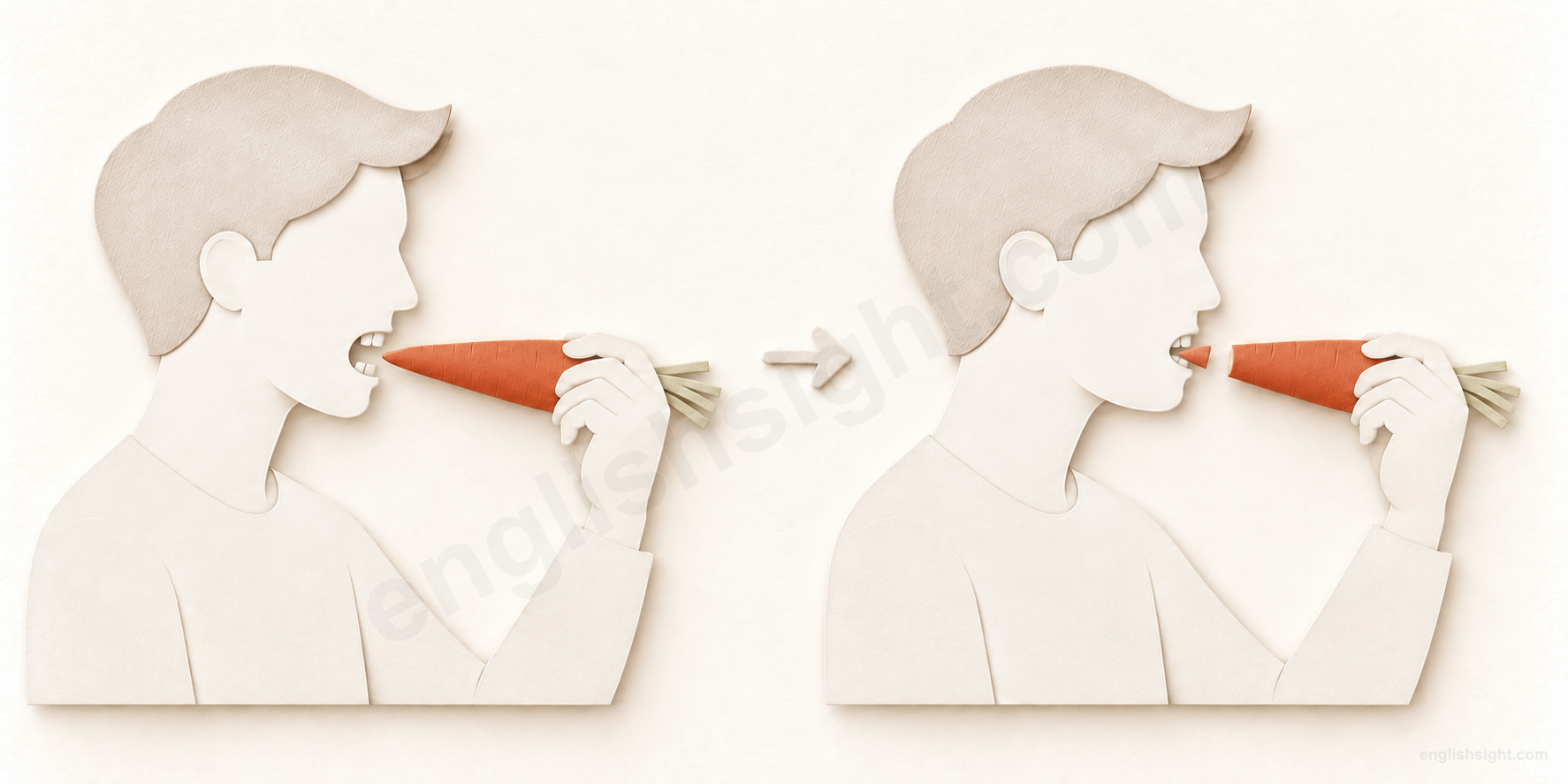
An intact carrot is held beside open teeth.
bite
A small tip remains between the teeth, separated from the carrot.
The teeth close on the carrot tip.
Closing teeth can grip, cut, or pierce. Here they cut off a carrot tip; not every bite removes a piece.
In a physical bite, teeth close on something to grip, cut, or pierce it. Related uses can highlight concentrated pressure, a sharp sensation, or a forceful effect.
The sketch illustrates cutting off food. Holding or marking something is also possible: not every bite removes a piece. The link to sharpness is a teaching model, not a claim about a picture shared by every speaker.
Bite can be a verb for an action or a noun for the action, a portion, a mark, or a quality. Start with teeth making firm contact, then read the surrounding words to find the intended meaning.
The contact model helps organize several uses. Established idioms still need to be learned as expressions; they are not predictions from a single hidden meaning.
01
Teeth, skin, and contact
Start with a physical action, then distinguish its direction, result, and the person or thing affected.
01
bite + person / thing; bite without an object
bite something; Does it bite?
close teeth on a person or thing
Situation before
A puppy reaches for a towel.
Action or interpretation
Its teeth catch the cloth.
Biting names tooth contact; eating is only one possible purpose.
The subject does the biting, and a direct object names the target: The puppy bit the towel. Without an object, Does it bite? asks about an animal’s behavior. A bite can hold, pinch, or cut; it need not remove a piece.
I won’t bite! is also a playful invitation to approach or talk without fear. The speaker presents themselves as approachable; they are usually not discussing an actual attack.
Bite at can direct attention to the target of biting: The puppy bit at the towel as I pulled it away. This wording does not tell you that the puppy held on or removed a piece.
Example
The puppy bit the towel and would not let go.
Watch the difference Bite is not a general replacement for eat. You eat soup, but normally do not bite it.
02
bite + possessive + nails
bite your nails
use teeth on your fingernails
Situation before
A person waits nervously.
Action or interpretation
Their teeth work at a fingernail.
The object can be part of the biter’s own body.
Bite your nails describes the action or habit. The possessive follows the person: I bite my nails; she bites hers. Nervousness is a possible context, not part of the verb’s definition.
Compare chew: chewing typically involves repeated jaw movements to break something down. A bite may be just one closing movement. Neither word automatically says the material is swallowed.
Example
I bite my nails when I am waiting for difficult news.
Watch the difference Use nails for the body part; nail-biting as an adjective can instead describe a tense event.
03
bite into / through + thing; bite + thing + in half / in two
bite into / through something
penetrate a surface or cut all the way through
Situation before
A person puts a crisp roll near their teeth.
Action or interpretation
The teeth enter the crust or cut through it.
Into shows entry; through adds passage across the material.
Bite into a roll directs attention to teeth entering it, often at the start of eating. Bite through a cord means cutting through its thickness with teeth. Through supplies the more complete result.
Bite something in half or in two names the result in another way: She bit the wafer in half. These are useful combinations of the verb with a direction or result, not three unrelated meanings of bite.
Example
She bit into the roll, but the crust was too hard to bite through.
Watch the difference Biting into something does not by itself mean swallowing it or cutting completely through it.
04
bite off + noun; bite + noun / pronoun + off
bite a piece off
separate something with the teeth
Situation before
A biscuit is still in one piece.
Action or interpretation
A small piece comes away.
Off adds separation from the larger whole.
Bite off a piece and bite a piece off are both possible. When the object is a pronoun, put it between the verb and off: bite it off.
Compare bite into the biscuit, which focuses on entering it. Bite a piece off explicitly says that a piece becomes detached. The amount comes from the object, not from off.
Example
He bit a small corner off the biscuit.
Watch the difference Say bite it off, not bite off it.
05
bite down on + noun / pronoun
bite down on something
press the teeth firmly onto something
Situation before
A folded cloth is between the teeth.
Action or interpretation
The jaw closes firmly on it.
Down emphasizes closing pressure; on introduces what receives it.
Bite down on the cloth focuses on pressing the teeth together against it. The expression does not necessarily describe cutting anything away.
Use on with the target: bite down on it. Unlike bite it off, this pattern does not place the pronoun between bite and down.
Example
He bit down on the folded cloth.
Watch the difference Do not infer separation from down; use off when a piece is removed.
06
animal / insect + bite + person; be / get bitten (by…); a bite from…
be bitten; an insect bite
an animal or insect injures the skin
Situation before
Mosquitoes are nearby.
Action or interpretation
A person has itchy marks on an arm.
The passive puts the affected person first; the noun can name the resulting mark.
An active sentence names the biter first: A mosquito bit me. A passive sentence can omit it: I was bitten. Get bitten is a conversational alternative describing the event.
A mosquito bite, a dog bite, and a bite mark are noun combinations. From can identify the cause: a bite from a dog. Mosquitoes bite; bees and wasps are commonly described as stinging. The words are not freely interchangeable for every insect.
Example
I was bitten on the arm, and the bite still itches.
Watch the difference Use bit for simple past and bitten after be or have: it bit me; I have been bitten.
07
fish + bite; get / have / wait for + a bite
The fish are biting; get a bite
a fish takes or tries to take fishing bait
Situation before
Bait hangs in the water.
Action or interpretation
A fish takes it and the line moves.
A fishing bite is contact with bait, not proof of landing a fish.
In a fishing conversation, The fish aren’t biting needs no object. The activity supplies the understood target: the bait.
Get a bite or wait for a bite uses a countable noun. A bite is a sign of a fish taking the bait; the fish may still escape.
Example
We waited by the lake for an hour without getting a bite.
Watch the difference A bite does not necessarily mean a fish has been caught and brought out of the water.
This noun names an arrangement of the teeth, not a single biting action.
In dental conversation, your bite is how the two sets of teeth meet. A dentist may check or correct it. The surrounding situation distinguishes this from a wound or a mouthful.
The meaning is useful in an appointment, but technical names for different dental conditions are outside this lesson.
Example
The dentist checked my bite after fitting the crown.
Watch the difference My bite feels different refers to tooth contact here, not to the taste of food.
02
A mouthful or a quick meal
The noun can count an action or a portion. In a familiar invitation it can refer to eating something small.
09
take / have + a bite of…; in one bite; not eat a bite
take / have a bite of something
take one mouthful, or refer to that portion
Situation before
A sandwich has not been eaten.
Action or interpretation
One mouthful is taken from it.
The noun can count the action and the amount taken.
Take a bite of the sandwich is a natural way to describe starting or continuing to eat. Have a bite can offer someone a taste. Take a bite out of it also draws attention to the part removed.
In one bite means in a single mouthful. Between bites describes the pauses while eating. I haven’t eaten a bite emphasizes having eaten nothing; it is not normally a precise measurement.
The portion idea can also extend beyond food. I heard only short bites of their conversation means that I heard brief fragments. Small pieces or snippets is a plainer alternative in this context; no eating is involved.
Example
Would you like a bite of my sandwich?
Watch the difference Use a bite for one countable portion; bare bite does not mean a single mouthful.
10
have / grab + a bite (to eat)
grab a bite to eat
eat something, often a small or quick meal
Situation before
There is a short gap before the train.
Action or interpretation
Friends get something to eat.
A bite to eat refers to food or a meal, not necessarily one literal mouthful.
Have a bite to eat and grab a bite are informal ways to suggest or describe eating. Grab adds the idea of fitting it in quickly.
A bite of lunch is another informal combination. You do not need to count actual bites, and the phrase does not specify a particular dish.
Example
Let’s grab a bite before the train leaves.
Watch the difference A bite to eat is an informal invitation; it does not promise a full formal dinner.
03
Pressure, sharpness, and impact
Objects and situations can bite without having teeth. Look for pressure, a sharply felt sensation, or an effect that matters.
11
thing + bite into + surface; thing + bite
a strap bites into your shoulder
press into or grip a surface
Situation before
A loaded bag hangs from a narrow strap.
Action or interpretation
The strap presses painfully into a shoulder.
A nonliving object can exert concentrated pressure without having teeth.
The strap is the subject and the shoulder is the surface after into. This extends the physical contact model: pressure is focused strongly in one place.
Tyres or screws can also bite when they get a firm grip. That need not be harmful: The tyres finally bit into the snow describes gaining traction. The material and situation decide whether the result is useful or painful.
Example
The narrow strap was biting into my shoulder.
Watch the difference Into is followed by its object: biting into it, not biting it into.
12
problem / cost / policy + begin / start to bite; bite hard
begin to bite
start to have a strongly felt, usually unpleasant effect
Situation before
Prices have risen.
Action or interpretation
Households find the extra expense difficult.
The subject is a pressure or problem; bite says its effect is being felt.
The rising costs are beginning to bite puts attention on consequences. No teeth or literal wound is involved. Begin or start can highlight the point when a problem becomes noticeable.
Bite hard intensifies the effect. This wording is common in discussion of costs, restrictions, and economic difficulty; it is more vivid than simply have an effect.
Example
Higher energy costs are beginning to bite.
Watch the difference This intransitive use needs no person as a direct object. Do not force the literal biting pattern into it.
13
have / add / give + some / more / extra bite
give food some bite
add a sharp, noticeable flavor
Situation before
A dressing tastes mild.
Action or interpretation
Mustard makes its flavor sharper.
Bite can be a quality of flavor, rather than a portion of food.
In give it some bite or have more bite, bite is normally uncountable. The speaker highlights a flavor that makes an impression, often approvingly.
Compare a bite of cheese, which is a mouthful. Some bite in the sauce is a quality of the sauce. The noun does not name one fixed flavor such as sweetness or saltiness.
Example
A little mustard gives the dressing more bite.
Watch the difference Do not read more bite as more mouthfuls in a discussion of flavor.
14
a bite in the air; the bite of the wind; biting + cold
a bite in the air; biting cold
a sharply felt cold sensation
Situation before
Someone steps outside in the evening.
Action or interpretation
The cold feels sharp on the skin.
Cold is described through the sharp feeling it produces.
There is a bite in the air suggests noticeable sharp cold. The bite of the wind similarly names a sensation. It is not an exact temperature measurement.
The wind bit my face uses the verb with the affected body part. Biting cold is the related adjective pattern: biting describes the cold’s sharp effect.
Example
There was a bite in the air as we walked home.
Watch the difference This bite does not refer to an insect in the air; use the weather context.
15
with / without bite; have / lack bite; biting + criticism
a speech with bite
force or sharpness that makes something effective
Situation before
A draft speech sounds weak.
Action or interpretation
A revision gives its criticism more force.
Bite can describe the impact of words or a performance.
A review with bite makes a sharper impression than a bland one. Lacks bite criticizes something for having too little force. Here bite is generally uncountable.
This connects with the sharpness model, but context decides whether the effect is admired or resented. Biting criticism is the related adjective: criticism can feel cutting without any physical contact.
Example
Her speech had wit, but it lacked bite.
Watch the difference Having bite is not automatically being rude; the expression can praise an effective performance.
16
take + a (large) bite out of + money / budget; bite into + profits
take a bite out of a budget
use up or remove a noticeable part of available money
Situation before
A repair bill arrives.
Action or interpretation
Less money remains for the holiday.
A missing portion is a useful metaphor for a financial reduction.
The bill is treated like something removing a mouthful from a larger amount. In the money use, take a bite out of names the reduction, and a large bite emphasizes its size.
Compare a literal bite out of a sandwich. The grammar is similar, but a budget is not food. Bite into profits is another figurative way to describe costs reducing what remains.
Example
The repair bill took a large bite out of our holiday budget.
Watch the difference The idiom does not specify the exact amount or percentage removed.
04
Respond, hold back, or become interested
Some expressions suggest a sharp response; others describe preventing one. Read their objects and prepositions carefully.
17
bite back (at + person / criticism)
bite back at someone
answer criticism with an angry or forceful response
Situation before
A team is criticized in public.
Action or interpretation
Its coach responds sharply.
Back presents a response directed toward the earlier attacker.
Bite back can stand alone or take at plus the target. The coach bit back at the criticism means the coach reacted strongly, not that anyone used their teeth.
This figurative use is vivid and often appears in reporting. It differs from bite back a remark, which describes preventing words from coming out.
Example
The coach bit back at claims that the team had stopped trying.
Watch the difference At identifies the target; it is not the direct object pattern used for suppressing a comment.
18
bite back + noun; bite + noun / pronoun + back
bite back a comment
prevent words or feelings from being expressed
Situation before
A sarcastic reply comes to mind.
Action or interpretation
The speaker decides not to say it.
Here back keeps something in, rather than sending an answer back.
Bite back a laugh, a smile, or an angry comment describes restraint. The object names what is suppressed. This use often suits written narration.
Bite the comment back is also possible. A pronoun goes in the middle: bite it back. Contrast She bit back at him, where she actually responds rather than staying silent.
Example
I bit back a sarcastic reply and asked a calm question instead.
Watch the difference Bite it back means suppress it; bite back at him means react against him.
19
bite + possessive + tongue / lip
bite your tongue / lip
hold back words or an emotional reaction
Situation before
A remark makes someone want to argue.
Action or interpretation
They resist the urge to respond.
The idiom describes restraint; literal tooth contact is not required.
Bite your tongue often means choosing not to say something likely to cause trouble. Bite your lip can also concern keeping an emotion from showing. Change the possessive with the speaker: I bit my tongue; she bit her lip.
The same words can be literal. I bit my tongue while eating reports an accidental injury. I wanted to correct him, but I bit my tongue describes restraint. The situation tells you which meaning is intended.
Example
I wanted to argue, but I bit my tongue and let her finish.
Watch the difference Do not assume physical injury whenever tongue or lip is the object.
20
bite + person’s head + off
bite someone’s head off
speak to someone in a sudden, very angry way
Situation before
A colleague asks an ordinary question.
Action or interpretation
The reply is unexpectedly hostile.
The expression describes the harshness of a reply, not actual violence.
Bite my head off and bite her head off keep the possessive linked to the person receiving the angry reply. It is an informal complaint about how someone speaks.
Compare bite back: bite back usually responds to an earlier attack or criticism. Bite someone’s head off can be an excessive reaction even to an innocent question.
Example
There’s no need to bite my head off; I was only checking the time.
Watch the difference The conventional noun is head; replacing it with another body part will not preserve the idiom.
21
be bitten by + the travel / acting / … bug
be bitten by the travel bug
develop a strong enthusiasm for an activity
Situation before
Someone enjoys a first trip abroad.
Action or interpretation
They become eager to travel again.
The bite is a metaphor for catching an enthusiasm.
The travel bug is an imaginary cause of the new enthusiasm. Be bitten by the acting bug follows the same familiar pattern. The passive makes the newly enthusiastic person the subject.
This is a figurative branch, not a general rule that bitten by always means interested. In bitten by a mosquito the cause is literal. The bug phrase and the activity context supply the interpretation.
Example
After that first trip, Maya was bitten by the travel bug.
Watch the difference This does not mean that travel caused a real illness or insect bite.
22
I’ll bite; nobody / no one + bit
I’ll bite. What is it?
accept an invitation to ask or show interest
Situation before
A friend hints at surprising news.
Action or interpretation
The listener asks for the answer.
A fishing metaphor treats interest as taking the offered bait.
I’ll bite is an informal, sometimes playful way to respond to a puzzle or tempting hint: you agree to hear more. It does not describe an intention to attack.
No one bit can likewise mean that nobody showed interest in an offer or took the bait. The offer may be a trap, but trickery is not required in every use.
Example
“Guess what I found in the attic.” “I’ll bite. What was it?”
Watch the difference Use the conversational context; I’ll bite is not a neutral formal request for information.
23
what + be + biting + person?
What’s biting you?
ask why someone is annoyed
Situation before
A friend is unusually irritable.
Action or interpretation
Someone asks about the reason.
This informal question treats a problem as a source of irritation.
What’s biting you? means roughly Why are you so annoyed? The subject what stands for the unknown cause, and you is the affected person.
The wording can sound challenging rather than sympathetic. What’s bothering you? is often a gentler choice when you want to offer support.
Example
What’s biting you today? You seem annoyed with everyone.
Watch the difference This can sound blunt. It is not an ordinary way to ask which insect caused a mark.
05
Learn these expressions as a whole
The literal action may help you remember an idiom, but its established meaning and tone come from the complete expression.
24
bite the bullet (and + verb)
bite the bullet
face a difficult or unwelcome task
Situation before
A necessary repair has been delayed.
Action or interpretation
The person decides to deal with it.
The whole idiom expresses resolve in an unwelcome situation.
Use this informal idiom when someone accepts that an unpleasant action must be faced. The next action is often introduced with and: bite the bullet and make the call.
The picture of teeth gripping something may help with memory, but it does not explain this meaning by grammar alone. Learn the fixed phrase, including the.
Example
We finally bit the bullet and paid to replace the broken boiler.
Watch the difference It does not mean causing a new problem or literally biting ammunition.
25
bite off more than + subject + can / could chew
bite off more than you can chew
take on more than you can manage
Situation before
Someone accepts several large commitments.
Action or interpretation
The work exceeds their time or ability.
The idiom contrasts taking something on with being able to deal with it.
You may be willing to accept a project yet unable to handle its size. That contrast makes the food image memorable: getting a mouthful is easier than managing an oversized one.
The pronouns and tense follow the situation: I bit off more than I could chew. Use the full expression for overcommitment, not merely for a difficult task that remains manageable.
Example
By taking three evening courses, I had bitten off more than I could chew.
Watch the difference Keep off and the comparison with chew; bite more is not this idiom.
26
person / thing / plan + bite the dust
bite the dust
fail, stop working, or be defeated
Situation before
An old printer has been unreliable.
Action or interpretation
It finally stops working.
This informal expression presents an ending as a defeat.
An old machine can bite the dust when it stops working; a plan or business can do so when it fails. The context supplies the kind of failure.
The phrase can also mean die, often with a humorous or flippant tone. That tone makes it unsuitable for sensitive news about a real person’s death.
Example
Our old printer finally bit the dust halfway through the report.
Watch the difference Do not use this idiom merely to say something has become dusty.
27
bite the hand that feeds + person
bite the hand that feeds you
harm or turn against someone who supports you
Situation before
An organization gives someone help.
Action or interpretation
The recipient attacks that supporter.
The idiom connects receiving support with harming its source.
The hand represents a provider of support, not necessarily someone giving food. People use this expression to criticize behavior they see as ungrateful.
The phrase expresses an evaluation. Using it does not prove that a supporter was right or that the criticism was unfair; the surrounding facts still matter.
Example
He accused the grant recipient of biting the hand that fed her.
Watch the difference This is a judgment about dependence and loyalty, not a neutral synonym for disagree.
28
once bitten, twice shy
once bitten, twice shy
become cautious after an unpleasant experience
Situation before
Someone loses money on an unreliable seller.
Action or interpretation
They hesitate before ordering again.
The saying links a bad experience with later caution.
Use the saying when an earlier disappointment explains reluctance to repeat a risk. The bite is the bad experience; shy describes being wary of another one.
Once and twice belong to the fixed saying. They do not require exactly one incident followed by exactly two occasions of caution, and shy here need not describe a generally timid personality.
A separate informal passive use can mean being cheated: He got bitten in an online scam. Learn this from the fraud context; be bitten does not always mean be cheated. It can describe the kind of bad experience behind the saying, but the saying is not limited to scams.
Example
I check sellers carefully now: once bitten, twice shy.
Watch the difference Do not treat the saying as a rule that every bad experience must produce the same response.
29
possessive + bark + be worse than + possessive + bite
someone’s bark is worse than their bite
someone sounds fiercer than they really are
Situation before
A manager sounds very stern.
Action or interpretation
Their behavior is less harsh than their tone suggests.
The comparison separates threatening sound from actual aggression.
The animal image contrasts a loud warning with an actual bite. Applied to a person, the idiom reassures a listener about someone who sounds intimidating.
It does not say the person is always kind or harmless. It makes a relative comparison: what they do is less fierce than what their voice or words lead you to expect.
Example
Don’t be put off by his stern voice; his bark is worse than his bite.
Watch the difference The comparison is worse than, not louder than; the established meaning concerns apparent and actual severity.
30
get / give someone + a second bite at / of the cherry
a second bite at the cherry
another opportunity to try
Situation before
A first attempt is unsuccessful.
Action or interpretation
A new opportunity is offered.
This British idiom treats another attempt as another chance at something desirable.
A second bite at the cherry and a second bite of the cherry both refer to another chance. The noun phrase can follow get or give someone.
The phrase is associated with British English. Another chance is a straightforward alternative that works across varieties. The ordinal can change: one bite at the cherry emphasizes a single opportunity.
Example
The extra interview gave her a second bite at the cherry.
Watch the difference This is an opportunity, not a second prize or a guaranteed success.
Keep the action, grammar, and idiom apart
Forms and sentence roles
The standard learner forms are bite /baɪt/, bites, bit /bɪt/, bitten /ˈbɪtn/, and biting. Say It bit me yesterday and It has bitten me before. The noun is bite, plural bites. The separate noun a bit means a small amount and is not the noun for a biting action.
Action, portion, mark, or quality?
Take a bite counts a mouthful or action; an insect bite names an injury or mark; add some bite describes flavor or force. The article, modifier, and context help choose the reading. Teeth meeting is a separate dental use.
The verb does not supply every result
Bite can be transitive or intransitive, progressive for an ongoing action, and passive when something receives a bite. Off adds separation; through adds passage through material; into points to entry or pressure. I had a dog bite me once uses the ordinary have + object + verb construction to report an experience, not a special sense of bite.
Informal language has limits
I won’t bite can reassure, but What’s biting you? can sound confrontational. This bites is a slang complaint that something is bad; use a plainer description in formal or tactful conversation. The lesson includes familiar idioms without presenting them as equally frequent in every region.
Read the whole expression
Choose the meaning that fits the situation and construction.
1. A dog injured your hand yesterday. Which past-tense sentence is standard?
2. You want to say a piece was removed with the teeth. Which pronoun order works?
3. You thought of an angry reply but chose not to say it. Which expression fits?
4. A repair bill took a bite out of your savings. What happened?
5. A friend says, Let’s grab a bite before the film. What are they suggesting?
6. You wanted to object but bit your tongue. What does that mean here?
7. You accepted five projects and cannot manage them. Which idiom fits?
Sources and teaching notes
Oxford and Collins entries were read to check meanings, constructions, and idioms. The explanations and examples are original. Connections between meanings are teaching interpretations, not claims of a universal mental picture.
The diagram highlights one physical relation; the wording and context explain the other uses.