A harsh taste, a painful experience, a resentful feeling.
Let the noun and the construction tell you what kind of bitterness is meant.
When the hurt remains
When the hurt remains
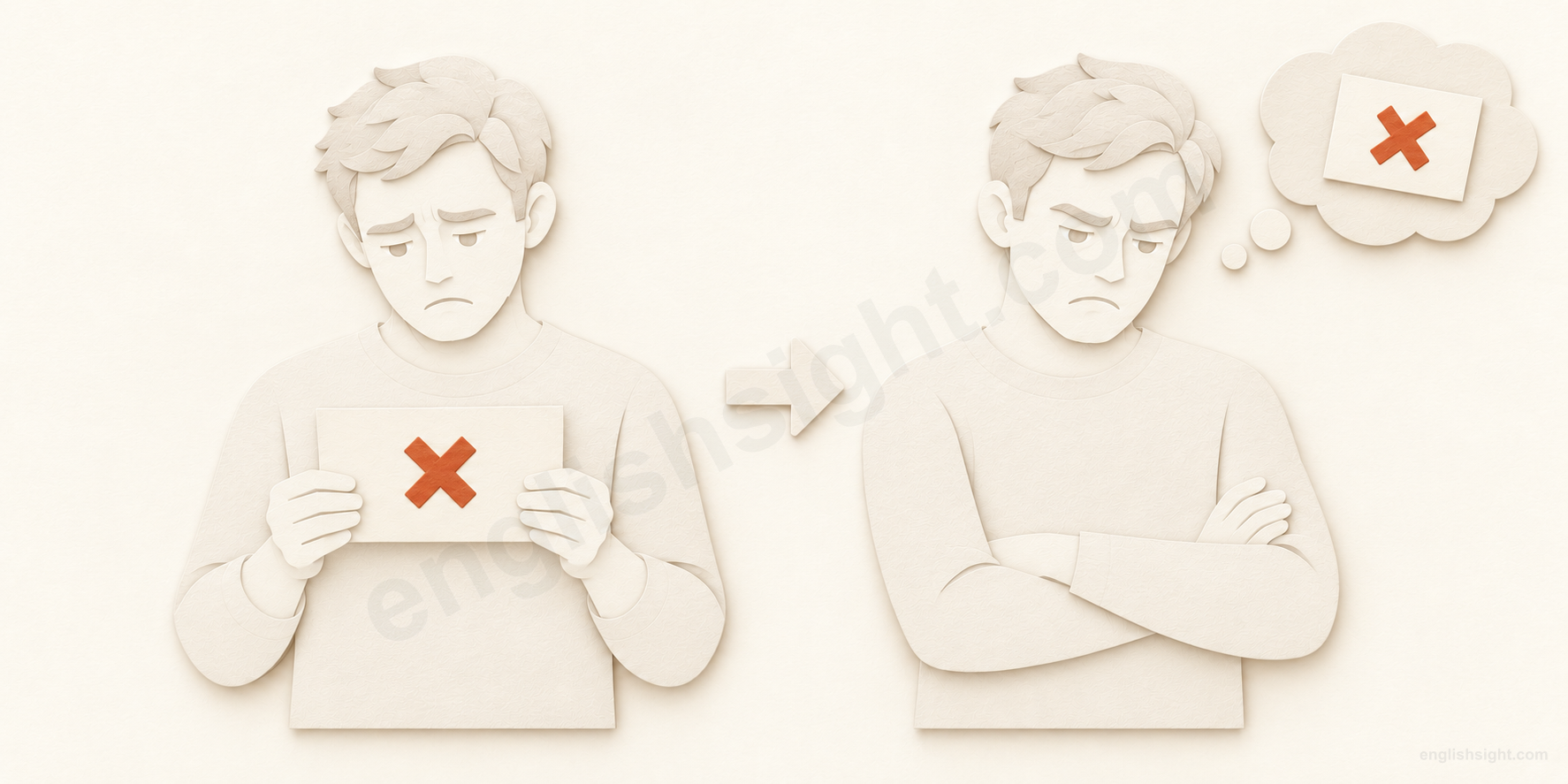
A man looks down at a notice bearing a cross.
bitter
Later, he folds his arms and frowns while remembering the notice.
The news passes into memory; hurt and resentment remain.
The event is over, but he still feels hurt and resentful.
When it describes a person’s attitude, bitter often means that hurt and resentment remain after disappointment or perceived unfair treatment.
The sketch follows one person from a disappointing notice to the lingering feeling it leaves. It illustrates an emotional use, not the taste, weather, beer noun, or every idiom. No actual unfairness is proved by the person’s reaction.
Bitter can describe coffee, winter wind, a hostile dispute, or someone who feels hurt and resentful. These meanings share a useful idea of harshness, but they are not interchangeable: bitter chocolate need not be disliked, and a bitter defeat need not make someone resentful.
The sketch focuses on the emotional branch: disappointment or perceived unfairness can leave someone feeling hurt and angry afterwards. It is one teaching model, not a claim about a picture shared by every native speaker or a formula for every phrase.
01
Taste and weather
With food, bitter describes a taste. With weather, it describes painful cold. Neither use says that a person feels resentment.
have the strong taste found in unsweetened coffee or some medicines
Situation
You try a piece of very dark chocolate.
Meaning in context
You notice its strong, unsweet taste.
Bitter describes the flavor, not whether everyone dislikes the food.
Bitter is an adjective: it can come before a noun, as in bitter chocolate, or after a linking verb, as in The coffee tastes bitter. Taste links the drink to a quality; it does not require an adverb here.
People may enjoy a bitter flavor, especially in coffee or chocolate. Bitter does not mean spoiled, poisonous, or simply lacking sugar. Water is not sweet, but that does not make it bitter.
Sour is the acidic taste associated with lemon juice. Bitter and sour can occur together, but they are different tastes. Spicy describes the heat of foods such as chilli; it is not another word for bitter.
In a sentence
This chocolate tastes bitter, but I like it.
Watch the difference Say The tea tastes bitter, not tastes bitterly. Unsweetened does not automatically mean bitter.
The subject is the weather, not an unhappy person.
A bitter wind, bitter weather, and the bitter cold describe cold that feels severe and unpleasant. The idea of a harsh sensation helps connect this use to taste, but no food is involved.
It is bitter outside and The weather turned bitter are also natural. Turned describes a change; bitter supplies the resulting quality. In the bitter cold, cold is a noun. In bitterly cold, cold is an adjective modified by an adverb.
Bitter is not a general replacement for very: a bitter wind is cold, but bitter hot is not the normal matching expression.
You may also meet It was bitter cold, where bitter itself acts as a restricted intensifying adverb. Bitterly cold is a useful alternative. This restricted use does not make bitter an all-purpose adverb.
In a sentence
We waited for the bus in the bitter cold.
Watch the difference The bitter cold names the cold conditions; a bitter person usually has hurt and resentful feelings.
02
Hurt, resentment, and hostility
Look at what bitter describes: a person can remain resentful, words can express hostility, and a loss can cause deep unhappiness. Those are related but different judgments.
03
be / feel / become / remain + bitter; bitter about + noun / -ing; bitter towards / toward + person
be bitter about / towards someone
feel hurt and angry after disappointment or perceived unfair treatment
Situation
A colleague receives an opportunity you believe should have been yours.
Meaning in context
You remain angry and hurt when you think about the decision.
About names the issue; towards or toward can name the target of resentment.
A bitter person carries hurt together with anger or resentment. This often follows a disappointment or a belief that someone treated them unfairly. It does not establish that the treatment really was unfair.
Use bitter about an event or situation: bitter about losing, bitter about the decision. Use bitter towards someone or bitter toward someone to direct the feeling at a person. Both toward and towards occur in standard English.
Be or feel bitter describes a state. Become, grow, or turn bitter describes developing that state; remain or still be bitter emphasizes its persistence. Bitter alone does not specify how long the feeling lasts.
Compare disappointed, which need not involve anger at anyone, and angry, which can describe a brief reaction without lasting hurt. Calling someone bitter can sound critical, so it is a strong description.
In a sentence
Months later, he was still bitter about being passed over for the job.
Watch the difference Use about being passed over, not about be passed over. The preposition is followed by a noun phrase or an -ing form.
04
bitter + words / criticism / remark / laugh / smile; speak / say + bitterly
bitter words / a bitter laugh
speech or laughter with an angry, hurt, or cutting edge
Situation
A speaker remembers a broken promise.
Meaning in context
The hurt comes through in a sarcastic remark.
The words or tone express the feeling; bitter does not mean loud.
Bitter words, bitter criticism, and a bitter remark express sharp resentment or hostility. A bitter laugh or smile can similarly show hurt, cynicism, or anger rather than uncomplicated amusement.
The adjective describes the speech or expression. To describe how someone speaks, use the adverb bitterly: She spoke bitterly about the decision. A quiet comment can be bitter, and a loud comment need not be.
This is an extension from a harsh taste to an emotionally harsh effect. It is a teaching connection, not a rule that any negative comment should be called bitter.
In a sentence
“So much for keeping promises,” she said with a bitter laugh.
Watch the difference A bitter laugh is not necessarily happy laughter. Use bitterly to modify spoke or said.
Two neighbors disagree over access to a shared drive.
Meaning in context
The disagreement becomes intensely hostile.
Bitter describes the hostility of the relationship or conflict.
A bitter argument, dispute, battle, or feud involves intense anger or hostility. The word says more than difficult or lengthy: a long technical discussion can be perfectly friendly.
Bitter enemies and bitter rivals extend the same idea to the participants. Bitter opposition is strongly hostile resistance; a bitter struggle or bitter fighting can involve fierce actual fighting. The noun tells you whether the conflict is verbal, political, competitive, or physical.
Their relationship turned bitter describes a change from a less hostile relationship to one marked by resentment. It is not a phrasal verb: turn is a linking verb and bitter is its adjective complement.
In a sentence
A disagreement over the shared drive grew into a bitter dispute.
Watch the difference Bitter rivals suggests personal hostility; close rivals only says the competitors are closely matched.
an event or feeling that causes or shows deep unhappiness
Situation
A team prepares for months and narrowly misses its goal.
Meaning in context
The loss hurts deeply.
The result is painful; nobody has to blame another person.
A bitter disappointment, defeat, or blow is a painful setback. Bitter emphasizes the emotional impact. A blow here is figurative: the bad news hurts, rather than physically strikes, someone.
Bitter regret, bitter sorrow, and bitter tears describe deep unhappiness. She shed bitter tears means she cried with great sorrow; it does not mean someone tested the taste of the tears.
These combinations usually place bitter before the noun. Compare The result was a bitter disappointment with She was bitter about the result: the second describes a resentful person, while the first can describe grief without resentment.
In a sentence
Missing the final by one point was a bitter disappointment for the team.
Watch the difference For the person’s deep disappointment, say bitterly disappointed, not bitter disappointed.
07
learn / know + from bitter experience; a bitter experience / lesson; the bitter truth / reality
learn from bitter experience / the bitter truth
painful experience or an unwelcome fact that is hard to accept
Situation
You rely on a backup that has never been tested.
Meaning in context
A failure teaches you a painful lesson.
The experience is bitter because it hurts to undergo or accept it.
Learn from bitter experience means learn through something unpleasant that actually happened. Experience is uncountable in this phrase, referring to knowledge gained through events. A bitter experience can instead mean one particular painful event.
A bitter lesson is something learned painfully. The bitter truth or bitter reality is a fact that is upsetting to face. Bitter describes its emotional difficulty, not whether it is accurate.
This use connects the harshness of taste to something hard to live through or accept. It does not necessarily involve the continuing resentment shown in the diagram.
In a sentence
I learned from bitter experience to check that the backup really works.
Watch the difference From bitter experience describes how knowledge was gained; it does not mean learning only about bitterness.
03
Expressions to learn as a whole
Taste becomes a metaphor in some familiar expressions. Other idioms describe accepting hardship or continuing despite it; their grammar belongs to the complete phrase.
08
event + leave + a bitter taste + in someone’s mouth
leave a bitter taste in someone’s mouth
leave an unpleasant feeling about an experience
Situation
You discover that the competition rules were changed without warning.
Meaning in context
Even after it is over, the event feels unfair or unpleasant to remember.
The remaining feeling is compared to a lingering taste.
Literally, coffee or medicine can leave a bitter taste in your mouth. Figuratively, an event can leave a bitter taste in your mouth by leaving anger, disappointment, or distrust behind.
Leave identifies what produces the effect; the possessive identifies the person affected: in my mouth, in her mouth, in their mouths. The event itself need not involve eating or speaking.
This expression makes the connection between physical taste and an emotional aftereffect particularly clear. The context decides whether taste is literal or figurative.
In a sentence
The last-minute rule change left a bitter taste in my mouth.
Watch the difference Do not assume a literal flavor when the subject is a decision, deal, or other experience.
09
something + be + a bitter pill (for someone) (to swallow); swallow a bitter pill
a bitter pill (to swallow)
an unpleasant fact or event that is difficult to accept
Situation
You find out that a year of work cannot be used.
Meaning in context
You must face an unwelcome fact.
Swallow means accept within this idiom; no actual pill is needed.
A bitter pill, often a bitter pill to swallow, is unwelcome news, failure, or another fact that is hard to accept. The metaphor is of having to take unpleasant medicine.
For someone names the affected person: a bitter pill for the team to swallow. The fact itself can be the subject: Losing the contract was a bitter pill. You can also say that someone had to swallow a bitter pill.
This expression concerns the difficulty of acceptance. It does not promise that the setback will help you, even though real medicine may be beneficial.
In a sentence
Having to abandon the project was a bitter pill for us to swallow.
Watch the difference The normal verb is swallow; do not translate this idiom word by word using eat.
10
continue / fight / stay + to the bitter end; remain / continue + until the bitter end
to / until the bitter end
continue to the finish despite difficulty or unpleasantness
Situation
A court case becomes long and difficult.
Meaning in context
Someone decides to keep going until it is finally resolved.
The whole expression emphasizes persistence through hardship.
Fight, stay, or carry on to the bitter end means continue through difficulties until something is finished or no further action is possible. Until the bitter end can emphasize the duration in the same way.
The phrase can sound determined, dramatic, or lightly humorous in a small everyday difficulty. It does not guarantee victory: someone can fight to the bitter end and still lose.
Learn the expression with the and end. It is not simply a prediction that the ending will taste bitter or that every ending will be tragic.
In a sentence
They promised to fight the case to the bitter end.
Watch the difference To the bitter end expresses persistence, not assured success or necessarily death.
11
take + the bitter + with the sweet
take the bitter with the sweet
accept unpleasant parts of life along with pleasant ones
Situation
A new opportunity brings both benefits and inconveniences.
Meaning in context
You accept that the good comes with some bad.
The bitter and the sweet stand for contrasting kinds of experience.
In this established saying, the bitter means the unpleasant parts and the sweet means the enjoyable parts. Take means accept. With connects the two as parts of the same life or situation.
There is no following noun after bitter or sweet: the adjectives stand for those general categories. This is not a pattern for calling any unhappy person a bitter.
The expression is about accepting a mixture, not enjoying every unpleasant part or claiming that a harmful situation must be tolerated.
In a sentence
Touring is exciting, but the travel is exhausting; you take the bitter with the sweet.
Watch the difference Keep the full expression. The bitter here does not refer to the British beer.
04
Drink names and related word forms
Bitter can also name a beer. Keep that noun separate from bitterness, the name of a taste or feeling, and bitterly, the usual adverb.
12
a pint / glass of bitter; two bitters (servings); a dash of bitters (flavoring)
a pint of bitter / bitters
a British beer name, or a separate name for a bitter drink ingredient
Situation
You read a British pub menu and a cocktail recipe.
Meaning in context
You distinguish a beer from a concentrated flavoring.
These are drink nouns, not descriptions of someone’s mood.
In British English, bitter is a type of beer, generally associated with a noticeable hop taste. A pint of bitter names an amount of that beer. Two bitters can mean two servings in an ordering context.
Bitters also names a strong plant-based alcoholic liquid used in small amounts to flavor drinks: a dash of bitters. In that use, the final -s is part of the usual name; it does not mean two glasses of bitter beer.
The names connect to bitter taste, but the grammar is a separate noun use. A bitter drink simply describes a drink’s flavor and need not name the British beer style.
In a sentence
The menu lists bitter by the pint, while the cocktail recipe calls for a dash of bitters.
Watch the difference Bitters in a recipe is not automatically the plural of a beer order. Context decides which noun is intended.
13
bitter + noun; linking verb + bitter; bitterly + verb / disappointed / cold; the bitterness of / bitterness about
bitter / bitterly / bitterness
choose an adjective, an adverb, or the noun for the quality
Situation
You want to describe a person, a reaction, or the feeling itself.
Meaning in context
You choose the word form that fits the sentence.
The ending changes the grammatical job, not just the intensity.
Bitter is normally an adjective: a bitter person, the drink is bitter. Bitterly is the usual adverb: she complained bitterly describes an angry or hurt manner; bitterly disappointed and bitterly cold mean extremely disappointed or cold.
Bitterly is not a freely usable substitute for very: bitterly happy is not the normal counterpart of bitterly disappointed. Its intensifying use is associated with unpleasant feelings and cold.
Bitterness is normally uncountable. The bitterness of the coffee names a taste; bitterness about the decision names resentment; the bitterness of the dispute names hostility. The surrounding nouns and prepositions identify the sense.
For comparison, more bitter and most bitter are the usual forms; bitterest also occurs. This coffee is more bitter compares flavor, while He grew more bitter compares resentment. Bitter is stressed on the first syllable: /ˈbɪtə(r)/.
In a sentence
She was bitter about the decision and complained bitterly, but her bitterness gradually faded.
Watch the difference A bitter disappointment uses an adjective before a noun; bitterly disappointed uses an adverb before an adjective.
Keep the senses and grammatical jobs distinct
A connection is not a prediction rule
Harsh taste, uncomfortable cold, emotional pain, and hostility are established uses. The diagram shows only hurt and resentment after disappointment. You cannot add bitter to every unpleasant thing and expect an ordinary expression.
A feeling is not proof of unfairness
Someone can be bitter because they believe they were treated unfairly. The word reports or evaluates their feeling; it does not settle what happened. Disappointment alone is weaker and does not require resentment.
Grammar belongs to the complete sentence
Be bitter is an adjective construction, not a passive verb. Bitter about losing uses an -ing form after a preposition. Turn bitter describes a change of state. Ordinary adjective uses have no separable particle or direct object.
Scope of this lesson
This lesson covers the modern adjective, familiar idioms, British beer and the separate bitters flavoring noun, plus bitterly and bitterness. Specialized brewing verbs meaning add bitterness, technical plant names, and the nautical noun bitter end are not developed here.
Choose the meaning and form
Read what bitter describes and choose the interpretation or expression that fits.
1. You enjoy dark chocolate despite its strong bitter flavor. Which statement fits?
2. A colleague still feels hurt and resentful months after a promotion decision. Which sentence expresses that?
3. Complete the sentence: The cancellation left us ___.
4. The news was a bitter pill for the team to swallow. What does that usually mean?
5. They fought to the bitter end but lost. Is this contradictory?
6. A recipe asks for a dash of bitters. What is meant?
Sources and teaching notes
Modern meanings, constructions, and idioms were checked against the dictionary entries below. The explanations and examples are original; the diagram is a teaching interpretation of the emotional use.
The sketch illustrates one meaning connection; it is not a picture shared by every native speaker.