A thin, flat part, understood through its setting.
From a knife’s cutting part to fan blades, grass leaves, and shoulder blades.
A part, a shape, and a role
Recognize the part, then identify its role
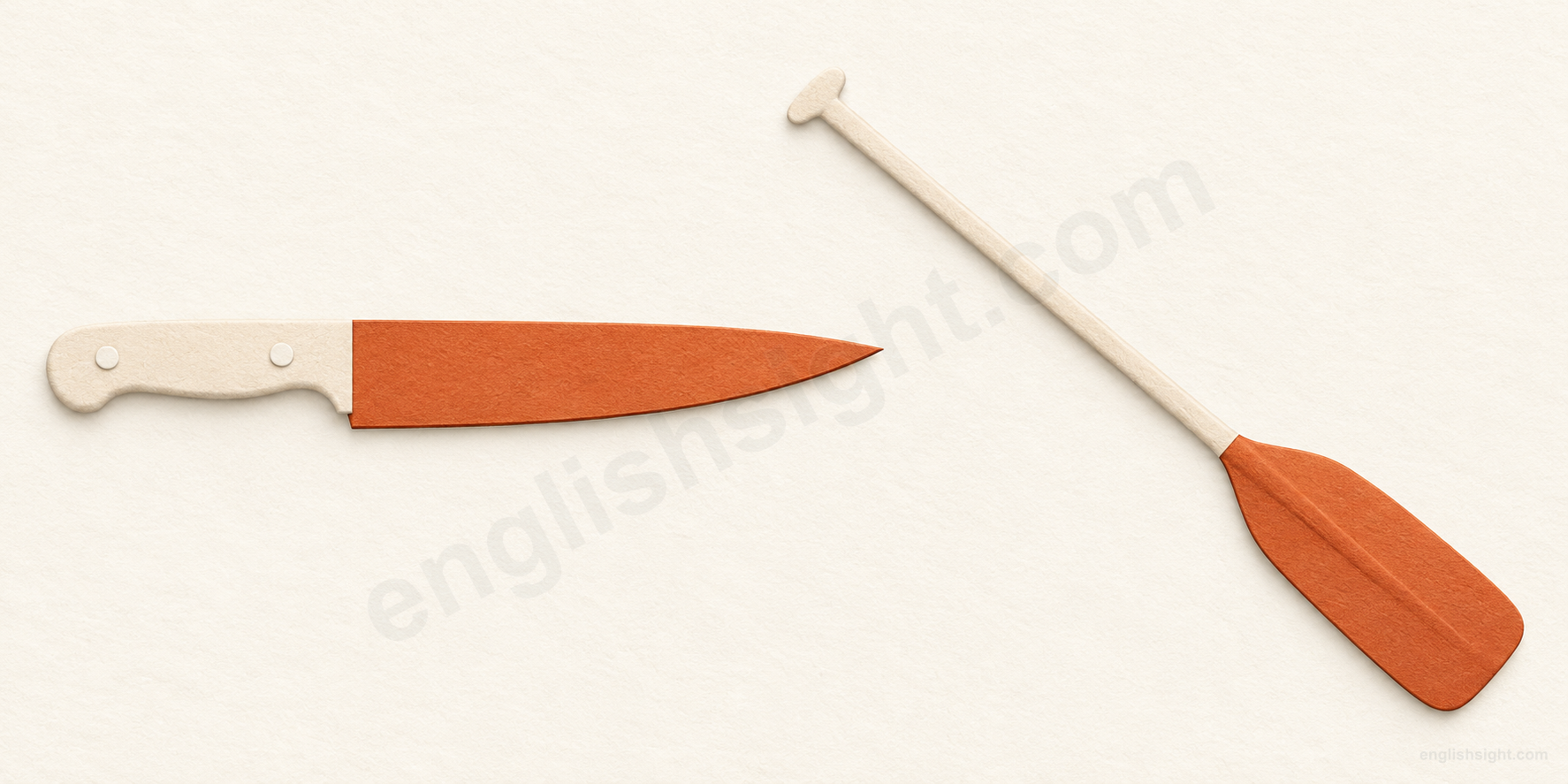
Identify the whole knife and paddle.
blade
The knife blade cuts; the paddle blade pushes against water.
Pick out the orange blade, distinct from the handle or shaft.
Both orange parts are blades. Their objects give them different jobs.
Blade often names a relatively thin, flat part; its object or setting tells us whether it cuts, moves something, or is part of a plant or body.
This is a bounded shape-and-part connection, not a rule that any flat object can be called a blade. Curved machine blades and established compounds must be learned in context.
Blade /bleɪd/ is usually a countable noun: one blade, two blades. It often names a relatively thin, flat part of something. The surrounding words tell you which object and which role are meant.
A knife blade cuts; a fan blade moves air; a blade of grass is a leaf. Shape helps connect these uses, but sharpness and cutting do not belong to every use. This lesson offers a teaching connection, not one image that every English speaker must share.
01
Cutting parts and their condition
Name the part of a tool, distinguish it from its edge, and describe whether it cuts well.
01
a knife / saw blade; the blade of + tool
the blade of a knife
the part that cuts, as distinct from the handle
Situation or whole object
You identify the parts of a kitchen knife.
Part or meaning identified
You name its flat cutting part, rather than the whole tool.
The blade has an edge; the blade and the edge are not exactly the same thing.
A knife is the whole tool. Its blade is the part extending from the handle, while its edge is the narrow boundary that does the cutting. You can describe the flat side of a blade without referring to that edge.
The same part name occurs with saws, scissors, axes, and cutting machines. A saw blade may have teeth; blade does not mean that the edge must be smooth. Knife blade and the blade of a knife express the same part–whole relationship.
In a sentence
The knife has a wooden handle and a steel blade.
Watch the difference Do not use blade for the handle, or edge for the entire flat piece.
02
a sharp / blunt / dull blade; sharpen / replace + the blade
a sharp / blunt blade
describe whether a cutting edge works well
Situation or whole object
A cutting tool no longer slices cleanly.
Part or meaning identified
You describe the blade as blunt or dull and discuss maintenance.
Sharpness describes the cutting edge, not the overall thinness of every object called a blade.
A sharp blade cuts readily. A blunt blade, or a dull blade, has lost the sharp edge needed for a clean cut. Dull is particularly familiar in American English; blunt is also a normal description of a cutting edge.
Sharpen the blade means make its edge sharp again. Replace the blade means fit a different one. These are ordinary verb–object combinations, not special meanings of blade. A blade can be thin yet blunt.
In a sentence
This blade is dull, so the paper tears instead of cutting cleanly.
Watch the difference Blunt does not mean broken, and a broken blade is not necessarily blunt.
03
a razor blade; two razor blades
a razor blade
the cutting piece used in a shaving tool
Situation or whole object
You need a fresh cutting piece for a razor.
Part or meaning identified
You ask for a razor blade rather than a whole new razor.
Razor identifies the tool; blade identifies its cutting component.
A razor blade is a very thin metal cutting piece used for shaving. The razor is the tool that holds or incorporates it. A disposable blade can be changed when it loses its sharpness.
One razor may contain more than one blade. In two razor blades, blades carries the plural ending; razor remains a noun modifier. The compound names an object, not an idiom.
In a sentence
I bought a packet of razor blades for my old razor.
Watch the difference A razor blade is not the same as the complete razor.
02
Working surfaces in tools and machines
A blade can move air, press against water, wipe glass, push material, or run on ice. The equipment name tells you its job.
04
a fan blade; propeller / rotor / turbine blades
fan / propeller / rotor blades
the shaped working parts of fans, propellers, rotors, and turbines
Situation or whole object
You look at a fan, a propeller, or a helicopter rotor.
Part or meaning identified
You identify the individual parts turning around the centre.
Here blade names a working part in rotating equipment, not a cutting knife; its role depends on the mechanism.
A fan blade is one of the projecting parts that turn around the centre. Propeller blades and helicopter rotor blades belong to the same broad family of shaped rotating parts. The noun before blades specifies the mechanism.
Turbine blades are another engineering use: a flow of water, steam, or air drives the turbine, rather than the turbine working like a fan to move air. Some machine blades are curved or twisted to suit their job, so flat is a helpful shape connection, not an exact geometric rule. The number of blades is a count of parts, not a speed.
In a sentence
The fan has three blades that push air around the room.
Watch the difference Do not assume that fan blades are designed to cut things.
05
the blade of an oar / paddle; an oar blade
the blade of an oar
the broad part that pushes against water
Situation or whole object
An oar has a long shaft and a wider end.
Part or meaning identified
You identify the broad end placed in the water.
The broad surface, rather than a sharpened edge, does the work.
The blade of an oar is its flattened end. The rower uses that end against the water to move the boat. Blade distinguishes it from the shaft and the part held in the hands.
A paddle also has a blade, although an oar and a paddle are different kinds of equipment. The of phrase identifies the whole object; it does not describe material. A wooden blade describes material instead.
In a sentence
She lowered the blade of the oar into the water.
Watch the difference The whole long oar is not just its blade.
06
a wiper blade; windscreen / windshield wiper blades
a wiper blade
the contact part that clears water from vehicle glass
Situation or whole object
The car’s wipers leave streaks on the glass.
Part or meaning identified
You identify the replaceable contact parts as wiper blades.
A blade can wipe rather than cut.
A wiper blade is the long narrow part with a rubber edge that contacts the glass. It belongs to a windscreen wiper in British English, or a windshield wiper in American English.
The blade is distinct from the arm that carries it. Replace the wiper blades usually means change the wiping components, not the whole motor system. Learn wiper blade as an established part name; shape alone cannot tell you which machine is meant.
In a sentence
We replaced the worn wiper blades before the rainy season.
Watch the difference The rubber contact edge is not a sharpened metal cutting edge.
07
a bulldozer blade; a snowplough / snowplow blade
a bulldozer blade
the broad working plate used to push material
Situation or whole object
A machine faces a pile of soil.
Part or meaning identified
Its broad front plate pushes the soil aside.
Blade may name a broad pushing surface, not a thin cutting tool.
A bulldozer blade is the broad plate at the front of the machine that moves earth. A snowplough blade, or snowplow blade in American spelling, similarly pushes snow out of the way.
These blades may be curved. Their useful connection with the other tool senses is a relatively thin working surface; they need not be narrow or knife-sharp. The machine name supplies the specific function.
In a sentence
The bulldozer pushed the loose soil with its blade.
Watch the difference Do not understand blade here as a spinning fan part or a separate knife.
08
ice-skate blades; the blades of + skates
ice-skate blades
the metal runners beneath ice skates
Situation or whole object
You look beneath a pair of ice skates.
Part or meaning identified
You name the narrow metal parts that contact the ice.
The blade is beneath the boot; it is not the whole skate.
An ice skate has a metal blade under the boot. In skating, the edges of that blade matter for movement on the ice. The part name connects to a thin metal form, but its use differs from cutting food.
Skate blades and the blades of the skates are alternative ways to name the parts. Once ice skating is the topic, the shorter blades can be clear: My blades need sharpening.
In a sentence
The skater stepped onto the ice on newly sharpened blades.
Watch the difference A wheel on an ordinary roller skate is not an ice-skate blade.
03
Grass, leaves, and a body-part name
The thin or flat shape connection extends beyond tools. Learn the plant expressions and shoulder blade with their own boundaries.
09
a blade of grass; several blades of grass; not a blade of grass
a blade of grass
one narrow grass leaf, counted individually
Situation or whole object
Grass covers a patch of ground.
Part or meaning identified
You pick out one individual leaf.
Blade supplies the countable unit; grass is normally a mass noun here.
A blade of grass means one slender grass leaf. Say two blades of grass, with the plural on blades, rather than two grasses when you mean two individual leaves. Grasses can instead refer to different kinds of grass.
Not a blade of grass emphasizes that there is not even one such leaf: There was not a blade of grass in the yard. This is an emphatic use of the same countable unit, not a separate cutting meaning. Nothing has to be sharp or in motion.
In a sentence
A single blade of grass grew through a crack in the path.
Watch the difference Blade of grass names a leaf, not the whole lawn or a grass-cutting tool.
10
a leaf blade; the blade of a leaf
a leaf blade
the expanded part of a leaf, as distinct from its stalk
Situation or whole object
A leaf has a stalk and an expanded surface.
Part or meaning identified
You distinguish the leaf’s broad part from its stalk.
This botanical use is related to grass blades through leaf shape.
In plant descriptions, leaf blade names the expanded surface of a leaf, excluding the stalk. It can be broad rather than long and narrow. This is more specialized than the everyday expression a blade of grass.
Leaf blade puts leaf before blade as a noun modifier. The blade of the leaf expresses the same part relationship. Not every whole leaf is normally called a blade in everyday conversation; leaf is the general word.
In a sentence
The diagram shows the leaf blade joined to a short stalk.
Watch the difference Use leaf for a whole leaf in ordinary conversation unless the part distinction matters.
11
a shoulder blade; my left shoulder blade; between the shoulder blades
a shoulder blade
one of the flat bones at the upper back
Situation or whole object
Someone indicates a place on the upper back.
Part or meaning identified
You name the bone there as a shoulder blade.
The full compound names a body part; no cutting action is involved.
A shoulder blade is one of the pair of broad, roughly triangular bones at the back of the shoulders. Scapula is its anatomical name. In everyday speech, keep shoulder unless the context already makes the bone clear.
Say my left shoulder blade or between my shoulder blades. The first specifies one side; the second locates something in the space between the two bones. This is a settled compound connected by flat shape, not a blade attached to a shoulder.
In a sentence
The backpack strap rubbed just below my right shoulder blade.
Watch the difference Shoulder names a broader body region; shoulder blade names a particular bone.
Keep shape, part, and function distinct
Blade, edge, knife, and leaf
Blade names a part in the tool uses; edge names its boundary; knife names a whole tool. Leaf is the general plant word. These nouns overlap in particular descriptions, but they are not freely interchangeable.
Grammar follows the noun being counted
Use a blade and blades. In two blades of grass, blade carries the plural. In two knife blades, knife identifies the kind and blades is plural. A blade guard means a guard for a blade: blade is a noun modifier, not a new adjective meaning.
Scope and established expressions
The modern noun and useful compounds are the focus. The learner entries consulted do not present an everyday phrasal-verb or idiom family for blade. Specialist verbs such as blading a golf shot or blading on inline skates, sports-equipment striking surfaces, phonetic tongue blade, meat cuts, archaeological blades, specialized plant or animal parts, regional sheep shears, US slang blade for a whole knife used as a weapon, and old literary uses for a sword, swordsman, or fashionable young man are outside this beginner lesson. Their meanings cannot be predicted simply from the drawing.
Choose the part and the meaning
Read the object name and the situation. Do not assume every blade is sharp.
1. You mean the whole flat metal cutting part of a kitchen knife, rather than only its sharp boundary. Which phrase is more precise?
2. You pick out three individual grass leaves. Which phrase expresses that count?
3. What are the blades in “The fan has four blades” designed to do?
4. A speaker points to a flat bone at the upper back. Which expression names it?
5. Which part of an oar is its blade?
6. The car’s wipers leave streaks. You are replacing their rubber-edged contact components. What do you ask for?
Sources and teaching notes
Dictionary entries support the uses and part names below. The explanations and examples are original. The diagram is a teaching comparison, not evidence that every meaning has one origin or one shared mental picture.
The diagram connects selected uses; it does not show a picture shared by every native speaker.