Connect the physical noun with medical language, family ties, and established idioms.
A liquid circulating through a living body
A liquid circulating through a living body
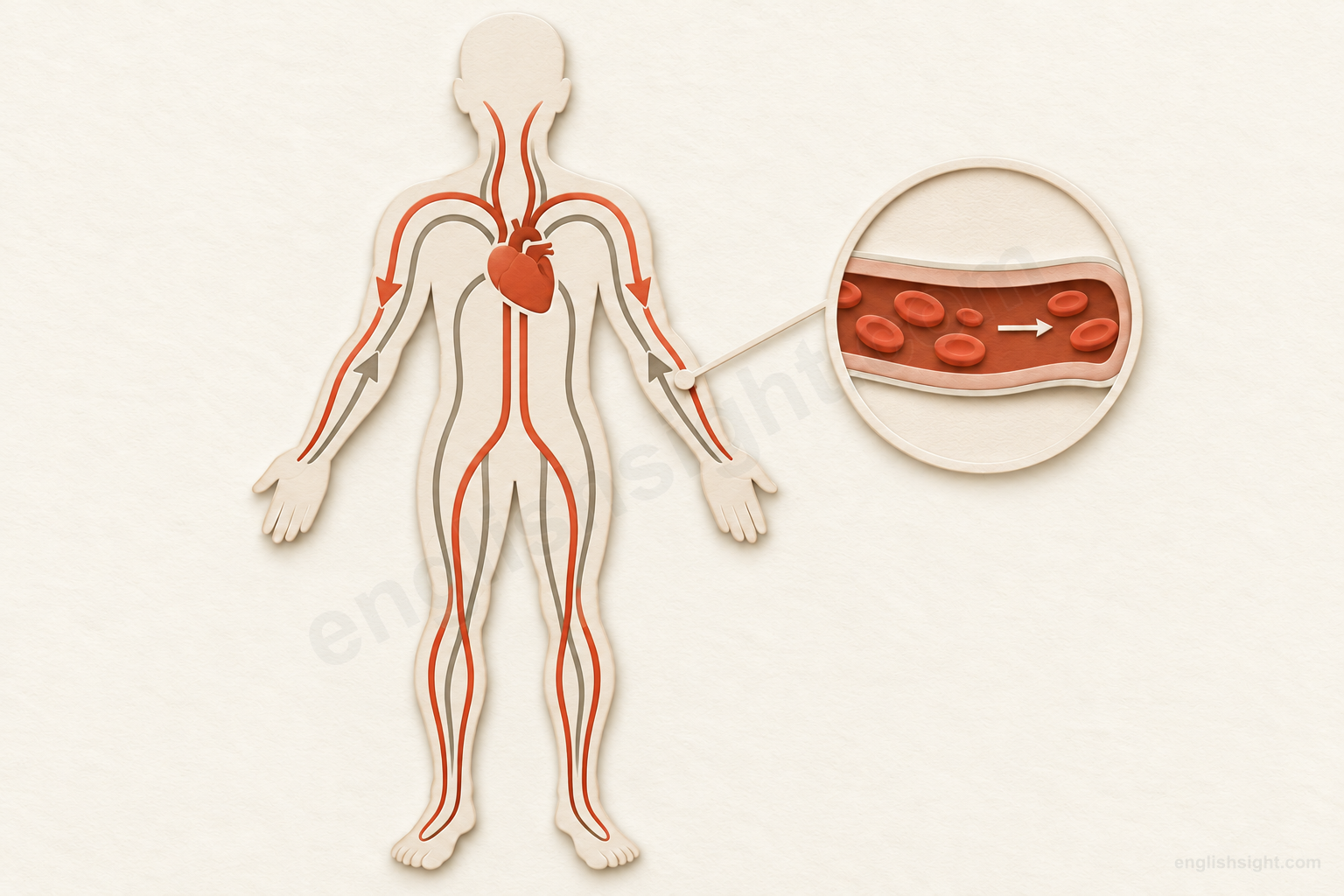
The heart pumps blood.
blood
Blood returns toward the heart as circulation continues.
Blood flows through vessels around the body.
The heart keeps blood circulating through the body.
Blood is the liquid circulated by the heart through the body, carrying materials needed for life.
The diagram shows ongoing circulation, not a before-and-after transformation. Family and emotion expressions are separate figurative branches; this physical picture cannot predict their wording.
Blood first names the liquid circulating through the body. Start there, then let the whole expression tell you whether you are discussing health, family, emotion, or conflict.
The body’s dependence on blood offers a useful memory link to life and family. Many phrases, however, have conventional meanings that must be learned as phrases. This lesson’s visual model is a teaching aid, not a claim about every speaker’s mental image.
01
The liquid and everyday medical language
Start with the physical substance. The verb or the following noun tells us what happens to it or what is measured.
01
blood + singular verb; a drop / sample of blood
blood flows through the body
the liquid circulating inside a living body
Situation
The heart pumps.
What is described
Blood travels through vessels around the body.
Blood names the substance; flow and pump describe its movement.
Blood carries oxygen and other materials around the body. A blood vessel is a tube it travels through; a blood cell is a cell in the liquid. Neither phrase is another meaning of blood.
In ordinary use, blood is uncountable: some blood, not a blood. Count a quantity or container instead: a drop of blood, two samples of blood. Blood is /blʌd/, with the vowel of cup, despite its spelling.
In a sentence
A drop of blood had dried on the sleeve.
Watch the difference Use a drop of blood, not a blood, when counting drops.
02
lose + blood; person / wound + bleed
lose blood / bleed
have blood leave the body
Situation
A cut opens.
What is described
Blood comes out of it.
Lose blood names the loss; bleed is the corresponding everyday verb.
A person loses blood; a wound bleeds. You can also say My finger is bleeding. Blood is the noun, while bleed has the forms bleed, bled, bled.
Covered in blood describes blood on a surface. It does not by itself say whose blood it is. In She lost a little blood, a little measures the amount; it does not make blood countable.
In a sentence
He lost a little blood when he cut his finger.
Watch the difference Say His finger is bleeding, not His finger is blooding.
03
draw blood (from someone); take a blood sample
draw blood
take a sample, or cause bleeding
Situation
A nurse prepares a test; elsewhere, a cat scratches someone.
What is described
Blood is collected, or a scratch makes blood come out.
The situation distinguishes medical collection from injury.
At a clinic, draw blood means take blood from someone for a medical purpose. Take a blood sample is a clear alternative. Draw blood from someone names the person the blood comes from.
A scratch can also draw blood: it breaks the skin enough to cause bleeding. In argumentative writing, a question that draws blood hurts an opponent’s position. That figurative use is aggressive, not a medical procedure.
In a sentence
The nurse drew blood from my arm for the test.
Watch the difference Draw blood does not always mean injure someone; check the medical or conflict context.
04
give / donate blood; receive / have a blood transfusion
give / donate blood; receive a blood transfusion
provide blood for others, or receive blood as treatment
Situation
A donor gives blood; a patient needs blood.
What is described
Blood is collected for use, or supplied to the patient.
Donation and receiving a transfusion describe different sides of medical care.
Give blood and donate blood are ordinary ways to describe donation. The person is a blood donor. Neither expression means give someone a medical test.
A patient receives or has a blood transfusion. In The patient was given a transfusion, the patient receives the treatment; they are not the donor. The countable noun is transfusion, so a blood transfusion is grammatical even though blood is uncountable.
In a sentence
Several colleagues donated blood, and one patient received a blood transfusion.
Watch the difference Distinguish giving blood as a donor from being given a blood transfusion as a patient.
05
have a blood test; a blood sample; blood test results
have a blood test
have a sample examined for health information
Situation
A sample has been collected.
What is described
The sample is tested.
The test examines blood; it is not the same event as donating it.
A blood test is an examination of a small sample. Have a blood test describes the patient’s experience; do or carry out a blood test describes performing the examination.
Blood identifies the kind of test and stays singular before test. You can have two blood tests. A blood sample is the material collected, while a test is the examination of it.
In a sentence
I’m having a blood test tomorrow, and the results should arrive later.
Watch the difference Use two blood tests, not two bloods, in general learner English.
06
What is your blood type / blood group?
blood type / blood group
a medical category of blood
Situation
A form asks for a category.
What is described
You give your blood type.
Type or group names the category, not an amount of blood.
Blood type is especially North American wording; blood group is used in British and North American English. Both name a classification used in medicine.
Use What is your blood type? or Do you know your blood group? The countable head noun is type or group: different blood types. This medical category is distinct from family origin.
In a sentence
The form asks whether I know my blood type.
Watch the difference A blood type does not mean a kind of personality.
07
take / check / measure + possessive + blood pressure
take someone’s blood pressure
measure the pressure of circulating blood
Situation
A clinician prepares the measuring equipment.
What is described
A pressure reading is recorded.
Take means measure here; no blood needs to be removed.
Blood pressure concerns the pressure of blood moving around the body. Take, check, or measure someone’s blood pressure describes measuring it; high and low describe the reading or condition.
Compare take some blood, which means collect blood. The extra noun pressure changes what is being taken. My blood pressure is high and I have high blood pressure are ordinary sentence patterns.
In a sentence
The nurse took my blood pressure before the appointment.
Watch the difference Taking blood pressure and taking a blood sample are different procedures.
The phrase concerns a substance in blood, not a new kind of blood.
Blood sugar commonly refers to the amount of glucose in blood. Blood sugar level makes the measurement explicit. You can talk about a high or low blood sugar level.
In Her blood sugar has risen, sugar is the head noun and blood identifies where it is measured. This is different from blood pressure: the two phrases name different measurements.
In a sentence
She wrote her blood sugar level in a notebook.
Watch the difference Blood sugar is not another name for blood pressure.
02
Family connections and things that feel natural
Blood can stand for ancestry or family connection. Some established expressions extend this to character; they are not scientific explanations of ability.
09
be related by blood; a blood relative; blood ties
related by blood / a blood relative
connected through shared ancestry
Situation
Two people trace their family histories.
What is described
They find a common ancestor.
By blood specifies a biological family connection.
Related by blood distinguishes shared ancestry from a relationship through marriage. A blood relative is someone with that connection; blood ties refers to such family links.
The expression describes one kind of relationship. It does not say that adoptive families or other close relationships are less real. In We are related by blood, by blood describes the basis of the relationship, not a physical exchange of liquid.
In a sentence
They are related by blood, although they have never met.
Watch the difference Do not interpret by blood as meaning they exchanged blood.
10
be of + adjective + blood; have + ancestry expression + blood
of noble blood
have a particular family origin
Situation
A historical account describes a family line.
What is described
It identifies a person’s ancestry.
Blood can stand for descent in formal or historical wording.
Of noble blood describes descent from a noble family. Similar ancestry expressions occur with national origins, but ordinary conversation often uses ancestry or family background instead.
This is a family-origin sense of the noun, not a claim about the actual color or composition of someone’s blood. Do not use ancestry wording as proof of personal qualities.
In a sentence
The historian discovered that the merchant was of noble blood.
Watch the difference This wording sounds formal or historical; comes from a noble family is plainer.
11
have blue blood; be blue-blooded
blue blood
royal or aristocratic ancestry
Situation
A story discusses inherited social rank.
What is described
A character is described as having blue blood.
Blue blood is an established expression about ancestry.
Blue blood means connection by birth to royalty or the aristocracy. It does not describe the color of a person’s blood. Blue-blooded is the related adjective.
Use this expression when social origin matters in a story or historical discussion. It is not a general term for someone who is simply wealthy or successful.
In a sentence
In the novel, blue blood matters more than personal achievement.
Watch the difference Wealth alone does not give someone blue blood.
12
activity / quality + be / run + in + possessive + blood
be / run in someone’s blood
feel like a natural or family characteristic
Situation
A child grows up among musicians.
What is described
As an adult, making music feels deeply natural.
The expression presents a tendency as part of someone’s nature.
If music is in her blood or runs in her blood, it seems a natural part of her, often linked with her family. The grammatical subject is the activity, quality, or tendency; the possessive names the person.
This is figurative language, not evidence that a skill needs no learning. Compare The medicine is in her blood, where medicine really is present in the liquid. The surrounding nouns decide the reading.
In a sentence
Both his parents are actors, and performing seems to be in his blood.
Watch the difference In his blood describes a perceived disposition, not a medical test result.
13
be flesh and blood; a flesh-and-blood person; possessive + own flesh and blood
flesh and blood / your own flesh and blood
a real human being, or your family member
Situation
A discussion concerns human limits or family loyalty.
What is described
The expression stresses humanity or kinship.
The possessive form often shifts attention to a relative.
Flesh and blood can mean a real human with ordinary feelings and limits: I’m only flesh and blood. A flesh-and-blood person is real, rather than an imagined figure or a machine.
Your own flesh and blood stresses that someone belongs to your family. In She would not abandon her own flesh and blood, the phrase refers to a relative, not to the material of her body.
In a sentence
He is her own flesh and blood, but she still disagrees with him.
Watch the difference Being flesh and blood and being someone’s own flesh and blood have different focuses.
14
Blood is thicker than water.
Blood is thicker than water.
family loyalty can outweigh other ties
Situation
Someone chooses to help a relative.
What is described
They explain the choice with a saying.
The full saying expresses a view about loyalty.
This proverb presents family bonds as stronger than other relationships. A speaker may use it to explain siding with a relative even after a disagreement.
It is a saying people can accept, question, or reject, not a rule about how everyone behaves. In this use, thicker is part of the fixed comparison; the point is loyalty rather than a lesson about liquids.
In a sentence
“I’ll help my brother this time. Blood is thicker than water,” she said.
Watch the difference The proverb describes a belief about family, not an obligation every listener must accept.
03
Resentment, anger, and fear
These expressions use blood as an image of strong feeling. Learn the complete wording: boiling and running cold express different emotions.
15
there is + bad blood + between A and B
bad blood between people
lasting resentment or hostility
Situation
A disagreement has damaged a relationship.
What is described
Unfriendly feelings remain.
Bad describes the relationship, not unhealthy blood.
There is bad blood between A and B means there is hostility or resentment between them, often after a dispute. The expression focuses on the troubled relationship rather than one moment of anger.
Use no bad blood to deny lasting resentment: We disagreed, but there is no bad blood between us. Oxford labels the expression old-fashioned; Collins includes it in its current idiom material. Ill feeling or resentment is a plain alternative.
In a sentence
There was still bad blood between the neighbors after the argument.
Watch the difference Bad blood is not the ordinary medical expression for a blood disorder.
16
something + make + possessive + blood + boil
make someone’s blood boil
make someone extremely angry
Situation
Someone watches unfair treatment.
What is described
They feel intense anger.
Boiling is the emotional image in this fixed expression.
The unfair act is the subject of makes; the angry person appears in my, your, or another possessive before blood. It makes my blood boil says that something provokes strong anger.
You can also say My blood was boiling. No literal heating is meant. This is stronger than It annoys me and can make a statement sound forceful.
In a sentence
Seeing the children treated so unfairly made my blood boil.
Watch the difference Use boil after make: made my blood boil, not made my blood to boil.
17
make + possessive + blood + run cold; possessive + blood + run cold
make someone’s blood run cold
fill someone with fear or horror
Situation
Someone hears a frightening account.
What is described
They feel sudden fear.
Running cold signals fear, unlike the anger of boiling.
The story made my blood run cold means it frightened or horrified me. My blood ran cold presents the reaction directly. Make my blood freeze is a related expression.
The person experiencing fear is identified by the possessive. Compare in cold blood, which judges a cruel act; it does not describe the listener’s fear. Similar words appear in different constructions with different meanings.
In a sentence
Her account of the break-in made my blood run cold.
Watch the difference Blood ran cold describes fear; blood boiled describes anger.
04
Violence, responsibility, and competition
Check whether the situation is literal violence, a serious accusation, or an exaggerated description of competition.
18
shed / spill blood; blood + be shed / spilled
shed / spill blood
cause injury or death through violence
Situation
A dispute becomes violent.
What is described
People are wounded or killed.
Blood can stand for the human harm caused by violence.
Shed blood and spill blood often refer to injuring or killing people. In reports or serious appeals, without blood being shed means without such violence.
This dramatic wording is not the usual choice for describing a small accidental cut. Shed has the past tense and past participle shed. A possessive can identify the victim: spill innocent people’s blood. The scene may involve real blood, but the expression foregrounds harm and loss of life.
In a sentence
They hoped the dispute would end without more blood being shed.
Watch the difference Shedding blood is violent harm here; donating blood is a different action.
19
kill / murder / commit a violent act + in cold blood
in cold blood
deliberately and without pity in a cruel act
Situation
A story describes a deliberate violent crime.
What is described
The speaker condemns how it was committed.
The phrase describes the manner of acting, not body temperature.
In cold blood is used especially of deliberate, cruel violence carried out without emotion or pity. The phrase commonly follows a verb such as kill or murder.
It is strongly disapproving. It does not normally praise someone for remaining calm under pressure. Compare blood runs cold: that describes being frightened, not doing something cruel.
In a sentence
The witness said the guard had been killed in cold blood.
Watch the difference Do not use in cold blood to mean calmly completing an ordinary task.
20
have + (someone’s) blood + on + possessive + hands
have someone’s blood on your hands
be responsible for someone’s death
Situation
A decision leads to deaths.
What is described
Someone is accused of responsibility.
Hands represent responsibility, even without physical contact.
This serious expression blames someone for a death. They need not have killed the person with their own hands; responsibility can be indirect.
Compare His hands were covered in blood, which describes an observable stain. He has blood on his hands can be an accusation with no visible blood at all. Context decides whether the wording is literal or idiomatic.
In a sentence
The families said the officials who ignored the danger had blood on their hands.
Watch the difference This is a strong accusation about death, not a light way to mention any mistake.
21
be after / out for + possessive + blood; bay for blood
be after / out for someone’s blood; bay for blood
want someone hurt or punished
Situation
An angry group demands consequences.
What is described
They pursue punishment.
The expression often exaggerates hostility rather than announcing literal violence.
She is after my blood or out for my blood means she is very angry with me and wants to punish me. The expression can be humorous, but its tone is hostile.
People baying for blood are loudly demanding punishment, especially in news or British usage. Compare smell blood: that means notice a rival’s weakness. Wanting punishment and sensing an opportunity are different meanings.
In a sentence
After the disastrous result, some fans were baying for the manager’s blood.
Watch the difference In this sports context, baying for blood need not mean wanting anyone physically injured.
22
opponent / competitor + smell / scent blood
smell / scent blood
recognize a rival’s weakness and a chance to win
Situation
A competitor makes a serious mistake.
What is described
The rival presses harder.
Blood is an image of vulnerability in a contest.
Smell blood or scent blood suggests that someone notices an opponent is vulnerable and sees a chance to defeat them. The subject is the competitor taking advantage.
It is a vivid, aggressive image used in sport, politics, business, or argument. Nothing needs to have a physical smell. Unlike be out for blood, it emphasizes a perceived opening rather than simply a wish to punish.
In a sentence
The challenger smelled blood after the champion made two early errors.
Watch the difference The expression does not guarantee that the challenger will actually win.
23
side / player + draw first blood
draw first blood
gain the first success in a contest
Situation
Neither side has gained an advantage.
What is described
One side achieves the first success.
First marks an early advantage, not the final outcome.
In competition, draw first blood means achieve the first success against the other side. A match report may use it for an opening score. Collins marks this use mainly British.
Compare draw blood, which can mean collect a medical sample or cause bleeding. Adding first in a contest produces a familiar competitive expression. Winning the first point does not mean winning the whole match.
In a sentence
Our team drew first blood with a goal in the opening minute.
Watch the difference Use drew for the past tense of draw; first blood need not involve any injury.
05
New people, hard work, and difficult requests
These fixed expressions describe a group’s energy or the effort needed for a task. Their meanings cannot be assembled from blood alone.
24
need / bring in + new / fresh / young blood
new / fresh / young blood
new people who bring energy or ideas
Situation
A group keeps repeating the same approach.
What is described
New members bring different ideas.
Blood stands for people as a renewing force.
The committee needs fresh blood means it needs new people with new ideas or energy. Bring in new blood describes recruiting them. Young blood is another established version.
This is a people-related metaphor, not a request for a transfusion. Fresh blood need not mean younger people specifically. Keep blood uncountable in this expression: some fresh blood, not three fresh bloods.
In a sentence
The club brought in some fresh blood to help plan its events.
Watch the difference Distinguish young blood meaning new people from the historical a young blood meaning a fashionable man.
25
put blood, sweat, and tears into something; sweat blood to do something
blood, sweat, and tears; sweat blood
very hard work and sustained effort
Situation
A team works through a demanding project.
What is described
The result reflects great effort.
The whole expression intensifies the amount of work.
Blood, sweat, and tears is a noun phrase for intense effort and difficulty. Put blood, sweat, and tears into something describes investing that effort. It need not involve actual injury or crying.
Sweat blood is an informal verb expression: We sweated blood to finish on time. It describes strenuous effort. The words work together as an established image; blood alone does not simply mean hard work in any sentence.
In a sentence
A lot of blood, sweat, and tears went into restoring the old cinema.
Watch the difference Keep the familiar order blood, sweat, and tears; sweat blood is a separate verb expression.
26
getting something + be like getting blood from / out of a stone
like getting blood out of / from a stone
extremely difficult to obtain what you want
Situation
You repeatedly ask for information or help.
What is described
Very little is provided.
The impossible physical image expresses difficulty getting a response.
Getting an answer was like getting blood from a stone says the person or source was extremely unhelpful. It can describe obtaining information, money, an apology, or cooperation.
Both from a stone and out of a stone are established forms. Collins also records the American variant out of a turnip. The idiom emphasizes difficulty; it is not an instruction to extract a real substance.
In a sentence
Getting a clear answer from that office was like getting blood from a stone.
Watch the difference The comparison criticizes the difficulty or lack of cooperation, not the quality of real blood.
06
A less central verb use
Blood is mainly a noun in everyday English. A transitive verb also occurs when someone gains their first practical experience.
27
blood + person; person + be blooded
blood a new player
give someone an initial test through practical experience
Situation
A new player has only trained with the team.
What is described
The coach introduces them to competitive play.
Here blood is a transitive verb; the person is its object.
In sports or other writing about demanding activities, blood someone means give them their first practical experience. Blooded and blooding are the verb forms. This is a less central use for a beginner than the noun.
The verb also has specialized hunting uses. These are separate from the ordinary verb bleed, meaning lose blood. A player can be blooded without being wounded; the point in this context is gaining experience.
In a sentence
The coach plans to blood two new players in the next match.
Watch the difference He was blooded can mean he gained experience; He bled means blood came out of his body.
Read the noun and the complete expression
Noun, verb, and related forms
The everyday substance noun is uncountable. Use blood is, some blood, or a drop of blood. In blood tests, the plural belongs to tests. Blood as a verb (bloods, blooded, blooding) has limited experience and hunting uses. Bleed (bled, bled) is the ordinary verb for losing blood.
A phrase carries more than a single word
Bad blood concerns resentment; blue blood concerns ancestry; fresh blood can mean new people. Blood running cold concerns fear, while in cold blood condemns deliberate cruelty. These are established combinations, not meanings produced by blood on its own.
The boundary of this lesson
Medical examples teach wording, not how to interpret readings or choose treatment. Specialized anatomy, hunting rituals, historical fashionable-men senses, regional forms of address, and names spelled Blood are not developed here. Derived words such as bloody, bloodless, and cold-blooded need their own usage notes.
Choose the meaning that fits
Use the situation and the whole expression.
1. At a clinic, the nurse says, “I’ll draw some blood.” What does the nurse mean?
2. A frightening story makes you feel horrified. Which sentence fits?
3. A committee wants new members with different ideas. What can it say?
4. The nurse takes your blood pressure. What is being described?
5. Two cousins say, “We are related by blood.” What is the connection?
6. Which sentence uses the ordinary noun for the liquid correctly?
Sources and teaching notes
Dictionary sources support the meanings, patterns, and usage notes. The explanations, examples, exercises, and schematic diagram were created for this lesson; the visual connection is a teaching interpretation.
The diagram supports a learning connection; it does not claim that all speakers picture blood in the same way.