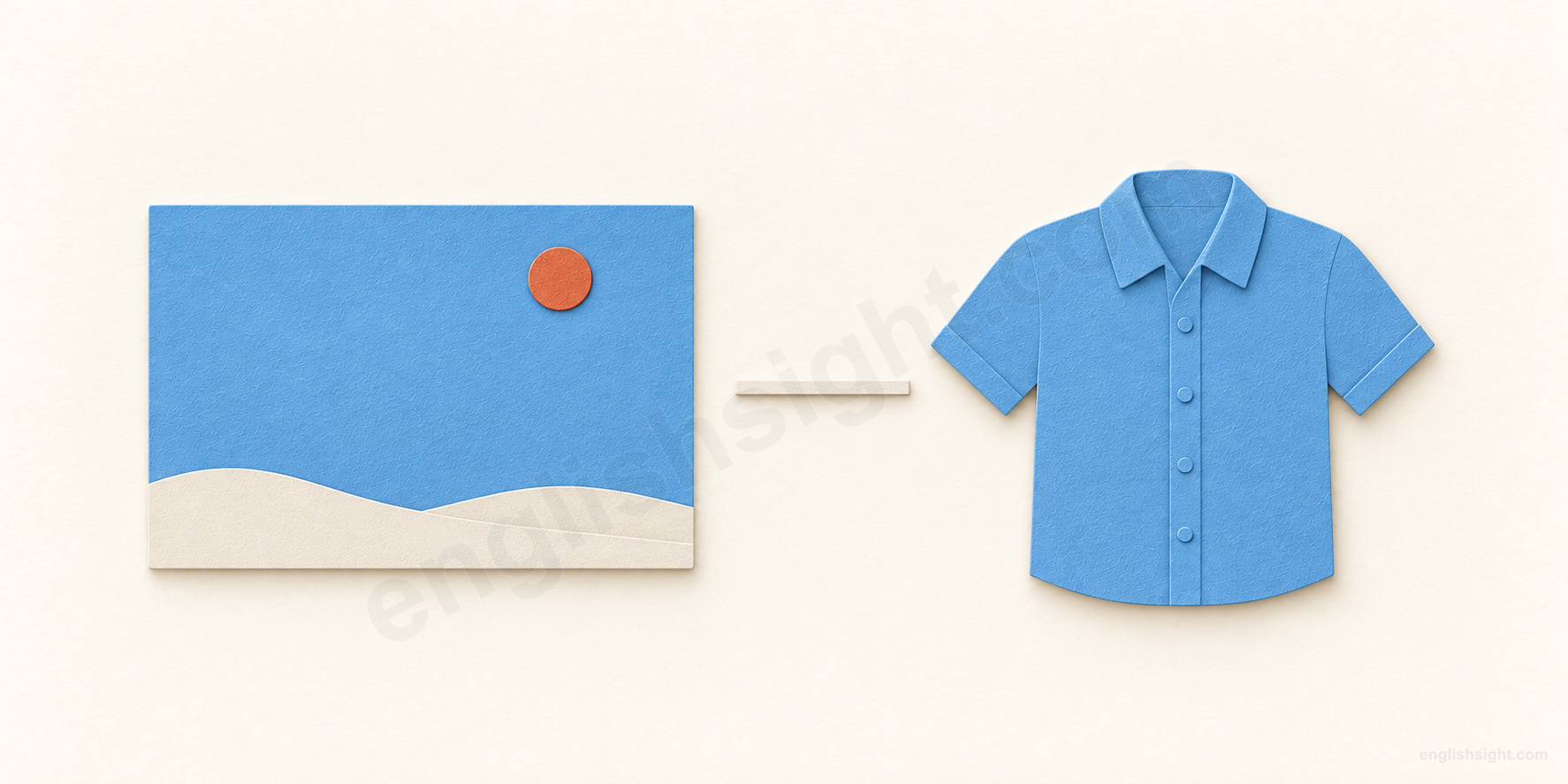
Recognize blue as a color, then read the grammar and the whole expression.
The same color, different things
The same color, different things
A clear daytime sky is blue.
blue
The shirt is blue too.
The same color describes two different things.
A sky and a shirt can share the color blue.
Blue names a color: the same color can describe very different things, such as a clear daytime sky and a shirt.
The basic relation is a shared property, not movement or a transfer. The color model supports literal descriptions; mood, music, political labels, and idioms need their own explanations.
Start with a visible property: a clear daytime sky and a shirt can both be blue, although they are very different things. Blue can describe their color or name the color itself.
Feeling blue, playing the blues, and hearing news out of the blue are established uses. Learn their complete patterns instead of assuming that every meaning follows from the color. This lesson offers a teaching connection, not a single mental picture shared by all English speakers.
01
Recognize, describe, and choose a color
Start with visible color. Grammar lets blue describe an object, name the color, specify a shade, or describe a change. These uses do not require a hidden metaphor.
01
blue + noun; subject + be / look + blue
a blue shirt / The shirt is blue
describe the color of a thing
Situation or starting point
You need to identify one shirt among several.
What you mean
Its color helps the listener choose it.
Blue describes a property of the shirt, not an action.
Blue is an adjective in a blue shirt and The shirt is blue. In the first pattern it comes before the noun; in the second, be links the shirt to its color. Blue eyes, blue jeans, and a blue sky use the same adjective pattern.
The familiar color reference is a clear daytime sky. This is a way to recognize a color category, not a statement that every sky or every sea always looks blue. An object can be blue without being connected with sadness.
In a sentence
Please bring the blue shirt from the chair.
Watch the difference English adjectives do not take a plural ending: blue shirts, not blues shirts.
02
light / pale / dark / deep + blue; bluer (than…); the bluest
light blue / dark blue / bluer
specify or compare shades within the blue color category
Situation or starting point
Two samples both look blue.
What you mean
You describe how their shades differ.
Light and dark refine the color; bluer compares it.
Light blue, pale blue, dark blue, and deep blue help distinguish shades. Navy blue names a very dark blue. These combinations are more informative than blue alone when choosing paint or clothes.
The comparative is bluer and the superlative is bluest. The sea looks bluer today compares its appearance with another time; the bluest sample compares it with a set. A bluer sample is not automatically a darker one.
In a sentence
The bedroom walls are pale blue, but the door is dark blue.
Watch the difference Use bluer to compare how blue something looks; use darker blue when darkness is the specific contrast.
03
blue; a + adjective + blue; shades of blue; plural blues
blue / a blue / blues
name the color itself or particular shades of it
Situation or starting point
You are choosing a color scheme.
What you mean
You talk about blue as the color being considered.
A color name can be a noun as well as an adjective.
In Blue is my favorite color, blue names a color in general and is uncountable. In We chose a soft blue, a blue means a particular shade; two blues means two shades or kinds of blue.
Add some blue to the picture can refer to blue paint or another blue coloring material. The noun does not require the name of the colored object after it. Compare blue curtains, where blue is an adjective describing curtains.
In a sentence
We compared three blues before choosing a pale one for the kitchen.
Watch the difference Blues can mean shades here; it does not always refer to music or sadness.
04
wear blue; be dressed in blue; in + a blue + clothing noun; dress blues
wear blue / be dressed in blue
wear clothing of that color
Situation or starting point
Someone asks what you will wear.
What you mean
You describe the color of your clothes.
The color name stands for clothing in that color.
Wear blue and be dressed in blue describe clothing without naming every item. In a blue jacket, the noun jacket is explicit. In blue alone, clothing is understood from the context.
A blue team may be identified by its kit. Separately, the boys in blue is an informal expression for the police; it is a conventional label, not a rule that anyone wearing blue is a police officer. For a neutral reference, say the police.
The phrase dress blues refers to a blue uniform worn on formal occasions. This use of blues names clothing, rather than shades of color or a musical style.
In a sentence
Maya will be dressed in blue at the celebration.
Watch the difference In blue describes clothing here; I feel blue usually describes mood.
05
turn / go + blue; paint / dye + object + blue; blue with + cause
turn blue / paint something blue
become blue or cause something to have that color
Situation or starting point
A gate has its old color.
What you mean
Painting gives it a blue surface.
Turn marks a change; paint supplies the action that produces the color.
The gate turned blue describes a change of color. We painted the gate blue names the action and its result: the gate is the object, and blue describes the resulting color. Blue is still an adjective in both patterns.
Blue with cold describes a bluish appearance of skin. That is a physical appearance, unlike feeling blue, which normally describes sadness. Dictionaries also list a verb blue, meaning make or become blue, but paint it blue or turn blue is clearer for ordinary color descriptions.
In a sentence
We painted the garden gate blue to match the front door.
Watch the difference In paint the gate blue, blue is the result, not an adverb describing how carefully you paint.
06
some blue cheese; blue cheese + food noun
blue cheese
a kind of cheese with blue mold running through it
Situation or starting point
You read the ingredients of a salad.
What you mean
Blue cheese identifies a particular type of cheese.
The color helps name a food category, not a mood.
Blue cheese names cheese with characteristic blue mold in it. The whole piece need not have a uniform blue surface. The name is useful on menus and labels.
Some blue cheese refers to an amount of the food. Blue cheese dressing names a dressing made with it: the food name modifies dressing. This is not an idiom for unhappy cheese.
In a sentence
Would you like blue cheese dressing with your salad?
Watch the difference Learn blue cheese as a food name; simply making another cheese look blue does not give it that name.
02
Mood, music, and adult content
These are established uses, not a rule that blue things are sad. The surrounding words tell you which meaning is intended.
07
feel / be + (a little) blue; feel blue about + noun / -ing
feel blue
feel sad or low in spirits
Situation or starting point
Your friend has left, and you miss them.
What you mean
You describe your low mood informally.
Feeling supplies an emotional context for blue.
Feel blue is an informal way to describe sadness. Be blue and a little blue can carry the same emotional meaning when the context is a person’s mood. Blue can also describe a sad or depressing period, as in a blue day.
This is an established meaning, not something you can calculate from the color. I am wearing blue concerns clothes; I am feeling blue concerns feelings. The phrase alone does not specify the cause, severity, or duration of the sadness.
In a sentence
I felt a little blue after my friend moved away.
Watch the difference Feeling blue does not mean that your skin has turned blue.
08
have / get / beat + the blues; the Monday blues
have the blues / beat the blues
have sad feelings, or do something to overcome them
Situation or starting point
A person has a spell of low spirits.
What you mean
They name the feeling or try to improve it.
The blues is a fixed plural expression for sadness.
Have the blues describes sad feelings; get the blues describes coming to feel that way. Beat the blues means overcome the low mood. The verb gives the activity; the blues supplies what someone feels or tries to overcome.
The Monday blues names low spirits associated with Monday. Here blues is an emotional noun, whereas blue in feel blue is an adjective. Neither expression by itself is a medical diagnosis.
In a sentence
A walk with a friend helps me beat the blues.
Watch the difference Keep the in have the blues. A blue normally means a shade or another countable use, not a spell of sadness.
09
play / sing + (the) blues; a blues band; a blues song
play the blues / a blues band
refer to blues music
Situation or starting point
You want to describe the music at a café.
What you mean
You identify its musical style.
Blues is a music name, not just a report of how a listener feels.
Blues is a musical tradition developed by African American musicians in the southern United States. Play blues and play the blues refer to that music; a blues band and a blues singer use blues before another noun.
As a music name it is uncountable: Blues is popular here. A blues can also mean an individual blues song. Compare have the blues, where the phrase describes sad feelings. A cheerful listener can enjoy the blues.
In a sentence
A blues band plays at the café every Friday.
Watch the difference Use blues music, not blue music, as the ordinary name of the genre.
10
a blue joke / movie; blue the air; the air + be + blue with oaths
a blue joke / blue the air
describe sexual humor or, in a separate expression, angry swearing
Situation or starting point
Someone describes the kind of language used.
What you mean
The context identifies adult content or swearing.
These are conventional uses of blue, not visible colors.
A blue joke contains sexual humor; a blue movie contains sexual material. This use is mainly useful for recognizing a description of content. It does not mean that the joke is sad or that the film has a blue tint.
Blue the air is a separate informal expression meaning swear angrily: He blued the air when the machine broke. The verb forms are blues and blued. You may also read that the air was blue with oaths, meaning that there was a lot of swearing. Swearing need not be a sexual joke, so do not treat these expressions as exact synonyms.
In a sentence
The host avoided blue jokes because children were in the audience.
Watch the difference Do not use blue to mean any unsuitable or disappointing joke; this content meaning is specific.
03
Unexpected events, rare events, and strong reactions
Learn these expressions as complete units. A color sketch can anchor the word, but cannot predict the meaning of an unfamiliar idiom.
11
happen / arrive / call + out of the blue; out of a clear blue sky; come as / be + a bolt from the blue
out of the blue / a bolt from the blue
unexpectedly, or a sudden surprising event or piece of news
Situation or starting point
You have no warning of a call.
What you mean
The call surprises you.
Unexpectedness belongs to the whole expression.
Out of the blue works like unexpectedly: someone can call, an offer can arrive, or a problem can arise out of the blue. The event can be welcome or unwelcome. Out of a clear blue sky is a longer expression for the same unexpectedness: The offer came out of a clear blue sky.
A bolt from the blue is a noun phrase for a sudden surprise, often surprising news. His resignation was a bolt from the blue emphasizes its impact. The sky association may help memory, but the expression does not require an outdoor event.
In a sentence
An old classmate called me out of the blue last night.
Watch the difference Keep the articles: out of the blue and a bolt from the blue.
12
subject + verb + once in a blue moon
once in a blue moon
very rarely
Situation or starting point
You describe how often you buy takeaway food.
What you mean
You say it happens only on rare occasions.
This is a statement about frequency.
Once in a blue moon is an informal expression for very rarely. It can describe a habit or repeated event: We go there once in a blue moon.
It does not mean never, and it is not a precise timetable. Compare out of the blue, which describes an event as unexpected. A rare event can be planned; an unexpected event need not be rare.
In a sentence
We order takeaway once in a blue moon.
Watch the difference Do not substitute it for once a month; the idiom gives no exact interval.
13
do something + until / till + person + be + blue in the face
until you are blue in the face
for a very long time or with great effort, without the desired result
Situation or starting point
You repeat the same argument.
What you mean
The other person still refuses to agree.
The idiom exaggerates prolonged, unsuccessful effort.
You can explain until you are blue in the face, but… commonly says repeated effort will not change the outcome. Argue, talk, tell, and explain fit naturally because the expression often concerns unsuccessful persuasion.
Until or till marks the imagined limit. Blue in the face is exaggerated language here, not a prediction that a speaker’s face will literally change color. Compare turn blue in a physical description.
In a sentence
You can argue until you are blue in the face, but the rules will not change.
Watch the difference Use the whole phrase for futile effort; blue alone does not mean persistent.
14
subject + be + black and blue; leave / beat + someone + black and blue
black and blue
covered with bruises
Situation or starting point
A fall has left marks on your leg.
What you mean
You describe the bruised appearance.
The color pair conventionally describes bruising.
Black and blue describes skin marked by bruises after a fall or a blow. The expression groups the dark colors of bruising; it does not require every mark to be exactly black and blue.
Beat someone black and blue uses the same phrase as a result: the person is left badly bruised. In a bruise context, the pair is a fixed expression; a black-and-blue jacket can simply have those two colors.
In a sentence
My leg was black and blue after I fell off the bike.
Watch the difference In an injury context this means bruised, not sad and not dressed in dark clothes.
15
scream blue murder (about + noun); North American scream bloody murder
scream blue murder
shout loudly, especially in protest
Situation or starting point
A passenger is very angry about a charge.
What you mean
They protest loudly.
The expression describes a strong reaction.
Scream blue murder is a British expression for loud screaming or a loud protest. North American English uses scream bloody murder for a similar reaction.
Someone may scream blue murder about a fee, a delay, or another unwanted decision. The expression is emphatic and informal; it does not report that a murder has occurred.
In a sentence
Passengers screamed blue murder about the extra baggage charge.
Watch the difference For a calm or formal report, protested strongly is usually more suitable.
16
talk / talked / be talking + a blue streak
talk a blue streak
talk a lot and very fast
Situation or starting point
A child is excited to recount a trip.
What you mean
Their speech is rapid and continuous.
The expression describes the amount and speed of speech.
Talk a blue streak is an informal American expression. It describes someone talking rapidly and at length, often because they are excited or have a great deal to say.
It does not by itself mean that the person is swearing. Compare blue the air, which specifically concerns angry swearing. A person can talk a blue streak about an entirely ordinary topic.
In a sentence
Ella talked a blue streak about her first day at camp.
Watch the difference Keep a in talk a blue streak. A streak of blue instead describes a visible line or band of color.
17
be / find yourself + between the devil and the deep blue sea
between the devil and the deep blue sea
faced with two unpleasant choices
Situation or starting point
Two possible decisions would both cause problems.
What you mean
You explain why choosing is difficult.
Neither available alternative seems acceptable.
This idiom describes a difficult choice between two unwanted alternatives. A speaker might use it when staying in a job and leaving it both create serious problems.
The whole expression carries the dilemma meaning. The devil and the sea are not literal participants in the situation. For plain wording, say I have two bad options or explain the alternatives directly.
In a sentence
With rent to pay and a job I could not stand, I felt caught between the devil and the deep blue sea.
Watch the difference It describes two bad alternatives, not simply any difficult problem.
04
Work, reputation, relationships, and public life
These labels occur in conversation, media, and workplace English. Several are compounds or regional expressions; their meanings belong to the whole expression.
18
blue-collar + workers / jobs / work
blue-collar workers
workers who do physical work, especially in industry
Situation or starting point
You are describing types of work.
What you mean
Blue-collar identifies an occupational category.
The compound concerns work, not the color someone happens to wear.
Blue-collar modifies workers, jobs, or communities associated with physical work in industry. It is often contrasted with white-collar, used for office work.
A blue-collar worker need not be wearing a blue shirt at the moment. This is an established social and occupational label, not a judgment of someone’s intelligence, skill, or personal worth.
In a sentence
The town has many blue-collar jobs in its factories.
Watch the difference Write the compound with a hyphen before a noun: blue-collar jobs.
19
blue-chip + company / shares; a blue chip
a blue-chip company
a well-established company with a strong reputation, especially in finance
Situation or starting point
A business report describes a large established firm.
What you mean
The label signals its reputation and perceived financial quality.
The compound is a business label rather than a literal color.
Blue-chip companies or shares are associated with established businesses and a reputation for financial strength. The noun a blue chip can refer to a company or its shares.
The label describes how the business or investment is regarded; it is not a guarantee of future results. In wider use, blue-chip can describe something considered especially valuable or excellent, such as a blue-chip prospect in sport.
In a sentence
The report compares several blue-chip companies in the same industry.
Watch the difference Do not infer that blue means reliable in every new combination; learn blue-chip as a compound.
20
have blue blood; be of blue blood
blue blood
royal or noble family background
Situation or starting point
A biography discusses someone’s family origins.
What you mean
Blue blood identifies aristocratic ancestry.
The phrase concerns inherited family status.
Blue blood refers to belonging to a royal or noble family. It is a conventional expression used in descriptions of ancestry or social history.
It does not mean that a person is kind, rich, or successful merely because of their family background. Nor does the expression describe the literal color of their blood.
In a sentence
The novel’s hero has blue blood but very little money.
Watch the difference Noble ancestry and present wealth are different facts; blue blood refers to the former.
21
true-blue + supporter / fan / member description
a true-blue supporter
a thoroughly loyal supporter or a very typical member of a group
Situation or starting point
A supporter remains committed through difficult seasons.
What you mean
True-blue emphasizes their loyalty.
True-blue is a fixed adjective with context-dependent associations.
Especially in North American English, a true-blue supporter is strongly committed to a person, group, or principle. True-blue can also describe a typical example of a kind of person, as in a true-blue Californian.
In British political use, true-blue can specifically describe firm support for the Conservative Party. Compare blue in US political reporting, which has a different party association. Read the country and context before interpreting a political color.
In a sentence
Sam is a true-blue fan who attends even when the team keeps losing.
Watch the difference The general loyalty sense is not automatically a reference to a political party.
22
win a blue ribbon; blue-ribbon + panel / committee / product
a blue ribbon / a blue-ribbon panel
an award for excellence, or a group selected for its expertise
Situation or starting point
A competition chooses a winner or an organization selects experts.
What you mean
The expression marks an award or a reputation for quality.
The noun names an honor; the adjective describes high quality.
A blue ribbon can be an award for outstanding performance, including a first-place ribbon in a competition. A blue-ribbon cake is praised as excellent or prize-winning.
A blue-ribbon panel is a group chosen for its expertise or standing. Its members need not wear ribbons. These uses are particularly useful in American competition and public-affairs contexts; ribbon colors in actual competitions depend on the event.
In a sentence
The city appointed a blue-ribbon panel to study the transport problem.
Watch the difference A blue ribbon is the noun phrase; blue-ribbon is the compound adjective before panel.
23
blue-sky + thinking / ideas / research
blue-sky thinking
exploring new ideas without immediately limiting them to what is practical
Situation or starting point
A team begins discussing a future project.
What you mean
They explore possibilities before practical decisions.
The compound describes a way of generating ideas.
Blue-sky thinking involves new ideas that may not yet be practical or possible. It is common in descriptions of planning, design, and research.
Blue-sky ideas do not have to be ready for immediate use. Compare a blue sky, which literally describes the sky’s color. The hyphenated adjective in blue-sky thinking has an established abstract meaning.
In a sentence
We began with some blue-sky thinking before discussing the budget.
Watch the difference It does not simply mean optimistic thinking or thinking outdoors.
24
be + someone’s / the manager’s + blue-eyed boy
someone’s blue-eyed boy
a man especially favored by a person or group
Situation or starting point
A manager repeatedly gives one employee special opportunities.
What you mean
Others describe him as the manager’s favorite.
This idiom describes favorable treatment rather than eye color.
Someone’s blue-eyed boy is an informal, mainly British expression for a favored man, often with disapproval of the special treatment. It can refer to an adult.
Compare a blue-eyed boy in a literal description: there, blue-eyed simply says that a boy has blue eyes. Possession, context, and the discussion of favoritism help identify the idiom. Favorite is a plainer choice when you do not need its tone.
In a sentence
Since his first successful project, Leo has been the director’s blue-eyed boy.
Watch the difference The idiom does not tell you the person’s actual eye color.
25
blue + state / county / voters; an area + be + blue
a blue state
in US political reporting, a state associated with Democratic support
Situation or starting point
A report uses color labels to discuss US voting patterns.
What you mean
Blue identifies Democratic support in that context.
Political color labels are conventions, and the country matters.
In US political language, a blue state or a blue county is associated with stronger support for Democratic candidates. The label does not mean that every resident supports the same party.
Blue can also modify voters or describe an area’s political tendency. Do not carry this party association into every country: British true-blue Tory has a different political meaning. No particular state or election result is asserted here.
In a sentence
The article contrasts blue states with red states in US elections.
Watch the difference Political blue describes a convention in a particular setting, not a visible color or a universal party label.
Check the pattern before choosing the meaning
Sound and forms
Blue is pronounced /bluː/, like blew, the past tense of blow; the spellings and meanings differ. Its comparative and superlative are bluer and bluest. As an ordinary color adjective it stays blue with plural nouns. As a color noun, a blue and blues can identify shades.
Adjective, noun, and less usual verb
In The door is blue, blue describes a state. In We painted it blue, it describes a result. The noun names the color in Blue suits this room. Dictionaries also record blue as a verb, with blued and blueing or bluing; technical coloring and metal-treatment uses are outside the main everyday lesson. Blue the air is a fixed informal exception covered above.
Clothing, feelings, and music
She is in blue concerns clothing. She feels blue concerns sadness. She has the blues concerns sad feelings. She plays the blues concerns music. These are useful contrasts, not interchangeable ways of describing one situation.
Learn the whole expression and its register
Out of the blue means unexpectedly; once in a blue moon means very rarely. A blue-collar job, a blue-chip company, and a blue-sky idea are established compounds with different meanings. Political colors and informal idioms depend on place and context. This is a selection of useful modern uses, not every technical, historical, or regional meaning.
Choose the meaning that fits
Use the situation and the full expression, not just the color word.
1. You need two shirts of a particular color. Which phrase is standard?
2. A designer says, “We compared three blues.” What does blues mean here?
3. You miss a friend and want to describe your sadness informally. Which sentence fits?
4. A café advertises a blues band. What is it describing?
5. A classmate calls after years with no warning. Which phrase describes the surprise?
6. “You can explain until you are blue in the face, but I will not agree.” What does the speaker mean?
7. A news report mentions blue-collar workers. What does the label concern?
Sources and teaching notes
Dictionary meanings, constructions, idioms, and register labels were checked against the sources below. Explanations and examples are original. The shared-color connection is a teaching model, not proof of how every other meaning developed.
The diagram connects familiar color uses. It does not claim that every speaker imagines the same picture.