Recognize boards, meet a board, board a train, and understand the whole expression.
A firm face for a purpose
A firm, flat piece provides a usable surface
A broad, relatively thin board is ready to use.
board
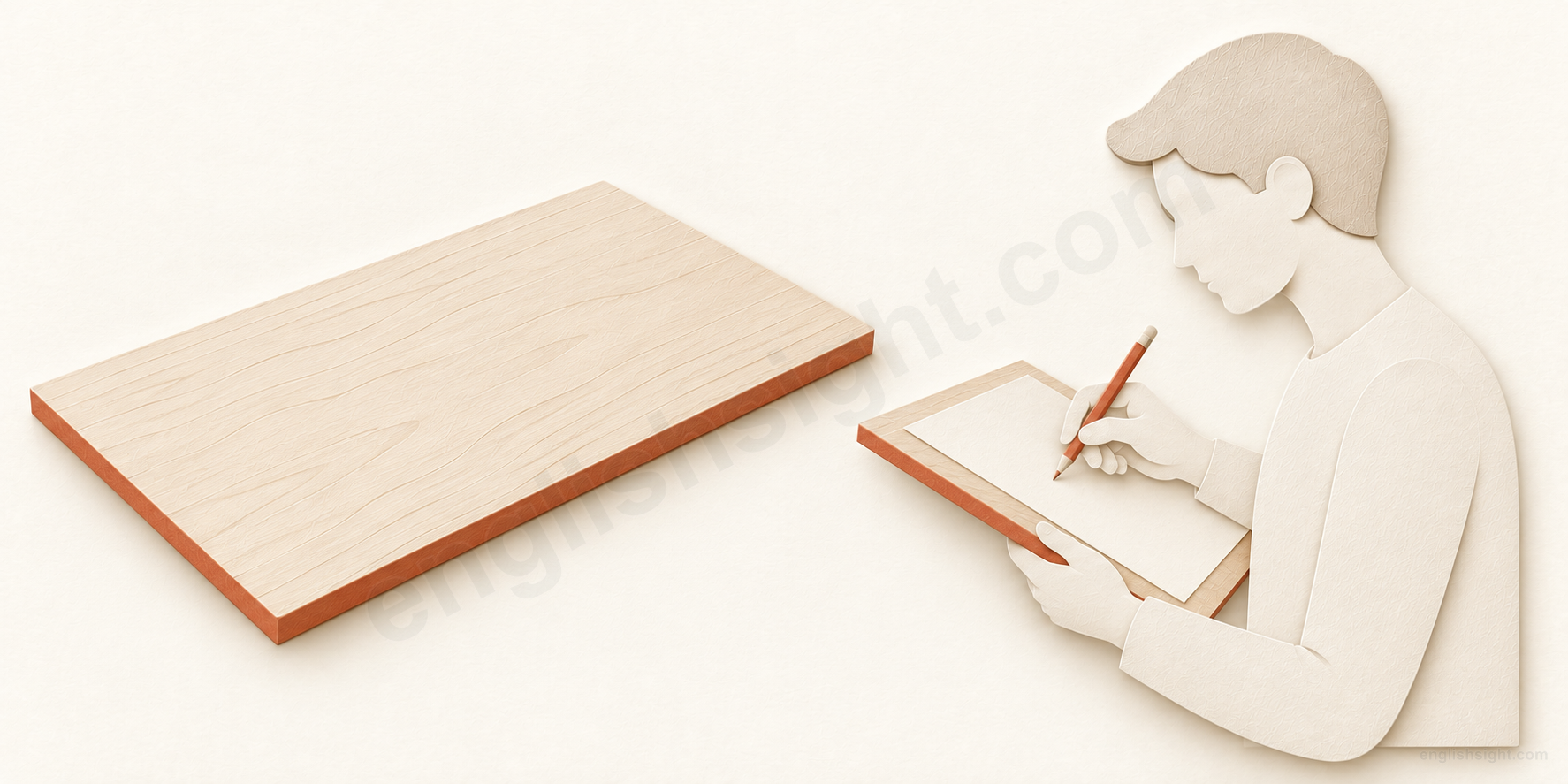
The person uses the board as a drawing surface.
Its firm, flat face supports the paper.
A board provides a broad, firm, flat surface to use.
A physical board is broad and relatively thin, with a firm face that can support work, carry information, or form part of a structure.
The sketch shows the physical starting point. Governing groups, food and accommodation, boarding vehicles, and fixed expressions need their own explanations; the surface model does not predict them.
A wooden board gives you a useful starting point: a broad, relatively thin piece with a firm, flat face. Its purpose explains names such as cutting board, noticeboard, and game board.
Modern English also uses board for official groups, meals, and entering vehicles. Learn those established branches and their grammar directly. The picture is a memory aid for the physical family, not a claim that all meanings or all speakers share one mental image.
01
Flat pieces and useful surfaces
Start with the physical object. Its material, shape, and purpose explain many compounds, but context tells you which board is meant.
01
a board; boards; a board in / across something
a wooden board
a relatively thin, flat piece of strong material
Situation or starting point
A fence has a damaged wooden piece.
Meaning in context
You replace that piece with a new board.
The broad face and small thickness help identify the object.
A board is often a sawn piece of wood used in a floor, fence, wall, or other structure. It is relatively thin compared with its length and width. A plank is a closely related word, especially for a long piece of timber.
Use a board for one piece and boards for several: The floor boards creak. Board can also name material, especially in compounds such as hardboard and chipboard; it does not always describe an individual wooden plank.
In a sentence
One of the boards in the fence is loose.
Watch the difference A board need not be a table or a sign. The context supplies its purpose.
02
a cutting / chopping / ironing board; a cheese board
a cutting board / an ironing board
a purpose-made surface to work on
Situation or starting point
You need a suitable surface for a task.
Meaning in context
A board supports the food, clothing, or drawing.
The first word names the task or use.
A cutting board, also called a chopping board, provides a surface for cutting food. An ironing board supports clothing while you iron. These are countable objects, even when the board is made of plastic or has a padded cover.
Learn the compound as the name of an object, rather than assuming every board has the same shape. A cheese board can be a serving board; on a menu it can also mean the cheese and other food served on it.
In a sentence
Put the vegetables on the cutting board.
Watch the difference Board names the working surface; table usually names a larger piece of furniture.
03
write / draw something on the board; erase something from the board
write on the board
use a classroom or meeting-room writing surface
Situation or starting point
You want the group to see a question.
Meaning in context
The question is written on the shared surface.
The familiar local context makes the board identifiable.
In a classroom, the board often means a blackboard, chalkboard, or whiteboard. You write on it and erase or rub information off it. The noun alone does not tell you whether to use chalk or a marker.
On describes writing on a surface. The usually points to the particular board the people present can identify; a board introduces one without assuming that shared identification.
In a sentence
Please write your question on the board.
Watch the difference Write on the board, not in the board, when you mean its visible writing surface.
04
put / pin / post a notice on the board
a noticeboard / bulletin board
a surface for displaying notices
Situation or starting point
A notice needs to be seen by visitors.
Meaning in context
It is displayed on a board in a shared place.
The board holds information rather than making decisions.
Noticeboard is usual in British English; bulletin board is a common American equivalent. People pin, put, or post notices on it. After the object is clear, they may simply call it the board.
A board that displays information does not have to be something you write on directly. A sheet of paper attached to it is also on the board. In other contexts, a scoreboard displays scores and a departures board displays travel information.
In a sentence
The room changes are listed on the noticeboard.
Watch the difference A notice on the board is displayed information; a person on the board may be a committee member.
05
post something on a message / discussion board
a message board / discussion board
an online place for exchanging posts about a topic
Situation or starting point
People have questions about the same topic.
Meaning in context
Their posts and replies appear in a shared online space.
The information-display idea extends to a digital space.
A message board or discussion board is an internet forum. You post a question on it, read replies, or start a discussion. No physical wooden surface is involved.
The noun names the shared place, not one message. Calling a group of posts a board depends on the site and context; an email inbox is not automatically a message board.
In a sentence
I asked about the missing part on the repair discussion board.
Watch the difference Board here names an online forum, not the people who manage the website.
06
a piece on the board; move a piece across the board; play a board game
a chessboard / board game
the playing surface, or a game played with one
Situation or starting point
Players need marked positions for their pieces.
Meaning in context
The pieces occupy positions on the board.
The board is the playing surface; the game includes rules and actions.
In chess and similar games, a board is the surface on which pieces move. A chessboard has its own marked layout. Once the game is known, you can simply say the board.
A board game is a game played using a board. Board modifies game in this compound; it does not name a committee or mean boarding a vehicle. Moving a piece across the board can describe literal movement, unlike the fixed expression prices rose across the board.
In a sentence
Leave the pieces on the board so we can finish the game later.
Watch the difference The board is one part of a game, not necessarily the whole set of pieces and rules.
07
ride / stand on a board; jump off a diving board
a surfboard / diving board
a specially designed board used in a sport
Situation or starting point
The sport requires a particular kind of equipment.
Meaning in context
The person rides on it or jumps from it.
The sport tells you which equipment board names.
In surfing, skateboarding, and snowboarding, a board is the equipment the rider stands on. The full names surfboard, skateboard, and snowboard identify the sport. A diving board is a platform from which someone jumps into water; it is not something they ride across the pool.
Context can shorten these names to board. It does not make the objects interchangeable: borrow a board at a ski resort will be understood differently from the same request at a surfing beach.
In a sentence
She climbed onto her surfboard and paddled out.
Watch the difference A diving board stays in place; a surfboard travels with its rider.
08
a circuit board; replace / repair the board
a circuit board
a flat support carrying parts of an electronic circuit
Situation or starting point
An electronic device needs connected components.
Meaning in context
The components and connections are carried on a board.
The object remains a physical supporting surface.
A circuit board carries electronic components and their connections. In a repair discussion, the board may refer to that component when everyone knows which device is being discussed.
This is a technical compound worth recognizing in everyday repair information. It does not mean a display screen or a keyboard; those names identify different parts.
In a sentence
The technician found a damaged component on the circuit board.
Watch the difference Use the full compound when board alone would leave the object unclear.
09
board something up; board up something; be boarded up
board up a window
cover or close an opening with boards
Situation or starting point
A window is exposed or broken.
Meaning in context
Wooden boards cover the opening.
Board supplies the material; up helps express closure.
To board up a window, door, or building is to cover its openings with wooden boards. People may do this for protection, after damage, or when a property is unused. The action does not necessarily mean the building will be demolished.
This is a separable phrasal verb: board up the window or board the window up. With a pronoun, say board it up. The passive is common: The shop was boarded up.
In a sentence
They boarded up the broken window before the rain arrived.
Watch the difference Board it up, not board up it. Board a plane has a different meaning and no up.
02
People with official responsibilities
A board can be a decision-making group or an official body. Read the surrounding words to distinguish people from a physical surface.
10
the board of directors / trustees; the board approves / decides; a board meeting
the board of directors
a group with responsibility for directing an organization
Situation or starting point
A company needs an official decision.
Meaning in context
Its governing group considers and approves it.
Board names the people acting as an official group.
A company’s board of directors supervises or directs its affairs. Board members meet, discuss proposals, and make decisions. A board meeting is a meeting of that group, not a type of wooden object.
The board has approved the plan treats the group as one body. British English also permits the board have approved the plan when attention is on its members. American English generally prefers singular agreement for the group as a unit.
In a sentence
The board has approved the new training budget.
Watch the difference A board is a specific responsible group, not every employee or everyone attending a meeting.
11
be / sit / serve on the board; be appointed to the board
sit / serve on the board
be a member of an official board
Situation or starting point
A person is appointed to the governing group.
Meaning in context
The person takes part as a board member.
On marks membership here, not physical position.
Be on the board, sit on the board, and serve on the board describe membership. Sit does not require the person to be seated at the moment. A seat on the board is a position in that group.
She is on the board includes the, because board names an identifiable group. She is on board with the plan has no the and means she supports it. The small difference changes the interpretation.
In a sentence
Maya serves on the board of a local arts charity.
Watch the difference On the board describes committee membership; on board can describe participation or support.
12
a school / tourist / examining board; the Board of Education
a school board / tourist board
an official body responsible for a particular area of activity
Situation or starting point
An area of public activity needs an organization to oversee or promote it.
Meaning in context
A named board carries out that role.
The name tells you the body’s area of responsibility.
Board occurs in the names of public and other official bodies. A school board may oversee local schools; a tourist board promotes or provides information about tourism. An examining board organizes or sets examinations.
These bodies do not all have identical powers. Read the full name and context. Capitalize Board when it is part of an official name; a general description such as the local school board normally uses a lower-case letter.
In a sentence
The tourist board sent us a map of the walking routes.
Watch the difference Tourist board names an organization; noticeboard names a display surface.
03
Getting on and being on a vehicle
Board describes entering a vehicle; on board describes your position. An announcement can also make the flight itself the subject of board.
13
board + vehicle; wait to board; a vehicle is boarded by someone
board a train / plane / ship
get onto a vehicle, usually to travel
Situation or starting point
The traveler is outside the vehicle.
Meaning in context
The traveler has entered it.
Board describes entry; it does not itself describe the journey.
Board is used for entering a train, plane, ship, or bus. It is especially familiar in travel instructions and announcements; get on is more conversational. Board takes the vehicle directly: board the train. When the vehicle is understood, the object can be omitted: We are waiting to board.
The passive is also possible: The ship was boarded by inspectors. That says the inspectors entered it; it does not mean the ship was covered with wood. Boarding and checking in are different stages of an air journey.
In a sentence
We boarded the train ten minutes before it left.
Watch the difference Say board the plane, not board on the plane. Get on the plane uses a different construction.
14
a flight is boarding; board + passengers; a boarding pass
The flight is now boarding.
passengers are being invited or allowed to enter
Situation or starting point
Passengers are waiting near the gate.
Meaning in context
The boarding process is open or underway.
The flight can be the subject even though passengers move.
In an airport announcement, Flight 218 is boarding means passengers can now get on that flight. It does not mean the aircraft is getting onto another vehicle or has already taken off.
An airline can also say We are boarding passengers with young children first. Here the staff or airline is the subject and passengers are the object: board means allow or put them on. A boarding pass is the document used to board, not a promise that the aircraft is already leaving.
In a sentence
The flight to Lisbon is now boarding at Gate 6.
Watch the difference Now boarding describes entry arrangements, not a completed departure.
15
be / go on board; on board + vehicle; aboard + vehicle
on board / on board the ship
in or on a vehicle such as a ship, aircraft, or train
Situation or starting point
You ask where the travelers are.
Meaning in context
They are inside or on the vehicle.
The phrase describes position rather than the act of entering.
Be on board describes being on a ship, train, aircraft, or similar vehicle. Go on board describes movement onto it. Aboard can often replace the whole phrase: aboard the ship. Neither expression requires a person to stand on a visible wooden board.
Keep on board as two words in this lesson’s phrases: Everyone is on board. Before a noun, the adjective is commonly written on-board or onboard, as in on-board services. On the board, with the, normally points to a physical surface or membership of an official group.
In a sentence
There are forty passengers on board the ferry.
Watch the difference Board the ferry is a verb plus object; be on board the ferry describes location.
04
Joining, supporting, and understanding
On board extends beyond travel in established expressions about people and ideas. These meanings belong to the complete expression.
16
come on board; welcome on board; bring / have someone on board
come on board / welcome on board
join or be welcomed into a team or project
Situation or starting point
A person is not yet part of the project.
Meaning in context
The person joins the people working on it.
Joining a shared undertaking is expressed through a familiar travel phrase.
Come on board can mean join a team, project, or organization. Welcome on board is used to greet a new participant as well as an actual passenger. Bring someone on board means involve or recruit that person.
The project is not literally a vehicle. This is an established extension, not a rule that board alone always means join. Do not infer that a new participant has become a member of the company’s governing board.
In a sentence
We brought an experienced designer on board to help with the launch.
Watch the difference Joining the team does not automatically mean joining the board of directors.
17
be / get on board with + plan / idea; get someone on board
be on board with a plan
agree with or support a proposed course of action
Situation or starting point
A plan has been proposed.
Meaning in context
A person is willing to support or cooperate with it.
Support does not require physically joining a vehicle or organization.
I’m on board with the plan is an informal way to say that you support it or are willing to cooperate. Get someone on board can mean persuade them to support an idea, even when they already belong to the organization.
Context separates this meaning from recruitment: a new adviser coming on board joins the work; an existing colleague getting on board with the timetable accepts it. Neither wording says that every detail has been formally approved.
In a sentence
Everyone is on board with the revised timetable.
Watch the difference On board with an idea means support; on the board means membership of a governing group.
18
take something on board; take on board + idea / information
take advice / feedback on board
accept and understand information so that it receives serious consideration
Situation or starting point
Someone offers advice or raises a problem.
Meaning in context
You recognize it and include it in your thinking.
The idea is taken into consideration, rather than carried onto a ship.
Take something on board means accept or understand an idea, suggestion, or problem. In a work discussion, taking feedback on board says more than merely hearing the words: you give the feedback a place in your thinking.
The object can come before on board or, especially when longer, after it: take your comments on board; take on board the concerns raised by the team. With it, use take it on board. The expression does not guarantee that every suggestion will be followed.
In a sentence
We took your feedback on board and simplified the instructions.
Watch the difference I’m on board with it expresses support; I’ve taken it on board emphasizes accepting or understanding the information.
05
Meals, accommodation, and care
Board has a separate food-and-accommodation family. The grammar identifies who receives the service and who arranges or provides it.
19
room and board; board and lodging; pay for board
room and board / board and lodging
accommodation together with regular meals
Situation or starting point
You need somewhere to live and food during your stay.
Meaning in context
The arrangement supplies a room and meals.
Board names meals in this family, not a wooden surface.
In room and board, room supplies the accommodation meaning and board supplies the meals meaning. Board and lodging and bed and board are related expressions. You may encounter them in descriptions of jobs, study arrangements, and places to stay.
Meal-related board is uncountable: pay for board, not pay for a board. Keep this separate from a cheese board, which can be one serving of food presented on a board. The shared word does not make the constructions interchangeable.
In a sentence
The summer job includes room and board.
Watch the difference Room and board includes food as well as a place to sleep; room alone does not say meals are included.
20
stay on a full-board / half-board basis; book full board / half board
full board / half board
hotel arrangements with different numbers of meals included
Situation or starting point
You compare accommodation packages.
Meaning in context
You know which meals the price covers.
Full and half describe the meal arrangement, not the size of an object.
In British travel English, full board includes accommodation and all the main daily meals. Half board includes accommodation, breakfast, and an evening meal. It is not half a bedroom or half a meal.
Compare bed and breakfast, which specifies the room and breakfast. These names help identify a package; check the booking details for such things as drinks and meal times, rather than assuming that full board means every possible service is included.
In a sentence
We booked half board, so we will buy lunch separately.
Watch the difference Full board concerns meals and accommodation; it does not by itself mean an all-inclusive holiday.
21
board with + person / family; board at + place
board with a family / at a house
pay to live and have meals in someone’s home
Situation or starting point
A person needs a place to stay with meals.
Meaning in context
A household provides that arrangement for payment.
The person receiving accommodation is the subject.
Someone who boards with a family lives and eats there as a paying resident. With introduces the people providing the accommodation; at can introduce the place. This use is more specific than simply staying for a visit.
Boarding with someone is a living arrangement, not getting onto them. Boarding can describe an ongoing situation: Two students are boarding with us this term. A host can also board students, meaning provide their meals and accommodation for payment. These food-and-accommodation uses form a separate established branch; the flat-surface sketch does not predict them.
In a sentence
While studying in the city, I boarded with a local family.
Watch the difference Staying with friends does not automatically mean boarding; the board arrangement normally includes meals and payment.
22
board at school; a boarding school; board or attend as a day student
board at school
live at a school during the school term
Situation or starting point
A school offers residential places.
Meaning in context
The pupil lives there during term instead of going home each day.
The school context selects a residential meaning.
A pupil who boards lives at the school during the school term. A boarding school is a school with this residential arrangement. The verb can stand alone when the context is clear: Does your daughter board?
Compare a day pupil or day student, who attends lessons but does not live at school. Board at school does not mean stand on a classroom board or get onto a school bus.
In a sentence
He boards at school during the week and goes home on Fridays.
Watch the difference Boarding concerns where a pupil lives, not the act of attending classes.
23
board + animal + at + place; a provider boards animals
board a horse / pet
provide or arrange paid accommodation and feeding for an animal
Situation or starting point
The animal needs somewhere to stay and be fed.
Meaning in context
A stable or other care provider houses and feeds it.
The animal receiving care is the object.
Board can take an animal as its object when it receives accommodation and food for payment. An owner can board a horse at a stable; a care provider can board animals for their owners. Context tells you who arranges the service and who supplies it.
Compare the intransitive pattern I board with a family, where the subject receives accommodation. In I board my horse at a stable, my horse is the object and receives the accommodation. There is no transport meaning unless a vehicle context supplies one.
In a sentence
We board our horse at a stable outside town.
Watch the difference Boarding an animal here is arranging or providing care, not necessarily putting it on a train or ship.
06
Familiar fixed expressions
Keep the whole wording together. These expressions describe stiffness, broad effects, honest conduct, success, abandoned plans, and design work.
24
be / feel as stiff as a board
as stiff as a board
with a very stiff body that is hard to move or bend
Situation or starting point
You have been sitting in one position for hours.
Meaning in context
Your body feels rigid when you try to move.
The comparison draws on a physical board’s resistance to bending.
If you feel as stiff as a board, your body feels very stiff and does not bend or move easily. For example, you might say this after a long car journey or when trying to stretch. The comparison emphasizes stiffness, rather than simply being tired.
In as stiff as a board, stiff names the property and as ... as introduces the comparison. Board is a countable physical object here, so retain a: as stiff as a board. This familiar comparison connects to a board’s rigidity; it does not explain the word’s separate transport or organization meanings.
In a sentence
After the long drive, I got out of the car feeling as stiff as a board.
Watch the difference Stiff means hard to bend or move here; tired means needing rest.
25
a change applies across the board; an across-the-board + change
across the board
affecting all the relevant people, areas, or categories
Situation or starting point
A change might apply only to selected groups.
Meaning in context
It applies throughout the relevant group or organization.
Across gives broad coverage in this established expression.
Prices rose across the board means the increases affected the relevant range of prices, not just a selected item. The expression often appears with cuts, rises, improvements, or rules.
Before a noun, use the hyphenated modifier: an across-the-board increase. The phrase does not necessarily mean that every number changes by the same amount; it emphasizes coverage across the relevant categories. It does not mean the board of directors personally made the change.
In a sentence
The new safety rule applies across the board, including to managers.
Watch the difference Across the board is about the scope of a change, not physically crossing a wooden surface.
26
be above board; do something above board
above board
honest and legal, without concealed dishonest dealing
Situation or starting point
Someone wants to know whether an arrangement is trustworthy.
Meaning in context
You say it is conducted honestly and legally.
The expression evaluates conduct, not height.
A deal that is above board is honest and legal. You can also say someone did everything above board to describe the way they acted. Learn this as a complete expression rather than deriving its meaning from above plus the modern committee sense.
It does not mean that a deal is profitable or wise, only that there is no dishonest or illegal dealing. Keep it separate from on board, which may express participation or agreement.
In a sentence
We kept receipts to show that every payment was above board.
Watch the difference There is no the in the fixed expression above board.
27
sweep the board at / in + competition; swept the board
sweep the board
win all the prizes or events in a contest
Situation or starting point
Several awards or events are available.
Meaning in context
The same competitor wins them all.
The whole expression conveys complete competitive success.
In this idiom, sweep the board means win all the available prizes, seats, or events in the relevant competition. It is especially associated with British English. The past form is swept the board.
The phrase can be used emphatically, but it is stronger than simply win a prize. It does not describe cleaning a surface, and it has nothing to do with replacing all the directors of a company.
In a sentence
Our team swept the board, winning all four events.
Watch the difference One isolated win does not normally justify sweep the board.
28
a plan / principle goes by the board; went / has gone by the board
go by the board
be abandoned, ignored, lost, or no longer possible
Situation or starting point
A plan or principle is meant to guide what happens.
Meaning in context
It is no longer followed or cannot be carried out.
The subject is the plan or principle that is lost.
Plans, efforts, or principles can go by the board when events cause people to drop or ignore them. This is a fixed expression, especially familiar in British English. The past form is went by the board.
The plan went by the board does not mean a committee approved it. Compare The plan went before the board, which says that it was presented to the governing group for consideration. The different preposition changes the whole message.
In a sentence
Our picnic plans went by the board when the storm arrived.
Watch the difference By the board in this idiom does not identify a group that made a decision.
29
a project / proposal is on the drawing board
on the drawing board
being planned or considered, before implementation
Situation or starting point
An idea has been proposed.
Meaning in context
People are developing or considering it as a plan.
The design surface stands for a stage of planning.
A drawing board is a flat support for paper used in making drawings and plans. Figuratively, a project on the drawing board is still being prepared or considered; work may not yet have started on building or launching it.
The phrase can describe a first plan and does not imply failure. People can use it even when all the design work happens on computers.
In a sentence
A new library is on the drawing board, but construction has not started.
Watch the difference On the drawing board means in planning; on the board alone does not have that fixed meaning.
30
go back to the drawing board; it is back to the drawing board
back to the drawing board
start planning a new approach after an earlier one fails
Situation or starting point
An attempted plan has failed or been rejected.
Meaning in context
People return to planning and seek a different solution.
Back adds a return after an unsuccessful attempt.
Go back to the drawing board means return to the planning stage because the earlier idea did not work. You can also say It’s back to the drawing board as a complete conversational response to a failed attempt.
Compare a project on the drawing board: that only locates it at the planning stage. Back to the drawing board adds the need to rethink an earlier attempt; it need not mean discarding every useful detail.
In a sentence
The prototype leaked, so we went back to the drawing board.
Watch the difference The expression is about rethinking a failed approach, not simply drawing another picture.
Let grammar and context select the meaning
Three similar-looking patterns
Board the train describes entering it. Be on board describes being in or on it, or figuratively participating or supporting. Be on the board usually describes membership of a governing group, though context can also make on the board a literal surface location.
Countable objects and groups; uncountable meals
Use a board or several boards for physical pieces and official groups. Meal-related board is uncountable: room and board, full board. A cheese board is a different countable object or serving.
Forms and sound
The regular verb forms are board, boards, boarded, boarding. Board and bored sound alike in the standard pronunciations, but bored is the adjective for having little interest: I’m bored. Boarded describes a past action or, with up, a covered opening.
Different verb patterns
A traveler can board a vehicle or simply board; a flight can be boarding; a resident boards with a host; an owner boards an animal at a stable. These are different established uses. Board up is separable, and not every expression containing board is a phrasal verb.
A useful range, with clear limits
This lesson includes modern everyday objects, organizations, travel, accommodation, and familiar idioms. Specialist sporting and nautical meanings, professional board examinations, and older theatre expressions are outside the main teaching range.
Choose the meaning that fits
Use the whole expression and the situation, including any article or preposition.
1. You are describing the act of getting onto a train. Which sentence fits?
2. Which sentence says that Lina is a member of a company’s governing group?
3. An airport announcement says, “Flight 218 is now boarding.” What does it tell passengers?
4. A colleague says, “I’ve taken your feedback on board.” What is the intended meaning?
5. A hotel advertises half board. Which meals does this British travel term normally include?
6. You must cover a broken window with boards. Which pronoun order is correct?
7. A rule applies across the board. What does that emphasize?
8. A design failed, and the team says it is back to the drawing board. What happens next?
Sources and teaching notes
Dictionary entries below support the meanings and usage distinctions. The explanations and examples are original. The surface connection is a bounded teaching model, not a source for predicting every meaning.
The diagram explains the physical surface family; other established meanings are taught in the text.