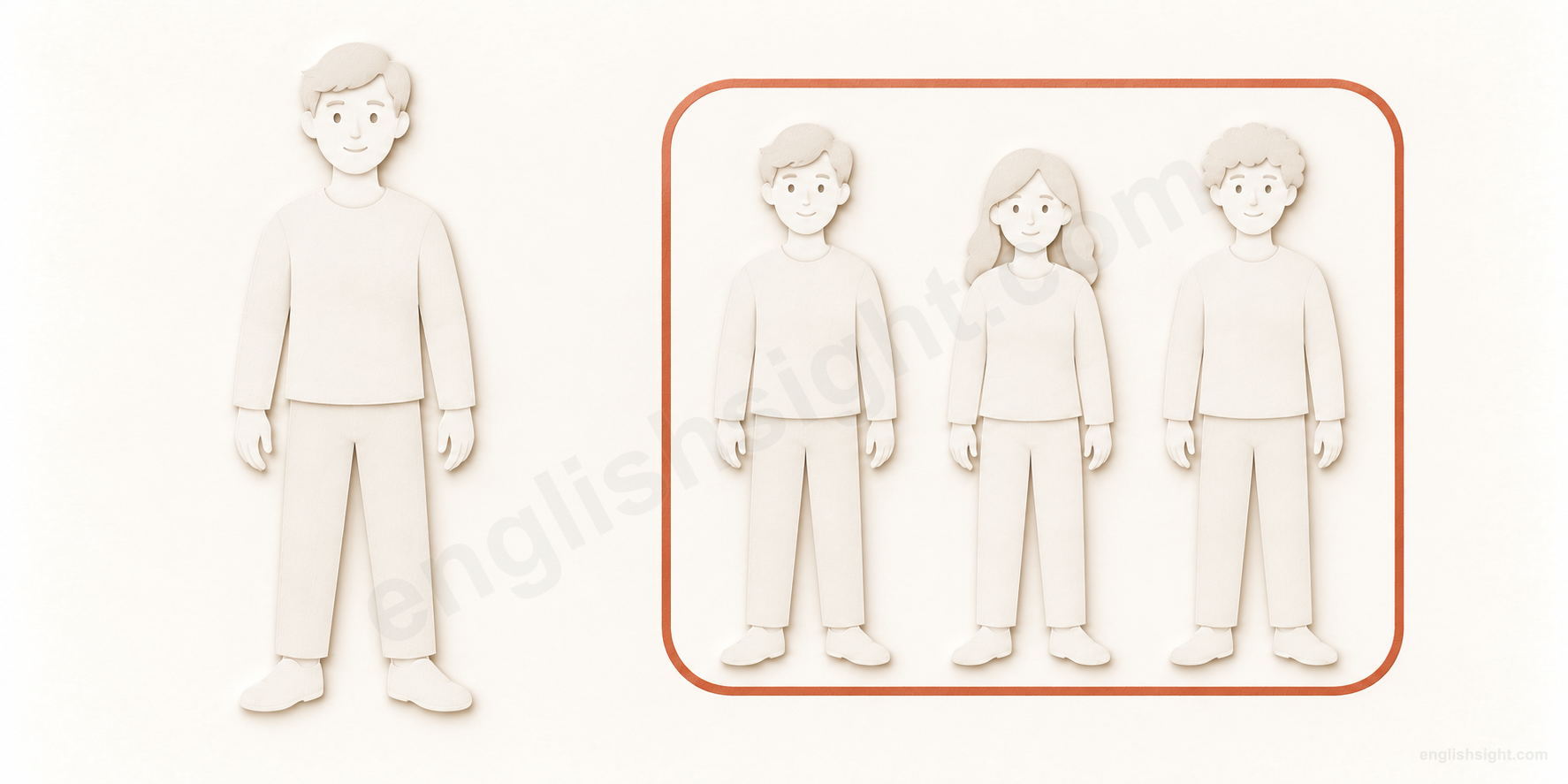
A person has a physical body; several people can form one body. The outline marks grouping, not a container or a change over time.
Body can name a physical whole or something considered as one collective unit. In a separate main-part use, it identifies the substantial central structure.
The diagram compares a person’s complete physical body with people grouped as one body. It shows a relationship between uses, not a person changing into a group. The torso and main-part uses narrow the focus; fullness and idioms are further established branches.
Your body is your physical whole. A car has a body as its main structure, while a student body is a collection of people viewed together. These are connected uses, but the surrounding words decide which meaning fits.
This lesson uses “a whole or substantial unit” as a teaching connection. Fullness senses and established idioms need their own explanations; no single picture predicts every expression, or represents what every English speaker imagines.
01
A person’s physical whole
Start with the body itself. Context can narrow body to the torso or identify a dead person. Familiar compounds describe communication, daily rhythms, and how someone sees their appearance.
01
my / your / the + body; the body of + person or animal; body + noun
the human body / my body
the physical whole of a person or animal
Situation / context
After a long walk, your legs, back, and shoulders all feel tired.
What body names
You describe your physical self as a whole.
Here body includes the head and limbs, not just the middle.
In My whole body aches, body gathers your physical parts into one whole. Your body contrasts with your mind when you talk about physical and mental experience; it does not replace person in every sentence.
Use a determiner for an individual body: my body, the dog’s body, or a healthy body. Body weight and body temperature put the noun body before another noun to identify a physical measurement. The plural is bodies: Different bodies respond differently.
In a sentence
My whole body felt tired after the long walk.
Watch the difference Body does not mean a particular organ. My body hurts is broad; My knee hurts identifies the painful part.
02
head / arms / legs + and / near / against + body; upper / lower body
head and body / upper body
the main middle part of a physical body
Situation / context
An instruction contrasts your head or arms with the middle of your body.
What body names
Body has a narrower scope in this context.
The contrast with other body parts tells you what body includes.
Body sometimes means the trunk or torso, excluding the head and, in a narrower use, the arms and legs too. Keep your arms close to your body asks you to hold them near your middle; it does not imply that arms are never parts of a body.
In The bird has a grey body and a black head, the contrast narrows body. Upper body and lower body identify regions, especially in exercise instructions; do not assume every use of upper body is a strict anatomical synonym for torso.
In a sentence
She held the parcel against her body with both arms.
Watch the difference Body has both a whole and a main-part use. Read the contrast instead of imposing one definition everywhere.
03
a (dead) body; find / recover / identify + a body
a dead body / identify a body
the physical remains of a person or animal that has died
Situation / context
A rescue report refers to a person who has died.
What body names
The report uses body for the person’s physical remains.
The context can supply dead even when the adjective is absent.
The police found a body normally means a dead body. But body alone does not always mean dead: Your body needs rest clearly describes a living person. The situation selects the meaning.
Recover a body means find and bring back the remains; identify a body means establish whose remains they are. Neither phrase describes helping a living person recover from illness. Corpse usually names a dead human body and can sound stark; body is common in factual reports.
In a sentence
Rescuers recovered the missing climber’s body the next morning.
Watch the difference A body was recovered and Someone recovered describe very different situations. Check which noun is the subject.
04
someone’s body language; read / interpret + body language
body language
communication through posture and movement
Situation / context
Someone says little but leans away during a conversation.
What body names
Their posture contributes to the impression you receive.
Language describes communication; body tells you the means.
Body language is the way physical position and movement communicate feelings or thoughts. In this compound, language extends beyond spoken words. The body is a means of expression.
Use it as an uncountable noun: Her body language seemed relaxed. Body languages is not the normal way to refer to several gestures. An interpretation is still an interpretation; the phrase itself does not guarantee that you have correctly understood another person.
In a sentence
His words were welcoming, but his body language seemed tense.
Watch the difference Body language is not a list of body-part names and does not mean a spoken language about anatomy.
05
my / your + body clock; someone’s body clock + verb
body clock
the natural timing of needs such as sleep
Situation / context
Your usual waking time arrives even though you have no alarm set.
What body names
You describe your internal daily timing.
Clock is a metaphor for timing within the body.
Your body clock is the natural system associated with when you feel ready to sleep, wake, or eat. It is not a watch that you wear or an organ literally shaped like a clock.
The compound is countable: my body clock, our body clocks. In a sentence about travel or a changed routine, it names your internal timing rather than the time displayed on a device.
In a sentence
My body clock still wakes me before six, even on holiday.
Watch the difference A body clock and an alarm clock are different kinds of timing: natural rhythm versus an external device.
06
body image; a positive / negative body image; someone’s body image
body image
a person’s perception and evaluation of their own appearance
Situation / context
Two people may think very differently about how they look.
What body names
You name each person’s view of their own body.
Image here is a mental view, not necessarily a photograph.
Body image concerns how someone sees and feels about their physical appearance. A positive body image describes a positive view of oneself, not a picture with good lighting.
You can discuss body image generally without an article, or say a positive / negative body image. The expression names perception and evaluation; it does not by itself tell us someone’s actual shape, size, or health.
In a sentence
The workshop explores how advertising can influence body image.
Watch the difference A photograph of a body is not automatically what the expression body image means in this discussion.
02
The main structure or section
A vehicle, an instrument, and a piece of writing can have a body. Find the substantial main part and distinguish it from attachments or surrounding sections. The clothing sense is a separate established use.
07
the body of + object; a car body; the main body of + building
the body of a car / plane
the substantial main structure of an object
Situation / context
A mechanic separates damage to the outer structure from a problem with a wheel.
What body names
Body identifies the main structure being discussed.
The main part is distinguished from attached or separate components.
A car body is its main shell or structure, rather than its wheels or engine. A plane’s body is its central structure, rather than its wings. The exact part depends on the object; body is not a universal label for everything inside an outer covering.
This main-part use also occurs with buildings: the main body of the building distinguishes a central section from an extension. The connection with a physical body is a useful teaching analogy, not a rule that every object must have a part called a body.
In a sentence
The car’s body was badly scratched, but the engine still worked.
Watch the difference The body of a car is not its whole mechanical system. The object and the contrast determine the scope.
08
the body of + email / essay / report; body text; body paragraph
the body of an email / essay
the main text or central section of a document
Situation / context
You distinguish an email’s subject line from the message itself.
What body names
The message text goes in the body.
Body names the main content rather than a heading or surrounding material.
The body of an email is the main message text. In an essay, the body normally develops the argument between the introduction and conclusion. An email and an essay have different structures, so the exact boundaries follow the kind of document.
The main body of the text contrasts with notes, headings, or supplementary material. Body text uses body as a modifier. Body paragraph names a paragraph within the main development, not an anatomical topic.
In a sentence
Put the booking reference in the body of the email, below the greeting.
Watch the difference In this use body says where the content belongs; it does not say the document is about the human body.
09
the body of + guitar / violin; the instrument’s body
the body of a guitar
the main structure of a stringed instrument
Situation / context
You distinguish a guitar’s neck from its larger main section.
What body names
Body names the main structure joined to the neck.
This is an established main-part use in instrument vocabulary.
In descriptions of a guitar or violin, the body is the main structure joined to the neck. For an acoustic guitar or violin, it is the resonating sound box. Body does not name the strings, the neck, or the person playing.
The wooden body has a crack describes physical damage to the instrument. A tone with body describes the fullness of a sound instead: the noun phrase around body distinguishes a structure from a quality.
In a sentence
There is a small crack in the body of the old violin.
Watch the difference Read whether body names a physical part or a quality of the sound. These are related but different uses.
10
a + colour / material + body (British); a bodysuit; the body of a dress
a body / a bodysuit
a close-fitting one-piece garment
Situation / context
A clothing description names a fitted garment that fastens between the legs.
What body names
In British English, body can name the garment.
This countable clothing noun is a separate established use.
A body can mean a close-fitting garment covering the torso and bottom and usually fastening between the legs. This sense is particularly British; bodysuit is the corresponding term given for North American English.
She bought a black body can be a clothing sentence when the context is clear. Outside that context, bodysuit identifies the item more explicitly. The body of a dress can instead mean the dress’s torso section, not a separate bodysuit.
In a sentence
She chose a black body to wear under the loose trousers.
Watch the difference A body in a clothing catalogue is not necessarily a person or a corpse. Use the shopping context.
03
People considered together
Body can name an organization or a collection of people; informal bodies can also count people as helpers. Read the surrounding words to find out whether people share an official function, a school, another connection, or an action.
11
a governing / regulatory / advisory / professional body; bodies + plural verb
a governing / regulatory body
an organized group with a particular function
Situation / context
A group has responsibility for decisions or standards.
What body names
You refer to the organization as a body.
The members are considered together as an organization.
A governing body makes or oversees decisions; a regulatory body sets or enforces standards; an advisory body gives advice. The modifier identifies the role. Body by itself does not mean government, because a professional or independent body may also be an organization.
Treating many people as one unit connects this sense with the diagram. A body is countable: several professional bodies. American English usually favours singular agreement for an organization viewed as one unit. British English more readily uses plural agreement when the members are in view; this does not make plural agreement impossible in American English.
In a sentence
An independent body will review the complaints.
Watch the difference Body identifies an organized group here. It does not refer to one official’s physical body.
12
the student body; a student body of + number
the student body
all the students of an institution considered together
Situation / context
A college describes its students as a community.
What body names
The expression includes the students collectively.
Student identifies the members, not the topic of a person’s anatomy.
The student body means the institution’s students as a whole, not just its student council or one class. An announcement addressed to the student body is addressed to that collective group.
A student’s body refers to one student’s physical body. The student body has no possessive apostrophe: it is an established compound. A college can have a student body of two thousand, where of introduces the number of students.
In a sentence
The new library is open to the entire student body.
Watch the difference Distinguish the student body from a student’s body and from the smaller student council.
13
a (large / small) body of + plural people noun
a body of people
a group connected or considered together
Situation / context
Many volunteers share a task without forming a formal institution.
What body names
You refer to them collectively.
Of names the people who make up the group.
A body of volunteers, supporters, or people treats a number of individuals as a collective. It need not name a legally established organization. The context tells you their connection.
This phrasing is more formal than a group of volunteers. Compare a body of volunteers with the bodies of the volunteers: the first names one group; the second refers to the volunteers’ physical bodies. Word order and number matter.
In a sentence
A large body of volunteers helped with the clean-up.
Watch the difference In a body of people, body is the group noun; people names its members. Do not automatically read it as anatomy.
14
need / want + a few more / extra + bodies
a few more bodies
people counted informally as helpers or participants
Situation / context
A team needs extra people to carry some heavy boxes.
What body names
The speaker informally counts the people needed.
Here bodies refers to people, with emphasis on their physical presence.
Body can informally stand for a person. In We need a few more bodies to move these boxes, the plural refers to extra helpers, not corpses. The task makes the living-person interpretation clear.
This use can make people sound like numbers or physical resources. People or helpers is usually a more neutral choice. Do not treat body as a general replacement for person: I met a helpful person is more natural than I met a helpful body.
In a sentence
We need a few more bodies to carry the tables upstairs.
Watch the difference A report about finding bodies may mean dead people; a request for extra bodies to help refers to living helpers. Read the context.
15
plural group subject + act / leave / arrive + in a body
in a body
all together as one group
Situation / context
The members leave a meeting together rather than one by one.
What body names
Their joint action is described as happening in a body.
The fixed phrase tells how the group acts.
The delegates left in a body means they left together as a group. In a body is an established adverbial phrase; it describes the manner of the action, not the inside of someone’s physical body.
Compare There is a foreign body in his eye: that uses in to locate something physically. In a body in the group-action sense is relatively formal, so together or as a group is often simpler in everyday conversation.
In a sentence
The residents went in a body to the council meeting.
Watch the difference Keep the article in the fixed phrase: in a body. In the body normally points to a particular physical body or main section.
04
A mass, a collection, or a distinct object
A body of evidence gathers many pieces into a collection; a body of water is a distinct expanse. Foreign body and celestial body use the more formal object sense.
16
a large / growing body of + evidence / research / knowledge; someone’s body of work
a body of evidence / work
a substantial collection considered together
Situation / context
Several studies or pieces of work contribute to a larger collection.
What body names
You discuss the collection as a body.
Body counts the collection, while of names what it contains.
A body of evidence is a collection of supporting material. Evidence remains uncountable: a large body of evidence, not a body of evidences. A growing body of research similarly presents several findings as a collection.
A writer’s body of work means their works considered together: The exhibition spans her entire body of work. It does not mean the central paragraph of one work. A body of opinion is a substantial grouping of views; the expression alone does not say that everyone agrees.
In a sentence
A growing body of evidence supports the new explanation.
Watch the difference Body of does not always mean the main part of one thing: compare the body of the report with a body of research.
17
a large / small body of water; bodies of water
a body of water
a distinct area or mass of water
Situation / context
A map shows a lake or another separate expanse of water.
What body names
You describe the expanse without specifying its exact type.
Water is the material; body makes a distinct expanse countable.
A body of water can be a lake or a sea. Bodies of water lets you count separate expanses even though water itself is uncountable. It is useful when the exact geographical category is less important than the water area.
Two bodies of water means two distinct expanses, not two dead bodies in water. In two bodies in the water, in gives their location; in two bodies of water, of identifies what makes up each expanse.
In a sentence
Several small bodies of water appear on the map near the village.
Watch the difference Keep the plural on body: bodies of water. Do not write bodys or waters for this ordinary use.
18
a foreign body in + place; foreign bodies
a foreign body
an object present somewhere it does not belong
Situation / context
An examination finds a tiny piece of material in an eye.
What body names
The object is described as a foreign body.
Foreign means out of place, not from a different country.
A foreign body is an object that has entered something else and does not belong there. The phrase is common in medical descriptions, where body names the unwanted object rather than the whole patient.
A foreign body in the eye could be a tiny fragment. Its size does not prevent body from meaning object. The expression describes its relation to the surrounding place; it says nothing about nationality.
In a sentence
The examination revealed a small foreign body in her eye.
Watch the difference Do not interpret a foreign body as a foreign person’s body. This is an established object expression.
19
a celestial / heavenly body; celestial / heavenly bodies
celestial / heavenly bodies
natural objects in space, such as stars and planets
Situation / context
An astronomy description groups planets and stars as objects.
What body names
It calls them celestial or heavenly bodies.
An adjective identifies the kind of physical object.
Body can mean a distinct physical object in formal or scientific language. In celestial bodies and heavenly bodies, it refers to objects such as planets and stars, not to people living in the sky.
A solid body in a physics discussion similarly treats something as a physical object or mass. This formal sense does not make body a natural substitute for object in every ordinary sentence: I put an object on the table is clearer than I put a body on the table.
In a sentence
The telescope can track several celestial bodies at once.
Watch the difference In a general conversation, an unexplained body may suggest a physical person or remains. The scientific modifier supplies the intended sense.
05
Fullness and substance
Body can describe how substantial hair looks or a drink feels. This is an uncountable quality, rather than a person, an organization, or a container.
20
hair with body; give / add + body + to hair; give hair more body
give hair more body
make hair look or feel fuller
Situation / context
Hair lies flat and appears to lack volume.
What body names
A description contrasts it with fuller-looking hair.
Body is an uncountable quality of fullness.
Hair with body looks or feels full rather than flat. In This style gives my hair more body, gives more body describes the effect on its appearance; no extra anatomical body is added.
Use more body, some body, or hair with body. This quality sense is uncountable, unlike several bodies of water. A product description may promise body, but the vocabulary itself does not prove that a product works.
In a sentence
The shorter cut gives her hair more body.
Watch the difference More body describes fullness, not necessarily longer hair or more individual hairs.
21
a drink with body; plenty of body; a full-bodied wine
a wine with body / full-bodied
fullness or substance in a drink’s taste and feel
Situation / context
A description contrasts a light-feeling drink with a more substantial one.
What body names
Body names that substantial quality.
This is a quality of the drink, not the bottle or the amount poured.
A wine with body has a full, substantial quality in the mouth. Full-bodied is the related adjective. This sense is uncountable: plenty of body, not many bodies.
A full-bodied wine is not a full bottle: the first describes a quality, the second an amount in a container. The broader fullness sense can also describe sound, as in a voice with body. Learn the noun being described instead of imagining a human figure inside the drink.
In a sentence
The menu describes this red wine as full-bodied.
Watch the difference Full-bodied is not a synonym for sweet, and body does not refer to the shape of the bottle.
06
Learn the whole expression
These phrases express commitment, survival, refusal, character, or a serious setback. The words around body contribute essential meaning; a picture of a physical body cannot predict them all.
22
commit / dedicate oneself body and soul to + noun / -ing; work body and soul
body and soul
with your full commitment and energy
Situation / context
Someone gives a cause all their effort and emotional commitment.
What body names
You emphasize how completely they are involved.
The pair body and soul presents the whole person figuratively.
To commit yourself body and soul to a project is to give it your whole effort and commitment. The whole phrase intensifies dedication; it does not normally ask the reader to analyse a religious theory.
It commonly follows a verb: They worked body and soul to save the theatre. In a discussion of philosophy, body and soul may instead be a literal contrast of physical and spiritual aspects. Context distinguishes the idiom from that topic.
In a sentence
She committed herself body and soul to restoring the old theatre.
Watch the difference Do not confuse complete commitment with keeping body and soul together, the separate idiom for meeting basic living needs.
23
(just / barely) keep body and soul together
keep body and soul together
manage to afford the basic necessities of life
Situation / context
A person’s income only covers essential living costs.
What body names
The phrase emphasizes getting by with very little.
This whole idiom concerns survival, not wholehearted effort.
Keep body and soul together means obtain enough of what you need to live, often through a small income. Barely or just stresses how little money or support there is.
The words keep and together create an established expression. Do not interpret it as instructions for holding body parts together, and do not confuse it with work body and soul, which stresses complete effort.
In a sentence
The occasional repair jobs barely kept body and soul together.
Watch the difference The expression says little about enjoying a good standard of living; it emphasizes meeting essential needs.
24
Over my dead body!; proposal + over someone’s dead body
over my dead body
a forceful, informal refusal or objection
Situation / context
Someone proposes something you strongly oppose.
What body names
You emphatically say you will not allow it.
The whole expression signals opposition, usually figuratively.
Over my dead body! expresses strong opposition: the speaker presents the proposal as something they will resist completely. In ordinary figurative use it is not a prediction that someone will die.
It can stand alone or appear after the disputed proposal. The possessive identifies the person objecting: over her dead body reports her objection. It is confrontational and may be jokingly dramatic; I strongly disagree is more neutral.
In a sentence
“Can we sell your old guitar?” “Over my dead body!”
Watch the difference Do not treat it as a polite routine way to say no. The dramatic tone is part of its meaning.
25
not have / not have got a + character adjective + bone in one’s body
not have a… bone in your body
have none of the stated character quality
Situation / context
You want to emphasize that someone is completely free of cruelty.
What body names
You use an anatomical image to describe character.
The adjective supplies the quality; the negative idiom denies it completely.
She hasn’t got a cruel bone in her body means she is not at all cruel. Bone and body form a figurative expression of completeness; the sentence is about personality, not a medical scan.
The adjective can change: not an unkind bone in his body strongly denies unkindness. Keep the negative wording when interpreting the meaning. A cruel bone without the surrounding construction does not independently mean a cruel personality.
In a sentence
He doesn’t have a cruel bone in his body.
Watch the difference Identify the quality and the negative first. Not a cruel bone praises kindness; it does not accuse someone of cruelty.
26
a body blow to + person / plan / confidence; deal a body blow to…
a body blow to…
an event that seriously damages someone’s hopes or plans
Situation / context
A project loses an important source of support.
What body names
You describe the loss as a severe setback.
The blow is figurative damage, not necessarily physical contact.
A body blow to a project, business, or someone’s confidence is a serious setback. The expression uses the idea of being hit to describe the damaging effect of news or an event.
In The funding cut dealt a body blow to the project, the funding cut causes the damage and the project is affected. Body blow is a compound noun; dealt is the verb. This meaning belongs to the compound, not to body alone.
In a sentence
Losing the grant was a body blow to the community project.
Watch the difference A body blow in this example is an event with a harmful effect. Nobody needs to be physically hit.
Read the noun phrase, not just body
Forms and countability
Body is mainly a noun in this lesson: one body, two bodies; a body’s shape, several bodies’ shapes. British pronunciation is /ˈbɒdi/ and American pronunciation is /ˈbɑːdi/. Physical bodies, organizations, objects, and collections are countable. Body meaning fullness is uncountable: more body, not more bodies.
Body of can express different relations
The body of a report is its main text; a body of reports is a collection. A body of volunteers is one group; the bodies of the volunteers are their physical bodies. Of does not have one translation that resolves every case.
A singular modifier and a compound’s own grammar
Body temperature and body weight keep body singular before another noun. Body language, body clock, and body image are established compounds, not phrasal verbs. Full-bodied is an adjective; soft-bodied describes having a soft physical body, while full-bodied describes fullness in a use such as wine.
Agreement and scope
For a collective organization, American English usually favours singular agreement; British English more readily allows plural agreement for the members. This is a tendency, not an absolute ban on plural agreement in American English. This lesson focuses on the noun. The literary verb body forth, sports body / body up, specialized technical meanings, and every possible body compound are outside its expanded practice.
Choose what body means
Read the surrounding nouns, the number, and the situation.
1. “Keep your arms close to your body.” What does body refer to in this instruction?
2. “The announcement went to the entire student body.” Who received it?
3. You mean several reports considered together, rather than the main text of one report. Which phrase fits?
4. A map marks three separate lakes. Which phrase can describe them collectively without naming their exact type?
5. “This cut gives my hair more body.” What changes in the description?
6. “Can we sell your guitar?” “Over my dead body!” What is the owner doing?
7. “The small income barely kept body and soul together.” What does the speaker mean?
Sources and teaching notes
The sources support the meanings and patterns below. Explanations, examples, and the relationship diagram are original teaching material; the shared-whole connection is a teaching model, not a claim about the historical origin of every sense.
The relationship diagram is a teaching aid, not an image shared by every native speaker.