Understand boiling water, boiling hot weather, and anger that boils over.
From quiet liquid to active boiling
From quiet liquid to active boiling
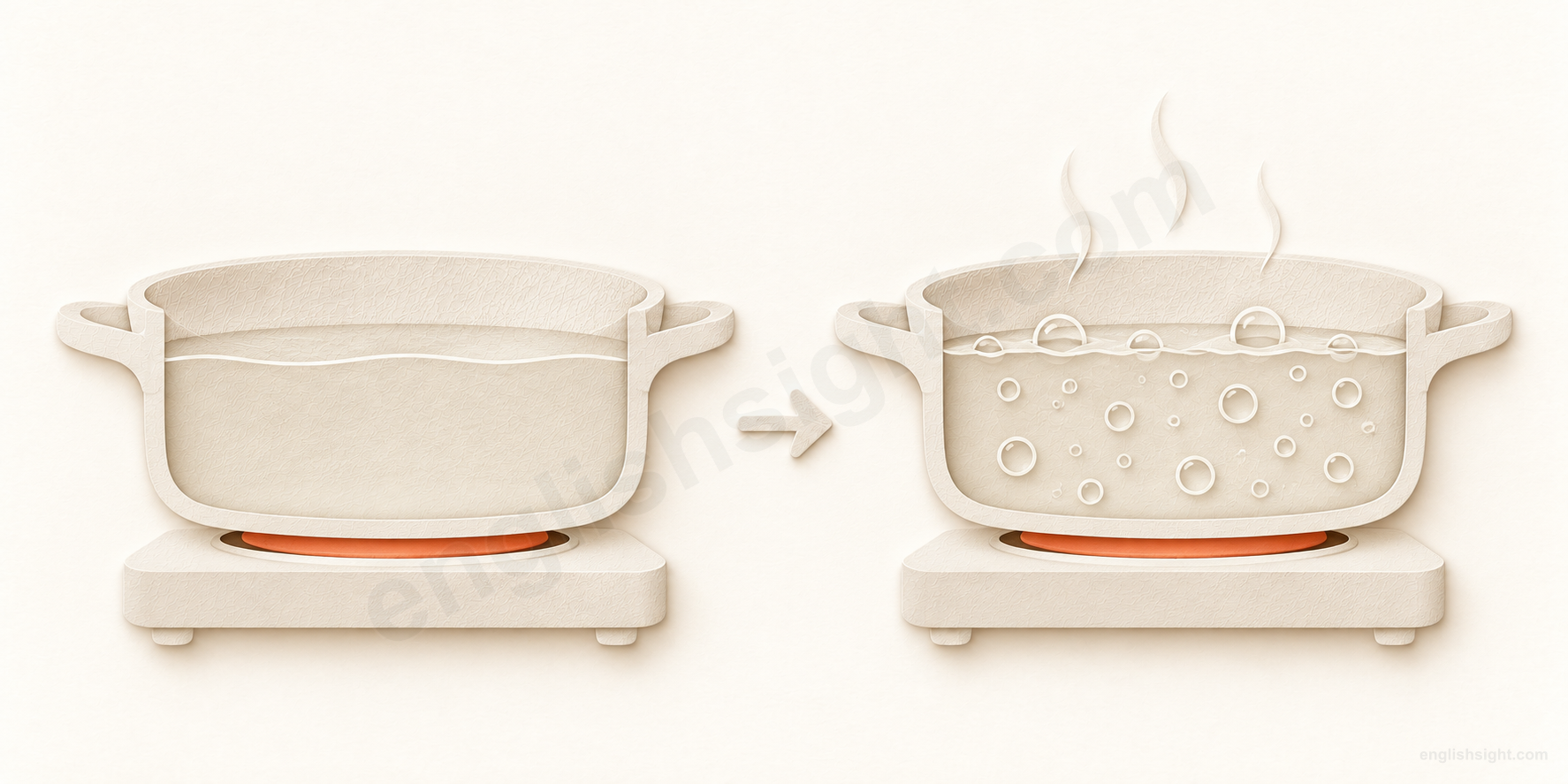
Water warms quietly in an open pan.
boiling
Vapor bubbles rise through the water and break at its surface.
Continued heating brings the water to a boil.
Continued heating changes quiet water into actively bubbling water.
A heated liquid is boiling when vapor bubbles form within it and rise through it.
The physical process anchors this teaching model. Hot feelings, emotional agitation, and reduction expressions need their own context and construction; the pot does not predict every use.
Start with liquid heated until vapor bubbles form and rise through it. This literal process provides a useful connection to descriptions of extreme heat and agitation.
The lesson centers on boiling as an adjective and the -ing form of boil. Related constructions explain what happens when over, up, down, or a fixed phrase joins the verb. They are not all separate meanings of boiling.
01
Water, heat, and cooking
Identify what is boiling: the liquid, its container, or food cooking in it. The grammar changes with the subject and object.
01
boiling + liquid; liquid + be + boiling; person + be + boiling + liquid
boiling water / The water is boiling.
liquid producing vapor bubbles under heat
Starting situation
The water is warm and its surface is quiet.
What the expression describes
Bubbles form and rise through the hot liquid.
Boiling names an active condition of the liquid.
Boiling water describes water in this condition. The water is boiling makes a complete statement about what is happening now. I am boiling water instead names the person heating it.
The diagram follows the same water before and during boiling. A few tiny bubbles during warming do not by themselves show a sustained boil. Visible mist above hot water alone is not proof either.
In a sentence
The water is boiling now, so turn the heat down.
Watch the difference Hot water need not be boiling. Do not use boiling for every warm liquid.
02
kettle / pan + be + boiling; be boiling + container; be boiling dry
The kettle is boiling.
the water inside a container is boiling
Starting situation
Water is heating inside the kettle.
What the expression describes
Its contents have reached a boil.
The container stands for its contents.
The kettle is boiling is especially familiar in British English. It refers to the water, not to metal turning into vapor. I am boiling the kettle means heating its water.
The pan is boiling dry means its water is disappearing through continued boiling. Dry names the resulting condition; it is not another word for hot.
In a sentence
The kettle is boiling; shall I make some tea?
Watch the difference The kettle is boiling and I am boiling the kettle give different grammatical subjects.
03
person + be boiling + food; food + be boiling / be being boiled
I am boiling the potatoes.
cook food in boiling water
Starting situation
Raw potatoes go into a pan of water.
What the expression describes
They cook in the hot water.
The food is being cooked; it is not turning into vapor.
I am boiling the potatoes has a cook as subject and food as object. The potatoes are boiling describes the food cooking without naming the cook. The potatoes are being boiled explicitly presents them as receiving the action.
Boiling potatoes is different from frying them in oil or steaming them above water. Boiling some potatoes for Maya names a beneficiary; for Maya does not change the cooking method. You can also say I am boiling Maya an egg: Maya is the beneficiary and an egg is the food, just as in boiling an egg for Maya.
In a sentence
I am boiling the potatoes while Maya prepares the salad.
Watch the difference Potatoes boiling in water are not themselves undergoing the liquid-to-vapor change.
The -ing form and the past participle answer different questions.
Boiling can name an activity: Boiling the vegetables takes time. In this use the whole -ing phrase acts as a noun phrase. In I am boiling them, am plus boiling forms the progressive verb.
Boiled water has undergone boiling; it can now be cold. Boiling water describes its present condition. Similarly, boiled potatoes describes the preparation, while boiling potatoes may mean potatoes currently cooking or the activity of cooking them.
In a sentence
The boiled water is cool now, but the water in the pan is still boiling.
Watch the difference Boiling is not the past tense. The verb forms are boil, boils, boiled, boiled, boiling.
05
the boiling point of + liquid; heat / bring + liquid + to boiling point
boiling point
temperature at which a liquid boils at a given pressure
Starting situation
The liquid is below its boiling temperature.
What the expression describes
It reaches the temperature at which boiling occurs.
Point identifies a temperature, not the amount of time spent heating.
The boiling point of water names a property under particular conditions. Pure water boils at about 100°C at standard atmospheric pressure; pressure changes that temperature. Boiling does not mean that every liquid is at 100°C.
Heat the sauce to boiling point describes reaching that condition. Bring it to a boil, common in American English, and bring it to the boil, common in British English, are familiar recipe alternatives.
In a sentence
At this pressure, the liquid has a lower boiling point than water.
Watch the difference Boiling point is a noun phrase. To boiling point expresses a target condition, not a place.
06
bring to a rolling boil; keep + liquid + boiling; reduce to a simmer
boiling / simmering
choose the intensity of cooking
Starting situation
The soup is bubbling strongly.
What the expression describes
The cook reduces the heat for gentler cooking.
Simmering is a gentler condition than a vigorous boil.
Recipes distinguish a rolling boil, with vigorous continuous bubbling, from a simmer, with gentle cooking close to boiling temperature. Reduce to a simmer asks for a change in heat and activity.
Keep it boiling asks you to maintain boiling. Keep it simmering asks for the gentler condition. The recipe supplies the intended method; boiling is not automatically the right instruction for every soup or sauce.
In a sentence
Once the soup is boiling, reduce the heat and let it simmer gently.
Watch the difference A simmer and a vigorous boil are different cooking conditions, even though both may show bubbles.
02
Very hot, very angry, or violently moving
Outside the kitchen, boiling can describe extreme heat or agitation. Context tells you whether the heat is literal or a comparison.
07
person + be boiling; it + be boiling (hot); boiling hot + noun
I am boiling. / boiling hot
feel or describe extreme heat
Starting situation
You enter a room in a thick coat.
What the expression describes
You feel uncomfortably hot.
With people or weather, boiling often intensifies hot rather than reporting real boiling.
I am boiling commonly reports how hot you feel. It is boiling in here describes the room; a boiling hot afternoon describes the weather. These are informal, vivid descriptions, not temperature measurements.
In boiling hot, dictionaries may label boiling as an intensifier or adverb. Learn the combination as a unit. Boiling already expresses an extreme, so absolutely boiling is a natural emphatic choice.
In a sentence
Can we open a window? I am boiling in this coat.
Watch the difference I am boiling usually means hot; add with anger or clear context when you mean furious.
08
be boiling with anger / rage; be boiling mad
boiling with anger / boiling mad
feel intensely angry
Starting situation
A promise has been broken again.
What the expression describes
You feel furious, even if you stay silent.
Strong emotional agitation is compared with hot, active liquid.
Boiling with anger or rage identifies the feeling with a with-phrase. Boiling mad is an informal intensifying expression; mad here means angry, not mentally ill.
A person can be boiling inside while speaking quietly. The expression reports emotional intensity and does not require an outward explosion. Boiling by itself can also mean angry in a clear anger context, but it can easily be understood as hot.
In a sentence
I was boiling with anger, but I waited before replying.
Watch the difference With anger names the emotion; it does not identify a companion or a physical substance.
09
anger / tension + reach boiling point; be at / near boiling point
reach boiling point
anger or tension reaches a critical level
Starting situation
People have become increasingly frustrated.
What the expression describes
The situation is close to an angry outburst.
The temperature threshold becomes an emotional threshold.
Frustration or tension reaching boiling point suggests that calm may break down. The expression can describe an individual feeling or a wider dispute. It does not guarantee that violence follows.
Was at boiling point describes the critical condition; was reaching boiling point describes movement toward it. Compare physical boiling point, which names a temperature. There is no numerical emotional boiling point.
In a sentence
After another long delay, frustration in the queue was reaching boiling point.
Watch the difference Reaching boiling point signals a critical level, not merely feeling a little annoyed.
10
make + person’s blood + boil; person’s blood + be boiling
make someone’s blood boil
cause someone to feel furious
Starting situation
You learn that a colleague was treated unfairly.
What the expression describes
The unfairness makes you very angry.
The whole idiom names an emotional cause and reaction.
That makes my blood boil assigns the cause to that and the angry experiencer to my. My blood was boiling describes the resulting feeling without using make.
In make my blood boil, make takes a bare infinitive: boil, not to boil. In My blood is boiling, is takes the -ing form. The blood image is figurative; it makes no medical claim.
In a sentence
My blood was boiling when I heard how they had treated her.
Watch the difference Say It makes my blood boil, not It makes my blood to boil.
11
boiling + sea / water (descriptive agitation)
a boiling sea
water moving in a violently agitated way
Starting situation
Waves collide beside the rocks.
What the expression describes
The surface churns and swirls.
A resemblance in movement can motivate boiling without literal heat.
In a descriptive phrase such as a boiling sea, the water may be cold: its turbulent movement resembles liquid in a pot. The writer emphasizes agitation, not the temperature.
This is a descriptive extension rather than the normal way to give a weather report. Rough sea or churning water is often plainer when you want to avoid the vivid comparison.
In a sentence
Below the cliff, a boiling sea battered the rocks.
Watch the difference Use context: a boiling sea does not normally mean seawater at its boiling temperature.
03
What over, up, and down add
These are established combinations of the verb boil. Learn the complete construction; boiling alone does not supply every meaning.
12
liquid / pan + be boiling over
boiling over
boiling liquid escapes over the rim
Starting situation
Bubbling milk rises toward the top of the pan.
What the expression describes
It runs over the side.
Over adds escape beyond the container’s edge.
The milk is boiling over reports a kitchen problem. Ordinary boiling need not spill anything; over supplies that extra result. This use has no direct object: the liquid or pan is the subject.
In a sentence
The milk is boiling over; turn off the heat.
Watch the difference Boiling over is more specific than boiling: it includes overflow.
13
anger / tension / person + boil over
anger boiling over
anger breaks out or a situation becomes more dangerous
Starting situation
Frustration has been building quietly.
What the expression describes
It comes out in an angry reaction.
The container image becomes a loss of emotional containment.
Anger boiling over emphasizes an outbreak. A person can boil over too. With tension or a conflict as subject, the phrase can describe escalation into a more dangerous situation.
Compare boiling with anger, which can remain an inner state. Boiling over puts the change or outbreak in focus; it need not mean physical violence.
In a sentence
When the meeting was cancelled again, his frustration finally boiled over.
Watch the difference Over does not mean the anger is over or finished.
14
emotion + boil up; boil + food / liquid + up; boil it up
anger boiling up / boiling something up
emotion develops strongly; heat food or liquid to a boil
Starting situation
An upsetting memory returns.
What the expression describes
Anger starts to rise inside you.
Up has an intensifying role, but the subject and object select the meaning.
I felt anger boiling up describes an emerging or intensifying feeling. Boiling over more strongly focuses on an outbreak beyond control.
We are boiling up some water is a separate cooking use meaning heating it to a boil. With a pronoun object say boiling it up. Do not confuse this transitive construction with anger boiling up by itself.
In a sentence
She could feel resentment boiling up as she read the message.
Watch the difference Boiling up water does not mean water must spill over the pan.
15
liquid + boil down; boil + liquid / information + down (to + result)
boiling down a sauce / a report
reduce liquid by boiling; shorten information
Starting situation
A sauce is too thin, or a report too long.
What the expression describes
Less liquid or a shorter account remains.
Down marks reduction in two established uses.
The sauce is boiling down means its quantity is reducing through boiling. I am boiling the sauce down makes the cook explicit.
Boiling a report down means removing less important material to make it shorter. To three paragraphs states the target length. With a pronoun, say boiling it down, not boiling down it. The information use is a metaphor, not a cooking instruction.
The water has boiled away means the water has disappeared as vapor through boiling. For example: The pan is empty because all the water has boiled away. Boiling a sauce down normally leaves a smaller amount of sauce; boiling all the liquid away leaves none of that liquid.
In a sentence
I am boiling the report down to three short paragraphs.
Watch the difference Reduction is the shared teaching connection; down does not simply mean movement toward the floor.
16
situation / issue + boil down to + noun / -ing phrase
It boils down to…
identify the essential issue or determining factor
Starting situation
A decision involves many details.
What the expression describes
You identify what ultimately matters.
This construction states an underlying basis rather than an editing activity.
It boils down to cost identifies cost as the basic issue. Compare I am boiling the report down, where a person actively shortens a text.
Use the simple form boils down to for the ordinary essential-issue meaning; Oxford marks this use as not progressive. To is a preposition: it can introduce a noun or an -ing phrase, as in It boils down to choosing the right time.
In a sentence
The choice boils down to how much space we need.
Watch the difference Keep to before the essential factor: boils down to cost, not boils down cost.
Read the subject, the form, and the whole phrase
Literal heat and expressive intensity
Boiling water describes a physical process. I am boiling often describes uncomfortable heat; boiling with rage describes anger. None of these expressions alone tells you the temperature of a person or room.
Grammar follows the construction
Boil can be transitive or intransitive. Compare I am boiling rice, The rice is boiling, and The rice is being boiled. Boiling is the -ing form; boiled is the past tense and past participle. The adjective boiling and the progressive verb can look alike, so use context.
A familiar saying
A watched pot never boils means waiting impatiently can make time seem to pass slowly. It is a saying about waiting, not a claim that watching changes boiling. For example: Stop checking the download every second—a watched pot never boils.
What this lesson leaves aside
The noun a boil meaning a skin swelling is a different lexical item. Specialized engineering uses, the dated expression the whole boiling, and wider idioms built on boil are outside this lesson’s main scope.
Choose what boiling tells you
Use the situation and the complete construction.
1. Water was boiled earlier and is cold now. Which label fits?
2. Someone says “I am boiling in this coat.” What do they mean?
3. Milk is bubbling but stays inside its pan. Which description is accurate?
4. You are furious but say nothing. Which phrase can describe this inner state?
5. You want to name cost as the essential issue. Which form fits?
Sources and teaching notes
The dictionary pages below support the usage coverage. Explanations and examples are original teaching material. The physical-to-figurative connection is a teaching aid, not a rule that generates every expression.
The diagram illustrates a useful connection; English speakers do not all share one mental picture.