From the body’s framework to bare essentials, deep feelings, and fixed expressions.
Hard support inside the body
Hard support inside the body
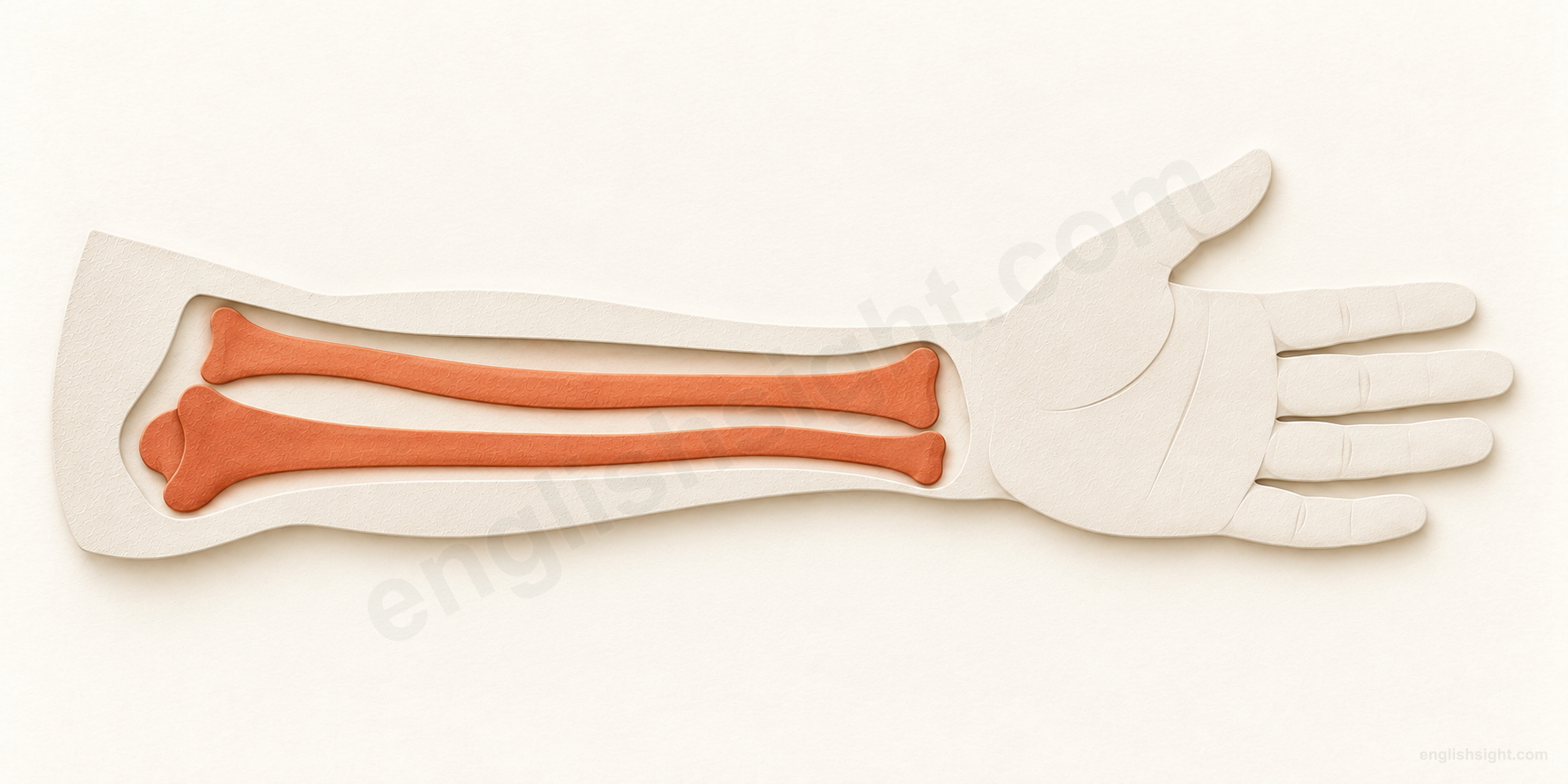
The forearm and hand provide the outer shape.
bone
The bones are parts of the body's inner framework.
Two hard bones lie inside the forearm.
Bones form an inner framework; this cutaway shows two inside a forearm.
Bones are hard parts that together form the body’s inner framework.
The sketch shows two bones inside a simplified forearm, with the hand providing context. It is a static relationship, not a before-and-after change or a complete anatomical diagram.
A bone is one of the hard parts that form a human or animal skeleton. Bone can also name the material itself. Start there, then notice the grammar and the whole phrase.
The inner framework offers a useful teaching connection for some figurative uses. Other expressions, such as bone up on, must be learned as established combinations; the picture does not predict them.
01
Bones in bodies, materials, and food
Start with a hard body part. Count individual bones, name the material, and notice when the same spelling becomes a cooking verb.
01
a / the + bone; plural bones; break a bone
a bone / broken bones
a hard part of a skeleton
Situation
A cyclist falls and injures her arm.
What is expressed
A scan shows a break in one hard internal part.
One bone is a part; the skeleton is the framework formed by many parts.
Bone is countable when you mean a particular part: a bone, two bones, the bones in your hand. Break a bone describes an injury; a broken bone names the injured part. Bone does not mean the whole arm or leg.
Names such as thigh bone and hip bone identify location. Bone structure refers to the arrangement of bones, often when describing a face. In bone marrow, bone tells us where the marrow is found; these combinations do not turn bone into a verb.
In a sentence
Nora broke a bone in her wrist when she fell.
Watch the difference Say a broken bone for one part and a skeleton for the whole framework. Bone is not the same as muscle.
02
made of + bone; bone + object; adjective + -boned
made of bone
the hard material of bones
Situation
You inspect an old carved button.
What is expressed
You identify the material used to make it.
Bone can name a substance without counting separate pieces.
In made of bone, bone is uncountable material, like wood in made of wood. A piece of bone counts a piece of that material. Compare three bones, which counts anatomical parts.
A bone handle is a handle made from that material. Collins labels this use before a noun as adjectival; Oxford presents the material as a noun. The practical distinction is between what a thing is made of and how many body parts there are. Fine-boned instead describes someone as having fine or delicate bones.
In a sentence
The old button is made of bone.
Watch the difference Made of bones suggests separate bones used as pieces; made of bone identifies the material.
03
fish / chicken + bones; meat on the bone; boneless / bone-in + meat
fish bones / meat on the bone
bones remaining in food
Situation
A cooked fish is on your plate.
What is expressed
You distinguish the flesh from its hard internal parts.
A fish bone is a bone in a fish, not a separate figurative sense.
In food talk, remove the bones and watch out for bones refer to real hard parts. Fish bones may be small and thin. Chicken on the bone still has the meat attached; boneless chicken has had the bones removed.
On the bone describes how meat is served, not where it was placed on the table. Bone-in is another food label for meat with the bone retained. These are useful combinations of the physical noun, rather than meanings to infer from every use of on or in.
In a sentence
I prefer chicken on the bone, but Leo buys boneless chicken.
Watch the difference Bone and boneless have opposite implications for food. Do not assume every piece of fish is boneless.
04
bone + meat / fish; be boned
bone a fish
remove bones from meat or fish
Situation
The cook has a whole fish to prepare.
What is expressed
The bones are removed before the next cooking step.
The object is the food that loses its bones.
As a cooking verb, bone means take bones out, not put them in. It is transitive: you bone a fish or bone the chicken. The passive is possible too: The fish has been boned.
Forms are bone, bones, boned, boning: drop the final e before -ing. Debone is another verb for removing bones. Boned fish describes the result of preparation; boneless fish describes the absence of bones. Bone up on, later in the lesson, has a different meaning.
In a sentence
The chef boned the trout before stuffing it.
Watch the difference Boning a fish removes bones. Do not read it as adding a bone or strengthening the fish.
05
hit / bang + possessive + funny bone
hit your funny bone
strike the sensitive area at the elbow
Situation
Your elbow knocks against a doorframe.
What is expressed
You feel an unpleasant tingling sensation.
Funny bone is a fixed everyday name, not a bone that is amusing.
The funny bone is the sensitive spot at the elbow where a nerve can be knocked. Hitting it may cause a sharp, strange feeling down the arm. Funny here belongs to the established name.
My funny bone usually refers to that place in my elbow. It does not mean a broken arm, and funny should not be interpreted as saying the pain is enjoyable. This lesson uses the physical expression, not its separate humorous associations.
In a sentence
I hit my funny bone on the doorframe.
Watch the difference The expression names a sensitive nerve area; it is not a precise anatomical name for a separate bone.
06
rest + possessive + bones; the bones of + person / animal
rest your bones / animal bones
bones standing for the body, or skeletal remains
Situation
A tired walker reaches a bench; an archaeologist examines a site.
What is expressed
In one context bones evokes a living body; in the other it names remains.
Context distinguishes a playful reference to the body from real skeletal remains.
Rest my weary bones is an expressive way to say rest my tired body. The plural can stand for the body as a whole; the speaker is not taking out and resting individual bones.
The bones of an animal found in the ground can instead be its physical remains. Both uses connect directly with the skeleton, but the first is figurative and conversational while the second may be literal reporting.
In a sentence
After the long walk, Dad sat down to rest his weary bones.
Watch the difference Do not assume bones always means a dead body: rest your bones can describe a living person.
02
The essential framework
An inner skeleton offers a useful comparison for a plan’s structure. These expressions distinguish an outline, added detail, and severe reduction.
07
the bare bones of + noun; a bare-bones + noun
the bare bones of a plan
the essential outline without developed detail
Situation
A group needs a starting plan.
What is expressed
The main steps exist, but supporting details are missing.
The skeleton becomes a comparison for a basic framework.
The bare bones of a plan are its essential elements. Bare tells us the extra detail has not been supplied. We have the bones of a story similarly means we have its basic structure.
A bare-bones plan uses a hyphenated adjective before the noun and means a very basic plan. Compare the bare bones of the plan: bones is a plural noun there. Neither expression automatically says the basic structure is bad.
In a sentence
We have the bare bones of a plan, but no dates or costs yet.
Watch the difference Keep the plural in the bare bones of. A bare bone normally refers to one literal bone.
08
put flesh on the bones of + idea / plan
put flesh on the bones of an idea
develop an outline by supplying detail
Situation
Your proposal lists only three main points.
What is expressed
Examples, costs, and responsibilities make it fuller.
The framework remains while details are added around it.
Put flesh on the bones of something means make a basic idea or plan more complete. The anatomical comparison is helpful: bones supply structure, flesh supplies substance around it.
You can also flesh out an idea. In the expression taught here, flesh represents the detail added around an outline. The proposal is not physically changing; people are developing its details.
In a sentence
Let’s put flesh on the bones of this proposal by adding a budget.
Watch the difference Learn put flesh on the bones of as a complete expression. The cooking verb bone does not mean to add details.
09
cut / pare + costs / budget + to the bone
cut costs to the bone
reduce spending or resources to a minimum
Situation
A business has already removed most optional spending.
What is expressed
It cuts spending as far as it can.
To the bone marks an extreme limit in this reduction expression.
Cut, pare, or strip something to the bone suggests removing nearly everything beyond the minimum. Costs, budgets, and services are common objects. The expression often suggests there is little or no room for further reduction.
This is stronger than cut costs, which could mean a small saving. It does not promise that the remaining resources are adequate, and it need not describe a wise decision. The budget has been cut to the bone is a natural passive.
In a sentence
The museum has cut its running costs to the bone.
Watch the difference Read the whole expression: cut to the bone concerns reduction; chilled to the bone concerns intensity.
03
Deep feelings and descriptions of the body
Some expressions reach imaginatively into the body; others describe thinness. Learn the whole phrase and its tone.
10
feel / know it in + possessive + bones; feel in your bones that + clause
feel it in your bones
have a deep conviction without clear proof
Situation
You cannot explain why you expect a change.
What is expressed
You express a strong personal intuition.
A feeling imagined deep inside the body is a teaching comparison, not evidence.
I feel it in my bones means I am strongly convinced, though I cannot give direct proof. Know in your bones and feel in your bones that… use the same familiar idea. The possessive follows the person: she feels it in her bones.
This is not simply pain in an actual bone. Compare I feel pain in my bones, which can be a physical description. The idiom communicates the speaker’s certainty; it does not make the prediction reliable.
In a sentence
I feel it in my bones that this visit will change everything.
Watch the difference Use plural bones in the idiom, and distinguish personal conviction from supporting evidence.
11
be chilled / frozen to the bone; something chills someone to the bone
chilled to the bone
affected very deeply by cold or fear
Situation
You have waited outside in freezing wind.
What is expressed
You feel thoroughly cold.
Reaching the bone suggests depth or intensity rather than a measured temperature.
Chilled or frozen to the bone can describe feeling intensely cold. A frightening sound or threat can also chill someone to the bone: the deep effect is fear rather than outdoor temperature.
Compare The wind chilled me to the bone with Her scream chilled me to the bone. The subject and context distinguish physical cold from emotional shock. This extension does not mean that bones have literally frozen.
In a sentence
The icy wind left us chilled to the bone.
Watch the difference To the bone does not always mean reduce to a minimum; check the verb it follows.
12
not have + a / an + quality adjective + bone in your body
not have an unkind bone in your body
have none of a named quality or ability
Situation
You want to describe a consistently kind friend.
What is expressed
You emphatically reject the idea that the friend is unkind.
No part of the imagined inner person has the negative quality.
She hasn’t got an unkind bone in her body means she is not at all unkind. He doesn’t have a selfish bone in his body similarly describes a thoroughly unselfish person.
The adjective supplies the quality being denied. It need not name a fault: I don’t have a musical bone in my body is an emphatic way to say I have no musical ability. These are personal judgments, not medical claims or evidence that an ability cannot be learned. Keep the negative construction to deny the quality.
In a sentence
Maya doesn’t have a selfish bone in her body.
Watch the difference The singular bone works with a in this negative pattern. Do not replace it with the plural bones after a.
13
be + all / nothing but + skin and bone(s); a bag of bones
skin and bones / a bag of bones
extremely thin
Situation
A rescue worker finds a severely underfed dog.
What is expressed
The description emphasizes its very thin body.
These expressions exaggerate how little flesh seems to cover the skeleton.
All skin and bone and nothing but skin and bones describe extreme thinness. Both bone and bones occur in this fixed expression. A bag of bones is another informal description of a very thin person or animal.
They commonly suggest concern, disapproval, or an unkind judgment, rather than admiration. In direct conversation about someone’s body, very thin is a more neutral choice. The phrases do not mean the person or animal literally has no muscles or organs.
In a sentence
When the shelter found the dog, it was nothing but skin and bones.
Watch the difference These descriptions can sound harsh when directed at a person; they are not neutral compliments.
04
Disagreement, honesty, and persistence
These fixed expressions organize conversations and judgments. Their meanings do not follow from the physical definition of bone alone.
14
have a bone to pick with + person
have a bone to pick with someone
have a complaint you want to discuss
Situation
Your roommate used your bike without asking.
What is expressed
You signal that you want to raise the problem.
The complaint belongs to the whole idiom, not the verb pick by itself.
I have a bone to pick with you announces annoyance or a disagreement that needs discussion. With introduces the person you want to speak to; the complaint can be explained in the next clause or sentence.
It can be playful among friends, but it can also sound confrontational. Compare Can we talk about the bike?, which opens the same topic more gently. No literal bone needs to be present.
In a sentence
I have a bone to pick with you: you borrowed my bike without asking.
Watch the difference Use with for the person. Do not interpret pick as choosing a bone from a meal.
15
something is / remains a bone of contention; between + parties
a bone of contention
a matter that causes disagreement
Situation
Two neighbors keep arguing about parking.
What is expressed
Parking is identified as the disputed issue.
This noun phrase names the issue, not either person in the argument.
A bone of contention is something people disagree about, often repeatedly. It can be an expense, a decision, a rule, or another disputed matter. Between identifies the parties: a bone of contention between the neighbors.
Have a bone to pick puts the speaker’s complaint into an interpersonal action. A bone of contention instead labels the problem itself and is common in discussion or reporting. The plural is bones of contention.
In a sentence
The parking rules remain a bone of contention between the neighbors.
Watch the difference A person is not usually the bone of contention when you mean the person complaining; the disputed issue is.
16
make no bones about + noun / -ing
make no bones about something
be open about it, or do it without hesitation
Situation
A speaker dislikes a proposed change.
What is expressed
She states her objection plainly.
The complete negative idiom conveys openness or lack of hesitation.
Make no bones about something means be frank about it: she makes no bones about her dislike of the plan. Make no bones about telling someone can also emphasize not hesitating to speak, even when the message may upset them.
About is a preposition, so it can take a noun or an -ing form: about the cost; about refusing. It does not take a bare infinitive. This is a fixed idiom, not a productive instruction to make or remove bones.
In a sentence
Ava made no bones about telling us that the plan would fail.
Watch the difference Say about telling, not about to tell. Keep no bones as part of the idiom.
17
throw + person + a bone; throw a bone to + person
throw someone a bone
give a small concession or limited help
Situation
A group asks for a major change.
What is expressed
It receives a small benefit instead.
The small offering may be far less than the recipient wanted.
Throw someone a bone often describes a limited concession intended to satisfy or quiet the recipient. The image of a small offering is useful, but in this idiom the bone may be money, an opportunity, or a policy change.
The expression can sound dismissive or patronizing: the speaker may think the offer is inadequate. Throw a bone to someone is another order. Give someone a little help is more neutral when you do not want that implication.
In a sentence
The company threw the staff a bone with a small discount instead of a pay rise.
Watch the difference Do not use it as an automatically appreciative way to describe generous help.
18
a remark / joke is + (too) close to the bone
close to the bone
uncomfortably direct, personal, or near the truth
Situation
A joke resembles a listener’s real difficulty.
What is expressed
The listener feels exposed or uncomfortable.
Here closeness concerns a sensitive subject, not physical distance.
A remark that is too close to the bone may touch an uncomfortable truth. The phrase can also describe jokes or writing that deal very directly with sensitive or indecent subjects.
This is not the same as a helpful observation being accurate. Tone and context matter: a joke can be close to the bone because it embarrasses someone or goes beyond what the audience considers acceptable. It need not prove that every detail of the joke is true.
In a sentence
His joke about missed deadlines was a little close to the bone for me.
Watch the difference Close to the bone concerns sensitivity; chilled to the bone concerns a deep effect.
19
be + like a dog with a bone
like a dog with a bone
determined to keep pursuing something
Situation
A reporter keeps asking about an unanswered question.
What is expressed
She refuses to let the matter drop.
The comparison focuses on persistence, not a literal dog in the situation.
Like a dog with a bone describes someone who holds on to a task or issue and will not give it up. It can praise determination or criticize someone for refusing to stop, depending on context.
The person is compared to a dog keeping its bone. This differs from throw someone a bone, where a person receives a small concession. Sharing the noun does not give the two idioms the same function.
In a sentence
Once Ruth noticed the missing payment, she was like a dog with a bone.
Watch the difference It can imply stubbornness as well as determination; do not assume it is always praise.
05
Emphasis and preparation
Bone strengthens a few established descriptions. Bone up on is a separate informal expression for studying or refreshing knowledge.
20
be + bone dry; be + (as) dry as a bone
bone dry / as dry as a bone
completely or extremely dry
Situation
A pot has received no water for a long time.
What is expressed
The soil has become thoroughly dry.
Bone strengthens dry in a conventional combination.
Bone dry means completely dry. As dry as a bone expresses a similar extreme through a comparison. The pot is bone dry and The pot is as dry as a bone are both natural descriptions.
Learn the combination rather than treating bone as a general substitute for very. Bone happy and bone interesting are not ordinary ways to intensify those adjectives. The image of a dry exposed bone is a memory aid, not a scientific statement that living bone contains no moisture.
In a sentence
The soil in this pot is bone dry.
Watch the difference Use bone dry as a fixed combination; bone does not freely intensify every adjective.
21
be + bone tired; work + possessive + fingers to the bone
bone tired / work your fingers to the bone
extremely tired, or working extremely hard
Situation
Someone has spent the whole day doing demanding work.
What is expressed
They describe exhaustion or the effort that produced it.
These are emphatic descriptions, not reports of exposed or damaged bones.
Bone tired means extremely tired. Work your fingers to the bone emphasizes working very hard, often with a sense of sacrifice. The first describes a state; the second describes effort.
I am bone tired after the move states exhaustion. She worked her fingers to the bone to keep the shop open emphasizes her labor and does not literally say her skin disappeared. Bone idle, by contrast, means very lazy; Oxford labels it British, old-fashioned, and informal. It is a critical description, not a synonym for being tired.
In a sentence
He worked his fingers to the bone to keep the family shop open.
Watch the difference Working hard and feeling tired are related but different claims; neither means being bone idle.
22
bone up on + subject / pronoun
bone up on something
study or refresh knowledge of a subject
Situation
You need to prepare for a visit or discussion.
What is expressed
You spend time learning or reviewing the relevant information.
The full phrasal verb supplies the studying meaning.
Bone up on a subject means study it, often to prepare for something or remind yourself of what you learned before. It is informal. You can bone up on history, safety rules, or the details of a project.
Keep on before the topic: bone up on it, not bone it up. Up does not describe physical movement here. Compare bone the fish, where bone is a transitive cooking verb with the fish as its direct object.
In a sentence
I need to bone up on the rules before I join the game.
Watch the difference Say bone up on them, not bone them up. Do not confuse this pattern with removing bones from food.
Read the noun, the verb, and the whole phrase
Countable part or material?
A bone and two bones count parts. Made of bone names material. Skeleton names the overall framework, while bone can identify one of its parts.
The drawing has limits
The arm sketch explains the physical inner framework and supports a comparison with the structure of a plan. It does not establish the history of every idiom or claim that all speakers share one mental picture.
Forms and register
The noun plural is bones. The cooking verb has bones, boned, boning, and can be passive. Bone up on is informal; many bone idioms are expressive rather than neutral. Specialized clothing, musical, gaming, color, historical, and slang uses are outside the main lesson.
Pronunciation
Bone is one syllable: British /bəʊn/, American /boʊn/. It rhymes with own. The noun and cooking verb have the same pronunciation; the plural bones and third-person verb bones end in /z/.
Choose the meaning in context
Look at what follows bone and what the speaker is trying to do.
1. You are identifying the substance of an old handle. Which sentence fits?
2. The chef has boned the fish. What has happened?
3. You have the bare bones of a proposal. What do you have?
4. “I feel it in my bones that we will win.” What does this normally express?
5. Your roommate says, “I have a bone to pick with you.” What should you expect?
6. You want to review the rules before a game. Which expression works?
Sources and teaching notes
The linked dictionaries support the uses and register notes. Explanations, examples, and the compatibility sketch are original teaching material. The framework connection is a teaching model.
The diagram illustrates a meaning connection, not a picture shared by every speaker.